
Five-Year Plan
The Soviet Union's five-year plans set factory-level output targets to industrialize a peasant economy, at the cost of millions of lives.
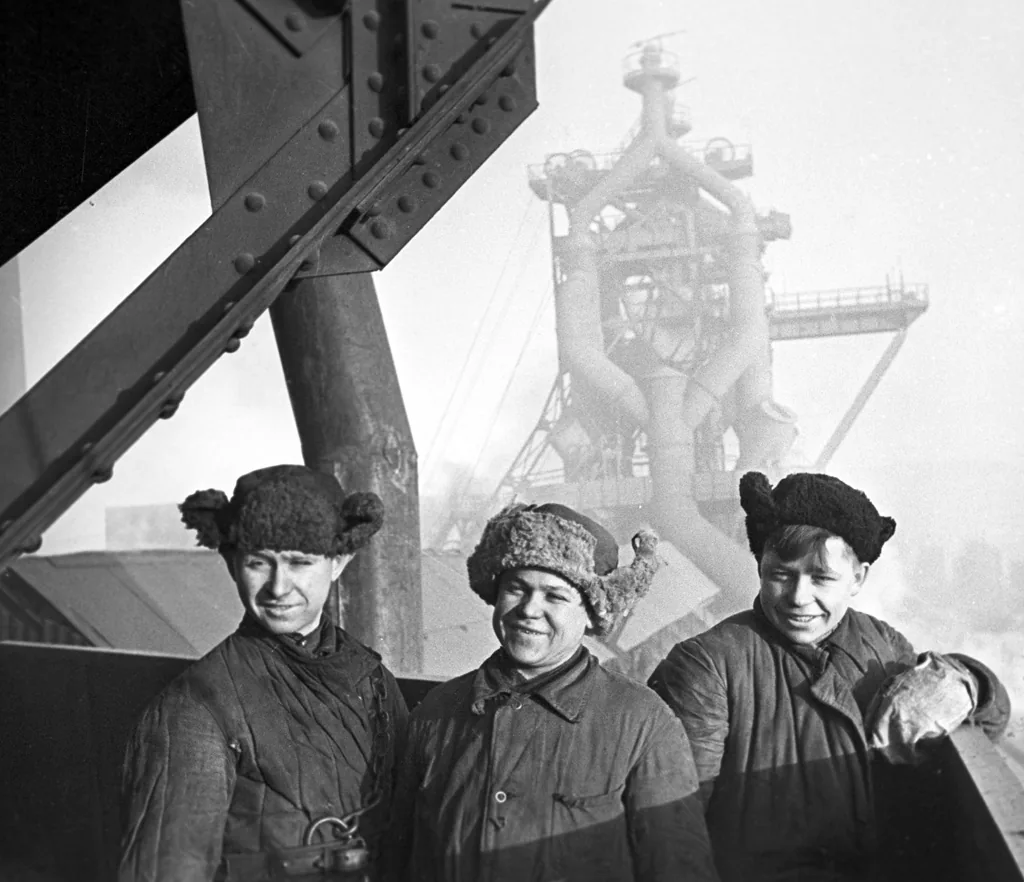
A five-year plan was an economic program used by the Soviet Union from 1928 to 1991, in which a central agency called Gosplan set production targets for the entire economy. The Soviet leader Joseph Stalin launched the first plan in 1928 to turn a mostly rural country into an industrial power as fast as possible. It worked. By 1940, Soviet output of steel, coal, and electricity had multiplied several times over, and new industrial cities had risen across the Urals and Siberia where none had existed before. The factories built under the early plans produced the tanks and weapons that helped the Soviet Union survive World War II. The cost was enormous: the policies that paid for industrialization killed millions of people through famine and forced labor.
How Stalin industrialized the Soviet Union
Speaking to factory bosses in 1931, Stalin declared that his country lagged fifty to a hundred years behind the industrialized world and had a decade to catch up or face destruction. A little over ten years later, in June 1941, German armies crossed the Soviet border.
Gosplan set physical output targets for the entire economy: how many tons of steel a mill should pour, how much coal a mine should dig, how many tractors a factory should build. Those targets reached every factory floor. A director who hit his quota might be promoted. One who fell short could be arrested. No price system guided what to produce or how much a raw material was worth. Each factory received a number from the capital and a date.
The money for industrialization came from the countryside. Under collectivization, the state forced peasants onto collective and state farms and seized the harvest. It sold the grain abroad and used the earnings to purchase industrial equipment and bring in technical specialists from the West. Ford helped build an automobile factory at Gorky. The American firm Arthur G. McKee modeled the Magnitogorsk steel complex on the U.S. Steel plant in Gary, Indiana. Magnitogorsk became the largest steelworks in the Soviet Union.
Collectivization caused famine across the Soviet Union in 1932 and 1933. The Holodomor in Ukraine killed an estimated 3.5 to 5 million people. A parallel famine in Kazakhstan killed about 1.5 million, roughly a third of the Kazakh population. Forced labor from the Gulag built mining camps, canal projects, and rail lines in remote places that could not attract paid workers.
The first plan was announced as finished after only four years, and official output figures from the period are known to be inflated. But the underlying change was real. By 1940, the Soviet Union was producing many times more steel, coal, and electricity than it had in 1928. Within a single generation, millions of peasants had become factory workers.
How the five-year plans shaped World War II
Stalin had deliberately placed heavy industry east of the Ural Mountains, out of reach of an invasion from the west. When Germany attacked in June 1941, this decision made it possible to evacuate over 1,500 factories from the western Soviet Union, mostly to the Urals and Siberia. Soviet tank output was more than twice Germany's in 1942. Many of the armored vehicles that stopped the German advance rolled out of plants that had not existed when Stalin gave his 1931 speech.
The first plans also changed how the world saw central planning. While Western economies collapsed during the Great Depression of the early 1930s, the Soviet Union was growing. It avoided the depression entirely, and this impressed foreign observers at a time when capitalism appeared to have failed.
Did the five-year plans work?
The plans achieved their central goal: they turned a peasant economy into an industrial one fast enough to survive a war. But the system that built the first steel mills could not run the economy those mills created.
Targets set in physical units produced exactly what was measured and nothing else. A quota counted in tons yielded unnecessarily heavy goods. A quota counted in units yielded shoddy ones. The incentive structure discouraged innovation, because a factory that performed well only received a higher quota the next year. Consumer goods were treated as whatever was left after heavy industry and the military took what they needed. The Soviet Union could build an intercontinental ballistic missile but could not reliably supply shoes.
Each plan delivered less than the one before, once the straightforward gains of shifting labor from farms to factories were exhausted. By the 1970s, growth had slowed so much that historians call the period the era of stagnation. Thirteen plans were issued between 1928 and the Soviet Union's collapse in 1991.
Which countries used five-year plans?
The Soviet model spread widely after World War II. China launched its first Five-Year Plan in 1953, on Soviet advice and with Soviet engineers. China then attempted to accelerate the process with the Great Leap Forward. The result was a famine that killed an estimated 15 to 45 million people, far worse than the Soviet famines of the 1930s. After 1978, China's leader Deng Xiaoping kept publishing the Five-Year Plan document but quietly abandoned the planning mechanism itself. China's 15th Five-Year Plan, covering 2026 to 2030, sets broad policy goals rather than factory-level output targets.
India adopted five-year plans in 1951 without the forced collectivization or political repression the Soviet Union used. India's Planning Commission ran twelve plans before the government replaced it with a different agency in 2015. Much of the postcolonial world set up planning commissions in the mid-twentieth century on the assumption that central planning was what a developing country needed to do. Most have since abandoned the model.
The five-year plan was one of the most widely copied approaches to state-led industrialization in the twentieth century. It remains the main case study in any argument about whether governments can develop an economy faster than markets can, and at what human cost.