
Fourteen Points
Woodrow Wilson's fourteen principles for ending World War I, presented to Congress in January 1918.
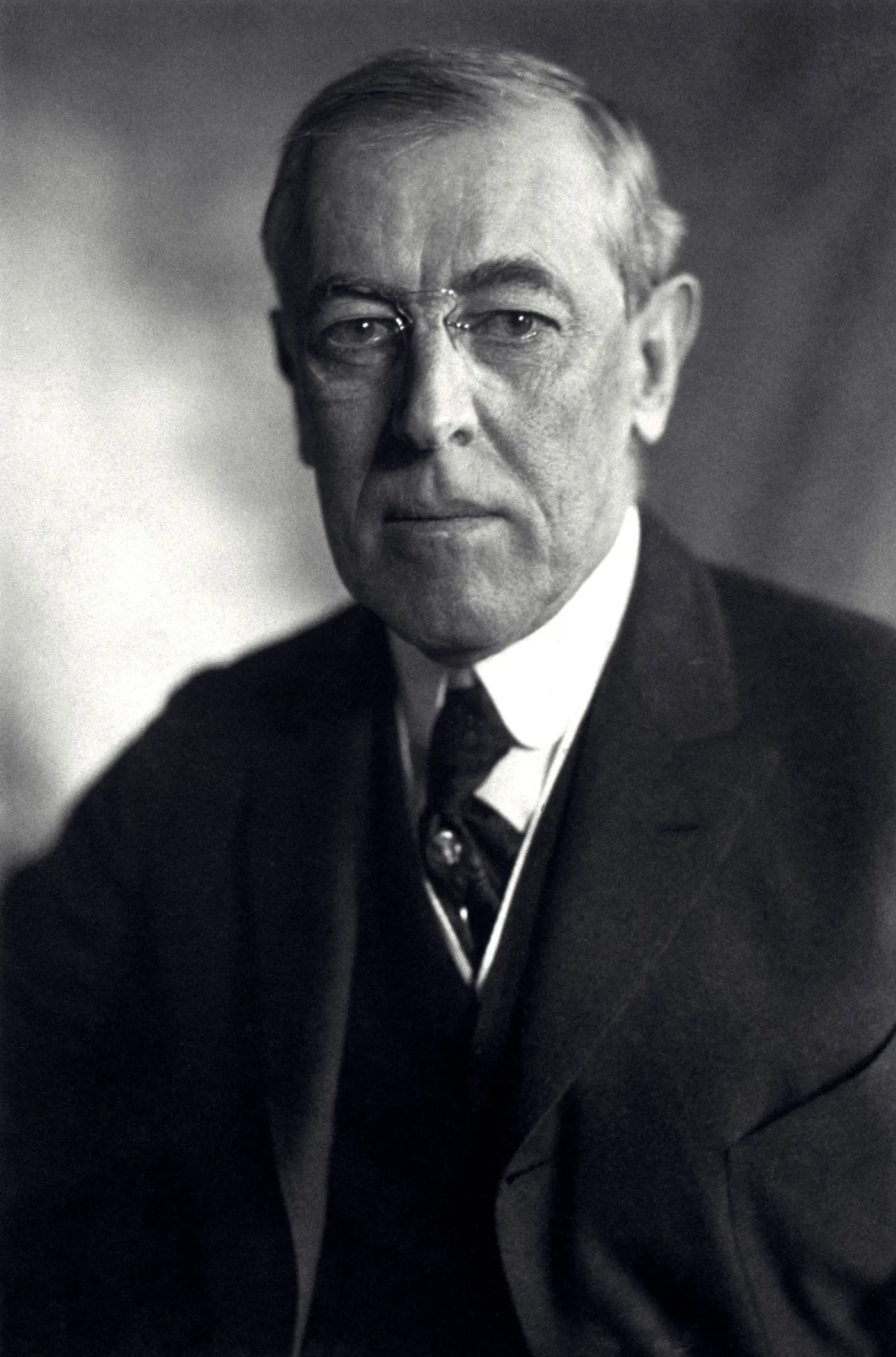
The Fourteen Points were a set of principles for ending World War I that US President Woodrow Wilson presented to Congress on January 8, 1918. They called for open diplomacy instead of secret treaties, freedom of the seas, free trade, reduced armaments, and the right of subject peoples to govern themselves. The fourteenth and final point, the one Wilson considered most important, called for a League of Nations to keep the peace. The speech made the United States the moral leader of the Allied cause. It also set off something Wilson did not intend: colonized and stateless peoples around the world read his call for self-determination as a promise that applied to them, not just to Europeans.
How Wilson delivered the Fourteen Points
Wilson had been a professor of political science and the president of Princeton University before entering politics. He won the governorship of New Jersey in 1910 and the presidency just two years later, with barely any experience in elected office. He was the son of a Presbyterian minister, and it showed in his speeches. As a child in Georgia during the Civil War, he had watched Union troops march through his town. He went on to become the first president with a PhD, earning his doctorate in political science from Johns Hopkins in 1886.
By January 1918 the war was in its fourth winter. The United States had entered only nine months earlier. No Allied leader had laid out war aims so directly. Wilson stood before Congress and listed fourteen numbered principles for peace. The first demanded "open covenants of peace, openly arrived at," a direct challenge to the secret deals that many blamed for pulling Europe into war. Others addressed free navigation of the seas, lower trade barriers, and smaller armies. A cluster of points addressed national self-determination: Poles, Czechs, South Slavs, Arabs, and other groups living under imperial rule should choose their own governments. The fourteenth point proposed "a general association of nations" to guarantee the peace.
The speech was translated into German and dropped behind the front lines. It told German soldiers and civilians that the United States would accept a fair peace, not a punitive one. In October 1918, Germany's chancellor, Prince Maximilian of Baden, sent Wilson a note requesting an armistice on the basis of the Fourteen Points. Germany surrendered the following month.
How the Fourteen Points fell apart at Versailles
The Paris Peace Conference opened in January 1919. Wilson sailed for France in December 1918, becoming the first sitting American president to visit Europe. But Britain's prime minister, David Lloyd George, and France's premier, Georges Clemenceau, wanted a different kind of peace. They wanted Germany declared responsible for the war, its territory reduced, and billions extracted as reparations. Clemenceau, who was 77 and had lived through two German invasions of France, reportedly said of Wilson's program: "God was satisfied with Ten Commandments. Wilson gives us fourteen."
Wilson traded away many of his points to save the one he cared about most, the League of Nations. The Treaty of Versailles that came out of Paris included the League, but it also imposed a punitive settlement. Germany was assigned responsibility for the war and ordered to pay reparations that would take decades to settle. It was the kind of peace Wilson had warned against.
Back in Washington, the treaty needed a two-thirds vote in the Senate. Republican senator Henry Cabot Lodge, the chairman of the Foreign Relations Committee, would ratify it only with reservations that limited American obligations under the League. Wilson refused any compromise. In September 1919, he set out on an 8,000-mile speaking tour to rally public support, giving 40 speeches in 22 days. He collapsed in Pueblo, Colorado. On October 2 he suffered a severe stroke that left his left side paralyzed. From his sickbed, Wilson told his supporters in the Senate to reject Lodge's reservations. They did, and the treaty failed to pass. The United States never joined the League of Nations, even though its president had proposed it. The League opened for business in January 1920 without its creator.
How the Fourteen Points traveled beyond Europe
Wilson meant self-determination mainly for Europeans living under collapsing empires: Poles, Czechs, Serbs. The rest of the world heard something bigger. In Egypt, nationalists launched a revolution in March 1919 demanding independence from Britain. In Korea, protesters took to the streets on March 1, 1919, calling for freedom from Japanese rule. In China, the May Fourth Movement erupted when the Paris conference handed former German holdings in Shandong province to Japan instead of returning them to China. In each case, protesters pointed to Wilson's own words.
A 28-year-old Vietnamese man living in Paris, later known as Ho Chi Minh, wrote a petition to Wilson at the peace conference asking for greater rights for Vietnam under French colonial rule. Wilson never saw it. The gap between what Wilson intended and what the world heard fueled anticolonial arguments for the rest of the century.
Wilson won the 1919 Nobel Peace Prize for proposing the League of Nations. By the time the prize was presented in December 1920, he was an invalid in his last months in office, and the League was meeting in Geneva without the country that created it. As a peace settlement, the Fourteen Points did not survive. But the principles Wilson named, that peoples should govern themselves and that nations should settle disputes openly rather than through backroom deals and force, became central to every later argument about borders, sovereignty, and international order.