
Self-Determination
Self-determination is the principle that peoples, not empires or conquerors, should choose who governs them.
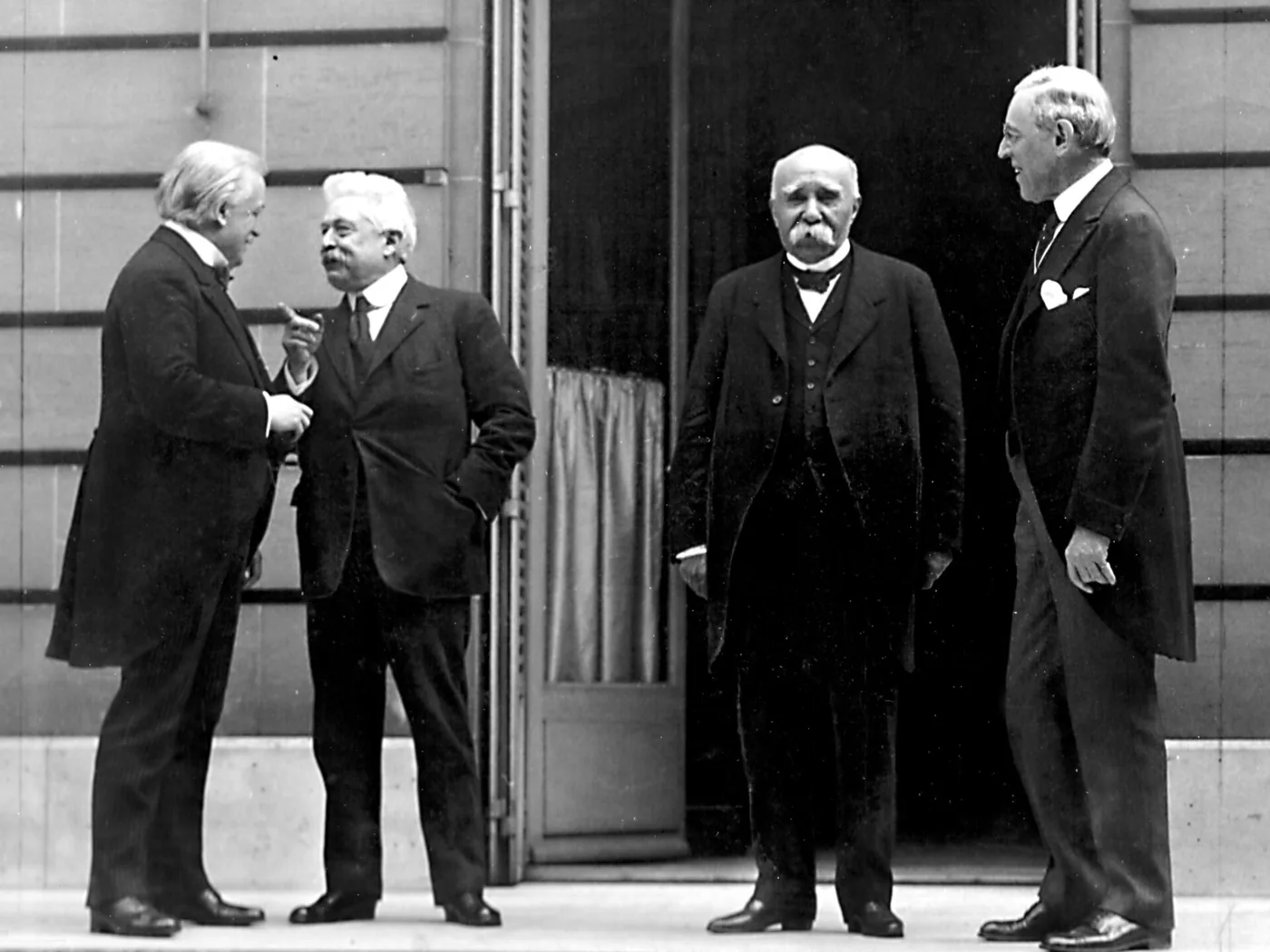
Self-determination is the principle that peoples, not empires or conquerors, should choose who governs them. The idea existed before 1918, but it became a global demand that year when Woodrow Wilson, the president of the United States, made it the basis of his plan for ending World War I. Wilson's Fourteen Points, announced on January 8, 1918, did not use the phrase "self-determination," but its territorial clauses assumed it: the peoples of central and eastern Europe should decide their own governments. The principle had a basic problem, though. It says a group of people should choose their own state, but it does not say which groups qualify. Robert Lansing, Wilson's secretary of state, recognized the danger. The phrase, Lansing wrote in his diary, was "loaded with dynamite." It would create expectations that no peace settlement could satisfy, and it would cost thousands of lives.
How self-determination redrew the map of Europe
The Treaty of Versailles and its companion treaties broke up the Austro-Hungarian and Ottoman empires and created new states in their place. Poland, Czechoslovakia, and Yugoslavia were all built on the principle that their peoples deserved their own countries. But central and eastern Europe's populations were not arranged in clean ethnic blocks. German-speaking towns sat inside Polish-speaking countryside. Hungarian districts ended up across new Romanian borders. Each new border drawn to free one national group trapped a minority of another inside a state that was not theirs.
The new states contained large, unhappy minorities. The share of people living as national minorities in these countries was barely smaller than it had been under imperial rule. The old empires had governed many peoples without defining themselves by ethnicity, so being a minority inside them had felt different than being one inside a state built for someone else's nation. Bohemia's Germans, for example, could be called Czechoslovak because they lived inside the historic kingdom of Bohemia, or German because they spoke German. Both answers had armed supporters, and both were available at the same time. Self-determination offered no answer, because which group qualified as a people was a political question, not something the principle itself could decide.
Who was left out in 1919
The victorious powers at Paris extended self-determination to the peoples whose empires had lost the war: Poles, Czechs, and Yugoslavs. They did not extend it to their own colonial subjects. Britain and France took the Ottoman Arab provinces as mandates, claiming that the local populations were not yet ready to govern themselves. The victorious powers kept their own empires untouched.
Ho Chi Minh, then a young Vietnamese man working in Paris under the name Nguyen Ai Quoc, submitted a petition asking that self-determination be applied to French Indochina. He rented a morning coat for the occasion, hoping to meet Wilson. No one received him, and the petition was ignored. Egyptian, Korean, and Chinese nationalists made similar appeals, with similar results.
The double standard pushed a generation of anticolonial leaders toward the Soviet Union. Moscow was making the same promise of self-determination for all peoples, without the racial exception that the Western powers had applied. For many independence movements across Asia and Africa, the Soviet Union became a more natural ally than the country that had proclaimed the principle.
Self-determination after 1945
The principle gained legal force after World War II. The UN Charter, signed in 1945, names "self-determination of peoples" as a purpose of the United Nations in Article 1. Both of the 1966 international human rights covenants, the ICCPR and the ICESCR, open with the same right in their Article 1: all peoples have the right of self-determination.
In 1960 the UN General Assembly passed Resolution 1514, the Declaration on the Granting of Independence to Colonial Countries and Peoples. The resolution declared that foreign rule violated human rights and called for an immediate end to colonialism. The vote was 89 to 0, with nine abstentions.
But self-determination after 1945 came with a firm limit. Independence applied to colonial territories along the boundaries that the colonial powers had drawn, and secession from an existing state was not permitted. African leaders made this rule explicit in 1964, when the Organization of African Unity voted to keep the borders that European powers had drawn. The reasoning was practical: if any group could redraw borders by ethnic claim, the result would be permanent war.
Why self-determination is still contested
The post-1945 rule settled who could claim independence: colonies, within their colonial borders. It did not settle what happens when a group inside an existing state wants to leave. That question has driven some of the hardest disputes since the Cold War ended.
Kosovo declared independence from Serbia in 2008. More than 100 countries recognized it. Serbia, backed by Russia and China, did not. Russia then invoked self-determination in 2014 to justify annexing Crimea from Ukraine, holding a referendum under military occupation. Starting in 1994, Russia had fought two wars to deny Chechnya the same right. Western governments took the opposite position from Russia in each case, supporting Kosovo's independence and rejecting Crimea's annexation.
The pattern is consistent: every government supports self-determination for the groups whose independence serves its interests and opposes it for those whose independence threatens them. Catalonia, Kurdistan, Taiwan, and Somaliland are all unresolved cases built on the same gap in the principle. Self-determination says peoples should govern themselves, but more than a century after Wilson made it the world's demand, no one has agreed on how to define a people.