
Peace of Utrecht
The Peace of Utrecht, signed in 1713, ended the War of the Spanish Succession and first wrote the balance of power into European diplomacy.
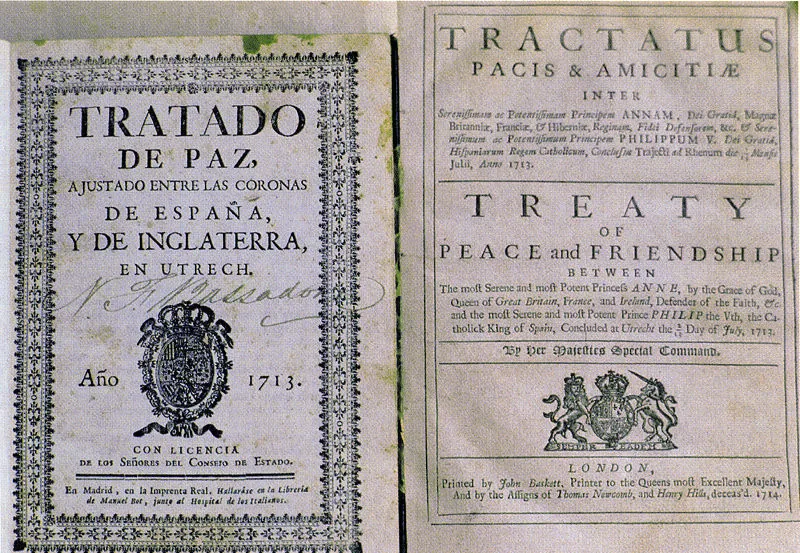
The Peace of Utrecht was a group of treaties signed from 1713 to 1715 in Utrecht, a city in the Dutch Republic. The treaties brought the War of the Spanish Succession to a close, a thirteen-year conflict that started when the last Spanish Habsburg died and left his empire to a grandson of France's Louis XIV. The settlement let Philip V keep the Spanish throne but barred the crowns of France and Spain from ever sitting on the same head. For the first time in European diplomacy, the treaties named the balance of power as an explicit goal. Britain came away with Gibraltar, large territories in North America, and a dominant position at sea. The principle behind the settlement, that no single state should dominate the continent, shaped European politics for the next two centuries.
The war that led to the Treaty of Utrecht
Charles II of Spain was the last of the Spanish Habsburgs, and generations of intermarriage within the family had left him severely disabled. He could barely speak or chew his food, did not walk until he was eight, and was known across Europe as "El Hechizado," the Bewitched. He had no children. He died in November 1700, just before his 39th birthday. His will left the entire Spanish empire to Philip of Anjou, a grandson of France's King Louis XIV, who had ruled France since 1643 and spent decades making it Europe's strongest military power.
The inheritance would add Spain, the Spanish Netherlands (present-day Belgium), much of Italy, and Spain's colonies across the Americas and the Pacific to the Bourbon orbit. If Philip someday inherited the French crown too, a single king would rule the largest empire in Europe. England, the Dutch Republic, and Austria formed a Grand Alliance in 1701 to prevent it.
The alliance's best commander was John Churchill, the Duke of Marlborough, who fought alongside the Austrian general Prince Eugene of Savoy. Between them they won a string of decisive battles: Blenheim in 1704, Ramillies in 1706, and Oudenarde in 1708. At Blenheim, their forces destroyed a French and Bavarian army so completely that a grateful Queen Anne gave Marlborough a royal estate at Woodstock. Blenheim Palace stands there today. But the victories weakened France without breaking it. By 1710 all sides were running out of money and men, and public support for the war was fading in both Britain and France.
What the Treaty of Utrecht settled
Britain's Tory government, led by Robert Harley and Henry St John, opened secret talks with France without telling its allies. The move was so controversial that after the peace was signed, St John fled the country and Harley was imprisoned in the Tower of London. But the talks produced a settlement that most sides could accept.
The treaties divided the Spanish empire. Philip V held on to the Spanish crown and its American colonies, but Philip and his heirs permanently gave up all rights to the French throne. Spain and France could share a ruling dynasty but never the same king.
Austria took the Spanish Netherlands, plus Naples, Milan, and Sardinia. Sicily went to the Duke of Savoy, who also gained a royal title. The Dutch Republic received a line of barrier fortresses along its southern border, meant to guard against future French advances. The Treaty of Rastatt, signed in 1714, concluded the separate peace between Austria and France.
Britain gained more than any other member of the alliance. Spain handed over Gibraltar and Minorca, which commanded the western Mediterranean. Gibraltar remains British territory today, and Spain still disputes the terms of the 1713 cession. From France, Britain received Nova Scotia, Newfoundland, and the lands around Hudson Bay in North America. France also recognized the Protestant line of succession to Britain's throne and promised to remove the Stuart claimant from French soil. France agreed to demolish the fortifications at Dunkirk, from which French raiders had attacked English and Dutch merchant vessels.
Spain also gave Britain the asiento, a thirty-year monopoly to supply enslaved Africans to Spain's American colonies at a rate of 4,800 people per year. The asiento opened Spanish colonial markets to British traders and expanded the Atlantic slave trade.
How the Treaty of Utrecht changed European diplomacy
Earlier peace settlements had produced a rough balance among Europe's major powers, but none had named the balance of power as a purpose. The Peace of Westphalia in 1648 is often credited with establishing the principle that sovereign states were equals under international law. Utrecht went further. Article 2 of the Anglo-Spanish treaty stated explicitly that peace in Europe depended on preserving the balance of power. The union of France and Spain had to be prevented to protect it. It was the first time a European treaty made that principle a deliberate, stated goal.
The idea outlived the borders the treaty drew. For the next century, Britain positioned itself as the balancer, opposing whichever power threatened to dominate the continent. It sided against Bourbon France first, then against Napoleon. When the statesmen at the Congress of Vienna in 1815 rebuilt Europe after the Napoleonic Wars, they used the same framework: a settlement designed to keep any one state from growing too strong. That principle, first written into treaty language at Utrecht in 1713, guided European diplomacy for the next two hundred years.