
Where does North Korea get its money?
North Korea has the world's fourth-largest military and a growing nuclear arsenal, but an economy smaller than Cambodia's. The money comes from Chinese trade, crypto heists worth billions, arms sales to Russia, and workers abroad whose wages go straight to the state.
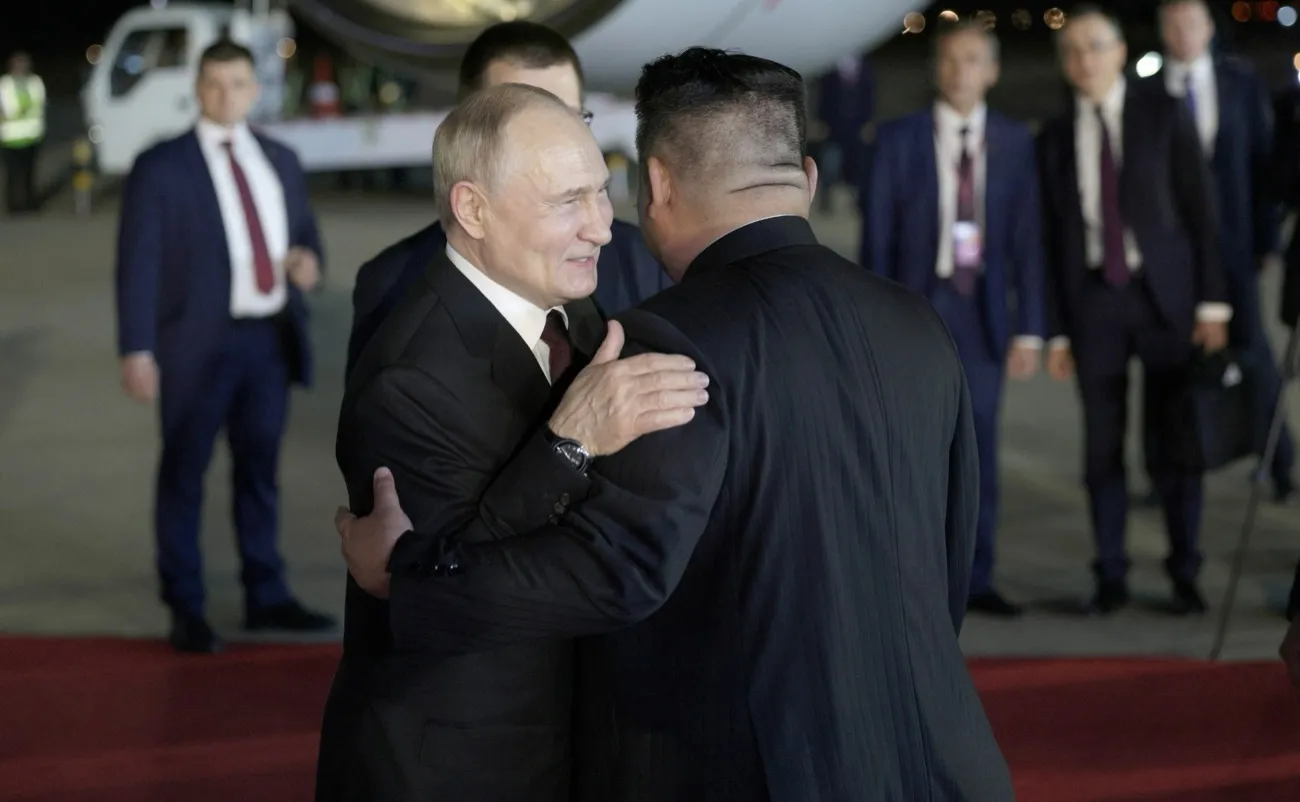
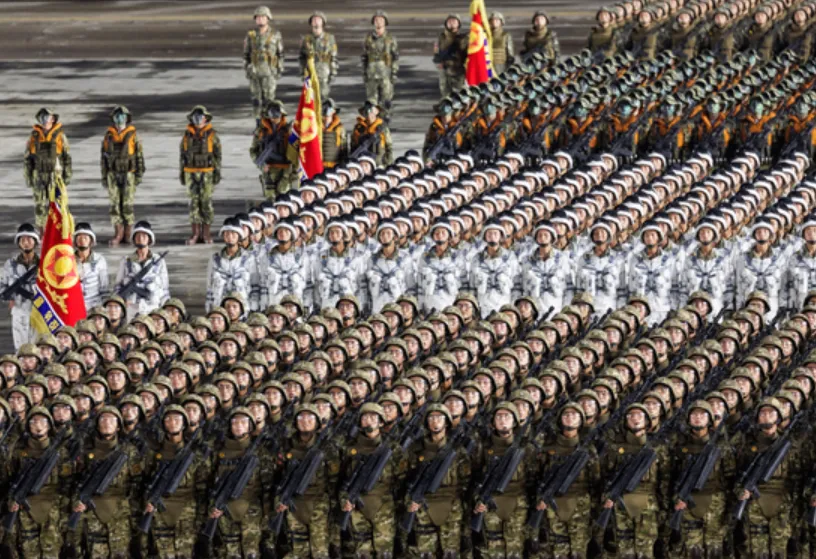
North Korea has roughly 1.2 million active-duty soldiers, the fourth-largest military on Earth. The country has tested nuclear weapons six times and launched more ballistic missiles in 2022 and 2023 than in all previous decades combined. Thousands of artillery pieces sit north of the demilitarized zone, positioned to strike Seoul, a city of ten million people about 35 miles from the border. By most estimates, the regime spends roughly a quarter of its gross domestic product on defense. The United States spends about 3.5 percent. Russia, even during its war in Ukraine, spends about 6 percent.
The country that pays for all this has an economy estimated at around $28 billion, comparable to Cambodia's. North Korea has been under United Nations sanctions since 2006 and American sanctions in some form since the 1950s. It is banned from exporting weapons, coal, textiles, and seafood, and largely cut off from the international financial system. None of that has stopped the buildup. The question gained new urgency in 2022, when North Korea began openly selling weapons to Russia and sending troops to fight in Ukraine, earning revenue and technology that sanctions were designed to prevent. The money comes from four sources, all of them well documented.
China keeps the lights on
China accounts for more than 90 percent of North Korea's foreign trade. It provides the fuel, food, machinery, and consumer goods that keep the country running. Without Chinese support, North Korea's economy would stop functioning within months.
Beijing's reason for keeping the regime alive is straightforward. A collapsed North Korea would send millions of refugees across the Chinese border into Manchuria. It could also produce a unified, American-allied Korea with US military bases on China's doorstep. Both outcomes are worse, from Beijing's perspective, than a difficult neighbor that serves as a buffer state.
When the UN Security Council tightened sanctions after North Korea's sixth nuclear test in September 2017, Chinese imports from North Korea officially fell by about 90 percent. The trade did not stop. It moved to smuggling, ship-to-ship transfers at sea, and Chinese middlemen working through front companies in Southeast Asia. A 2024 UN panel of experts documented hundreds of violations, including satellite photographs of ships transferring North Korean coal in open water. China's position has been that it meets its international obligations. The satellite images say otherwise.
Arms and soldiers for Russia's war
North Korea's finances changed in 2022, when Russia invaded Ukraine and began consuming ammunition faster than its own factories could replace it.
Kim Jong-un had spent a decade trying to break out of isolation. He had inherited the country in 2011 at roughly twenty-seven. As a teenager, he studied at a private school near Bern, Switzerland, registered under a false name. Classmates later remembered him as quiet, obsessed with basketball, and a devoted fan of the Chicago Bulls and Michael Jordan. He returned to Pyongyang, and when his father Kim Jong-il died, he became the leader of a nuclear-armed state with almost no diplomatic relationships. A decade of diplomacy, including summits with Donald Trump, went nowhere. Russia's war gave him a customer.
Starting in late 2022, North Korea shipped artillery shells and short-range ballistic missiles to Russia. By mid-2024, US and South Korean intelligence estimated the total at several million rounds and dozens of KN-23 missiles, some of which struck Ukrainian cities. In the autumn of 2024, North Korea sent an estimated 10,000 to 12,000 soldiers to fight alongside Russian forces in Kursk Oblast. It was the first time North Korean troops had fought abroad since the Korean War ended in 1953.
In return, Russia provided fuel, food, and military technology. South Korean intelligence officials said Russia was sharing satellite reconnaissance, submarine design, and missile guidance technology with Pyongyang. Russia got ammunition it needed immediately. North Korea got technology that sanctions were designed to prevent it from ever acquiring.
The world's most productive hackers
North Korea runs the most successful state-sponsored cybercrime operation in the world, measured by money stolen.
The main unit is the Lazarus Group, which US intelligence links to the Reconnaissance General Bureau, North Korea's military intelligence service. In February 2025, Lazarus hackers stole approximately $1.5 billion in cryptocurrency from Bybit, a Dubai-based exchange. It was the largest single crypto theft ever recorded. The FBI attributed it to North Korea within days. In 2022, the same group stole about $620 million from the Ronin blockchain network, which ran the online game Axie Infinity. Between 2017 and 2023, North Korea stole roughly $3 billion in cryptocurrency according to UN estimates, and the pace has accelerated since.
One of the few individuals identified by name is Park Jin Hyok, a North Korean programmer who lived in Dalian, China, working at a technology front company while running cyber operations for Pyongyang. A US federal indictment linked him to the 2014 hack of Sony Pictures, the 2016 theft of $81 million from Bangladesh's central bank, and the 2017 WannaCry ransomware attack that shut down hospitals across England. He has never been arrested.
Workers who never see their wages
For decades, North Korea sent tens of thousands of workers to Russia, China, and the Middle East to work in construction, logging, and manufacturing. The workers earned wages at or near local rates. The North Korean government took 70 to 90 percent and sent the money to Pyongyang. The workers lived in supervised dormitories, could not leave the work site unsupervised, and in most documented cases could not refuse the assignment. In Russian timber camps in Siberia, investigators documented workdays of fourteen to sixteen hours in sub-zero temperatures. The UN described the arrangement as state-organized forced labor.
A 2017 UN Security Council resolution ordered all member states to repatriate North Korean workers by December 2019. Russia and China reported compliance. Independent investigators found thousands of North Korean workers still in Russia under tourist and student visas, and in China under arrangements that met the letter of the resolution but not its purpose. Russia's wartime labor shortage has only increased demand. Annual earnings from overseas labor are estimated at $200 million to $500 million, though exact figures are impossible to verify.
Why sanctions have not stopped any of it
The sanctions on North Korea are the most comprehensive imposed on any country. They have not achieved their purpose. Since 2006, the nuclear arsenal has grown, the missile program has accelerated, and the regime shows no sign of weakening.
The fundamental problem is that sanctions assume a government will respond to economic pressure by changing its behavior. North Korea's government responds by shifting the cost onto the population. The military is fed before the civilians. The missile program is funded before hospitals or food imports. During the famine of the 1990s, triggered by the collapse of the Soviet Union and the loss of the subsidized fuel, fertilizer, and food that had kept North Korea's economy running, somewhere between 600,000 and one million people died. The government maintained its military at full strength throughout and continued developing weapons. The population absorbed the suffering. The regime survived.
China and Russia, the two countries with the most leverage over Pyongyang, each have reasons to keep North Korea intact. China fears a refugee crisis and an American-allied state on its border. Russia, since 2022, has needed North Korean ammunition and soldiers. In March 2024, Russia vetoed the renewal of the UN panel of experts that had been documenting North Korean sanctions violations, including the arms transfers to Russia itself. That ended independent enforcement oversight.
North Korea's combined revenues from Chinese trade, cybercrime, arms exports, and overseas labor do not add up to a wealthy economy. They do not need to. The regime spends an estimated $3 to $4 billion a year on its military in a country where most people live on less than a few dollars a day. As long as the population bears the cost and China and Russia see value in keeping the regime alive, the money will keep arriving.