
Alfred Thayer Mahan
Alfred Thayer Mahan was an American naval officer whose 1890 book argued that control of the sea was the key to national power.
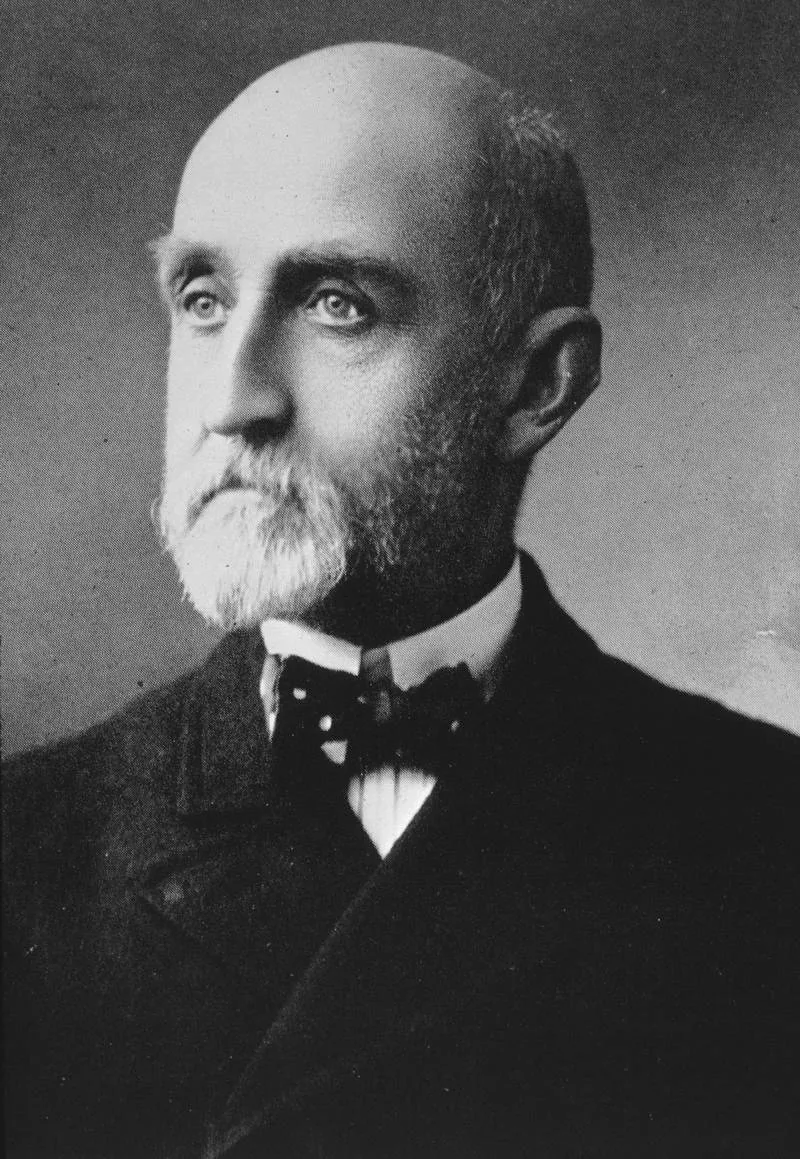
Alfred Thayer Mahan was an American naval officer who became the most influential naval strategist of the late nineteenth century. In 1890 he published The Influence of Sea Power upon History, 1660–1783, which argued that control of the sea was the key to national greatness. The book convinced the leaders of the United States, Germany, and Japan to build large battle fleets, and it helped set off the naval arms race that preceded the First World War. Mahan himself was a poor sailor who collided with something on nearly every ship he commanded. He was far better at studying navies than at running one.
How Mahan built his theory at the Naval War College
Mahan was born in 1840 at West Point, New York. His father, Dennis Hart Mahan, was the most famous professor at the US Military Academy, where he taught engineering for more than forty years. The younger Mahan chose the Navy instead of the Army. He entered the Naval Academy in 1856, graduated second in his class in 1859, and served during the Civil War, but he disliked life at sea. He grounded or collided with something on nearly every ship he commanded, and the Navy knew it.
In 1885 the Navy invited Mahan to teach at its new Naval War College in Newport, Rhode Island. He served as the college's president from 1886 to 1889 and again from 1892 to 1893. At Newport he studied centuries of British naval history and turned what he found into a theory. A nation's wealth depends on trade carried by sea. Protecting those trade routes requires a navy powerful enough to defeat any rival fleet. Mahan called this "command of the sea." He listed the ingredients a sea power needs, including geographic position, good harbors, a large seafaring population, and a government willing to pay for a navy.
Mahan's central argument was about how to use a fleet. A navy should not scatter its ships to raid enemy merchant vessels. Instead it should concentrate its capital ships into one large fleet and seek a single decisive battle, the way Admiral Horatio Nelson destroyed the combined French and Spanish fleet at Trafalgar in 1805. Destroy the enemy fleet and you control the ocean, along with every ship and cargo on it.
How the great powers responded to Mahan
The book reached the right readers at the right time. Theodore Roosevelt met Mahan at Newport in 1888, before the book was published, and the two became friends and allies. As president, Roosevelt pushed Congress to fund new warships and in 1907 sent the Great White Fleet, sixteen battleships, on a fourteen-month tour around the world to demonstrate American sea power.
Kaiser Wilhelm II of Germany wrote that he was not just reading Mahan but memorizing him, and he ordered copies placed on every ship in the German Navy. Admiral Alfred von Tirpitz used Mahan's arguments to persuade the Reichstag to fund a High Seas Fleet large enough to challenge the Royal Navy. The German building program started the dreadnought race with Britain, one of the forces that made the First World War more likely.
Officers in Japan's Imperial Navy studied Mahan as doctrine. Japan's commitment to the decisive fleet battle ran from its victory over Russia at Tsushima in 1905, during the Russo-Japanese War, to its defeat at Midway in 1942. There the doctrine broke against American carrier-based air power.
Did Mahan coin the term "Middle East"?
Mahan popularized the phrase, but he was not the first to use it. In September 1902 he published an article called "The Persian Gulf and International Relations" in the National Review, a British journal. In it he used the phrase "the Middle East." He wrote: "The Middle East, if I may adopt a term which I have not seen, will some day need its Malta." He was writing about sea lanes and the strategic value of the Persian Gulf, not about culture or geography. The term caught on quickly. British journalist Valentine Chirol used it in a series of articles later that year.
Mahan's influence on American naval strategy today
Britain's Julian Corbett argued in the early 1900s that Mahan overrated the single decisive battle and underrated limited naval operations. Aircraft carriers and submarines made the line of battleships obsolete, and no fleet has fought a Mahan-style decisive battle since 1944.
But Mahan's core idea still describes how the United States uses its navy. The country operates eleven carrier strike groups, maintains a global network of naval bases, and focuses on chokepoints from the Strait of Hormuz to the Strait of Malacca. In the South China Sea, American and Chinese naval vessels patrol the same waters, each trying to secure the trade routes that cross it. Mahan argued in 1890 that the country that controls the sea controls the trade. That is still the operating assumption of the US Navy.