
Balance of Power
The balance of power is the idea that when one country grows strong enough to dominate the rest, other countries form a coalition to stop it.
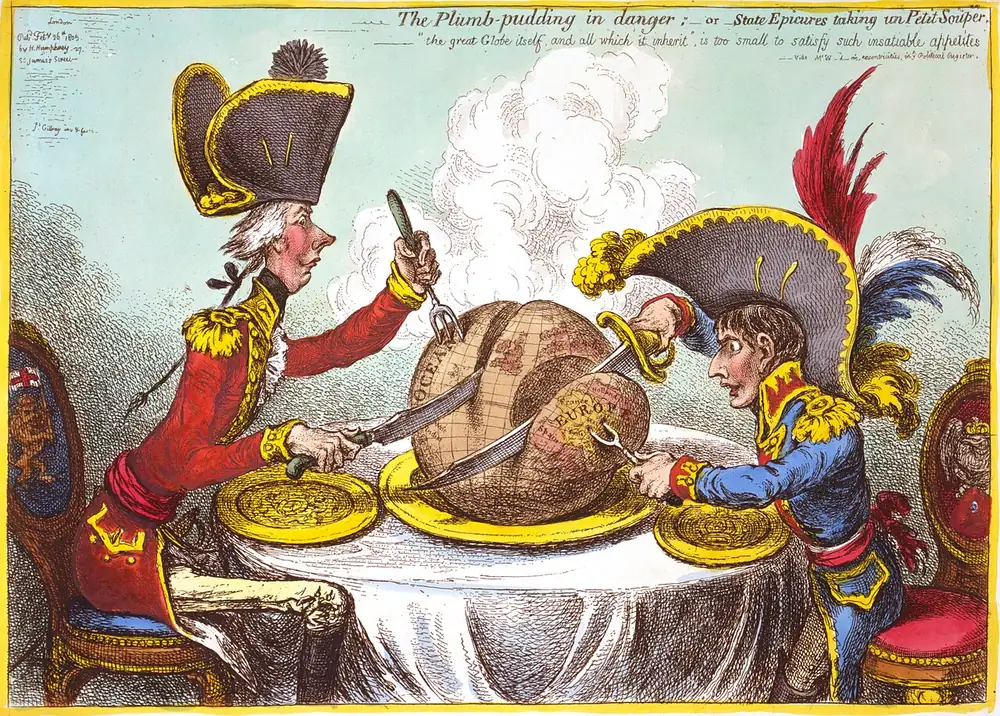
The balance of power is a principle in international politics: when one country becomes powerful enough to dominate its neighbors, the others tend to form an alliance against it. It works as both a theory about how countries behave and a strategy that governments have pursued on purpose for five hundred years. Renaissance Italy's five competing states, Florence, Venice, Milan, Naples, and the Papal States, pioneered the practice with shifting alliances and permanent ambassadors sent to keep watch on one another. Europe later copied it on a continental scale. In 1713, the Peace of Utrecht ended the thirteen-year War of the Spanish Succession. The treaty was the first to put the principle into law, calling for "an equal balance of power" as the foundation for lasting peace in Europe.
How Britain used the balance of power
Britain practiced this principle more consistently than any other European country. It did not seek to rule the continent, and its navy kept the island separate from continental armies. For four hundred years, Britain joined whatever alliance stood against the most powerful country in Europe. It fought Spain under Philip II, France under Louis XIV, Napoleon after the French Revolution upended the old order, and Germany in both world wars. Winston Churchill described the pattern in The Gathering Storm, writing that for centuries England had opposed "the strongest, most aggressive, most dominating Power on the Continent." It did not matter much who that power was or what it stood for.
The most stable period came after 1815. The countries that defeated Napoleon met at the Congress of Vienna, where Austria's Klemens von Metternich and France's Talleyrand helped design a settlement meant to prevent any single power from trying to take over again. Talleyrand had served the French monarchy, the Revolution, and Napoleon in turn, and at Vienna he managed to get defeated France accepted as an equal partner in the new order. The major powers then held regular meetings to settle disputes before they spread. This arrangement, later called the Concert of Europe, did not stop wars from happening altogether. But no war that drew in all the major powers broke out in Europe again until 1914.
How the balance of power works
A country can build up from within, strengthening its own military and economy to counter a rival. Or it can form alliances with other countries against a common threat. A third option is to side with the dominant power rather than opposing it, something scholars call bandwagoning. Small countries with no realistic chance of holding out on their own often take this path.
Kenneth Waltz argued in his 1979 book Theory of International Politics that the formation of balances is not a conscious choice. Because no government sits above all countries, the pattern emerges on its own, much like the way rival companies in the same industry gradually adopt similar strategies. The structure of the international system pushes countries toward balancing regardless of their intentions.
Stephen Walt refined this idea in The Origins of Alliances (1987). Walt argued that countries respond to perceived danger rather than to raw power alone. How threatening a country appears depends on its overall strength, its geographic proximity, its offensive capability, and what it seems to intend. This helps explain why the rest of the world did not form a coalition against the United States after the Cold War ended in 1991. The United States was the strongest country on earth, but most countries did not see it as a direct threat to their survival.
When the balance of power fails
Balancing breaks down in two ways. It can trigger the very conflict it was designed to avoid. By 1914, the rival alliance systems that had kept Europe stable for decades turned a quarrel in the Balkans into a war that pulled in every major power on the continent. Each alliance was strong enough that both sides believed they could win, and rigid mobilization schedules left little room to back down once the process started.
Balancing can also simply not happen at all. In the 1930s, every country threatened by Hitler's Germany held back, hoping another country would act. Britain and France each expected the other to take the lead. By the time they acted together, Germany had already absorbed Austria and most of Czechoslovakia.
Balance of power today
The behavior the balance of power describes is visible across the Indo-Pacific. AUKUS, the security partnership among Australia, the United Kingdom, and the United States, will give Australia nuclear-powered submarines to operate in waters where China's navy is expanding. The Quad groups the United States, Japan, India, and Australia around shared concerns about Chinese military and economic power. Japan has begun its largest military buildup since the Second World War. Finland joined NATO in 2023 and Sweden in 2024, both in response to Russia's invasion of Ukraine.
Chinese diplomacy, in turn, works to pull these groupings apart, offering trade and diplomatic partnerships to countries that might otherwise join them. Whether Asia is balancing against China or gradually accommodating its rise is one of the central questions in international politics today. The balance of power has shaped how countries respond to rising powers for five hundred years, and the pattern continues.