
Politburo
The Politburo was the small committee at the top of communist parties that made a country's real governing decisions.
The Politburo, short for Political Bureau, was the small committee at the top of a communist party that made a country's real governing decisions. In the Soviet Union, the Politburo usually had between ten and fifteen members. The government had a Council of Ministers that ran the ministries and a Supreme Soviet that passed laws, but neither body decided policy. The Politburo did. The Soviet Union had a written constitution, but the document that actually determined how power worked was the Communist Party's own internal rules. The same structure is still in use today. The Chinese Communist Party has a Politburo of roughly twenty members. Above that sits a Standing Committee of seven, which is the country's highest governing authority.
How the Soviet Politburo was created
The Bolsheviks set up the first Politburo on October 10, 1917, as a temporary committee to plan the seizure of power. It had seven members, including Lenin, Trotsky, and Stalin. Once the October Revolution succeeded, the committee lapsed.
The Politburo became a permanent body in March 1919, when the Eighth Party Congress created a permanent committee to handle decisions that could not wait for the full Central Committee, which had nineteen full members. The new Politburo had five full members: Lenin, Trotsky, Stalin, Kamenev, and Krestinsky. Two other bodies sat alongside it: the Orgburo, which handled party organization, and the Secretariat, which handled personnel and paperwork. Party members assumed the Politburo was the real seat of power and the Secretariat was a clerical office.
Stalin ended up with the Secretariat. While Trotsky commanded the Red Army and other leaders debated ideology, Stalin worked on appointments and organizational questions that his colleagues considered boring. In April 1922, the party made him its first General Secretary, a title that sounded like an office manager's. But the Secretariat decided who got appointed to jobs across the party: who ran local committees, who served on regional bodies, and who sat in the lower assemblies that elected the Central Committee. The Central Committee, in turn, elected the Politburo. By controlling appointments at every level, Stalin filled the party with loyalists. Within six years, the General Secretary's office had become the most powerful position in the Soviet Union, and Stalin's rivals on the Politburo, including Trotsky, had been expelled from the party.
The nomenklatura and Stalin's purge of the party
The appointment system that Stalin built was called the nomenklatura. The nomenklatura was a list of every important position in the country, paired with a list of people approved to fill them. Factory directors, newspaper editors, generals, ambassadors, university rectors, and heads of collective farms all appeared on the list. No one reached any of these jobs without party approval, and anyone who held one could be removed at any time. The system gave the Politburo control over the entire state without needing to run each institution directly.
In theory, the chain of authority ran upward: the Party Congress elected the Central Committee, which elected the Politburo. In practice, the Politburo decided who was nominated to each body, and nomination was the same as election. The system was circular: the Politburo appointed the people who appointed the Politburo.
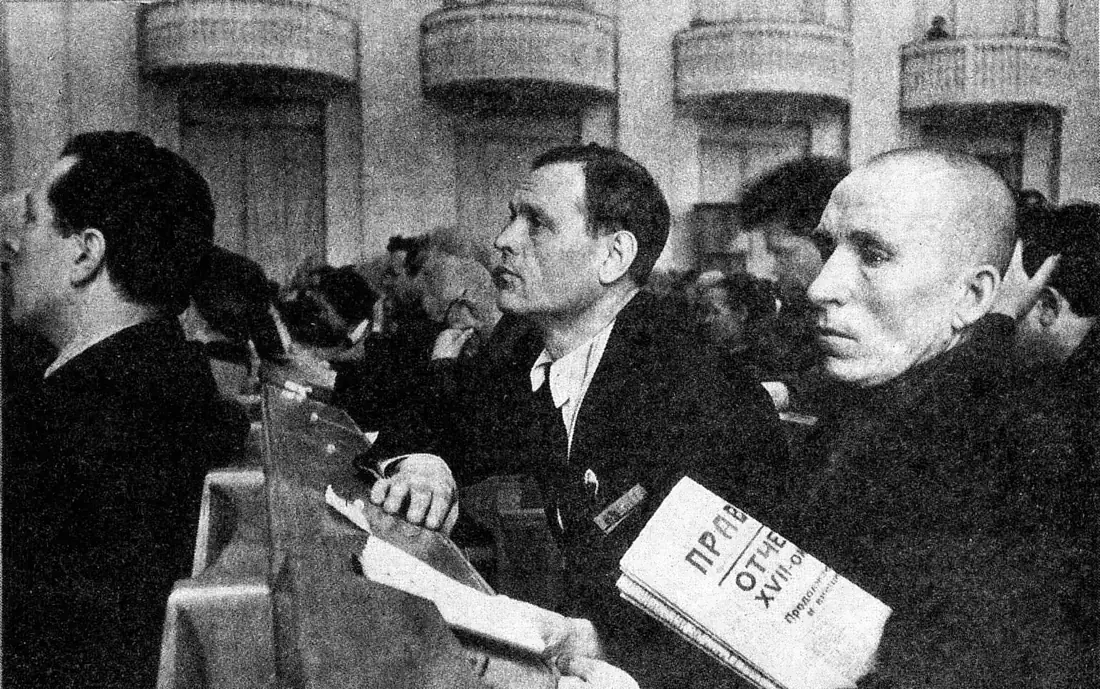
The Seventeenth Party Congress, held in 1934, showed what happened to anyone inside the system who fell out of favor. The 1,966 delegates came to Moscow to celebrate the achievements of the first Five-Year Plan. Within a few years, during Stalin's Great Purge, more than 1,100 of them were arrested. Of the 139 full and candidate Central Committee members elected at that congress, 98 were arrested and shot, most of them in 1937 and 1938.
In 1952, Stalin renamed the Politburo the Presidium and expanded its membership. His colleagues understood the move as preparation for another round of purges. Stalin died in March 1953 before carrying them out. The name reverted to Politburo in 1966 and remained until the Soviet Union collapsed in 1991.
Does China still have a Politburo?
Yes. The Chinese Communist Party has a Politburo of roughly twenty members. Its inner circle, the Politburo Standing Committee, has seven members. The Standing Committee is the most powerful governing body in China. Its members set policy on the economy, foreign affairs, the military, and internal security.
Xi Jinping's most important title is General Secretary of the Communist Party, the same position Stalin held. Like Stalin, Xi uses the appointment power that comes with it. The party's Organization Department manages who gets every significant post in the government and state-owned companies, a system that works much like the Soviet nomenklatura. The Party Congress meets every five years and performs the same role its Soviet predecessor once did: it ratifies decisions already made at the top. Foreign analysts still study seating arrangements at Chinese party meetings for clues about who holds real power and who is rising or falling.
Orbis has a full guide to how the party works in How the Chinese Communist Party is organized. The Politburo structure has proven effective at holding power but not at managing succession. Nearly every communist state has faced a leadership crisis when its leader died, because the system provides no reliable way to choose the next one.