
San Remo Conference
The San Remo Conference was a 1920 meeting where Allied leaders divided the former Ottoman Arab provinces into mandates under Britain and France.
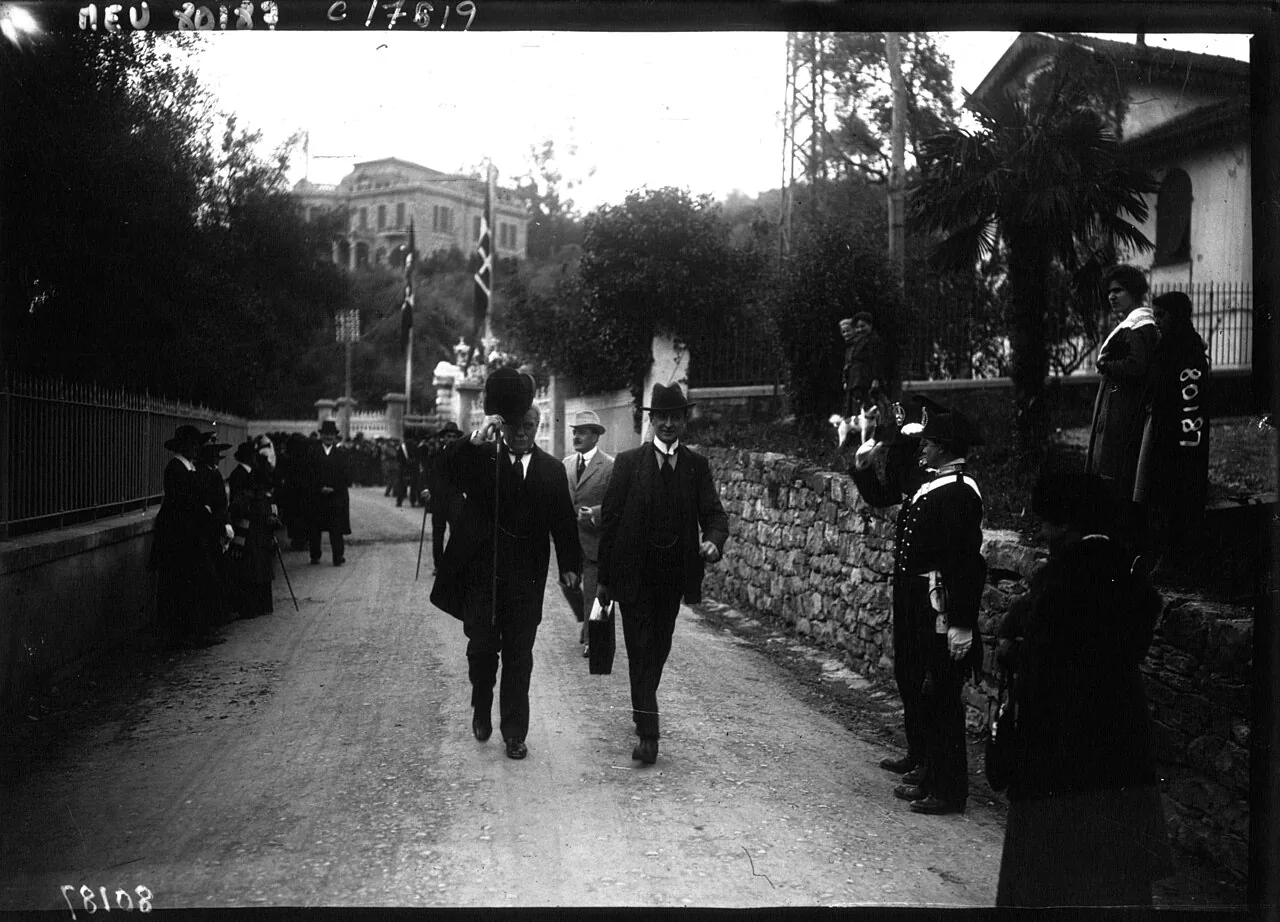
The San Remo Conference was a meeting of Allied leaders held from April 19 to 26, 1920, in a villa on the Italian Riviera. Britain's prime minister David Lloyd George, France's Alexandre Millerand, and Italy's Francesco Nitti, along with Japan's ambassador, divided the former Ottoman Arab provinces into mandates under the League of Nations. France received Syria and Lebanon. Britain received Mesopotamia, which became Iraq, and Palestine. The conference also gave the Balfour Declaration the force of international law and split the region's oil rights. People often cite the Sykes-Picot agreement as the deal that carved up the Middle East, but Sykes-Picot was a secret wartime deal that was never carried out as written. San Remo is the conference whose decisions drew the borders of the modern Middle East.
The wartime promises San Remo replaced
During World War I, Britain made three sets of promises about the same territory.
In 1915 and 1916, in what became known as the Hussein-McMahon correspondence, Britain assured Hussein bin Ali, the Sharif of Mecca, that most of the Arab provinces would become independent if the Arabs revolted against the Ottoman Empire. Hussein's son Faisal led the Arab Revolt on the strength of those assurances, and Arab forces helped Britain capture Damascus in October 1918.
At the same time, in 1916, British and French diplomats secretly divided the region into spheres of influence in the Sykes-Picot agreement. After the Russian Revolution, the Bolsheviks published its text, embarrassing both governments. By 1920 the agreement had been overtaken by events, but its broad outline, a French north and a British south, survived.
In November 1917, British Foreign Secretary Arthur Balfour sent a letter supporting "the establishment in Palestine of a national home for the Jewish people." It had no force in international law.
By 1919, President Woodrow Wilson's principle of self-determination was supposed to guide the postwar order. The Paris Peace Conference that year created the mandate system: a mandatory power would govern a territory until its people could govern themselves. In theory it was a trust. In practice, no one set an end date.
What the San Remo Conference decided
On April 25, 1920, the Allied Supreme Council passed a resolution assigning three Class A mandates. France received Syria and Lebanon. Britain received Mesopotamia and Palestine. The new state of Iraq was assembled from three former Ottoman provinces, and the Palestine mandate included the land east of the Jordan River that later became Transjordan. The United States attended the conference as an observer but did not take part in the decisions. The League of Nations gave its formal approval afterward.
The Palestine mandate incorporated nearly the full text of the Balfour Declaration. It committed Britain, as the governing power, to building a Jewish national home in Palestine while protecting the civil and religious rights of the non-Jewish population. What had been a letter from a foreign secretary was now a binding obligation under international law. For Palestinian Arabs, who made up about 87 percent of Palestine's population in the 1922 census, the declaration was no longer a statement of British intent. It was a legal duty that the mandatory power was bound to carry out. San Remo is still cited today in debates over the legitimacy of Israel's founding. The blog article How did Israel become a country? covers the full story.
A separate oil agreement, signed the day before on April 24, settled a long-running dispute over Mosul. Under Sykes-Picot, Mosul had been in France's zone. France had given up its claim to the province in 1918, and at San Remo it received a 25 percent share in the Turkish Petroleum Company, which held the area's oil concession. Iraq's northern border was drawn in large part because of the oil beneath it.
What happened after the San Remo decisions
One month before San Remo, on March 8, 1920, the Syrian National Congress, meeting in Damascus, had proclaimed an independent Arab kingdom under Faisal. He was the son of Hussein bin Ali, the Sharif who had launched the Arab Revolt, and he had spent much of 1919 in Paris lobbying for Arab independence at the peace conference. The San Remo decisions overrode his kingdom. In July 1920, French general Henri Gouraud issued an ultimatum, and French troops defeated Faisal's outnumbered force at the Battle of Maysalun on July 24. Faisal was expelled from Syria.
That same summer, a widespread uprising broke out across Iraq against British rule. The fighting lasted from late June to October 1920 and caused over 2,200 British casualties and far more Iraqi ones. The revolt pushed Britain away from direct colonial administration and toward a cheaper option: client monarchies. At a conference in Cairo in 1921, chaired by Winston Churchill, Britain installed Faisal as king of Iraq and gave his brother Abdullah the throne of Transjordan. Lebanon was separated from Syria as part of the French mandate.
The borders and states that San Remo created shaped the Middle East for the rest of the century. Iraq, Syria, Lebanon, Jordan, and Israel all trace their modern boundaries to decisions made at that conference. None of the people who lived in those territories had a voice in them.