
How the Polish-Lithuanian Commonwealth saved Europe and vanished from the map
Europe's largest state elected its kings, guaranteed religious freedom, and stopped the Ottomans at Vienna. Its own democratic rules destroyed it.
In January 1573, five months after French Catholics killed thousands of Protestants in the St. Bartholomew's Day Massacre, Polish nobles signed the Warsaw Confederation. It guaranteed complete religious freedom across the kingdom for every faith: Catholic, Lutheran, Calvinist, Orthodox. No other state in Europe offered anything close. Later that year, the nobles elected the French prince Henry of Valois as their king. Henry had been part of the French royal court that ordered the massacre in Paris. The nobles made him swear to uphold religious tolerance before they let him take the crown.
The country that demanded this oath was the Polish-Lithuanian Commonwealth. By most measures it was the most progressive state in Europe. It elected its kings. Its nobles had a constitutional right to resist unlawful orders. Its parliament gave a voice to roughly 8 to 10 percent of the population, at a time when the nobility in France and England accounted for about 1 to 2 percent. For two centuries it also served as Europe's military shield against invasions from the east, stopping the Mongols, the Teutonic Knights, and the Ottoman Empire. Then its neighbors carved it up, and the country disappeared from the map for 123 years.
How a union became Europe's largest state
The Commonwealth was born on July 1, 1569, when the Kingdom of Poland and the Grand Duchy of Lithuania signed the Union of Lublin. The merger created the largest state in Europe by area: roughly 400,000 square miles at its peak around 1618, with a population of about 11 million. It stretched from the Baltic Sea to the Black Sea steppes and included Poles, Lithuanians, Ruthenians (ancestors of modern Ukrainians and Belarusians), Germans, Jews, Tatars, and Armenians.
Its political system had no real equivalent. The king was elected by the entire noble class in open-air assemblies that sometimes drew 40,000 to 50,000 voters. Henry of Valois, the first king chosen this way, lasted five months before sneaking out of Kraków at night and riding for the French border to claim the French throne instead. The nobles shrugged and elected another.
The parliament, called the Sejm, met regularly and held real power over taxation and foreign policy. The nobles, the szlachta, enjoyed formal legal equality regardless of wealth: a poor nobleman with fifty acres had the same vote as a magnate with vast estates. They also held the liberum veto, a rule that allowed any single member of the Sejm to block all legislation and dissolve the entire session. The principle was radical for its time: no law should pass if even one representative believed it harmed his constituents.
How Poland held Europe's eastern border
The Commonwealth and its predecessor Polish kingdoms spent centuries fighting invasions that could have reshaped western Europe.
In April 1241, a Mongol army rode into Silesia during the great westward push that followed Genghis Khan's conquests. Duke Henry II the Pious met them at the Battle of Legnica with a Polish and German force. The Mongols won, killed Henry, and paraded his head on a spear. But Legnica was the westernmost point the Mongol armies ever reached in Europe, and they turned back east within weeks.
In 1410, a Polish-Lithuanian army met the Teutonic Knights at the Battle of Grunwald, one of the largest battles in medieval Europe. The Knights were a German crusading order that had built a military state along the Baltic coast and raided Polish and Lithuanian territory for two centuries. The combined army destroyed them. The Teutonic Order never recovered as a military power.
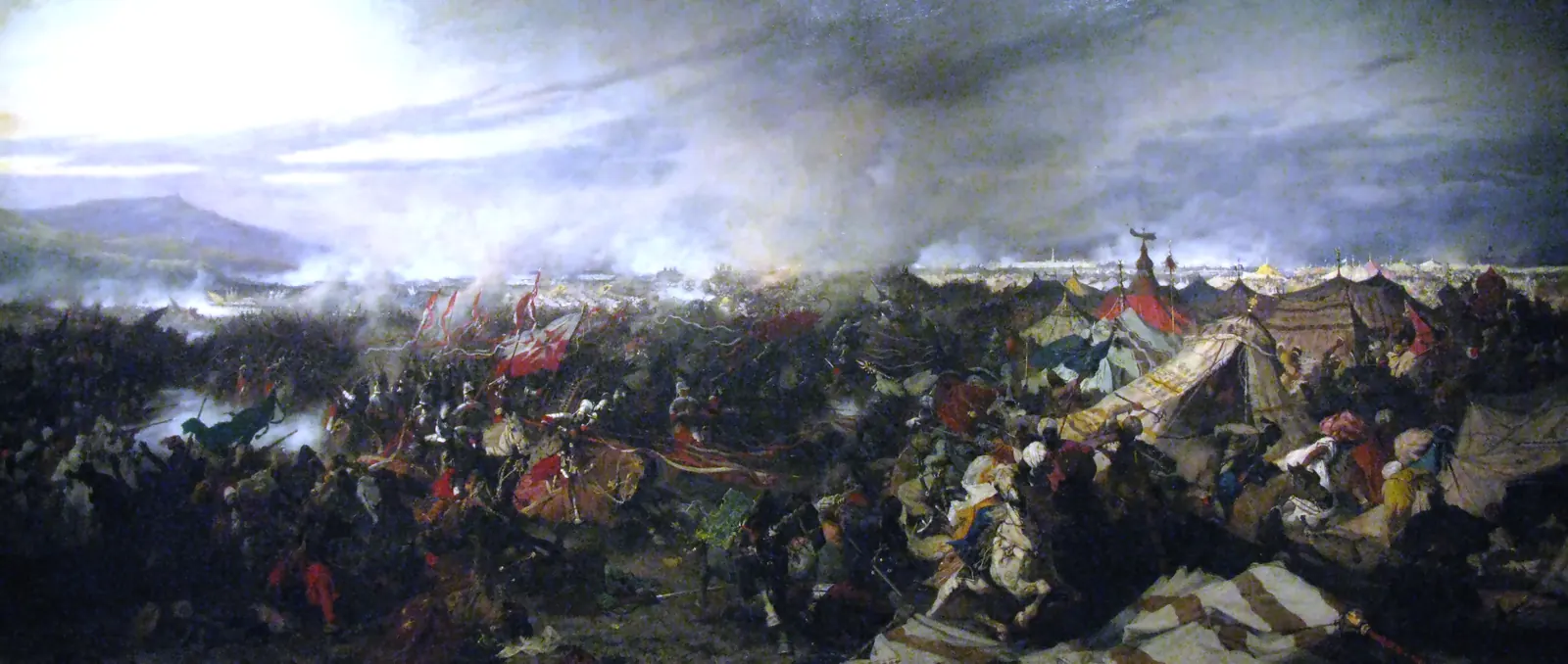
The climax came at Vienna in 1683. The Ottoman Empire had besieged the Habsburg capital with roughly 150,000 soldiers, and the city was weeks from falling. Jan III Sobieski, king of the Polish-Lithuanian Commonwealth, marched south with 20,000 Polish troops to join an allied relief force of about 70,000. On September 12, Sobieski personally led the charge: roughly 18,000 cavalry, including 3,000 of Poland's winged hussars, heavy lancers who wore large wooden frames with feathers on their backs, rode downhill into the Ottoman camp in what is considered the largest cavalry charge in recorded history. The Ottoman army broke within hours. Sobieski sent word to Pope Innocent XI from the captured Ottoman tent, paraphrasing Caesar: "Venimus, vidimus, Deus vicit." We came, we saw, God conquered.
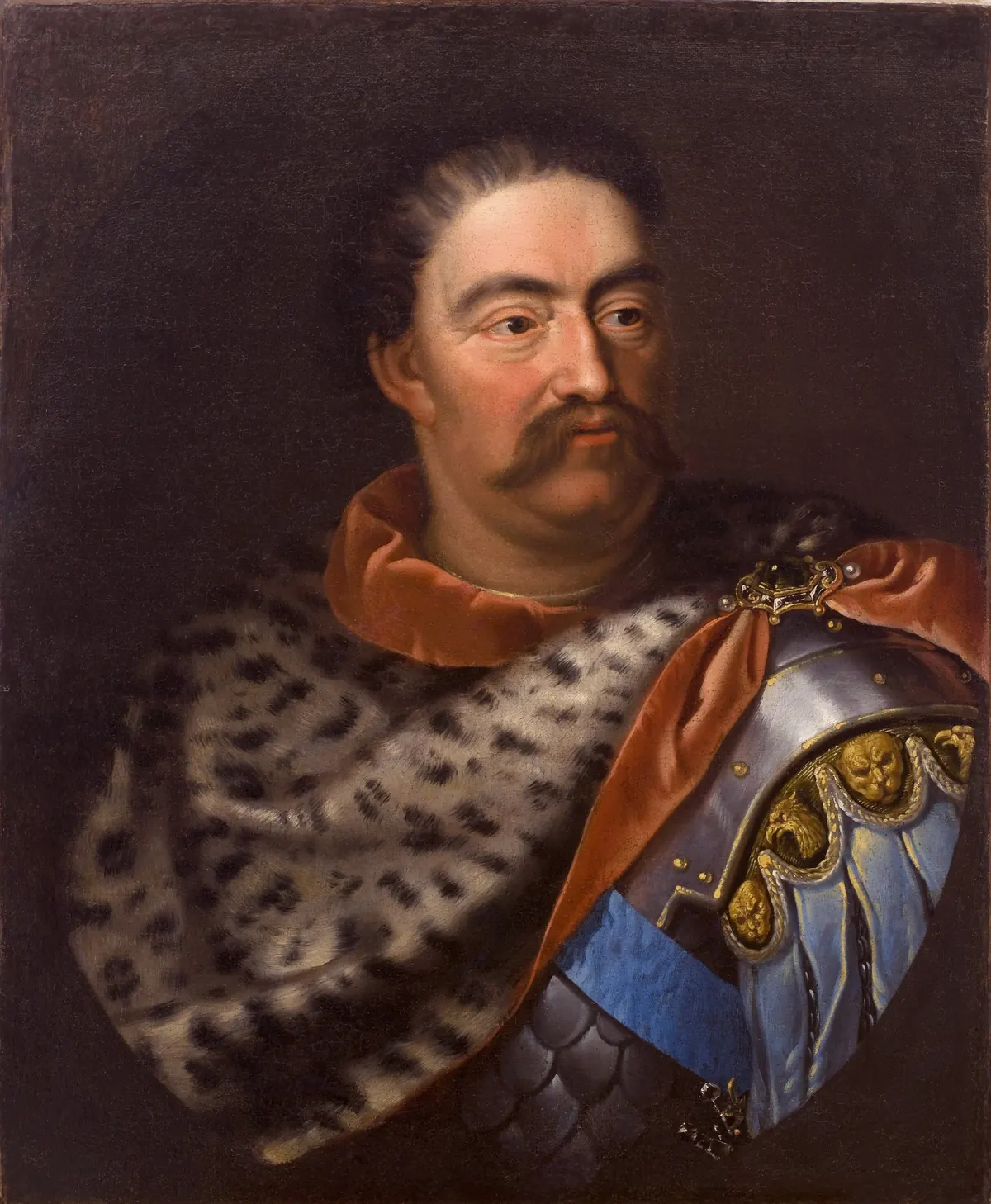
Sobieski was 54 years old at Vienna. He had been elected king in 1674 after defeating the Ottomans at the Battle of Khotyn the year before, and he had spent most of his adult life fighting on Poland's southern border. He spoke six languages, including Tatar. From the captured Ottoman tent, the first letter he wrote was not to the Pope or the Habsburg emperor but to his wife Marie Casimire, a French noblewoman he called Marysieńka.
How the liberum veto broke the state
The liberum veto worked when the nobles shared a basic loyalty to the Commonwealth. By the mid-1600s, Poland's neighbors realized they did not need to invade. They just needed to buy one nobleman.
The veto was first used to dissolve a Sejm session in 1652, when a deputy named Władysław Siciński objected to extending the session, walked out, and nullified every law it had passed. What had been a theoretical right became a practical weapon. Over the next century, roughly a third of all Sejm sessions were "exploded" this way, producing no legislation at all. During the 30-year reign of Augustus III (1733 to 1763), only one out of roughly thirteen Sejm sessions managed to pass anything. Russia, Prussia, and France routinely paid Polish nobles to veto military reforms, tax increases, and anything that might have strengthened the Commonwealth enough to resist foreign pressure.
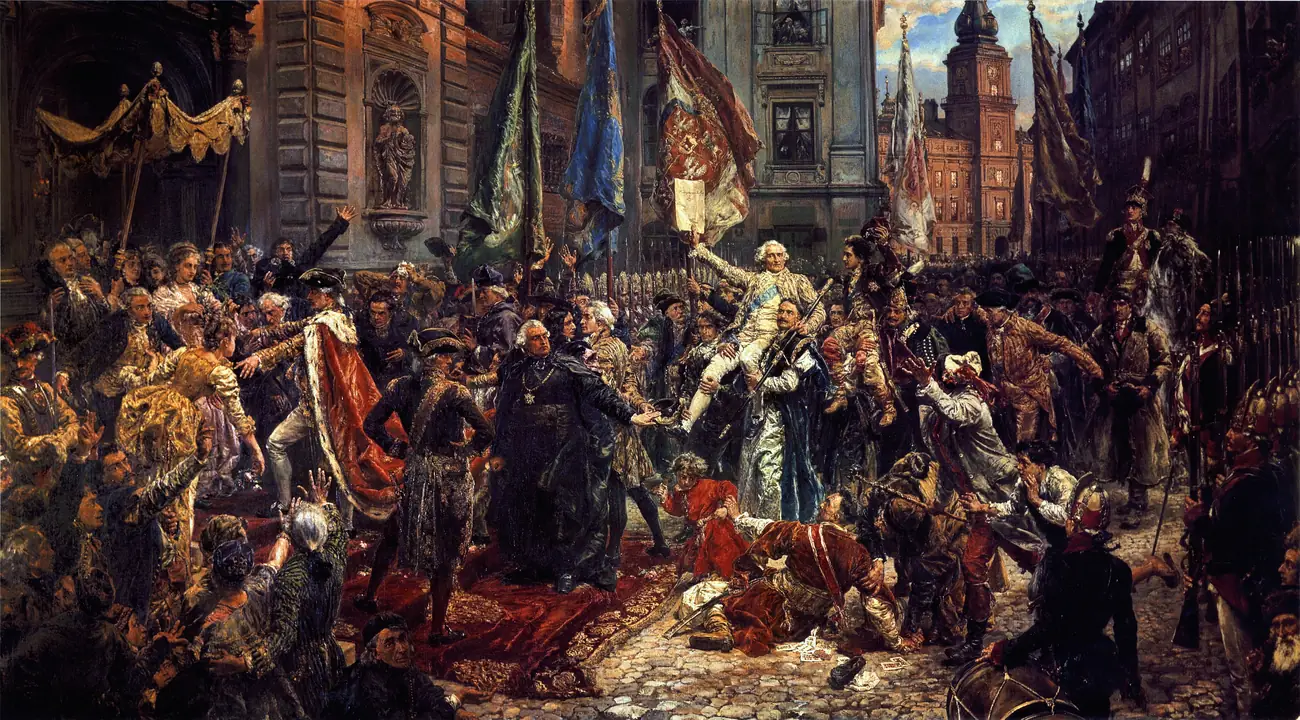
The Constitution of May 3, 1791, tried to fix everything at once. It was the first modern constitution in Europe and the second in the world after the American Constitution of 1787. It abolished the liberum veto, replaced the elected monarchy with a hereditary one, introduced separation of powers, and extended some political rights to townspeople. It lasted fourteen months. Catherine the Great of Russia invaded in 1792 to overturn it, because a reformed, functional Poland on her western border was exactly what she wanted to prevent.
The partitions followed quickly. Russia, Prussia, and Austria had already taken about 30 percent of the Commonwealth's territory in the First Partition of 1772. Russia and Prussia took more in 1793. After Polish forces under Tadeusz Kościuszko launched a failed uprising in 1794, the three powers divided what remained in 1795. Poland disappeared from the map of Europe entirely. It would not return as an independent state for 123 years, until 1918.
Why the Commonwealth still matters
The Polish-Lithuanian Commonwealth was a genuine experiment in large-scale democracy, religious tolerance, and constitutional government, centuries before those ideas became the norm in western Europe. The Warsaw Confederation guaranteed religious freedom 216 years before the French Revolution declared it. The May 3 Constitution came four years after America's. France adopted its first constitution four months later.
The reason it failed is the part worth remembering. The liberum veto was a democratic ideal: the protection of minority rights against majority power. In practice, it meant that any foreign power could stop the Polish government from passing laws by paying a single nobleman to walk out of the Sejm. Russia, Prussia, and Austria did not need to defeat Poland's armies. They needed to find one cooperative deputy, and there was always one.
Poland today spends a higher share of its GDP on defense than any other NATO member, nearly 5 percent in 2026. Since Russia's full-scale invasion of Ukraine in 2022, Poland has been the loudest European voice calling for stronger defenses on NATO's eastern flank. The argument is not abstract. A democracy on Europe's eastern border that could not defend itself disappeared from the map for 123 years. Poland is spending to make sure it does not happen again.
Test what you learned
5 quick questions on this article. No signup, just you against the text.