
We make Orbis, so it is first on this list. Below it are the apps we would recommend anyway, with what each one does well and where it falls short.
How these were chosen: each app is useful to someone learning or following geopolitics, available on a phone in 2026, and described by its actual pricing model. Prices differ by country and change often, so check the App Store or Google Play before you buy.
The short list
| App | Best for | Price model | Platforms |
|---|---|---|---|
| Orbis | Structured lessons from scratch | Subscription, free trial | iPhone, Android |
| GeoInsight | 3D globe with resource/chokepoint layers | Subscription, free trial | iPhone |
| Kinnu | General-knowledge microlearning with history | Free, paid tier | iPhone, Android |
| Blinkist | Book summaries (Prisoners of Geography and others) | Free, paid tier | iPhone, Android, web |
| Ground News | Seeing how outlets frame the same story | Free, paid tier | iPhone, Android, web |
| Atlas | Alerts on conflicts and military activity | Free, paid tier | iPhone |
| Espresso | Daily briefing from The Economist | Subscription | iPhone, Android |
| Foreign Affairs | Expert-level long-form essays | Free, paid tier | iPhone, Android |
| Seterra | Map quizzes (countries, capitals, flags) | Free | iPhone, Android, web |
| GeoGuessr | Guessing locations from Street View | Free, paid tier | iPhone, Android, web |
| Coursera | University-style courses | Free preview, subscription | iPhone, Android, web |
| The Great Courses Plus | Streaming video lectures by professors | Subscription | iPhone, Android, web |
| MarineTraffic | Live ship tracking at chokepoints | Free, paid tier | iPhone, Android, web |
| Liveuamap | Map of geolocated conflict events | Free, paid tier | iPhone, Android, web |
| Flightradar24 | Live flight tracking and airspace closures | Free, paid tier | iPhone, Android, web |
For learning geopolitics from scratch
Orbis
Best for: learning geopolitics and history in short lessons · Price: subscription with a 7-day free trial · On: iPhone, Android
Orbis has 22 courses and more than 650 lessons of 5 to 15 minutes each. The courses run from Geopolitics Foundations to the Cold War, the chip war, the Russia-Ukraine war, China and Taiwan, Kashmir, Iran and the nuclear age. Each lesson explains why something happened, with maps and primary sources, and ends with a few questions. More than 4,900 flashcards, tied to the lessons you have finished, come back on a spaced-repetition schedule.
The app also has a daily briefing that links each news story to the lessons that explain it, a 3D globe of flashpoints, chokepoints, trade routes and pipelines, and reference pages on countries, leaders, companies and resources.
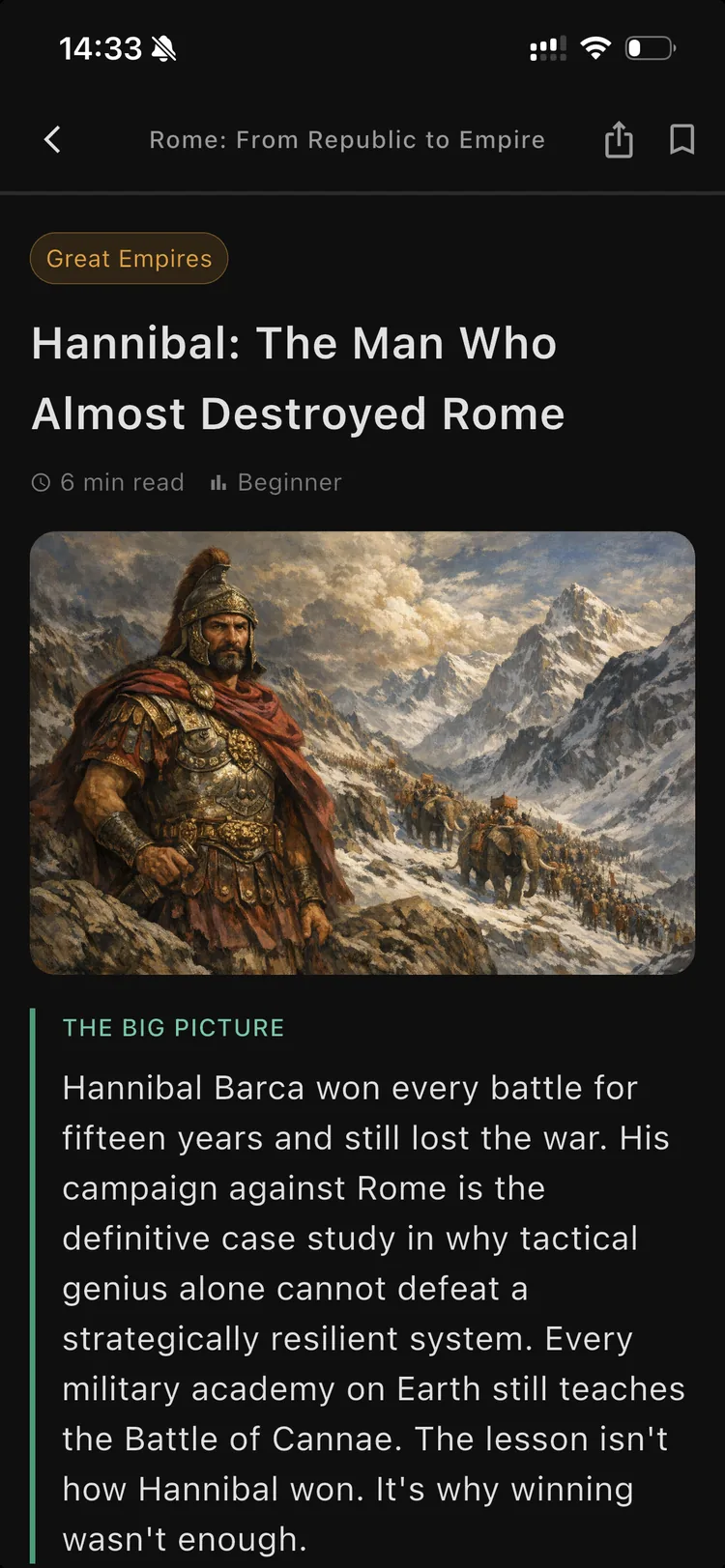
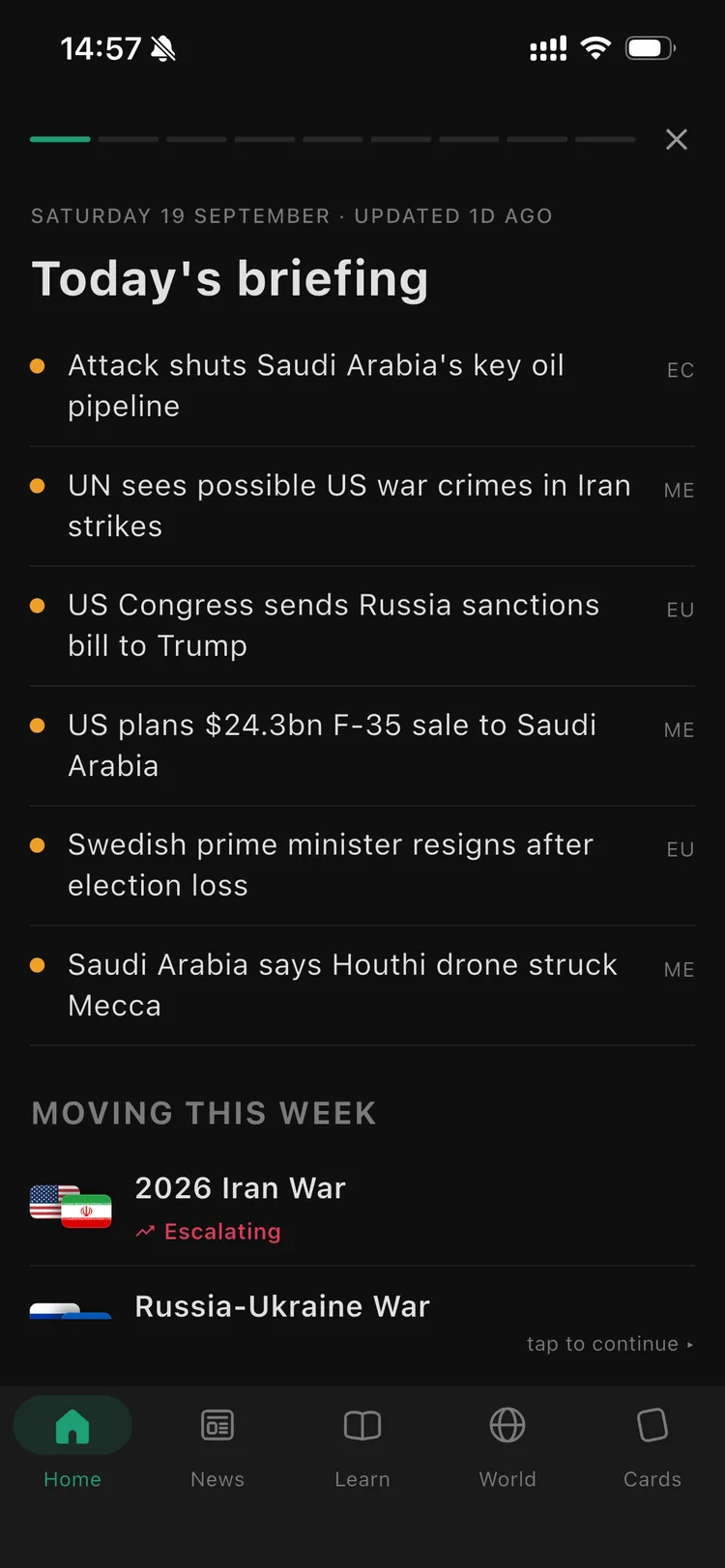
The limitation: Orbis is subscription only. After the 7-day free trial, there is no free tier. The app is in English only. Courses cover Europe, the Middle East and Asia far better than Africa and Latin America, which have no full course yet.
The only other geopolitics app built around lessons that we found is GeoInsight, an iPhone app with a 3D globe, map layers for oil routes, pipelines and chokepoints, and short history courses. It is very new and has almost no reviews yet, and its explanations are written by AI. It requires a subscription after a free trial.
The next two picks are general learning apps, not geopolitics-specific.
Kinnu
Best for: general-knowledge microlearning with history topics · Price: free with a paid tier · On: iPhone, Android
Kinnu uses spaced repetition to teach topics including World History, Ancient Civilizations and Rome. The memory science behind it is solid: lessons are short, and the app re-tests you at intervals to move facts into long-term memory.
The limitation: we found no geopolitics or current-affairs pathway in Kinnu. It is useful for building a history foundation, but you will need something else for the political side.
Blinkist
Best for: book summaries of geopolitics classics · Price: free with a paid tier · On: iPhone, Android, web
Blinkist has a 14-minute summary of Tim Marshall's Prisoners of Geography, broken into six key ideas. It also has summaries of Why Nations Fail and The Accidental Superpower. One free pick per day; the rest require a subscription.
The limitation: summaries flatten arguments. A 14-minute version of a whole book loses most of the evidence and the nuance. Blinkist is better as a way to decide which books to read in full than as a substitute for reading them.
For understanding the news
Ground News
Best for: seeing how outlets with different political leanings cover the same story · Price: free with paid tiers · On: iPhone, Android, web
Ground News groups coverage of each story from many outlets and labels each source's political bias, factuality rating and ownership. A "Blindspot" feature shows stories that one side of the political spectrum under-covers. The basic feed is free; paid tiers add more features.
The limitation: Ground News is an aggregator. It tells you who covers what and how they frame it, but it does not explain the history or geography behind a story. The bias ratings come from third-party sources, not Ground News's own reporting.
Atlas
Best for: fast alerts on conflicts and military activity · Price: free with a paid membership · On: iPhone
Atlas, from The Atlas News, is a geopolitics news feed in the open-source intelligence style: short briefs and push alerts on wars, military movements and unrest, which you can follow by region. It is one of the best-rated apps in the category, with more than a thousand ratings on the App Store.
The limitation: Atlas tells you what is happening minute by minute, with little background on why. It works best for readers who already know the region.
Espresso from The Economist
Best for: a concise daily briefing with global scope · Price: subscription (free for students) · On: iPhone, Android
Espresso publishes a "World in Brief" section updated three times a day, five one-minute articles, audio, and a daily chart. It is written by Economist journalists and covers politics, economics and business worldwide.
The limitation: Espresso is short and paywalled. It assumes you already know what the EU is, who runs which country, and what a basis point means. Beginners will want a learning app alongside it.
Foreign Affairs
Best for: expert-level analysis by policymakers and scholars · Price: free with a paid tier · On: iPhone, Android
Foreign Affairs, published by the Council on Foreign Relations, runs long-form essays and interviews. Non-subscribers can read the new daily articles for free; full issues require a subscription. The app includes audio for some articles and offline downloads.
The limitation: Foreign Affairs is dense. Articles often assume a lot of background knowledge. It is the best source once you have a foundation, but a poor starting point.
Reuters is worth adding for fast, neutral wire copy with little explanation or framing. Full access needs registration, and in most countries a subscription.
For learning the map
Seterra
Best for: memorizing countries, capitals and flags on a map · Price: free · On: iPhone, Android, web
Seterra (now part of GeoGuessr) has map quizzes for every region. Pick a continent, and it asks you to click on each country as it names them. It is the fastest way to go from "I cannot find Iran on a map" to knowing every country in the Middle East. The app is free, with ads on mobile.
The limitation: Seterra teaches where, never why. You will know that Djibouti is at the mouth of the Red Sea, but not why the US, China and France all have military bases there.
GeoGuessr
Best for: learning to read landscapes and cultural clues from around the world · Price: free with a paid tier · On: iPhone, Android, web
GeoGuessr drops you into Google Street View at a random location and asks you to guess where you are. Over time, you learn to recognize road signs, vegetation, driving sides and architecture. The free tier gives you a daily challenge; paid tiers add unlimited play.
The limitation: GeoGuessr teaches physical and human geography, not politics. You will get good at spotting a Cyrillic road sign, but you will not learn why Russia and Ukraine are at war.
Google Earth is also free and worth exploring for its Voyager guided stories, which walk you through specific places with satellite imagery.
This site has free map quizzes that test both geography and geopolitics: World Geography, Europe, Middle East and Africa.
For university-style courses
Coursera
Best for: structured courses from universities and the Council on Foreign Relations · Price: free preview, then subscription · On: iPhone, Android, web
Coursera has CFR's Global Affairs Explained specialization, a three-course series that covers the fundamentals of international relations. It also has O.P. Jindal Global University's Power and Foreign Policy in International Relations. Since August 2025, Coursera lets you preview the first module of nearly every course for free. The rest of the course needs a paid plan, a free trial or financial aid.
The limitation: university lecture format. Courses take weeks to finish and are not built for a daily habit. You need to set aside time the way you would for a college class.
The Great Courses Plus
Best for: deep video lectures by professors on history, politics and strategy · Price: subscription · On: iPhone, Android, web
The Great Courses Plus (called Wondrium from 2021 to 2024) streams long-form lecture courses by university professors. History and politics courses often run 12 to 36 lectures of 30 minutes each. The depth is real, closer to sitting in a classroom than watching a YouTube explainer.
The limitation: many history courses are years old and do not cover recent events. The subscription is one of the more expensive options on this list.
For following events live
These three apps show raw, real-time data with no explanation. Each one is most useful once you already know enough to interpret what you are seeing.
MarineTraffic
Best for: watching ship traffic through chokepoints like Hormuz, the Red Sea and Panama · Price: free with paid tiers · On: iPhone, Android, web
MarineTraffic shows live positions of ships worldwide using AIS transponder data. During the Houthi attacks on Red Sea shipping, you could watch tankers rerouting around the Cape of Good Hope in real time.
The limitation: ships in sanctioned fleets ("dark fleets") often switch off their AIS transponders. MarineTraffic shows only the ships that keep their transponders on.
Liveuamap
Best for: geolocated conflict events on a map · Price: free with a paid tier · On: iPhone, Android, web
Liveuamap pins news events and social-media reports onto a map, covering Ukraine, the Middle East and other conflict zones. It started in 2014 for the Ukraine conflict and has expanded to many regions.
The limitation: the pins are raw and often unverified. App reviews are mixed, and the interface can feel cluttered. Liveuamap works best as a supplement to a news source that provides context.
Flightradar24
Best for: tracking flights, airspace closures and military activity where transponders are on · Price: free with paid tiers · On: iPhone, Android, web
Flightradar24 tracks commercial and some military flights in real time. During the 2026 Iran war, you could watch airliners route around the closed airspace over the Middle East. The free tier covers basic tracking; paid tiers add history and weather layers.
The limitation: many military aircraft do not broadcast their position. Flightradar24 shows you civilian traffic and the occasional government jet, not the full picture.
How to combine them
Complete beginner: Start with a free map quiz (Seterra or this site's quizzes) to learn where countries are. Then pick one learning app for the "why": Orbis if you want short structured lessons, or Coursera's CFR specialization if you prefer a university format. Add Ground News or Reuters once you can place stories on a map.
Student or serious reader: Take a Coursera course and read the books on the reading list, starting with Prisoners of Geography and Chip War. Use Foreign Affairs for current analysis once you have the foundation.
News follower who wants more depth: Pair a news app (Ground News or Espresso) with this site's free reference pages: chokepoints, country rankings and country profiles. When a story mentions the Strait of Hormuz or BRICS, you can look it up in 30 seconds.
Free alternatives to apps
Not everything requires a download. This site's quizzes, World pages, blog and encyclopedia are free in the browser with no account. The learn geopolitics page lists recommended books, podcasts and YouTube channels.
- GuideHow to learn geopoliticsA step-by-step path, with books, podcasts and free courses for each step.
- GuideWhat is geopolitics?The definition, where the word comes from and the ideas behind it.
- WorldWorld: maps, rankings and dataCountry profiles, chokepoints, alliances and resources.
- QuizQuizzesFree quizzes on geography, history and the news, with no signup.