Geopolitics in one paragraph
Geopolitics is the study of how the physical world shapes what countries do and why they compete. It starts from the things a government cannot change: where its mountains and rivers are, whether it has a coast, who its neighbors are, and whether it has oil or has to buy it. The word combines the Greek "geo" (earth) and "politics" (the affairs of the state).
Russia is the clearest example. Moscow sits on the North European Plain, a stretch of flat, open land with no mountains or seas between it and Western Europe. Armies have used that plain to invade Russia repeatedly: Napoleon in 1812, Germany in World War I, and Germany again in 1941. That geography and that history are why Moscow has wanted buffer states between itself and Europe for centuries, and why it reads NATO's eastward expansion as a threat. Geopolitics explains these interests and pressures. It does not excuse the decisions leaders make in response to them.
Two shorter examples show the range. Britain is an island, so in peacetime it did not need a large standing army to guard a land border. It built a navy instead and became the world's dominant sea power. The United States sits between two oceans with weaker neighbors to its north and south, so it never had to keep a big army at home to defend its borders and could send its military power abroad.
Where the word comes from
The Swedish political scientist Rudolf Kjellén coined the word, "geopolitik" in Swedish, in 1899. It appeared in an article about Sweden's borders in the geographical journal Ymer. Kjellén was a professor and also a conservative member of the Swedish parliament. He saw the state as a living thing shaped by the land it occupied, an idea he developed in his 1916 book The State as a Life-Form. He also coined a second phrase that outlived him: "folkhemmet", the people's home, which later became the slogan of Sweden's Social Democrats, his political opponents.
Kjellén built on the work of the German geographer Friedrich Ratzel, who described the state as an organism that needs space to grow. Ratzel's 1901 essay "Der Lebensraum" gave a name to that idea: Lebensraum, "living space."
Karl Haushofer, a Bavarian general who had served as a military observer in Japan, became a professor in Munich after World War I and turned these ideas into a doctrine. In 1924 he founded a journal of geopolitics. That same year he visited his former student Rudolf Hess in Landsberg prison, where Hess was serving time alongside Adolf Hitler. Through Hess, Haushofer's ideas about Lebensraum reached the Nazi leadership, which used them to argue for conquest in Eastern Europe. How much Haushofer shaped Nazi policy is still debated.
Haushofer's own family shows how tangled the story was. His wife Martha was half-Jewish under Nazi law, and Hess protected the family. Their son Albrecht joined the circle behind the July 20, 1944 plot to kill Hitler and was shot by the SS in Berlin in April 1945. In March 1946 Karl and Martha Haushofer killed themselves at their farm in Bavaria.
After 1945 the word "geopolitics" was so closely tied to Nazi expansion that Western universities mostly avoided it for decades.
The word came back into everyday use in the 1970s. Henry Kissinger, the US national security adviser and then secretary of state, used it often to describe balance-of-power politics and helped bring it back. Historians still argue about how much of the revival was his doing.
The classic theories
Mahan and sea power
Alfred Thayer Mahan, a US naval officer, published The Influence of Sea Power upon History in 1890. His argument was straightforward: whoever controls the sea lanes controls trade, and whoever controls trade wins wars. The book was read closely in Britain, Germany and Japan, including by Kaiser Wilhelm II, and it fed the naval race between Britain and Germany before World War I. In the United States, Mahan influenced Theodore Roosevelt's push for a large navy.
Mackinder and the Heartland
Halford Mackinder, a British geographer, delivered a lecture titled "The Geographical Pivot of History" at the Royal Geographical Society on January 25, 1904. Mackinder argued that the interior of Eurasia, which he called the pivot area and later the Heartland, was the strategic center of the world. Railways would let a land power that controlled it move armies faster than any sea power could move ships around the coasts. In his 1919 book Democratic Ideals and Reality, written as advice to the peacemakers in Paris, he put the idea in three lines:
Who rules East Europe commands the Heartland:
Who rules the Heartland commands the World-Island:
Who rules the World-Island commands the World.
Mackinder himself never used the word "geopolitics." He was not only an armchair theorist: in 1899 he led the first recorded ascent of Mount Kenya, and he later ran the London School of Economics and sat in the British parliament.
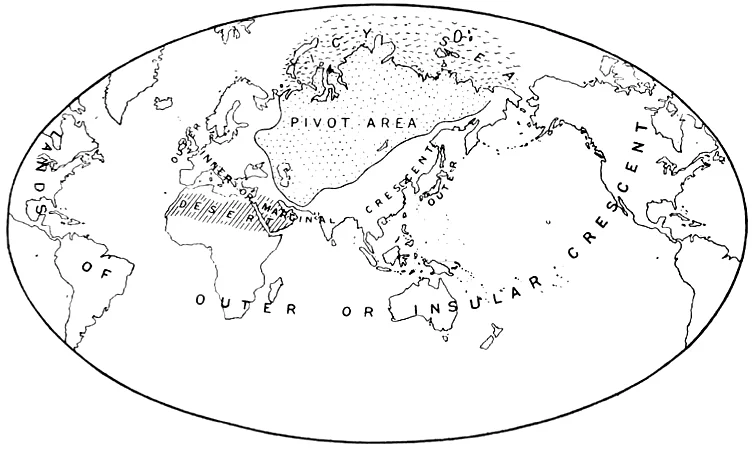
Spykman and the Rimland
Nicholas Spykman, a Dutch-American political scientist at Yale, disagreed with Mackinder. Spykman argued that the coastal ring of Eurasia, which he called the Rimland, mattered more than the interior, and that whoever controlled the Rimland would control access to both the Heartland and the world's oceans. Spykman died in 1943; his book The Geography of the Peace was published posthumously in 1944. His ideas fed into the US Cold War strategy of containment, which ringed the Soviet Union with alliances and bases along the edges of Eurasia.
The ideas that explain most of the news
Chokepoints
A chokepoint is a narrow passage through which ships must pass. About a fifth of the world's oil passed through the Strait of Hormuz before Iran closed it on February 28, 2026. Most of China's imported oil comes through the Strait of Malacca, a strait far from China that its navy cannot easily protect. Before the Houthi attacks on Red Sea shipping, about 12% of global trade passed through the Suez Canal, so when the container ship Ever Given got stuck there for six days in March 2021, hundreds of ships queued at both ends. The chokepoints map shows which ones are open, disrupted or closed.
Balance of power
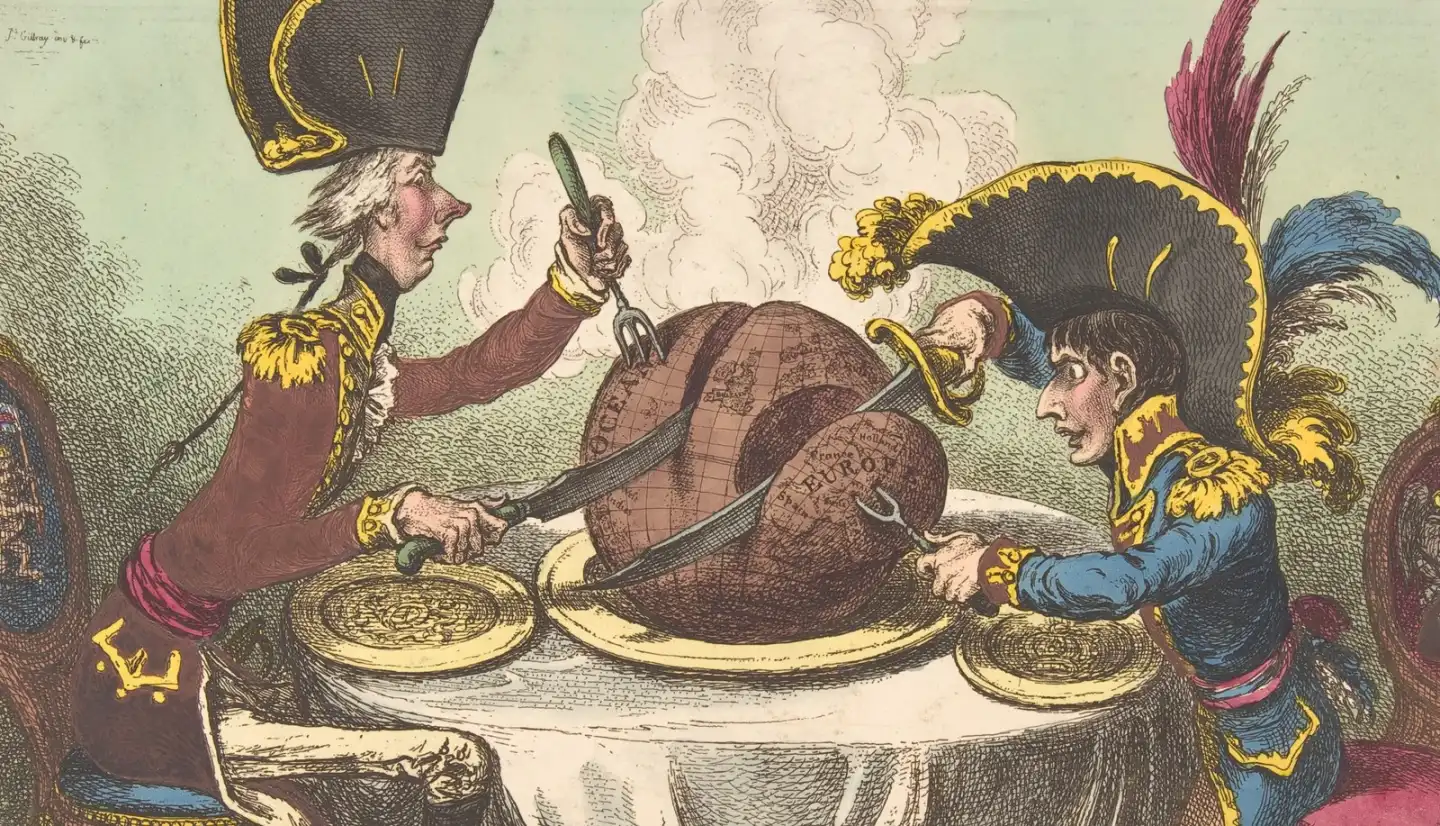
The balance of power is the idea that when one country grows strong enough to dominate the rest, other countries form a coalition to stop it. It explains why European states kept forming coalitions against the strongest power of the day: Habsburg Spain, then France under Louis XIV and Napoleon, then Germany.
The security dilemma
The security dilemma is the trap in which one country's defense looks like a threat to its neighbor. When one side builds more weapons or joins an alliance for protection, the other side feels less safe and arms itself in response, leaving both worse off.
Buffer states and spheres of influence
A buffer state is a small country kept between two larger powers so they do not share a direct border. A sphere of influence is an area where a major power controls other countries' alliances and trade without formally governing them. Russia's view of Ukraine and the former Soviet states fits both concepts.
Soft power
Joseph Nye, a Harvard political scientist, coined the term "soft power" in 1990 to describe a country's ability to influence others through attraction, such as culture, education and political values, rather than through force or money.
Deterrence
Mutually assured destruction is the condition in which both sides of a nuclear standoff can destroy each other even after absorbing a first strike. Many historians see it as the main reason the great powers have not fought a full-scale war against each other since 1945.
Resources and dependence
Countries that control a critical resource hold leverage over those that need it. China refines most of the world's rare earths, the minerals used in electronics, missiles and electric cars. In 2025 China began requiring export licenses for heavy rare earths and the magnets made from them, and its magnet exports fell 76% within two months. The strategic resources pages show who mines, refines and buys eleven of these materials.
Alliances
Formal alliances like NATO commit countries to defend each other, which raises the cost of attacking any one member. The pattern of who allies with whom, and who is left out, shapes nearly every conflict.
- WorldMaritime chokepointsThe narrow straits and canals world trade passes through, and which are open in 2026.
- EncyclopediaBalance of powerWhy countries band together against the strongest state.
- WorldStrategic resources by countryWho mines, refines and depends on oil, rare earths, uranium, lithium and more.
- WorldWorld alliances mapWho is in NATO, BRICS, the EU, the SCO and other blocs, with maps and tables.
Geopolitics, international relations and foreign policy
| What it studies | Typical question | |
|---|---|---|
| Geopolitics | How geography, resources and power shape states' interests and rivalries | Why does China care so much about Taiwan and the South China Sea? |
| International relations | The academic field of how states, institutions and other actors interact, including law, diplomacy, trade and theories such as realism and liberalism | Why do countries cooperate in the UN or the WTO? |
| Foreign policy | What one government decides to do abroad | Should Germany send tanks to Ukraine? |
Geopolitics is a lens inside the broader field of international relations, and it sits closest to the "realist" school associated with thinkers like Hans Morgenthau and, much earlier, Thucydides, the Athenian historian. In his account of the Peloponnesian War, Athenian envoys tell the people of the small island of Melos that "the strong do what they can and the weak suffer what they must." Today the word "geopolitics" is also used loosely, especially in business news, to mean any international politics with high stakes ("geopolitical risk").
Geopolitics in 2026: four examples
The Strait of Hormuz and the 2026 Iran war
Iran closed the Strait of Hormuz on February 28, 2026. Before that day, about a fifth of the world's oil passed through it. The closure immediately affected every country that depends on Gulf oil and gas. By October 2026 tankers were crossing again under US naval protection, while Iran still attacked ships. You can see which countries depend most on Hormuz and read about why the strait is so hard to reopen. Because the strait is only 39 km wide at its narrowest, Iran can threaten it from its own coast.
Taiwan and chips
TSMC makes about 90% of the world's most advanced semiconductors on an island about 130 km from mainland China. If a war or blockade cut off Taiwan's chip production, phone makers, carmakers and AI companies around the world would run short within months. The geography of the Taiwan Strait and the concentration of chipmaking on one island make this one of the highest-stakes geopolitical problems in the world. Read more: Why Taiwan makes the world's chips, What would a Chinese invasion of Taiwan look like?.
Russia and Ukraine
The same flat plain that explains Russia's historic insecurity also explains the war in Ukraine. Ukraine lies on the same open lowlands, southwest of Moscow, and was the largest buffer state between Russia and NATO. When Ukraine agreed in 1994 to give up the world's third-largest nuclear arsenal, it gave up its strongest deterrent in exchange for security assurances that did not stop Russia in 2014 or in 2022.
Critical minerals and rare earths
China controls most of the world's rare earth refining, giving it leverage over the supply chains for electronics, electric vehicles and advanced weapons. Other countries are trying to build alternatives, but mining and refining take years to scale. China has large deposits, but its real advantage is refining, which it built up over decades with state support while other countries left the dirty work to it. See the rare earths resource page.
The limits of geopolitics
Geography sets limits, but people make the decisions. North Korea and South Korea share one peninsula with the same mountains and coasts. Around 1960 South Korea was still poorer than Ghana. Today it is one of the world's largest economies, while North Korea is one of the poorest. The gap between the two Koreas comes from leaders, institutions and choices.
Geopolitics has also been used to justify conquest. Haushofer and the Nazis turned Ratzel's concept of Lebensraum into an argument for invading Eastern Europe. Any framework that says geography determines a country's destiny can be twisted into a claim that expansion is natural and inevitable.
Finally, geopolitics can be too narrow. It tends to underweight ideas, ideology, religion, economics and the role of individual leaders. Good analysts use it as one lens among several.
How to learn geopolitics
The step-by-step guide at How to learn geopolitics lays out a full path, from maps to books to daily reading. A good free starting point is the World Geography Quiz, because geopolitics makes more sense when you know where things are. The World section has country profiles, rankings and resource maps you can browse at your own pace. If you prefer to learn on your phone, there is a separate comparison of the apps worth trying.
Orbis's Geopolitics Foundations course turns the ideas on this page into 12 short lessons, from "What Is Geopolitics?" and "Geography as Destiny" through "The Eight Chokepoints," "The Balance of Power," "Nuclear Deterrence and MAD" and "How Wars Start."