
Disputed territory · Eastern Europe
Russian-occupied Ukraine
Fighting: the front line still moves in DonetskUpdated November 1, 2026
Russia holds about 19% of Ukraine, about 117,000 square kilometers including Crimea, by the count of DeepState, a Ukrainian project that maps the front line. Outside Crimea, which has its own page, Russia holds about 90,000 square kilometers. That includes almost all of the Luhansk region, about 80% of Donetsk, about 76% of Zaporizhzhia and about 72% of Kherson. Russia declared these four regions part of Russia on September 30, 2022. Ukraine and most UN members reject the annexation. In October 2026 the heaviest fighting was on the Pokrovsk and Kostiantynivka fronts in Donetsk.
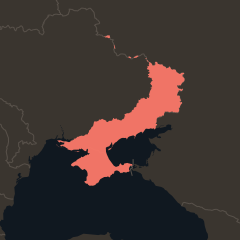
- Russia holds
- ~19%
- of Ukraine, about 117,000 km² with Crimea (DeepState)
- Annexed
- Sep 30, 2022
- Donetsk, Luhansk, Zaporizhzhia and Kherson
- Front line
- ~1,200 km
- of active front, by Ukraine's army chief, 2026
- Children in Russian-run schools
- ~582,000
- in about 2,000 schools, 2025-26 (Almenda Center)
Russian-occupied Ukraine in 30 seconds
- Russia holds almost all of Luhansk, about 80% of Donetsk, about three-quarters of Zaporizhzhia and Kherson, and small parts of four other regions. Crimea, annexed in 2014, has its own page.
- Russia declared the four regions Russian territory on September 30, 2022, after referendums held while its forces controlled them. The UN General Assembly rejected the annexation by 143 votes to 5.
- Russia governs the occupied land as part of Russia. It ties public services to Russian passports, runs about 2,000 schools on a Russian curriculum with no Ukrainian lessons, and held State Duma elections there in September 2026.
- By DeepState's and ISW's counts, Russia's advance slowed sharply in 2026. Putin says Russia took about 6,500 square kilometers this year. On October 21 Zelensky offered to freeze the war on the current line. Three-way talks with the United States are planned for Abu Dhabi after November 4.
How much of Ukraine does Russia control?
Russia holds about 19% of Ukraine's internationally recognized territory. DeepState, a Ukrainian project that maps the front line, put the figure at about 117,000 square kilometers in late October 2026, including Crimea. Outside Crimea, which Russia annexed in 2014 and which has its own page, Russia holds about 90,000 square kilometers.
By region, measured from DeepState's October 30, 2026 map against Natural Earth borders, Russia holds about 98.7% of Luhansk, about 79.7% of Donetsk, about 75.8% of Zaporizhzhia and about 72.1% of Kherson. Russian forces also hold small parts of Kharkiv (about 4.6%), Sumy (about 0.9%), Mykolaiv (the Kinburn spit, about 0.5%) and Dnipropetrovsk (about 0.1%). A gray zone of about 1,700 square kilometers lies between the two sides on DeepState's map.
Before the full-scale invasion of February 24, 2022, Russia-backed forces held about 16,800 square kilometers of Donetsk and Luhansk. In 2025 Russia gained about 4,300 to 4,800 square kilometers, mostly in Donetsk. In 2026 its advance slowed sharply, and Ukrainian counterattacks retook ground. DeepState's totals show a net Russian gain of about 900 square kilometers from January to late October. The Institute for the Study of War (ISW), a US think tank, assessed on October 16 that Russia had taken a net of about 100 square kilometers since January 1. President Putin said Russia had taken about 6,500 square kilometers in 2026.
What Russia holds, by region
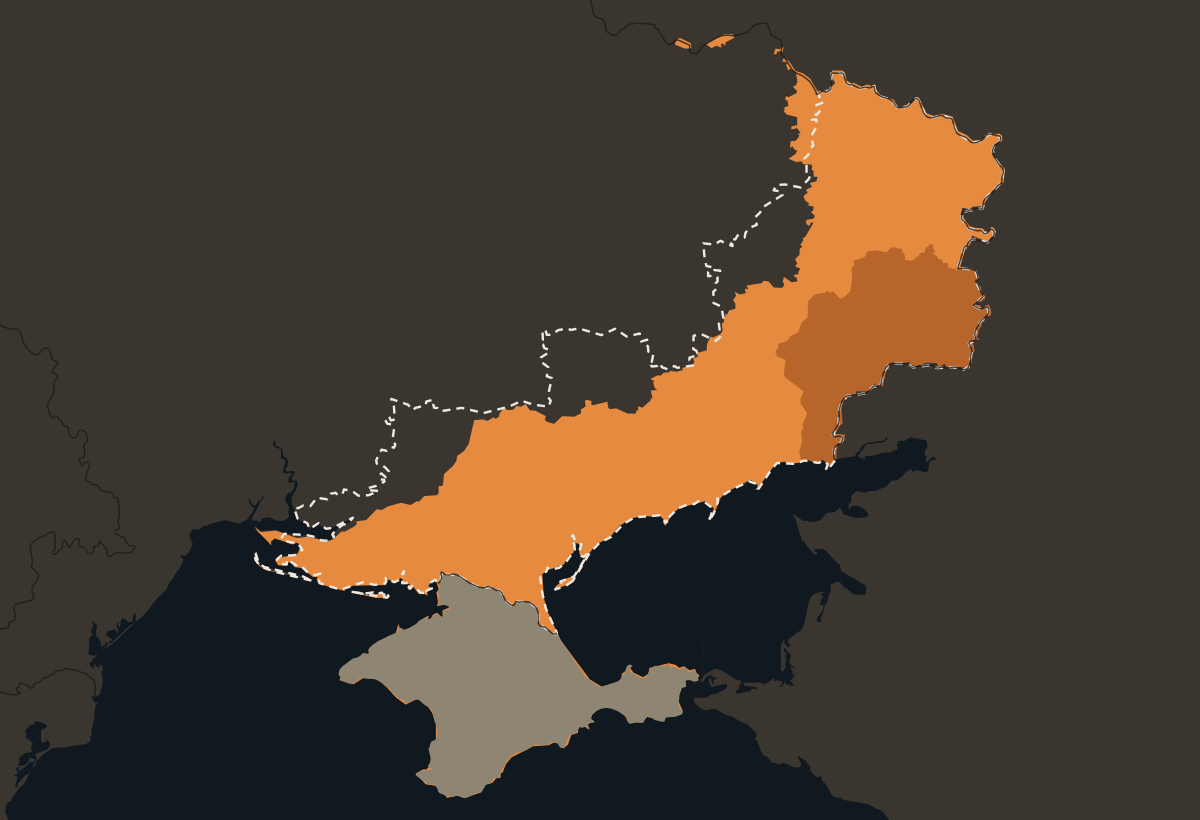 UKRAINE
RUSSIA
CRIMEA
Sea of
Azov DONETSK LUHANSK ZAPORIZHZHIA KHERSON Mariupol Melitopol Kherson Zaporizhzhia Kramatorsk Sloviansk Pokrovsk Kostiantynivka
 Zaporizhzhia
nuclear plant
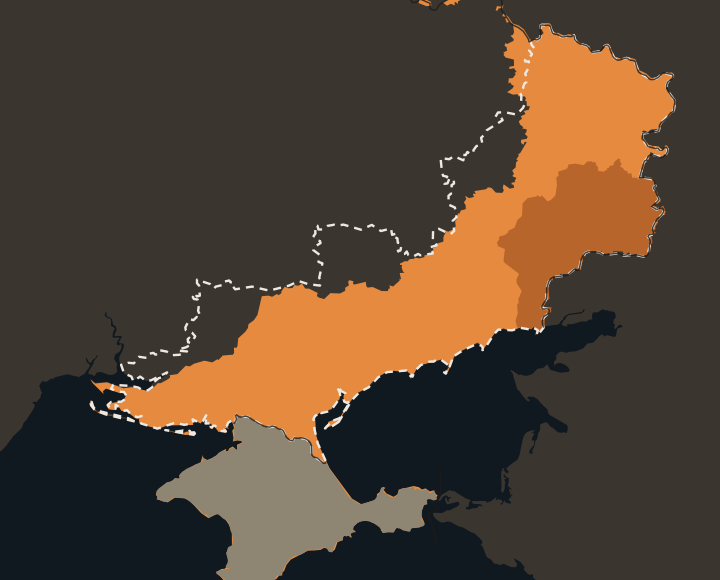 UKRAINE
RUSSIA
CRIMEA
Sea of
Azov DONETSK LUHANSK Donetsk Luhansk Mariupol Kherson Kramatorsk Sloviansk Pokrovsk
Zaporizhzhianuclear plant
How did Russia take eastern and southern Ukraine?
The war in the Donbas began in 2014 after Ukraine's revolution. Russia-backed armed groups seized government buildings in Donetsk and Luhansk and declared "people's republics." Russia said it was protecting Russian speakers after what it called a coup in Kyiv. Ukraine sent its army in what it called an "anti-terrorist operation." Ukraine said Russia sent weapons, fighters and troops. Russia denied it, but the European Court of Human Rights found that Russia had controlled the areas the groups held from May 2014.
The Minsk agreements of 2014 and 2015 reduced the fighting, and each side accused the other of breaking them. By early 2022 the war had killed more than 14,000 people, including about 3,400 civilians, by UN counts.
Russia recognized the two republics on February 21, 2022 and invaded three days later. Putin said he was protecting people who had faced "humiliation and genocide perpetrated by the Kyiv regime." In March 2022 the International Court of Justice said it was "not in possession of evidence substantiating" that claim. Russia besieged Mariupol for 86 days. An air strike on its drama theater killed about 600 civilians, by an AP estimate. Amnesty International found the strike was Russian. Russia blamed Ukraine's Azov regiment.
Ukraine retook most of the Kharkiv region in September 2022 and Kherson city in November. Russia took Bakhmut in May 2023 and Pokrovsk by early 2026.
How Russia took the land
- 2014Russia backs armed groups in Donetsk and Luhansk. Ukraine sends its army. The groups end up holding about 16,800 km².
- 2015The Minsk II agreement reduces the fighting but never stops it.
- Feb 2022Russia invades Ukraine from three directions.
- Mar 2022Russia besieges Mariupol and takes the south, including the Zaporizhzhia nuclear plant.
- Sep 2022Russia holds referendums and declares four regions Russian. The UN General Assembly rejects the annexation.
- Nov 2022Ukraine retakes the city of Kherson. The front settles along the Dnipro.
- 2025Russia advances 4,300 to 4,800 km², mostly in Donetsk.
- 2026Russia's advance slows, by DeepState's and ISW's counts. Fighting centers on the Pokrovsk and Kostiantynivka fronts.
What did Russia do with the annexed regions?
On September 23-27, 2022 Russia held referendums in the parts of Donetsk, Luhansk, Zaporizhzhia and Kherson it controlled. Russian-installed officials said more than 87% voted to join Russia in every region. Ukraine and Western governments call the votes illegal, held at gunpoint and with no credible monitoring. On September 30 Putin signed treaties declaring the four regions part of Russia. He called them "new regions" and said their people had chosen Russia. Russia does not fully control any of the four.
The UN General Assembly rejected the annexation on October 12, 2022, in Resolution ES-11/4. The vote was 143 in favor, 5 against (Russia, Belarus, North Korea, Nicaragua and Syria) and 35 abstentions, including China and India.
Russia governs the four regions as Russian federal subjects, with Russian-appointed heads, police and courts. It held State Duma elections there in September 2026, with voting from late August to September 20. Seven single-member constituencies were drawn in the four regions, and United Russia candidates won all seven. Ukraine and the EU do not recognize the results. Zelensky sanctioned 44 people who helped organize the vote, and on October 12 the EU sanctioned 77.
The UN vote on the annexation, October 12, 2022
What is life like under Russian occupation?
Russia requires residents to take Russian passports to get public services, pensions, health care and proof of property. In March 2025 Russia's interior minister, Vladimir Kolokoltsev, said 3.5 million passports had been issued in the occupied regions. The EU does not recognize them. Since January 20, 2026 a Russian law has required children to hold Russian passports to travel abroad.
About 582,000 children attend roughly 2,000 schools that follow the Russian curriculum, by the count of the Almenda Center, a Ukrainian rights group. Ukrainian was removed as a subject in December 2025. In September 2026 schools added a course on "spiritual and moral culture of Russia" and textbooks on the history of the Donbas and "Novorossiya." Ukraine, rights groups and the EU call this Russification. Russian officials say Russia is rebuilding the regions and that residents have the same rights as other Russian citizens.
In March 2024 the UN human rights office (OHCHR) reported, from more than 2,300 testimonies, that Russia had created "a climate of fear" in the occupied areas. It found that Russian forces arbitrarily detained people they saw as opponents, often with torture, and that some were never seen again. The same report criticized Ukraine for prosecuting as collaborators people who had only kept essential services running under occupation.
Passports
3.5 million
Russian passports issued in occupied Ukraine
Russia's interior minister gave this figure in March 2025. Russia ties pensions, health care and property records to a Russian passport. Ukraine's military intelligence said Russian police raided homes in October 2026 to find people who had refused one.
What happens next?
The United States brokered three rounds of three-way talks with Russia and Ukraine in Abu Dhabi and Geneva in January and February 2026. They stalled over territory. Russia demanded that Ukraine withdraw from the rest of the Donetsk region. Putin's aide Yuri Ushakov said in December 2025, "This area is Russian territory." Ukraine refused. Zelensky said Ukrainians would reject such a deal in a referendum.
On October 21, 2026 Zelensky said Ukraine was ready to freeze the war on the current front line. He said Ukraine would never recognize the occupied land as Russian. Russia has not accepted a freeze. The Kremlin says its terms have not changed since June 2024, when Putin demanded that Ukraine leave all four regions Russia claims and give up joining NATO. On October 27 Zelensky said US proposals had included a demilitarized zone on both sides of the front line in the Donbas.
Also on October 21, US envoy Steve Witkoff met Putin in St. Petersburg. On October 28 Ushakov said three-way talks would take place in Abu Dhabi after November 4. Zelensky said he hoped for talks between November 6 and 10.
A US draft plan from November 2025 accepted Russian control of Crimea and the Donbas in practice, though not in law.
Where each side stands
 UkraineFreeze the war on the current line. Will not recognize the occupation. Wants security guarantees.
- RussiaUkraine must leave all four claimed regions, give up joining NATO and accept limits on its army. In talks, Russia has pressed above all for the rest of Donetsk.
 United StatesBrokering three-way talks. A 2025 draft accepted Crimea and the Donbas as Russian in practice.
What is at stake in occupied Ukraine?
People
Several million Ukrainian citizens live under Russian control. Human Rights Watch estimates that about 1.6 million children remain in occupied Ukraine. Russia issues residents passports, conscripts men of military age and teaches children the Russian curriculum. In March 2023 the International Criminal Court issued arrest warrants for Putin and his children's commissioner, Maria Lvova-Belova, for the unlawful deportation of children from occupied areas to Russia. Russia rejects the court's authority. Ukraine says it will not abandon the people who stayed.
Industry
The Donbas was Ukraine's industrial heartland. Its coal mines, steel mills and chemical plants made up a large share of Ukraine's economy before 2014. Most of the industry in Russian-held areas has stopped or been taken over.
A nuclear plant
The Zaporizhzhia nuclear power plant, Europe's largest, has been under Russian control since March 2022. Its six reactors are shut down. The IAEA monitors it. Both sides accuse the other of endangering it.
Questions about Russian-occupied Ukraine
How much of Ukraine does Russia occupy?
About 19%, or roughly 117,000 square kilometers, by DeepState's count in late October 2026. That includes Crimea (about 27,000 square kilometers), almost all of Luhansk, about 80% of Donetsk, and about three-quarters of the Zaporizhzhia and Kherson regions. Small parts of Kharkiv, Sumy, Mykolaiv and Dnipropetrovsk are also held.
Does anyone recognize Russia's annexation?
Very few countries do. The UN General Assembly rejected it by 143 votes to 5 on October 12, 2022. Only Russia, Belarus, North Korea, Nicaragua and Syria voted against the resolution. China and India abstained. The European Union, the United States, the G7 and most of the world do not recognize the four regions as Russian.
What happened at the Zaporizhzhia nuclear plant?
Russian forces took the Zaporizhzhia nuclear power plant on March 4, 2022. It is Europe's largest nuclear plant, with six reactors. All six are shut down. The IAEA has kept monitors there since September 2022. Fighting has cut the plant's outside power more than 20 times, and it has relied on diesel generators for cooling. Russia and Ukraine accuse each other of attacks near the plant.
What are the Donetsk and Luhansk People's Republics?
In 2014 armed groups backed by Russia declared "people's republics" in parts of the Donetsk and Luhansk regions. Russia recognized them as independent states on February 21, 2022, three days before the full-scale invasion. On September 30, 2022 Russia declared both regions, along with Zaporizhzhia and Kherson, part of Russia. Russia appointed governors to run them as Russian federal subjects. Ukraine and most of the world still consider them occupied Ukrainian territory.
Can Ukrainians leave the occupied areas?
It is difficult. There is no open crossing over the front line. Most people who leave travel through Russia to a third country, such as Georgia or the Baltic states, and from there to Ukraine. The last direct crossing from Russia into Ukraine, in the Sumy region, closed in August 2024. Since January 2026 Russian law has required children to hold Russian passports to travel abroad.