
Why China and the Soviet Union became enemies
In 1950 they signed an alliance to build communism together. By 1969 they were shooting at each other on a frozen river. The split reshaped the Cold War and still defines the limits of the China-Russia partnership.
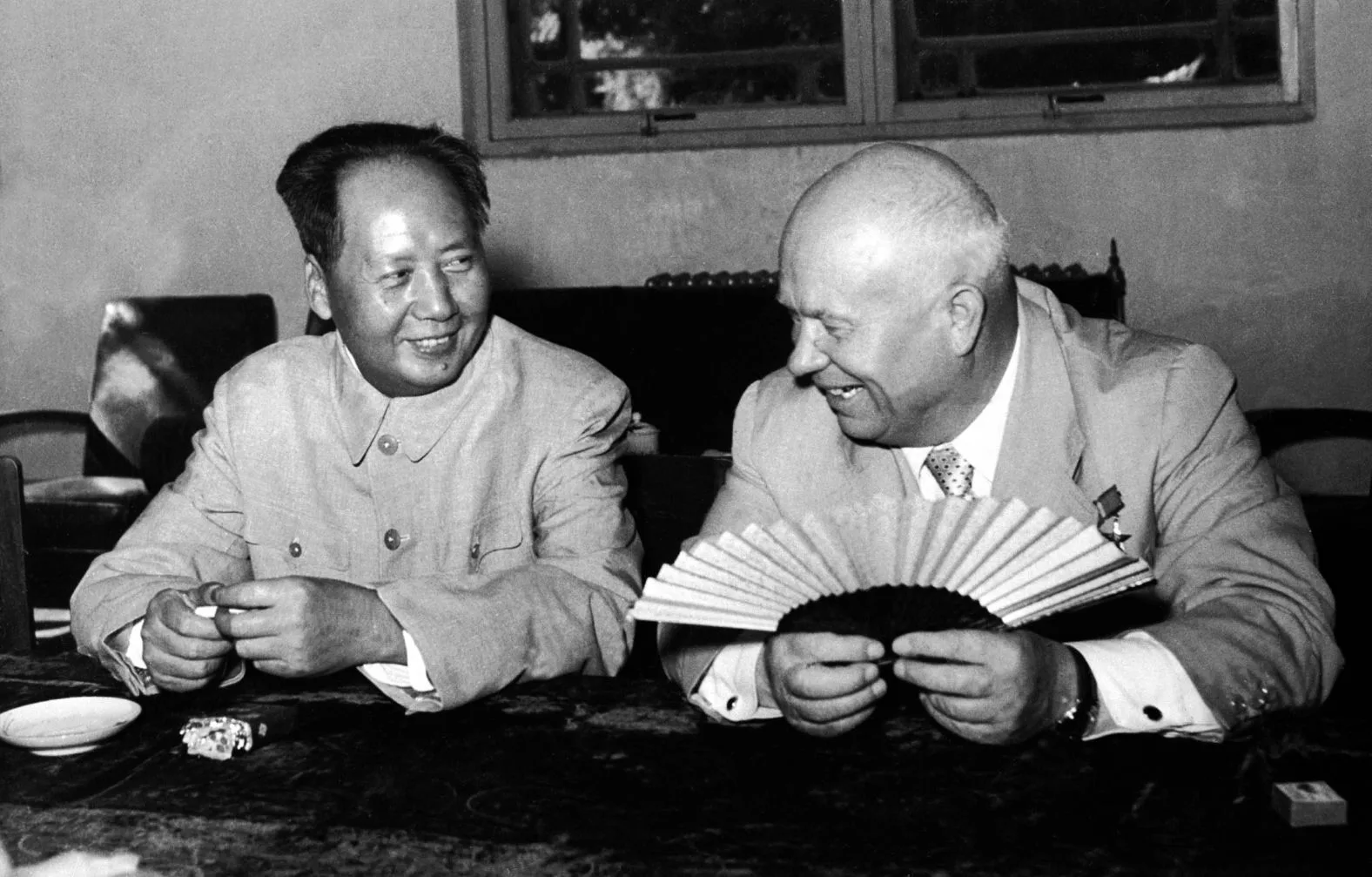
On March 2, 1969, Chinese soldiers opened fire on Soviet border guards on Zhenbao Island, a frozen sandbar in the Ussuri River between Manchuria and the Soviet Far East. The Soviets sent in reinforcements with armored vehicles. Over the next two weeks the two sides fought several engagements that killed dozens of soldiers on each side. Soviet military planners discussed launching a preemptive nuclear strike on China's nuclear facilities before they could grow any larger.
Twenty years earlier, Mao Zedong and Joseph Stalin had signed a treaty of friendship and alliance. China and the Soviet Union were the two largest communist states on Earth, bound by ideology, military cooperation, and thousands of Soviet advisors working in Chinese factories. By 1969 they were closer to nuclear war with each other than either had ever come with the United States.
How the alliance started
When Mao's communists won China's civil war in 1949, the Soviet Union was the first country to recognize the new government. In December of that year Mao traveled to Moscow to meet Stalin. It was the first time he had ever left China.
The visit was not friendly. Stalin had spent most of the civil war hedging his bets, offering more support to Chiang Kai-shek's Nationalists than to Mao's communists. Now that Mao had won anyway, Stalin treated him as a junior partner and kept him waiting in a government dacha outside Moscow for about two months while he dragged out negotiations. Stalin was stalling because the old treaty gave the Soviet Union port access and railway rights in Manchuria, and he did not want to give them up. Mao, who had fought a decades-long revolution to end exactly this kind of foreign privilege in China, was furious. He told people he had nothing to do in the dacha but eat, sleep, and shit. But the two sides eventually signed the Sino-Soviet Treaty of Friendship, Alliance, and Mutual Assistance in February 1950, and what followed was the closest thing to a communist Marshall Plan. The Soviet Union sent China thousands of technical advisors, helped design and build entire factories, and gave Mao's government its first modern industrial base. By the mid-1950s more than 10,000 Soviet experts were working across China, building everything from steel plants to the bridge over the Yangtze at Wuhan.
The arrangement had a clear hierarchy. Moscow led the communist world. Beijing followed. When North Korea invaded South Korea in 1950, China sent hundreds of thousands of soldiers to fight the American-led coalition while the Soviet Union provided weapons and air cover behind the scenes. As long as both sides accepted their roles, the alliance worked.
Why Mao turned against Moscow
The turning point was a speech. In February 1956, the Soviet leader Nikita Khrushchev stood before a closed session of the Soviet Communist Party congress and denounced Stalin. He called Stalin a tyrant who had murdered loyal communists, built a cult of personality, and nearly lost the war against Nazi Germany through his own paranoia. The speech was meant to stay inside the room. It leaked within weeks.
Mao was furious. He had modeled his own rule on Stalin's. He had purged rivals, launched mass campaigns, and built exactly the kind of personal authority that Khrushchev was now calling a crime. If denouncing a cult of personality was the new party line in Moscow, Mao's own position looked like the next target.
The argument was also about strategy. Khrushchev believed nuclear weapons made war with the West too dangerous, and that communism should win through economic competition rather than confrontation. Mao thought this was cowardice. At a 1957 meeting of communist leaders in Moscow, Mao told the room that even if a nuclear war killed 300 million Chinese, another 300 million would survive and build socialism on the ruins. The delegates sat in silence. Khrushchev, who had lived through the Second World War, found it genuinely frightening.
The personal dislike between the two leaders made everything worse. When Khrushchev visited Beijing in 1958, Mao held their meetings at a swimming pool. Mao was a strong swimmer who spent hours in the water as a point of pride. Khrushchev could barely swim and had to paddle around in inflatable water wings while Mao did laps beside him. Khrushchev understood the humiliation and never forgot it.
In 1959, the Soviet Union tore up its agreement to help China build a nuclear bomb and pulled out its nuclear advisors. The following year Moscow recalled all of its technical experts from China, more than a thousand of them, and took their blueprints with them. Factories went unfinished. Projects stopped mid-construction. The alliance was over in all but name.
The border war of 1969
Through the 1960s the break only deepened. The two parties published open letters attacking each other's ideology. They competed for the loyalty of communist movements across Asia, Africa, and Latin America. Inside China, Mao's fear that his own party would turn Soviet fed into the Cultural Revolution, which he launched in 1966. And the border became a military problem. China and the Soviet Union shared more than 4,000 miles of frontier, much of it drawn by treaties that Beijing called relics of nineteenth-century imperialism, signed when China was too weak to resist.
The fighting on Zhenbao Island in March 1969 turned a political split into a military crisis. It was the first time two nuclear-armed states had exchanged fire directly. The clashes were small in scale, a few hundred soldiers on each side, but the consequences were enormous. Soviet commanders discussed destroying China's nuclear program with a preemptive strike before it grew any larger. They sounded out the United States about how Washington would respond. The Americans told them not to do it.
The crisis ended in negotiation, but neither side pulled its troops back. For the next twenty years the Soviet Union kept roughly forty divisions, more than 300,000 soldiers, stationed along the Chinese border. China kept a similar force on its side. Two countries that had signed a friendship treaty in 1950 were now each other's primary military threat.
How the United States exploited the split
The split between Beijing and Moscow was the single biggest strategic gift the Cold War handed to Washington, and American policymakers almost missed it. For most of the 1960s the United States treated the communist world as a single bloc. It took Richard Nixon, of all people, the most famous anti-communist in American politics, to see what the split made possible.
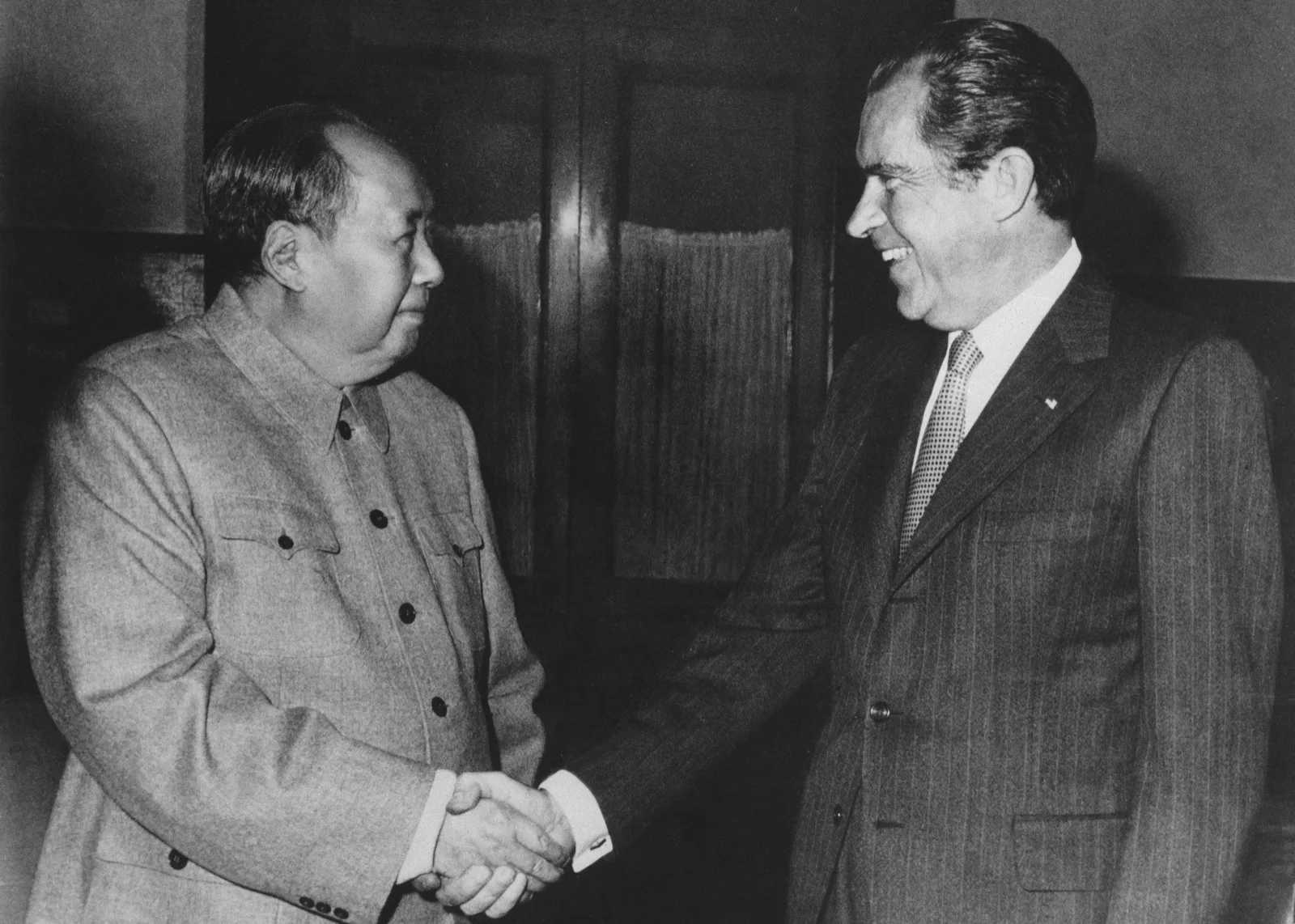
In 1971, Nixon's national security advisor Henry Kissinger flew to Beijing in secret. In February 1972 Nixon followed him, the first American president to visit China. Mao Zedong, who had spent two decades calling the United States the greatest enemy of the world's peoples, shook Nixon's hand in front of the cameras. The two countries did not become allies. But they now had a shared interest in containing Soviet power, and that was enough.
The result was devastating for Moscow. The Soviet Union went from facing one superpower rival to facing two, one in Europe and one in Asia, and had to spend money and troops defending both frontiers at once. This strategic overstretch is one of the pressures that wore the Soviet economy down through the 1980s and contributed to the Soviet collapse in 1991.
Why the split still shapes China and Russia
After the Soviet Union fell, China and Russia slowly rebuilt their relationship. The Chinese Communist Party also spent years studying why the Soviet Union fell, so that China would not follow it. Deng Xiaoping had already begun normalizing ties in the late 1980s. By the 2000s the two countries had settled their border disputes, started trading energy and weapons, and began voting together at the United Nations Security Council to block Western-backed resolutions.
Since Russia's full-scale invasion of Ukraine in 2022, the partnership has deepened further. China buys Russian oil at a discount. Russia buys Chinese electronics and industrial goods. Xi Jinping and Vladimir Putin have met more than forty times and call each other close friends.
But the history of the split sits underneath all of it. China and Russia have no mutual defense treaty. They share no ideology and no institutions beyond occasional joint military exercises. Their partnership rests on a shared interest in pushing back against American power. If that interest changes, there is nothing deeper holding it together. Beijing and Moscow were allies once before, when they shared both an ideology and a common enemy. It lasted less than a decade.
Test what you learned
5 questions on this article. About two minutes, no signup.