
How China's century of humiliation shaped the country it is today
In 1820, China produced a third of global output. The century of humiliation, a hundred years of lost wars and foreign occupation, left it among the poorest countries on earth.
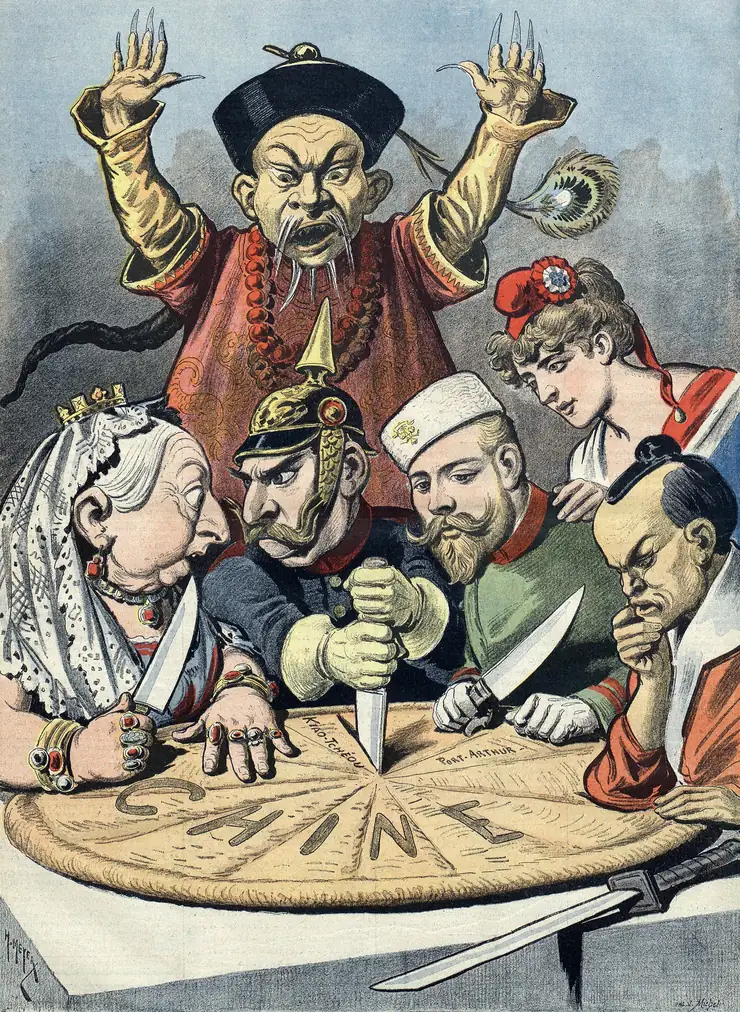
In 1820, China produced roughly a third of the world's economic output, more than all of Western Europe combined. The Chinese called their country Zhongguo, the Central Kingdom, and the name was not just a label. For most of the previous two thousand years, China had been the largest or second-largest economy on earth. Just four centuries earlier, it had built the largest ocean-going fleet the world had ever seen and sailed it to Africa. By 1949, China's share of global output had fallen below 5 percent. Foreign armies had occupied its capital more than once, foreign powers controlled its customs revenue, and its territory had been divided into spheres of influence claimed by Britain, France, Germany, Russia, Japan, and the United States.
The Chinese call that era 百年国耻, bainian guochi: the century of national humiliation. It runs from the First Opium War in 1839 to the founding of the People's Republic in 1949, and the government in Beijing has built much of its politics around the promise that the country will never be that vulnerable again.
How Britain forced the door open
The crisis began with tea. By the late 1700s, Britain was importing large quantities of Chinese tea, silk, and porcelain, but China wanted almost nothing Britain made. Silver flowed east year after year. The solution British merchants found was opium, grown in India and shipped to southern Chinese ports through the East India Company's network. By the 1830s, an estimated two million Chinese were addicted, and the silver flow had reversed.
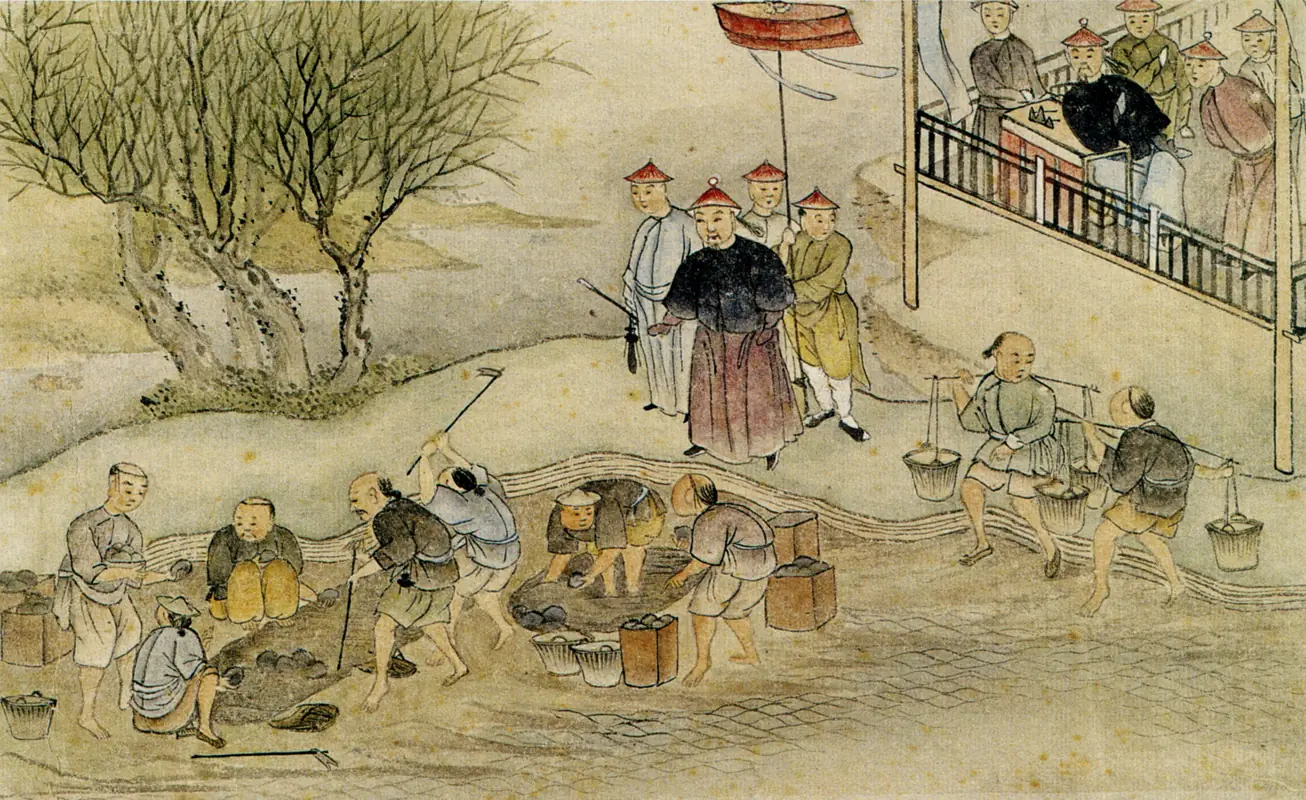
In 1839, the Qing emperor sent a senior official named Lin Zexu to Canton to stop the trade. Lin was a career civil servant who had risen through the imperial examination system and had a reputation across the bureaucracy for being impossible to bribe. He confiscated and destroyed more than 20,000 chests of British opium, roughly 1,400 tons, by dissolving it in trenches of lime and salt water and flushing the remains into the sea. He also wrote a letter to Queen Victoria asking how a country that banned opium at home could justify selling it abroad. The letter was never delivered. Lord Palmerston, the British foreign secretary, refused to receive the messenger. It was eventually published in The Times instead. Lin himself was rewarded for his work by being blamed for the war that followed. The Qing court exiled him to the northwestern frontier.
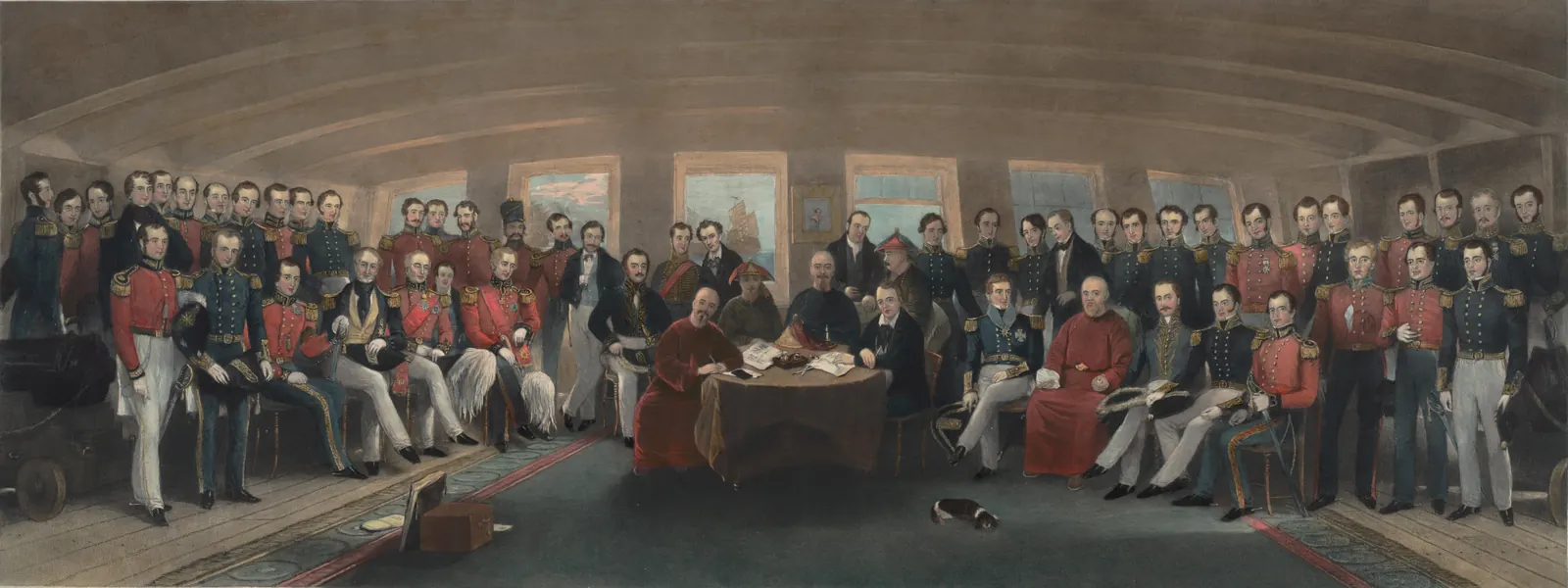
Britain's response was warships. The First Opium War lasted three years, and it was not a close fight. The Royal Navy's iron-hulled steamships outclassed everything the Qing had. The Treaty of Nanjing in 1842 forced China to cede Hong Kong to Britain outright, open five ports to foreign trade, and pay 21 million silver dollars in reparations. It was the first of what the Chinese call the unequal treaties. Over the next six decades, China signed dozens more.
How every major power took a piece
The pattern the Opium Wars set repeated for sixty years: a foreign power made a demand, China resisted, the foreign power won the war, and a treaty stripped away another piece of Chinese sovereignty.
In 1860, after winning the Second Opium War, British and French troops reached Beijing. French soldiers looted the Old Summer Palace, a complex of gardens, temples, and libraries that the Qing court had built over more than a century. Then the British commander, Lord Elgin, ordered the entire complex burned to the ground. His stated reason: Qing officials had seized 39 British, French, and Indian prisoners under a truce flag, and several had died in custody from torture. The fire lasted three days. The ruins stand in northwest Beijing today, deliberately left unrepaired.
During the same decades, China fought the deadliest civil war in recorded history. The Taiping Rebellion, led by a failed examination candidate who believed he was the brother of Jesus Christ, lasted from 1850 to 1864 and killed an estimated 20 to 30 million people.
But the most damaging defeat came from a country the Chinese had spent centuries treating as a cultural younger sibling. Western military observers expected China to win the Sino-Japanese War of 1894. China had 350 million people to Japan's 40 million, and its Beiyang Fleet included German-built ironclad battleships carrying 12-inch Krupp guns. At the Battle of the Yalu River on September 17, 1894, the two navies fought for five hours. Japan lost no ships, and China lost five of its ten warships. Captain Deng Shichang of the cruiser Zhiyuan attempted to ram a Japanese warship; his ship was sunk by torpedoes before it could close the distance. After the remaining fleet was destroyed at Weihaiwei the following February, the Chinese admiral, Ding Ruchang, was offered asylum by the Japanese commander. He refused and killed himself with an overdose of opium. The Treaty of Shimonoseki in 1895 forced China to cede Taiwan to Japan and pay a massive indemnity.
Foreign troops in Beijing and the end of the empire
In 1900, a Chinese militia movement called the Boxers attacked foreign residents across northern China and besieged the diplomatic quarter in Beijing. An army from eight countries, including Britain, France, Germany, Russia, Japan, and the United States, invaded and occupied the Chinese capital. The Boxer Protocol imposed an indemnity of 450 million taels of silver on China, one tael for every person in the country, equivalent to roughly $335 million in gold at the time. With interest over 39 years, the total came to nearly a billion taels. By then, more than 70 Chinese ports were open to foreign trade, and foreign citizens in those ports lived beyond the reach of Chinese law, tried instead in their own countries' consular courts.
The Qing dynasty fell in 1912, but the humiliation did not end with the empire. In 1915, Japan issued the Twenty-One Demands, a set of ultimatums that would have made China a Japanese protectorate. The public outrage was intense enough that Chinese nationalists declared a National Humiliation Day. In 1931, Japan invaded Manchuria. In 1937, it invaded China itself. Japanese troops killed tens of thousands of civilians and prisoners of war in the capital, Nanjing, in what became known as the Nanjing Massacre. The war lasted eight years and killed millions. When Japan surrendered in 1945, China's government and its communist opposition immediately turned on each other. The civil war that followed lasted four years and ended with Mao Zedong's communists driving Chiang Kai-shek and the Kuomintang to Taiwan.
On September 21, 1949, days before proclaiming the People's Republic, Mao told the Chinese People's Political Consultative Conference: "The Chinese people have stood up."
How China's government uses the century of humiliation today
Mao's sentence marked the end of a hundred years of foreign domination. What happened to the story afterward is the part most accounts of this period skip.
Under Mao, the Communist Party told a different founding story. It was about class struggle: workers and peasants overthrowing landlords and capitalists, not a nation of victims resisting foreign powers. The century of humiliation was in the background, but it was not the central narrative.
That changed after 1989. After the Tiananmen Square protests and the collapse of the Soviet Union, the Party needed a new basis for its authority. In 1991 it launched the Patriotic Education Campaign, rewriting school textbooks across the country to center modern Chinese history on the century of humiliation. Under Xi Jinping, the project has gone further. A 2023 law mandates patriotic education in schools, workplaces, and religious organizations. Xi's most repeated political goal, the "great rejuvenation of the Chinese nation," is defined explicitly as the reversal of the century of humiliation.
The narrative is selective. Russia seized more than 1.5 million square kilometers of Chinese territory during this period, an area larger than France and Germany combined. That fact is largely absent from the textbooks, because Russia is now a strategic partner. Taiwan, which Japan took from China in 1895 and which a separate Chinese government has controlled since 1949, remains at the center of the story.
The nationalism the campaign created is genuine but not always controllable. In 2012, when China and Japan clashed over disputed islands, anti-Japanese protests broke out in more than a hundred Chinese cities. Demonstrators smashed Japanese cars and storefronts. The government had to arrest its own protesters before the anger turned on Beijing itself for being too weak.
The century of humiliation is real history. The wars happened, the treaties were forced, and the economic collapse was enormous. It is also the most powerful political tool the Communist Party has. The ruins of the Old Summer Palace still stand in northwest Beijing, fenced off and labeled a patriotic education base: a reminder of what happened when China was weak, and an argument for the people who say they will keep it strong.
Test what you learned
6 questions on this article. About two minutes, no signup.