
Why Thailand keeps overthrowing its own democracy
Thailand has had 13 successful coups and 20 constitutions since 1932. The cycle is about a three-way contest for power no election has resolved.
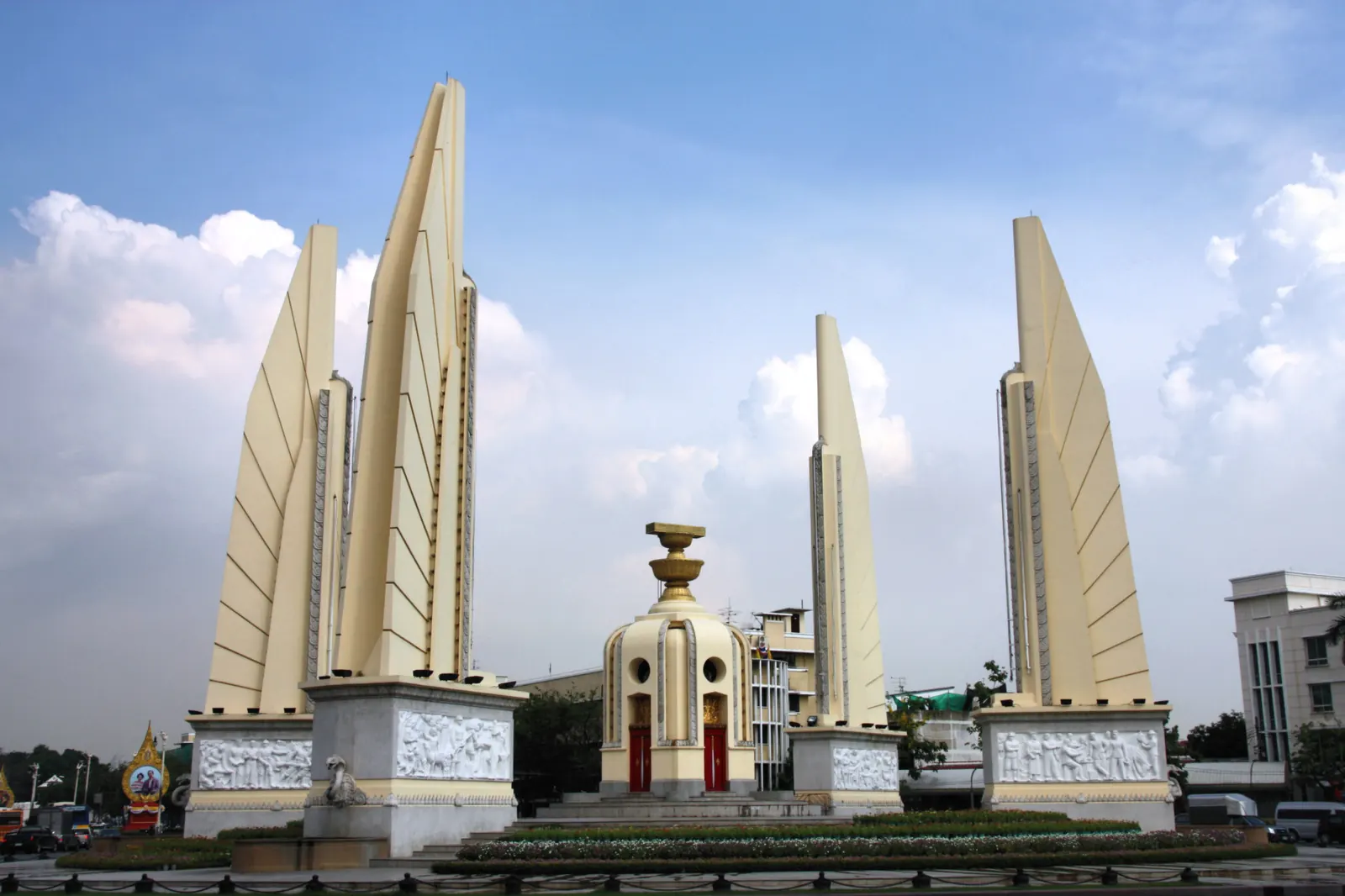
Thailand holds elections. The elections produce governments. The military removes those governments. A new constitution is written. Elections are held again. Since 1932, this cycle has produced 13 successful coups and 20 constitutions, more than any country in Asia and more than almost any country on Earth. The average Thai constitution lasts four years and three months. The most recent one, written after the 2014 coup, was designed specifically to keep the wrong people from winning power even if they won the most votes. It worked.
Other countries have coups. But most of them stop after one or two, either because democracy takes hold or because one strongman stays. Thailand does something different. It coups, holds elections, then coups again, and it has been doing it for nearly a century. The interesting part is not why a particular general seized power on a particular date. It is why the pattern never breaks.
A revolution that never finished
Thailand was never colonized, a fact Thais are rightly proud of and one that matters here. When the absolute monarchy fell in 1932, it was not thrown out by a foreign power or a mass uprising. A small group of about a hundred military officers and civilian intellectuals, calling themselves the Khana Ratsadon (the People's Party), staged a bloodless takeover while King Prajadhipok was at his summer palace. The king agreed to become a constitutional monarch. No one died.
The group's leading civilian, Pridi Banomyong, had studied law in Paris and wanted something like a European social democracy. The leading soldier, Plaek Phibunsongkhram, wanted a strong nationalist state closer to the model Japan was building. Within a few years the soldiers won that internal argument, and Phibun, as he was known, ran Thailand for most of the next two decades. Pridi was eventually forced into exile in China, where he spent the rest of his life.
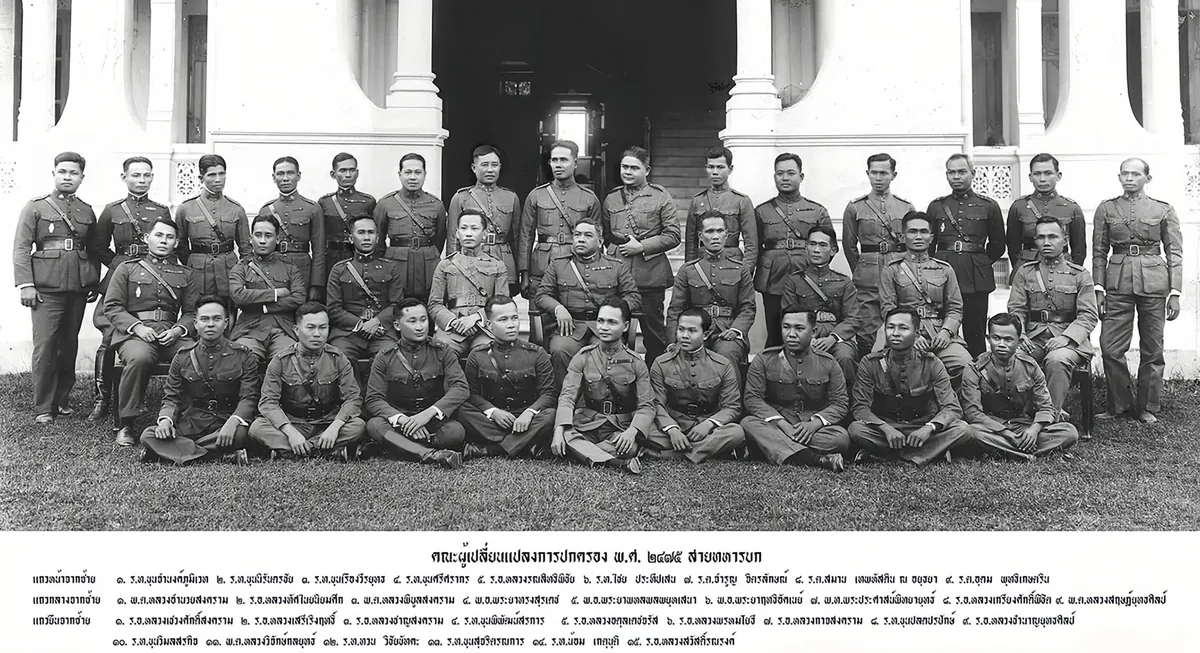
That early split set the template. The 1932 revolution replaced the king's absolute power but never settled who would get it instead. Civilians claimed a mandate from elections. The military claimed a duty to protect the nation. The monarchy, stripped of formal authority, rebuilt its influence quietly over decades. These three centers of power have competed for control ever since, and every Thai coup is a moment when one of them seizes it.
The monarchy's long game
The key to Thailand's cycle is the institution most countries would call a figurehead. King Bhumibol Adulyadej, Rama IX, took the throne in 1946 at age 18, after his older brother was found shot dead in the palace under circumstances that have never been officially resolved. Over the next seven decades, Bhumibol became the most powerful unelected figure in Thai politics.
He did it slowly. In the 1950s and 1960s, military strongmen ran the country and let the king have the ceremonial role. Bhumibol used that space to build a personal connection with rural Thailand, traveling to remote provinces, funding development projects, and cultivating an image of the king as father of the nation. Thailand's lese majeste law, Section 112 of the criminal code, made it a crime punishable by up to 15 years in prison to criticize him. Public discussion of the monarchy's political role became effectively impossible.
The result was a system scholars call "network monarchy." Bhumibol did not give orders the way an absolute king would. Instead, he worked through proxies: the Privy Council, trusted generals, the courts. His interventions were felt rather than announced. In 1973, student protests forced out a military dictatorship, and the king visibly sided with the students. In 1992, the army killed dozens of protesters in Bangkok during the crisis known as Black May. The king summoned both the protest leader and the military prime minister, General Suchinda Kraprayoon, to kneel before him on live television. Suchinda resigned. The moment cemented the idea that the king stood above politics, even as it showed he was at the center of it.
The Thaksin problem
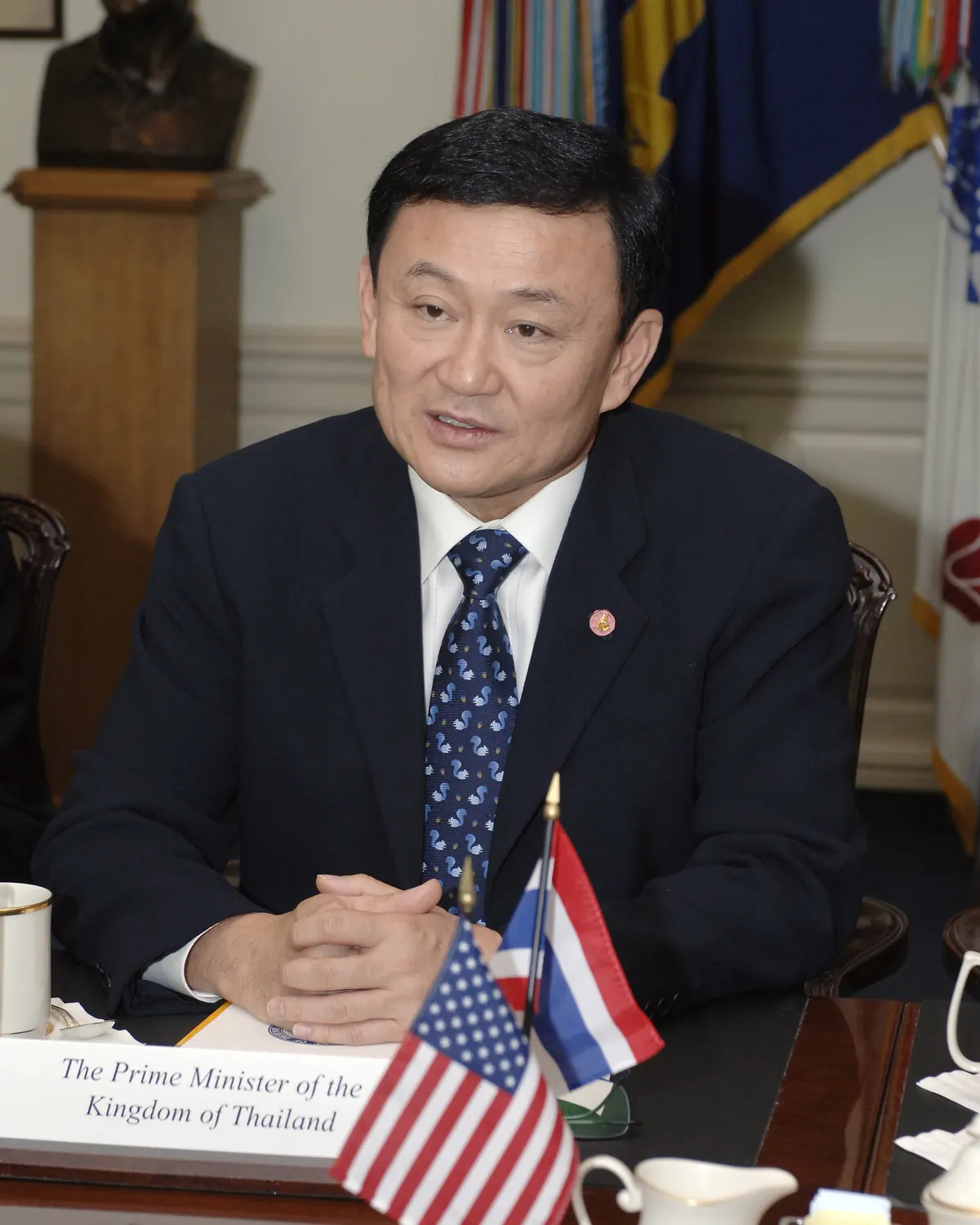
The cycle accelerated because of one person. Thaksin Shinawatra was a telecommunications billionaire who entered politics in the late 1990s and became prime minister in 2001. He was the first Thai prime minister ever to serve a full term and win re-election, and he did it by doing something no previous government had tried at that scale: he spent money on the rural poor. Universal healthcare for 30 baht (less than a dollar), village development funds, cheap agricultural loans. The programs were popular because they delivered things people could see.
For the Bangkok establishment (the military, the monarchy, the old bureaucracy) Thaksin was a threat unlike any they had faced. Previous elected governments had been weak coalitions, easy to topple or co-opt. Thaksin had his own money, his own base, and enough votes to keep winning. In 2006, the military removed him while he was at the United Nations in New York. He has lived mostly in exile ever since, though his influence over Thai politics has never stopped.
The pattern after 2006 is where the cycle becomes almost mechanical. Thaksin's allies won the next election. The courts dissolved their party. His allies regrouped, won again. The courts removed their prime minister. In 2010, Thaksin's supporters, the Red Shirts, occupied central Bangkok for weeks demanding new elections. The army cleared them out, killing more than 90 people, mostly civilians. In 2011, Thaksin's younger sister Yingluck Shinawatra won a landslide. In 2014, the military removed her too. General Prayuth Chan-ocha, who led that coup, ran the country for nine years.
A constitution built to prevent democracy
Prayuth's junta wrote Thailand's 20th constitution in 2017, and it is a remarkable document. It created a 250-member Senate entirely appointed by the military. That Senate could vote alongside the 500-member elected House to choose the prime minister. In practice, this meant a party needed to win roughly 376 of 500 House seats to overcome the Senate bloc, a near-impossible threshold. The constitution also gave the courts sweeping power to dissolve political parties and ban their leaders.
In 2023, the system produced exactly the result it was designed to prevent and then corrected for it. The Move Forward Party, led by a young businessman named Pita Limjaroenrat, won the most seats on a platform that included reforming the lese majeste law. The appointed Senate blocked Pita from becoming prime minister. The Constitutional Court then dissolved Move Forward entirely, ruling that its campaign to reform Section 112 was an attempt to undermine the monarchy. Pita and the party's executives were banned from politics for ten years.
The party that eventually formed the government was Pheu Thai, the latest vehicle of the Shinawatra family. Thaksin himself flew home from exile in August 2023, was briefly imprisoned, and was pardoned by the king. His youngest daughter, Paetongtarn Shinawatra, became prime minister in 2024 at age 37. In August 2025, the Constitutional Court removed her too, over a leaked phone call with Cambodia's Hun Sen during a border dispute. She was the fifth Thai prime minister removed by the courts since 2008.
The pattern in 2026
After Paetongtarn's removal, the conservative Bhumjaithai Party's leader Anutin Charnvirakul became prime minister and called a snap election in February 2026 during a wave of nationalism over the Cambodian border crisis. Bhumjaithai won 192 seats. The People's Party, successor to the dissolved Move Forward, won 120. Pheu Thai collapsed to 74.
Thailand's current government is the establishment's cleanest win in years. But the underlying arithmetic has not changed. The country's youngest voters still overwhelmingly support the reformist camp. The lese majeste law remains untouchable: in August 2026, a court sentenced an intellectually disabled man to three years in prison under Section 112. The military has not seized power since 2014, but the courts have removed five prime ministers in the years since, which raises a question about whether Thailand has replaced coups with something quieter that does the same job.
The pattern holds because the triangle holds. Elections give legitimacy to whoever can win the most votes. The military and the courts take it away when the winner threatens the monarchy or the establishment that surrounds it. Twenty constitutions have been written to solve this, and none of them have, because the problem is not the rules. The problem is that the three most powerful forces in Thai politics have never agreed on who gets the final say. Until they do, the cycle has no reason to stop.
Test what you learned
5 quick questions on this article. No signup, just you against the text.