
Potsdam Conference
The Potsdam Conference was the last meeting of the Allied leaders of World War II, held in July 1945 to decide the future of defeated Germany.
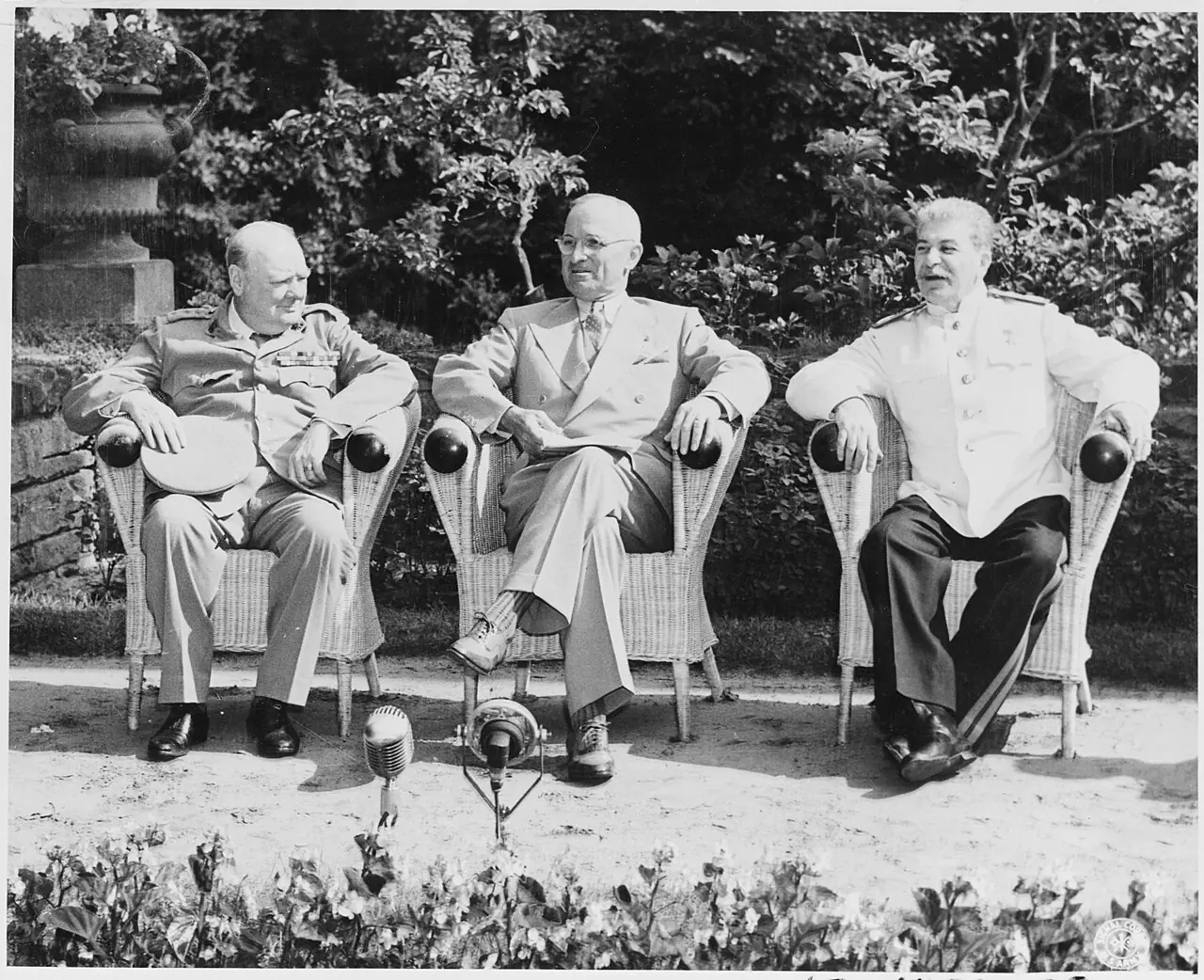
The Potsdam Conference was the last of three wartime summits between the leaders of the United States, the Soviet Union, and Britain. It ran from July 17 to August 2, 1945, at the Cecilienhof palace in Potsdam, just outside a Berlin that had been reduced to rubble. Harry Truman represented the United States, Joseph Stalin represented the Soviet Union, and Winston Churchill represented Britain, though Churchill was replaced partway through. The three powers had fought together to defeat Nazi Germany, but at Potsdam they were already arguing over what to do with the victory. The conference confirmed Germany's division into occupation zones, redrew Poland's borders, and demanded Japan's surrender. Most of what shaped European politics for the next four decades was either settled or left unresolved during these two weeks.
How the Potsdam Conference played out
The leaders at the table were not the same ones who had met five months earlier at the Yalta Conference. Franklin Roosevelt had died in April. Truman had taken his place after serving as vice president for only eighty-two days. He knew nothing about the Manhattan Project, America's atomic bomb program, until after he took office. He was more suspicious of the Soviets than Roosevelt had been.
Churchill attended the opening sessions, but on July 26 the results of Britain's general election came in. The Labour Party won. On July 28, the new prime minister, Clement Attlee, took Churchill's seat at the conference. Stalin was the only leader from Yalta present for the entire two weeks. He was also the only one whose army occupied Eastern Europe.
The atomic bomb shaped the conference without ever being formally discussed. The Trinity test, the first detonation of a nuclear weapon, had succeeded on July 16, one day before the conference began. On July 24, Truman told Stalin that the United States had developed "a new weapon of unusual destructive force." He said it casually, as if it were a small matter. Stalin said only that he was glad to hear it and hoped the weapon would help end the war with Japan. He showed no surprise. Soviet spies had been reporting on the bomb program for years, and Stalin had known about it longer than Truman had.
What was decided at the Potsdam Conference?
The conference's main decisions concerned Germany. The Allies agreed that Germany would remain a single economic unit but would be divided into four occupation zones, one each for the United States, the Soviet Union, Britain, and France. An Allied Control Council would govern the country. Allied policy called for demilitarizing Germany, removing former Nazis from public life, building democratic institutions, breaking up centralized power, and dismantling war industries. Historians later grouped these goals under the label "the five Ds."
Reparations proved the hardest question. In theory, the four-power arrangement was meant to keep Germany unified. But the compromise on reparations said each occupying power would take them primarily from its own zone. In practice, this worked as a partition. The Soviet Union could strip factories, equipment, and raw materials from eastern Germany without any check from the other powers. The arrangement made it almost inevitable that Germany would eventually split in two, which it did in 1949.
The conference moved Germany's eastern border westward to the Oder and Neisse rivers, transferring large territories to Poland. Poland itself had lost its own eastern territories to the Soviet Union, and the shift was partly compensation. The Allies approved what they called an "orderly and humane" removal of ethnic Germans from Poland, Czechoslovakia, and Hungary. What followed was neither. Roughly twelve million people were expelled, many violently. The Oder-Neisse border was not finally confirmed by formal treaty until German reunification in 1990.
On July 26, Truman joined with Britain and China to publish the Potsdam Declaration, an ultimatum warning Japan of "prompt and utter destruction" unless it surrendered unconditionally. The Soviet Union was not a signatory, because it had not yet entered the war against Japan. Japan's government gave a response that Washington read as a refusal. On August 6, less than a week after the conference closed, the United States dropped an atomic bomb on Hiroshima.
How the Potsdam Conference shaped the Cold War
The conference's biggest failure was the question of what would happen to the countries between Germany and the Soviet Union. Stalin had committed at Yalta to holding free elections in the nations his army had liberated. By the time of Potsdam, Soviet-backed governments were already taking shape in Poland, Romania, and Bulgaria. Truman and Churchill pressed Stalin on the promises, but they had no way to enforce them without threatening war against a Soviet army of eleven million men, with troops already stationed in the disputed countries.
Yalta is often criticized as the moment the West surrendered Eastern Europe to Soviet control, but at Yalta the Western leaders had only Stalin's word. Potsdam was when they discovered that word was worthless. They accepted the outcome without ever formally acknowledging it. Truman left the conference convinced that negotiating with the Soviet leader was pointless.
What followed came quickly. Seven months later, the American diplomat George Kennan sent his "Long Telegram" from Moscow, arguing that the Soviet Union had to be contained. Less than two weeks after that, Churchill gave his "Iron Curtain" speech. A year later, Truman announced the Truman Doctrine, committing the United States to opposing Soviet expansion. The occupation zones became West Germany and East Germany, and the division of Europe lasted until the Berlin Wall fell in 1989.
The final peace settlement with Germany that Potsdam had deferred did not come for forty-five years. It arrived with the Two Plus Four Agreement and German reunification in 1990. The conference's temporary arrangements had become the permanent map of Cold War Europe.