
Disputed territory · Polar
Antarctica
Quiet: all claims frozen by a 1959 treatyUpdated November 1, 2026
Seven countries claim parts of Antarctica: Argentina, Australia, Chile, France, New Zealand, Norway and the United Kingdom. The British, Chilean and Argentine claims overlap on the Antarctic Peninsula. Most other countries, including the United States, Russia and China, recognize none of the claims. The Antarctic Treaty, in force since 1961, froze every claim and bars new ones. The treaty has no expiration date. A separate ban on mining, in force since 1998, can be reviewed starting in 2048.
- Treaty parties
- 58
- 29 Consultative Parties with voting rights
- Area
- 14.2M km²
- larger than Europe, 98% covered by ice
- Research stations
- About 70
- run by about 30 countries, year-round and in summer
- Mining ban review
- From 2048
- a review can be requested, not automatic
Antarctica in 30 seconds
- Seven countries claimed parts of Antarctica between 1908 and 1943. The British, Chilean and Argentine claims overlap on the Antarctic Peninsula. One large sector, most of it Marie Byrd Land, is claimed by no country.
- The Antarctic Treaty, signed by 12 countries in 1959, froze every claim. It bans military activity and nuclear testing and opens every station to inspection. It has no expiration date.
- The Madrid Protocol of 1991 bans all mining. From 2048 any Consultative Party can request a review. A change needs three-quarters of the 26 countries that had voting rights in 1991, and all 26 must ratify it.
- Russia's state geology company has run seismic surveys in areas claimed by Britain and Norway. China opened its fifth station in 2024 and has proposed a sixth in the unclaimed sector. About 113,000 tourists visited in the 2025-2026 season.
Who claims Antarctica?
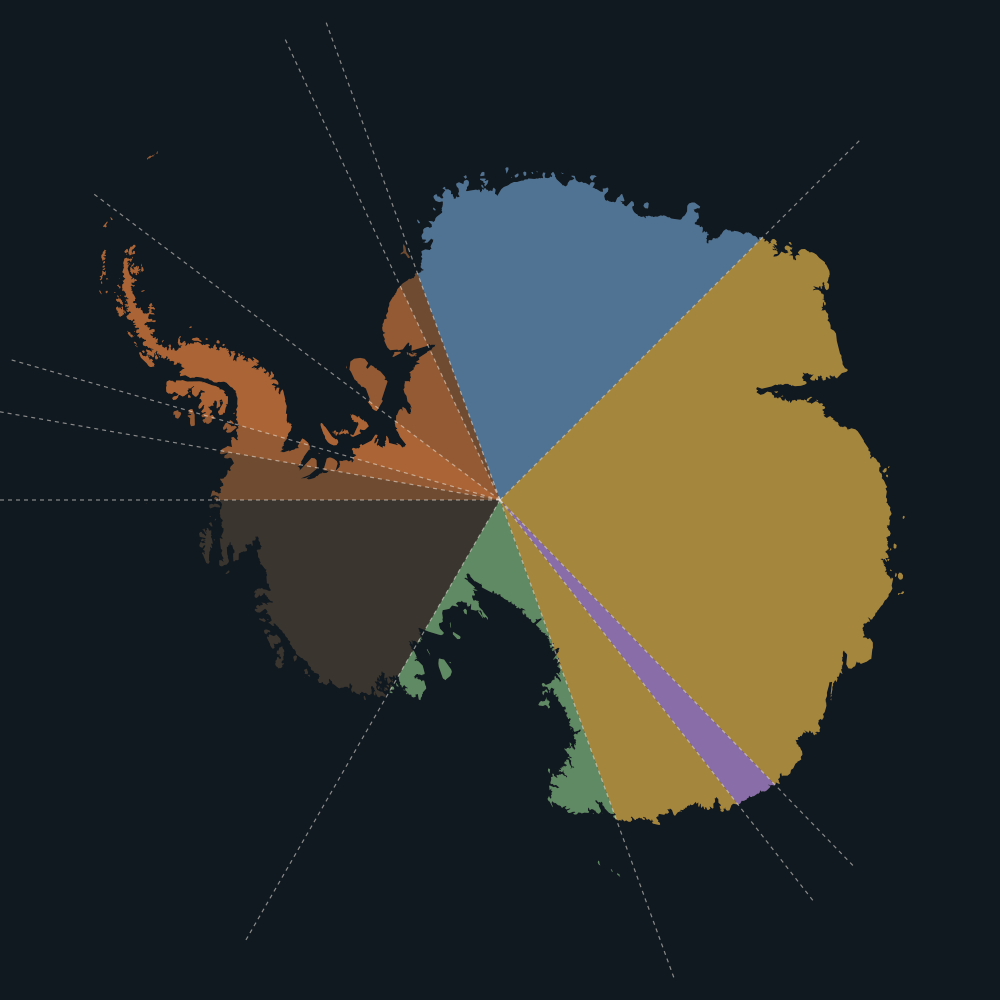
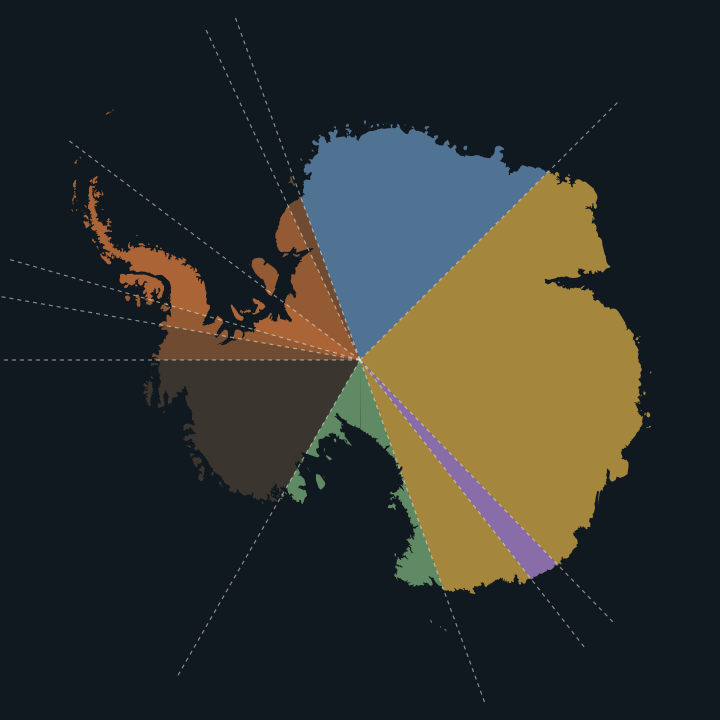
Seven countries claim parts of Antarctica. The United Kingdom made the first claim in 1908. Its British Antarctic Territory covers 20°W to 80°W south of 60°S. New Zealand claimed the Ross Dependency in 1923 (160°E to 150°W). France claimed Adélie Land in 1924 (136°E to 142°E). Australia claimed the Australian Antarctic Territory in 1933, about 42% of the continent, on both sides of Adélie Land. Norway claimed Peter I Island in 1929 and Queen Maud Land in 1939 (20°W to 45°E). In 2015 the Norwegian government said its claim reaches the South Pole. Chile claimed 53°W to 90°W in 1940, and Argentina claimed 25°W to 74°W in 1943.
The British, Chilean and Argentine claims overlap on the Antarctic Peninsula. In 1952 Argentine soldiers fired warning shots over a British survey team at Hope Bay. Argentina governs its claim as part of Tierra del Fuego Province, together with the Falkland Islands, which Argentina calls the Malvinas and also claims. Chile governs its claim from its Magallanes region.
The sector from 150°W to 90°W, most of it Marie Byrd Land, is claimed by no country. The United States and Russia reserve the right to make claims.
The seven claims
 United KingdomBritish Antarctic Territory, 1908. 20°W to 80°W
 New ZealandRoss Dependency, 1923. 160°E to 150°W
 FranceAdélie Land, 1924. 136°E to 142°E
 AustraliaAustralian Antarctic Territory, 1933. 45°E to 160°E, except Adélie Land
 NorwayQueen Maud Land, 1939. 20°W to 45°E, plus Peter I Island
 ChileChilean Antarctic Territory, 1940. 53°W to 90°W
 ArgentinaArgentine Antarctica, 1943. 25°W to 74°W
- Who owns Antarctica?The story of the claims and the treaty
 NORWAY
AUSTRALIA
FRANCE
NEW
ZEALAND UK, Chile, Argentina Unclaimed Marie Byrd Land South Pole Antarctic
Peninsula Weddell
Sea Ross
Sea Ross Ice
Shelf
 McMurdo
Peter I Island
 NORWAY
AUSTRALIA
FRANCE
NEW
ZEALAND UK, Chile, Argentina Unclaimed South Pole Weddell
Sea Ross
Sea
McMurdo
What does the Antarctic Treaty do?
The Antarctic Treaty was signed in Washington on December 1, 1959 by 12 countries: Argentina, Australia, Belgium, Chile, France, Japan, New Zealand, Norway, South Africa, the Soviet Union, the United Kingdom and the United States. It entered into force on June 23, 1961.
Article IV is the core of the treaty. It does not settle the claims or ask anyone to drop them. Nothing done while the treaty is in force can support or deny a claim, and no new or enlarged claim can be made. Claimant countries read this as preserving their rights. Non-claimant countries read it as recognizing nobody's. The text allows both readings.
The treaty bans military activity and nuclear testing. It guarantees freedom of research and lets any Consultative Party inspect any station. It has no expiration date.
Today the treaty has 58 parties. Twenty-nine of them are Consultative Parties, which take decisions by consensus at a yearly meeting. The 48th meeting was held in Hiroshima, Japan, from May 11 to 21, 2026. A proposal to list the emperor penguin as a Specially Protected Species did not reach consensus. Kyodo News, citing people familiar with the talks, reported that China opposed the listing and Russia backed China.
The treaty system
- 1959Twelve countries sign the Antarctic Treaty in Washington
- 1961The treaty enters into force on June 23
- 1972The Convention for the Conservation of Antarctic Seals is signed
- 1980CCAMLR, the convention on Southern Ocean fishing, is adopted
- 1991The Madrid Protocol bans all mining in Antarctica
- 1998The Madrid Protocol enters into force on January 14
- 2026The 48th Consultative Meeting in Hiroshima. 58 parties, 29 with voting rights
- 2048Any Consultative Party can request a review of the Madrid Protocol
Can anyone mine Antarctica?
No, not under the current rules. The Protocol on Environmental Protection to the Antarctic Treaty, signed in Madrid in 1991 and in force since January 14, 1998, bans all mineral resource activity other than scientific research. The ban has no end date.
Until 2048, the Protocol can only be changed by unanimous agreement of the Consultative Parties. From January 2048, any Consultative Party can ask for a conference to review it. A change adopted there needs a majority of all parties, including three-quarters of the 26 countries that were Consultative Parties when the Protocol was adopted in 1991. It takes effect only after three-quarters of the Consultative Parties ratify it, including all 26 of those countries. The mining ban stays unless a binding legal regime for mining is in force.
No one knows how much oil lies under Antarctica. In February 2026 the US Geological Survey published an estimate for one area, the Larsen Basin east of the Antarctic Peninsula. It put the mean at 269 million barrels of undiscovered, technically recoverable oil and 14.3 trillion cubic feet of gas. Deposits of coal and iron ore are also known.
Mining ban
2048
The first year a review of the Madrid Protocol can be requested
The Protocol entered into force on January 14, 1998. Fifty years later, any Consultative Party can ask for a review conference. The ban on mining continues unless a binding legal regime for mining is in force.
What are Russia and China doing in Antarctica?
Russia's state geology company Rosgeo has run seismic surveys off Antarctica for decades, including in areas claimed by Britain and Norway, with the research vessel Akademik Alexander Karpinsky. The United States sanctioned the vessel in February 2024. In May 2024, The Telegraph reported that evidence given to the UK House of Commons Environmental Audit Committee put the oil and gas in the surveyed areas at about 511 billion barrels. Russia has not confirmed the figure. Klaus Dodds of Royal Holloway, University of London, called the surveys "a precursor for forthcoming resource extraction." Rosgeo says its work in Antarctica is scientific and follows the treaty.
China opened its fifth station, Qinling, on Inexpressible Island in the Ross Sea on February 7, 2024. It houses 80 people in summer and 30 in winter. A CSIS analysis said a planned satellite ground station there could collect signals over Australia and New Zealand. China rejects claims of espionage. In 2025 China proposed a sixth station, a summer base for 25 people, at Cox Point in the unclaimed sector, with a target opening in 2027.
Neither China nor Russia has made a territorial claim. Russia, like the United States, reserves the right to make one.
Year-round research stations, selected countries
- Argentina7
 Russia5
- Chile4
 China3
- United States3
- Australia3
- United Kingdom2
What else is happening in Antarctica?
Tourism and fishing are the two largest commercial activities in and around Antarctica.
About 113,000 tourists visited Antarctica in the 2025-2026 season, according to IAATO figures reported in May 2026. The peak was about 122,000 in 2023-2024. Most tourists sail from Ushuaia in Argentina. Under IAATO rules, ships carrying more than 500 passengers cannot land anyone. The 2026 Consultative Meeting worked toward a common framework for regulating tourism but adopted no binding rules.
The Commission for the Conservation of Antarctic Marine Living Resources (CCAMLR) manages Southern Ocean fishing. It has 27 members and decides by consensus. Krill is the main catch. The krill fishery reached its 620,000-tonne trigger level and closed early for the first time on August 1, 2025, and again on August 12, 2026. Norway's ships took about half of the 2025 catch and China's about 37%. CCAMLR's 45th meeting, in Hobart from October 19 to 30, 2026, ended without agreement on new krill rules or on any new marine protected area, including a reserve off the Antarctic Peninsula proposed by Argentina and Chile.
Recent developments
- Feb 2024China opens Qinling, its fifth Antarctic station
- Feb 2024The US sanctions Russia's survey vessel Akademik Alexander Karpinsky
- May 2024The Telegraph reports the 511 billion barrel estimate
- Aug 2025The krill fishery reaches its limit and closes early for the first time
- Oct 2025CCAMLR 44 ends without new krill rules or marine protected areas
- May 2026The 48th Consultative Meeting in Hiroshima. No consensus on emperor penguins
- Aug 2026The krill fishery closes early again, on August 12
- Oct 2026CCAMLR 45 in Hobart ends without new krill rules or marine protected areas
What is at stake in Antarctica?
Oil and minerals
The US Geological Survey estimated a mean of 269 million barrels of oil and 14.3 trillion cubic feet of gas in one basin east of the Antarctic Peninsula. Deposits of coal and iron ore are known. Russian survey ships have mapped the offshore geology for decades. The Madrid Protocol bans extraction, and a review can be requested from 2048.
Freshwater and climate
Antarctica's ice sheet holds roughly 60% of the world's freshwater, in ice up to 4.8 km thick. If it all melted, global sea levels would rise about 58 meters. Parts of the West Antarctic ice sheet are already losing mass.
Krill and fishing
Antarctic krill feed whales, seals and penguins. The krill fishery reached its 620,000-tonne trigger level and closed early in 2025 and in 2026. In 2025 Norway proposed a new management plan that could have nearly doubled catches, then withdrew it. Conservation groups say the catch is too concentrated near the Antarctic Peninsula.
Questions about Antarctica
Does the Antarctic Treaty expire in 2048?
No. The Antarctic Treaty has no expiration date and stays in force indefinitely. The year 2048 matters for the Madrid Protocol, which bans mining. From January 2048, any Consultative Party can ask for a conference to review the Protocol. A change needs a majority of all parties, including three-quarters of the 26 countries that were Consultative Parties in 1991. It takes effect only after all 26 of them ratify it. The mining ban stays unless a binding legal regime for mining is in force. If an adopted change has not taken effect within three years, any party may withdraw from the Protocol.
Can a country own part of Antarctica?
Seven countries claim parts of Antarctica, and each treats its sector as its own territory. The Antarctic Treaty freezes the claims. It does not cancel them or ask anyone to give them up, and it bars new or enlarged claims while it is in force. Most other countries, including the United States, Russia and China, recognize none of the claims. Military activity is banned, and treaty inspectors can visit any station.
Why is Marie Byrd Land unclaimed?
The sector from 150°W to 90°W, most of it Marie Byrd Land, has never been claimed by any country. It covers about 1.6 million km², roughly the size of Iran. The United States explored the area and ran Byrd Station there from 1957 to 1972 but never made a claim. Norway's Peter I Island lies off its coast, but Norway claims only the island. The Antarctic Treaty bars new claims, so the sector stays unclaimed while the treaty is in force.
Has anyone been born in Antarctica?
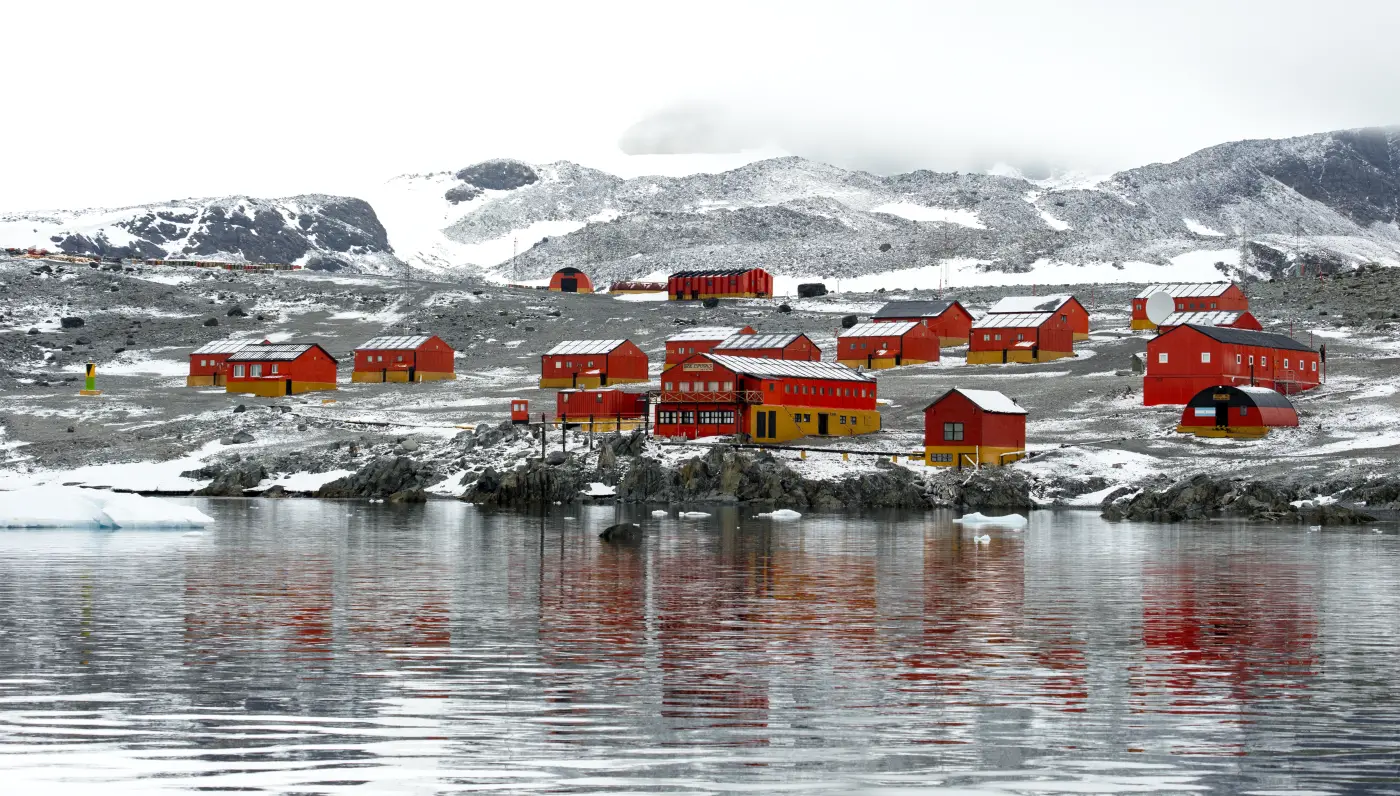
Yes. In 1977 Argentina flew Silvia Morella de Palma, seven months pregnant, to Esperanza Station on the Antarctic Peninsula. Her son Emilio Marcos Palma, born there on January 7, 1978, is the first person known to have been born on the Antarctic continent. Argentina presented the birth as support for its claim. Chile's first Antarctic birth followed in 1984 at Villa Las Estrellas, next to Frei Station. Esperanza and Villa Las Estrellas are the only places in Antarctica where families live.
How many people live in Antarctica?
No one lives in Antarctica permanently. About 1,000 people stay at research stations through the winter, and about 4,000 to 5,000 work there in summer. Families with children live at Esperanza and Villa Las Estrellas during tours of duty. Antarctica has no indigenous population.