
Disputed territory · South Caucasus
Nagorno-Karabakh
Settled: Azerbaijan retook it in September 2023Updated November 1, 2026
Nagorno-Karabakh is a mountainous region inside Azerbaijan where most people were ethnic Armenians. Armenian forces held it from the early 1990s. Azerbaijan retook part of it in a 44-day war in 2020 and the rest in a one-day offensive on September 19 and 20, 2023. More than 100,000 Armenians, nearly the whole population, then fled to Armenia. Azerbaijan now controls all of it. Armenia and Azerbaijan initialed a peace treaty at the White House on August 8, 2025, but it has not been signed.
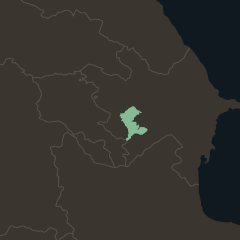
- Area
- About 4,400 km²
- the Soviet-era Nagorno-Karabakh Autonomous Oblast
- Armenians who fled
- 100,000+
- by October 3, 2023 (Armenian government)
- Armenians held in Baku
- 19
- by Armenian counts, including former Artsakh leaders
- Peace treaty
- Initialed
- at the White House on August 8, 2025, not yet signed
Nagorno-Karabakh in 30 seconds
- Nagorno-Karabakh was a mostly Armenian region inside Soviet Azerbaijan. In a war from 1988 to 1994, Armenian forces took it and seven surrounding districts. More than 600,000 Azerbaijanis and over 400,000 Armenians were displaced.
- In a 44-day war in 2020 Azerbaijan retook the town of Shusha (Shushi to Armenians) and the seven districts, some by fighting and some under the ceasefire. About 2,000 Russian peacekeepers then deployed.
- From December 2022 the only road to Armenia was blocked, first by Azerbaijani protesters and from April 2023 by an Azerbaijani checkpoint. Azerbaijan took the rest of the region in a one-day offensive on September 19 and 20, 2023. Over 100,000 Armenians fled.
- Armenia and Azerbaijan initialed a peace treaty at the White House on August 8, 2025. Azerbaijan says it will not sign until Armenia changes its constitution.
Who controls Nagorno-Karabakh now?
Azerbaijan controls all of Nagorno-Karabakh. It took the region in a one-day offensive on September 19 and 20, 2023. By October 3, 100,617 Armenians had fled to Armenia, by the Armenian government's count. Almost no Armenians remain. Armenia and the European Parliament called it ethnic cleansing. Azerbaijan rejects that and says it offered them a future as Azerbaijani citizens.
Azerbaijan calls the region Karabakh, also spelled Garabagh, and calls Stepanakert Khankendi. Under its Great Return program it is moving Azerbaijani families into the areas it regained. The first 36 families moved to Khankendi on January 21, 2026. In October 2026 President Ilham Aliyev said former displaced people had settled in 48 towns and villages. Mines have killed or injured 437 Azerbaijanis since November 2020, by Azerbaijan's mine agency.
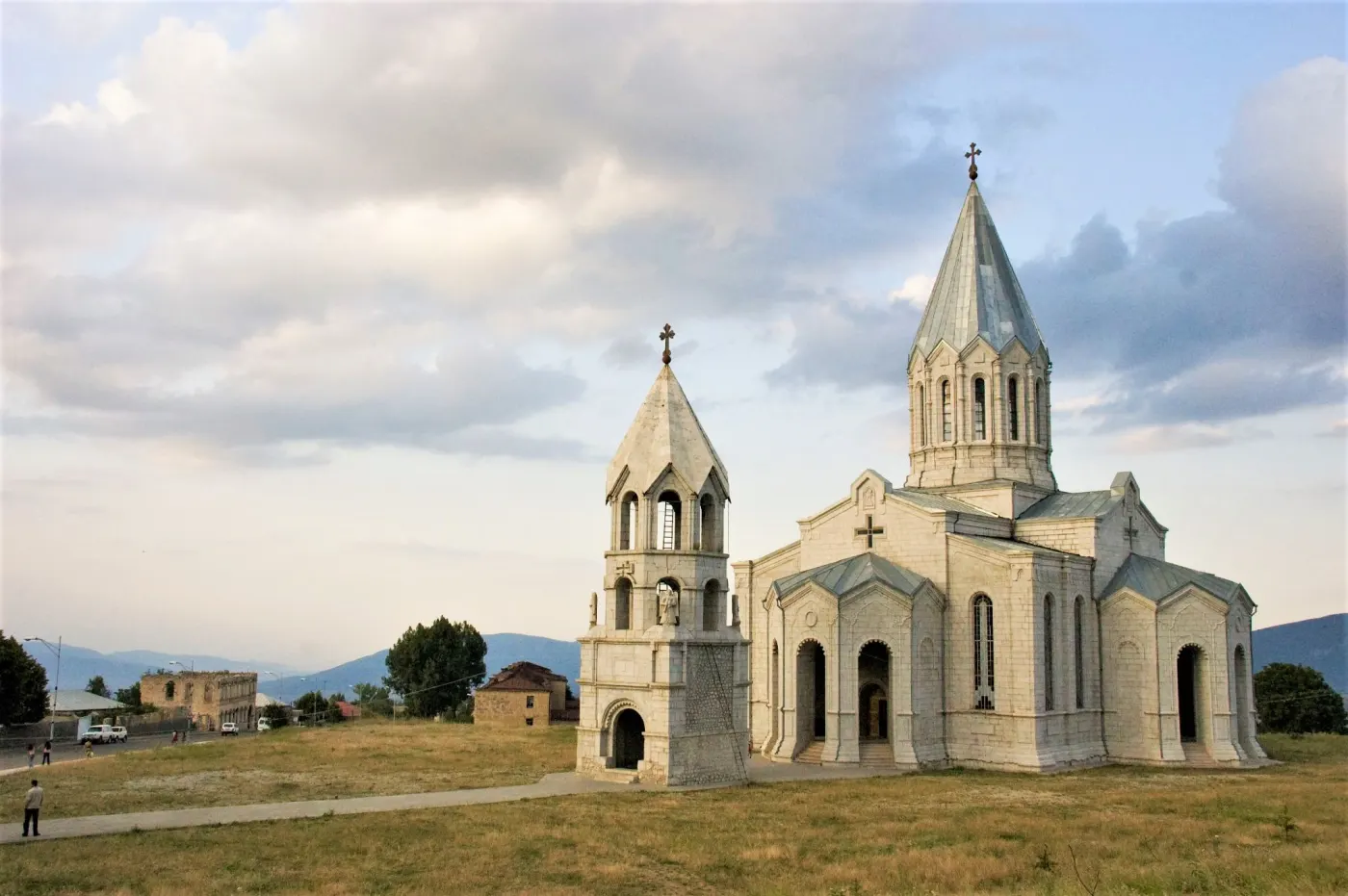
Each side accuses the other of destroying its heritage. Azerbaijan points to towns such as Agdam, left in ruins while Armenian forces held them. Caucasus Heritage Watch, a Cornell-based team that studies satellite images, reports that Armenian churches and cemeteries have been destroyed since 2023. Azerbaijan rejects this.
Karabakh Armenians declared the Artsakh Republic in 1991. Its president, Samvel Shahramanyan, signed a decree on September 28, 2023, dissolving it by January 1, 2024. In Yerevan in December he said no such document existed. No UN member state ever recognized Artsakh.
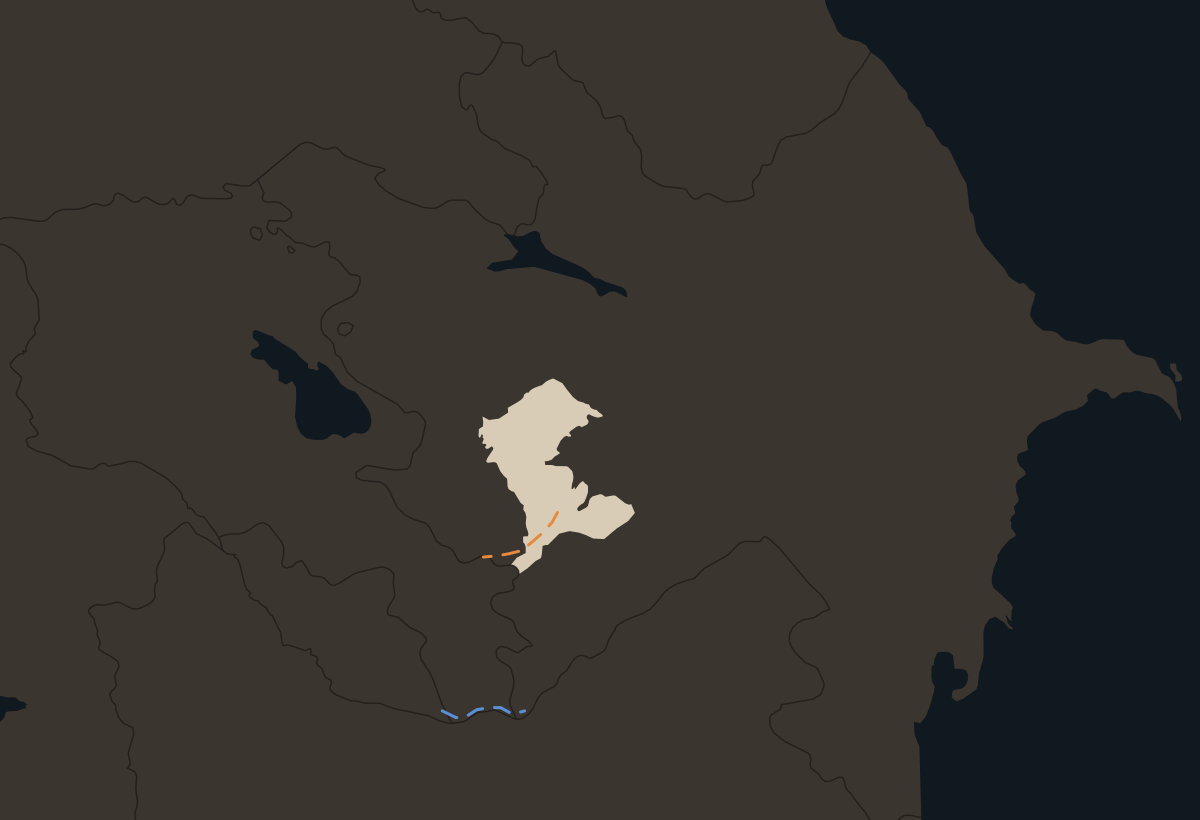 NAGORNO-
KARABAKH ARMENIA AZERBAIJAN IRAN GEORGIA Caspian
Sea Lake
Sevan
 Stepanakert /
Khankendi
Shusha / Shushi
Agdam
Yerevan
Baku
Lachin corridor
Nakhchivan(Azerbaijan) TRIPP route (planned)
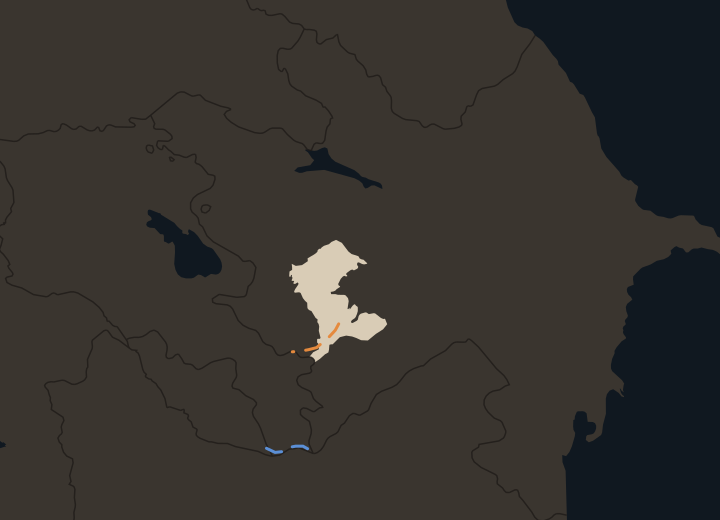 NAGORNO-
KARABAKH ARMENIA AZERBAIJAN IRAN GEORGIA Caspian
Sea Lake
Sevan
Stepanakert /Khankendi
Shusha / Shushi
Agdam
Yerevan
Baku
Lachin corridor
TRIPP route (planned)
Why did Armenia and Azerbaijan fight over Nagorno-Karabakh?
At the 1989 Soviet census the region was about 77% Armenian and 22% Azerbaijani. On July 4, 1921, the Caucasus Bureau of the Soviet Communist Party voted to give it to Soviet Armenia. The next day the bureau reversed that vote and kept it in Soviet Azerbaijan. In 1923 it became an autonomous oblast there. In February 1988 the oblast's council voted to join Soviet Armenia. Violence followed on both sides. Later that month mobs attacked Armenians in the city of Sumgait. The Soviet count was 32 dead, 26 of them Armenians. Armenians call it a pogrom. Azerbaijanis point to the expulsion of about 200,000 Azerbaijanis from Armenia from 1988 to 1991.
Full war broke out as the Soviet Union collapsed in 1991. Armenian forces took Nagorno-Karabakh and seven surrounding Azerbaijani districts. In February 1992 they captured the town of Khojaly. Azerbaijan says 613 civilians were killed there and calls it a genocide. Human Rights Watch counted more than 200 dead and held Karabakh Armenian forces directly responsible. A Russian-brokered ceasefire in May 1994 ended the fighting. About 30,000 people were killed, by common estimates. More than 600,000 Azerbaijanis were displaced inside Azerbaijan, and over 400,000 Armenians fled Azerbaijan, by Amnesty International's count.
The conflict from the Soviet era to 2023
- 1923The Soviet government creates the Nagorno-Karabakh Autonomous Oblast inside Azerbaijan
- 1988The region's council votes to join Armenia. Mobs attack Armenians in Sumgait. Azerbaijanis are driven out of Armenia
- 1991Karabakh Armenians declare the Artsakh Republic. Full war begins
- 1992Armenian forces capture Khojaly. Hundreds of Azerbaijani civilians are killed
- 1993Armenian forces take the districts around the region. Hundreds of thousands of Azerbaijanis flee
- 1994A Russian-brokered ceasefire ends the first war
- 2016A four-day war along the line of contact kills about 200 people
- 2020The 44-day war. Azerbaijan takes Shusha and the surrounding districts
- 2023Azerbaijan takes the rest of Nagorno-Karabakh in one day. Nearly all Armenians flee
What happened in the 2020 war?
On September 27, 2020, Azerbaijan launched a large offensive along the line of contact. Azerbaijan called it a counter-offensive after Armenian shelling. Armenia said Azerbaijan attacked first. Turkey had sold Azerbaijan Bayraktar drones, which destroyed Armenian armor and positions. From 2016 to 2020 Israel supplied 69% of Azerbaijan's major arms imports and Russia 94% of Armenia's, by SIPRI's count. On November 8, 2020, Azerbaijani forces took Shusha (called Shushi by Armenians), a hilltop town Azerbaijanis consider their cultural capital. Armenia's Prime Minister Nikol Pashinyan agreed to a ceasefire the next day.
The ceasefire, brokered by Russia, took effect on November 10. Armenia handed back the districts it still held around the region: Agdam, Kalbajar and Lachin, by December 1. About 2,000 Russian peacekeepers deployed along the line of contact and in the Lachin corridor. Both sides hit towns. Human Rights Watch documented Armenian missile and cluster munition strikes on the Azerbaijani cities of Ganja and Barda, and Azerbaijani cluster munitions in Stepanakert. Azerbaijan lost 2,908 soldiers and 100 civilians, by its official counts. Armenia lost about 3,800 people, by later Armenian counts.
Deaths in the 2020 war, soldiers and civilians (official counts)
 Armenian sideAbout 3,800
- Azerbaijani side3,008
How did Azerbaijan retake Nagorno-Karabakh in 2023?
In December 2022 Azerbaijanis who said they were protesting illegal mining blocked the Lachin corridor, the only road linking the region to Armenia. Armenia said the Azerbaijani government ran the blockade. In February 2023 the International Court of Justice ordered Azerbaijan to keep the road open. In April Azerbaijan set up its own checkpoint on it. On September 19, 2023, after mine blasts killed four Azerbaijani police officers and two civilians, Azerbaijan launched what it called anti-terrorist measures. Fighting stopped the next day. Azerbaijan said 192 of its soldiers died. Armenian officials counted 223 dead on their side, including 25 civilians.
Key dates
- Dec 2022Azerbaijani protesters block the Lachin corridor
- Apr 2023Azerbaijan sets up a checkpoint on the corridor
- Sep 19, 2023Azerbaijan launches its offensive
- Sep 20, 2023Karabakh Armenian forces agree to disarm, in talks mediated by Russian peacekeepers
- Oct 3, 2023Over 100,000 Armenians have fled to Armenia
- Jan 1, 2024The date set for the Artsakh Republic's dissolution
- Jun 12, 2024Russian peacekeepers complete their withdrawal
- Jan 2026Azerbaijan moves the first families to Khankendi
What happened to the Armenians who fled?
Armenia now hosts about 42 refugees per 1,000 people, the eighth highest rate in the world. A $250 million World Bank program helps refugees pay rent and buy homes. More than 45,000 have taken Armenian citizenship.
Azerbaijan freed four Armenian prisoners in January 2026. It still holds 19, by Armenian counts, including former political and military leaders of Artsakh. On February 5, 2026, a military court in Baku sentenced five of them, including former Artsakh president Arayik Harutyunyan, to life in prison on charges including war crimes and terrorism. Two other former presidents, Arkadi Ghukasyan and Bako Sahakyan, received 20 years. On February 17 the court sentenced Ruben Vardanyan, a billionaire born in Yerevan who made his fortune in Russia, to 20 years. He had served as Artsakh's state minister from November 2022 to February 2023. The defendants denied the charges. Azerbaijan says the trials were lawful and dealt with crimes against Azerbaijanis. Armenian rights groups and some European lawmakers called them unfair. Appeals were still being heard in 2026.
Refugees in Armenia
100,000+
Armenians who fled Nagorno-Karabakh in September and October 2023
Nearly the whole population left within two weeks. The exodus began after Azerbaijan's offensive on September 19 and sped up after a fuel depot exploded near Stepanakert on September 25, killing 218 people by the count of the region's Armenian officials. Armenia says 100,617 had arrived by October 3.
Will Armenia and Azerbaijan sign a peace treaty?
On August 8, 2025, Armenia's Prime Minister Nikol Pashinyan and Azerbaijan's President Ilham Aliyev met President Donald Trump at the White House. They signed a joint declaration, and their foreign ministers initialed a 17-article peace treaty. At their joint request, the OSCE closed the Minsk Group on November 30, 2025.
The treaty has not been signed. Aliyev says he will sign only after Armenia changes its constitution, which cites a 1990 declaration that Azerbaijan reads as a claim to Karabakh. Armenia rejects that reading. A new constitution needs a referendum, which parliament calls with 70 of 105 votes. Pashinyan's Civil Contract party won 64 seats in the June 7, 2026, election. On October 15, 2026, Pashinyan set a goal of signing and ratifying the treaty before 2031.
The deal also created TRIPP, the Trump Route for International Peace and Prosperity, a planned road and railway through Armenia's Syunik province linking Azerbaijan to its Nakhchivan exclave. Azerbaijan and Turkey have called it the Zangezur corridor. Armenia rejects that name, saying a corridor suggests land outside Armenian control. A company 74% owned by the United States will run it for 49 years, with an option for 50 more. Armenia keeps sovereignty over the route. Armenia's parliament ratified the framework agreement in October 2026. Building has not started.
The peace process
- Mar 2025Armenia and Azerbaijan agree on the treaty text
- Aug 8, 2025The leaders meet Trump at the White House and the treaty is initialed
- Sep 1, 2025OSCE ministers decide to close the Minsk Group
- Feb 2026A Baku court sentences former Artsakh leaders to life and 20 years
- Jun 7, 2026Pashinyan's party wins the election but falls short of two thirds
- Oct 15, 2026Pashinyan sets a goal of signing and ratifying the treaty before 2031
- Oct 2026Armenia's parliament ratifies the TRIPP framework agreement
What was at stake in Nagorno-Karabakh?
People
About 120,000 Armenians lived in Nagorno-Karabakh before September 2023. Nearly all of them fled. More than 600,000 Azerbaijanis had been displaced from the region and the surrounding districts in the 1990s, including about 40,000 who lived in the region itself. Azerbaijan is now resettling Azerbaijani families there.
The corridor
The Lachin corridor was the only road linking Nagorno-Karabakh to Armenia. It was blocked from December 2022 to September 2023, first by Azerbaijani protesters and then by an Azerbaijani checkpoint. The peace deal includes a planned route, the TRIPP, through Armenia's Syunik province, linking Azerbaijan to its Nakhchivan exclave. A company 74% owned by the United States will run it.
The Russia factor
Russia kept about 2,000 peacekeepers in Nagorno-Karabakh from November 2020. They did not stop Azerbaijan's 2023 offensive. Russia completed their withdrawal in June 2024. Armenia has since frozen its role in Russia's CSTO alliance and turned to the EU, France and India for arms and partnerships.
Questions about Nagorno-Karabakh
Is Nagorno-Karabakh part of Azerbaijan?
Yes. Azerbaijan has controlled all of Nagorno-Karabakh since September 2023. It was internationally recognized as part of Azerbaijan throughout the conflict, even when Armenian forces held it. No UN member state recognized the self-declared Artsakh Republic. Armenia itself did not recognize it, though it supported it politically and militarily.
What did each side argue?
Armenians argued that the region's people had a right to self-determination. Karabakh Armenians declared independence in September 1991, citing a 1990 Soviet law that let autonomous regions choose their status if their republic left the Soviet Union, and voted for it in a December 1991 referendum that local Azerbaijanis boycotted. Azerbaijan argued for its territorial integrity, and no UN member state recognized the secession. In 1993 the UN Security Council passed four resolutions calling for occupying forces to withdraw from districts of Azerbaijan, and asked Armenia to use its influence on the Karabakh Armenians. Both peoples see the region as a historic homeland. Armenians point to its medieval churches and Armenian princes. Azerbaijanis point to the Karabakh Khanate, whose ruler Panah Ali Khan founded Shusha in the 1750s.
Do any Armenians still live in Nagorno-Karabakh?
Almost none. Over 100,000 Armenians fled to Armenia in September and October 2023. A UN team that visited on October 1, 2023, was told that 50 to 1,000 Armenians remained.
What does Nagorno-Karabakh mean?
The name mixes three languages. Nagorno comes from the Russian word for mountainous. Kara means black in Turkic languages, and bagh means garden in Persian. Armenians call the region Artsakh, after an ancient Armenian province. Azerbaijanis call it Karabakh or Garabagh.
What was the Minsk Group?
The OSCE Minsk Group, co-chaired by Russia, the United States and France, mediated the conflict from 1992. It proposed several peace plans, none of which both sides accepted. In August 2025 Armenia and Azerbaijan jointly asked the OSCE to close it. OSCE ministers decided to do so on September 1, 2025, and the closure was completed on November 30, 2025.
What role did Turkey play?
Turkey is Azerbaijan's closest ally. Leaders of the two countries call them "one nation, two states." Turkish Bayraktar drones helped Azerbaijan win the 2020 war. Turkey closed its land border with Armenia in 1993 in solidarity with Azerbaijan and has kept it closed, though it lifted a ban on direct trade in May 2026.