
Country profile · South Caucasus
 Azerbaijan
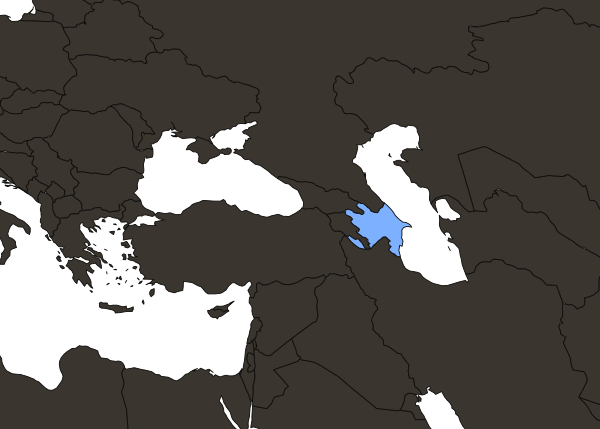
Azerbaijan is an oil- and gas-rich country of about 10.3 million people on the Caspian Sea. President Ilham Aliyev has ruled since 2003, when he succeeded his father. In September 2023 Azerbaijan took back Nagorno-Karabakh in a day, and over 100,000 Armenians fled. A peace treaty with Armenia was initialed at the White House in August 2025 but has not been signed.
Where Azerbaijan ranks
All rankings →Which alliances is Azerbaijan in?
All alliances →Who runs Azerbaijan?
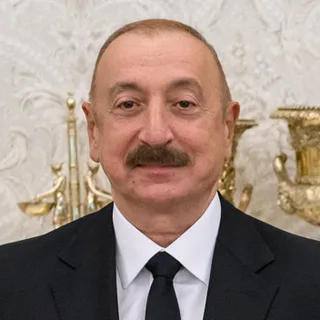
President Ilham Aliyev was born on December 24, 1961, in Baku. His father, Heydar Aliyev, was a KGB general who led Soviet Azerbaijan from 1969 to 1982 and was president from 1993 to 2003. Ilham Aliyev became prime minister in August 2003 and was elected president that October. Referendums ended term limits in 2009 and lengthened the presidential term to seven years in 2016. His wife, Mehriban Aliyeva, has been first vice president since February 2017. Aliyev won a snap election on February 7, 2024, with 92.12% of the vote. The main opposition parties boycotted it, and OSCE observers found a "restrictive environment". His New Azerbaijan Party won 68 of the 125 seats in parliament in September 2024, on a turnout of 37% (chart). Freedom House scores Azerbaijan 6 out of 100. In July 2026 a court jailed nine people from the news site Toplum TV for 12 to 15 years.
- New Azerbaijan Party 68
- Independents 44
- Other parties (11) 13
Photo (August 2025): The White House, Wikimedia Commons, public domain (cropped)
Who are Azerbaijan's allies and rivals?
Turkey is Azerbaijan's closest ally. Leaders call the two countries "one nation, two states." The Shusha Declaration of June 15, 2021, commits them to help each other if attacked. Turkish Bayraktar drones helped Azerbaijan win the 2020 war. Israel supplied 69% of Azerbaijan's major arms imports in 2016 to 2020 (SIPRI), and Azerbaijan supplied about 46% of Israel's crude oil in 2025. The United States signed a strategic partnership charter with Azerbaijan on February 10, 2026, during a visit by Vice President JD Vance. Russia is a harder partner. On December 25, 2024, Russian air defenses hit an Azerbaijan Airlines plane, and 38 of the 67 people on board died when it crashed in Kazakhstan. Russia agreed to pay compensation in April 2026. Relations with Iran are tense. On March 5, 2026, drones hit the airport in Nakhchivan. Azerbaijan blamed Iran, which denied it. Pakistan agreed in 2025 to sell Azerbaijan 40 JF-17 fighter jets.
Allies and partners
 TurkeyMutual help pledge of 2021; drones and drills
 IsraelMain arms supplier; buys Azerbaijani oil
 United StatesStrategic partnership charter signed February 2026
 PakistanSelling 40 JF-17 fighter jets

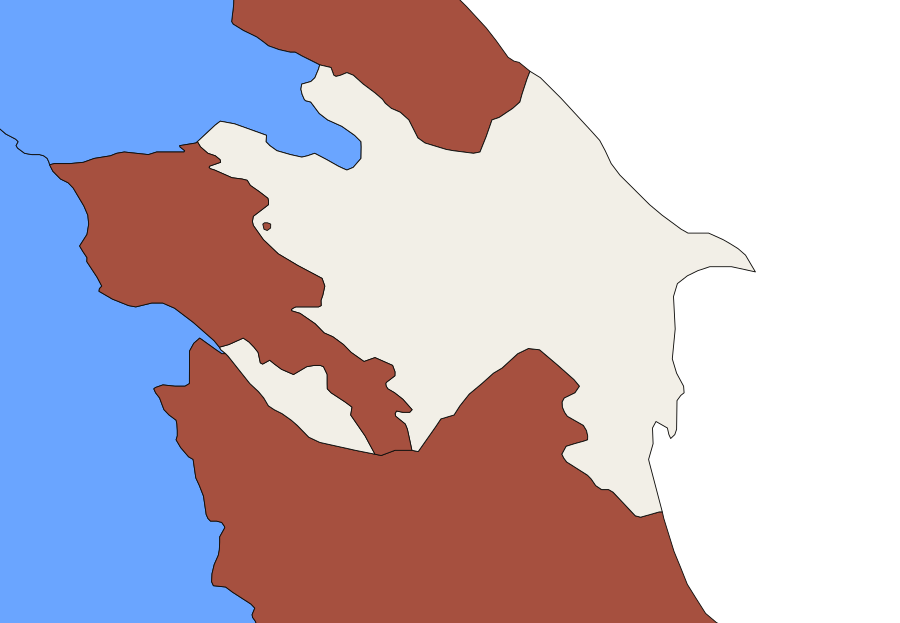
- Khankendi (Stepanakert) Capital of Karabakh's Armenians until they fled in September 2023. Azerbaijan calls it Khankendi.
- Nakhchivan Exclave cut off from the rest of Azerbaijan by Armenia. Drones hit its airport on March 5, 2026.
- TRIPP route Planned US-run road and rail link of 42 km through southern Armenia to Nakhchivan. Building is expected in 2027.
- Sangachal Oil and gas terminal south of Baku. The BTC pipeline starts here and runs 1,768 km to Ceyhan in Turkey.
- Azerbaijan
- Partner
- Tensions
Who does Azerbaijan trade with?
Azerbaijan exported goods worth about $24.5 billion in 2025 and imported about $24.4 billion (State Statistical Committee). Oil and gas made up about 85% of exports. Italy bought 45% of all exports, most of it crude oil (chart). The Azeri-Chirag-Gunashli fields, run by BP under the 1994 "Contract of the Century," pump most of the oil. The BTC pipeline has carried it to Turkey's Mediterranean coast since 2006, without crossing Russia. Azerbaijan sold 25.2 billion cubic meters of gas abroad in 2025, 12.8 billion of it to Europe. In 2022 it agreed with the EU to aim for at least 20 billion a year to Europe by 2027, but sales to Europe fell 8.5% in the first nine months of 2026. On October 16, 2026, the state oil company SOCAR said it wants to buy Russian gas again. The oil fund held $72.6 billion in June 2026.


 Bulgaria
Buys from
Share of Azerbaijan's imports
 China19.7%
 Russia15.3%
- Türkiye9.6%
- United States6.1%
 Switzerland5.3%
Goods, 2025, as reported by Azerbaijan. UN Comtrade.
What happened to Nagorno-Karabakh?
Nagorno-Karabakh is a mountain region inside Azerbaijan where Armenians made up about 77% of the population in 1989. In a war from 1988 to 1994, about 30,000 people were killed. Armenian forces took the region and seven surrounding districts, about 14% of Azerbaijan, and over 640,000 Azerbaijanis were displaced. In a 44-day war in 2020, Azerbaijan took the town of Shusha and several districts, and the ceasefire returned the rest. Azerbaijan lost 2,908 soldiers and Armenia about 3,800 people. Azerbaijan blocked the only road to Armenia from December 2022, then took the rest of Karabakh in a day on September 19 to 20, 2023. By October 3, 100,617 Armenians had fled. In February 2026 a court in Baku sentenced five former leaders of the Karabakh Armenians to life in prison. Azerbaijan spent 6.5% of its GDP on its military in 2025, the sixth highest share in the world (chart).
Military spending, share of GDP, 2025
Full ranking → Ukraine39.6%
 Algeria8.8%
- Israel7.8%
- Russia est.7.5%
 Saudi Arabia est.6.5%
- Azerbaijan6.5%
 Armenia6.1%
SIPRI Military Expenditure Database, 2026 edition
Will Azerbaijan and Armenia make peace?
On August 8, 2025, President Ilham Aliyev and Armenia's Prime Minister Nikol Pashinyan met President Trump at the White House. They signed a joint declaration, and their foreign ministers initialed a peace treaty. The OSCE group that had mediated since the 1990s closed on September 1, 2025. The deal includes TRIPP, the "Trump Route," a 42 km road and rail link through southern Armenia to Nakhchivan, run by a company 74% owned by the United States. Building is expected to start in 2027. Azerbaijan let Kazakh grain cross to Armenia in November 2025 and sold it gasoline in December. Aliyev says he will sign only after Armenia removes a reference to Karabakh from its constitution. Pashinyan's party won the June 7, 2026, election with 64 of 105 seats, short of the 70 needed to put a new constitution to a referendum. In October 2026 Pashinyan set a goal of signing by 2031. Azerbaijan still holds 19 Armenian prisoners.