
Part of Norway · Arctic
Svalbard
Part of the countryUpdated November 11, 2026
Svalbard is an Arctic archipelago that belongs to Norway. It lies about halfway between mainland Norway and the North Pole. Norway has held full sovereignty since 1925 under the Svalbard Treaty, signed in 1920. The treaty gives nationals of all 49 parties equal rights to live and work there. Russia's state company Arktikugol runs a settlement at Barentsburg. In September 2026, Norway's governor of Svalbard seized a Russian state vessel under a Norwegian court order. The seizure enforces a $4.22 billion arbitration award won by Ukraine's state energy company Naftogaz. Russia's government protested.
- People
- 2,904
- January 2026
- Area
- 61,022 km²
- glaciers cover almost 61%
- Treaty parties
- 49
- as of 2026
- Seed Vault samples
- 1.4 million+
- passed in June 2026
- From Oslo
- 2,000 km
- as the crow flies
Svalbard in 30 seconds
- Norway has held sovereignty over Svalbard since 1925 under a treaty signed in Paris in 1920. The treaty gives nationals of all 49 parties equal rights to live and work on the islands.
- Russia operates a settlement at Barentsburg through the state company Arktikugol, which has been there since 1932. About 392 people lived in the Russian settlements in January 2026.
- On August 31, 2026, a Norwegian court ordered the seizure of the Russian state vessel Professor Molchanov at Svalbard. The order enforces a $4.22 billion arbitration award won by Ukraine's state energy company Naftogaz. Russian President Vladimir Putin called seizures of civilian vessels "acts of state terrorism." On October 28, 2026, the court upheld the seizure.
- Norway's last coal mine on Svalbard, Gruve 7, closed on June 30, 2025. The economy now runs on tourism, research, satellite services and public administration.
Who owns Svalbard?
Norway owns Svalbard. The Svalbard Treaty, signed on February 9, 1920, recognizes Norway's "full and absolute sovereignty" over the archipelago. The treaty entered into force on August 14, 1925, and Norway formally took over the same day. Today 49 countries are parties to the treaty.
Svalbard is part of the Kingdom of Norway, but it is not a county or a municipality. It has no legislature of its own. A governor appointed by Norway's government runs the archipelago and serves as chief of police, the state's local representative and the environmental authority. The current governor is Lars Fause, who has held the post since June 2021. His successor, Jens Olav Vestgøte Sæther, was named on September 25, 2026, and will take over in January 2027.
Longyearbyen has had its own local council since 2002. It handles schools, utilities, land-use planning and other municipal-level services.
 Spitsbergen
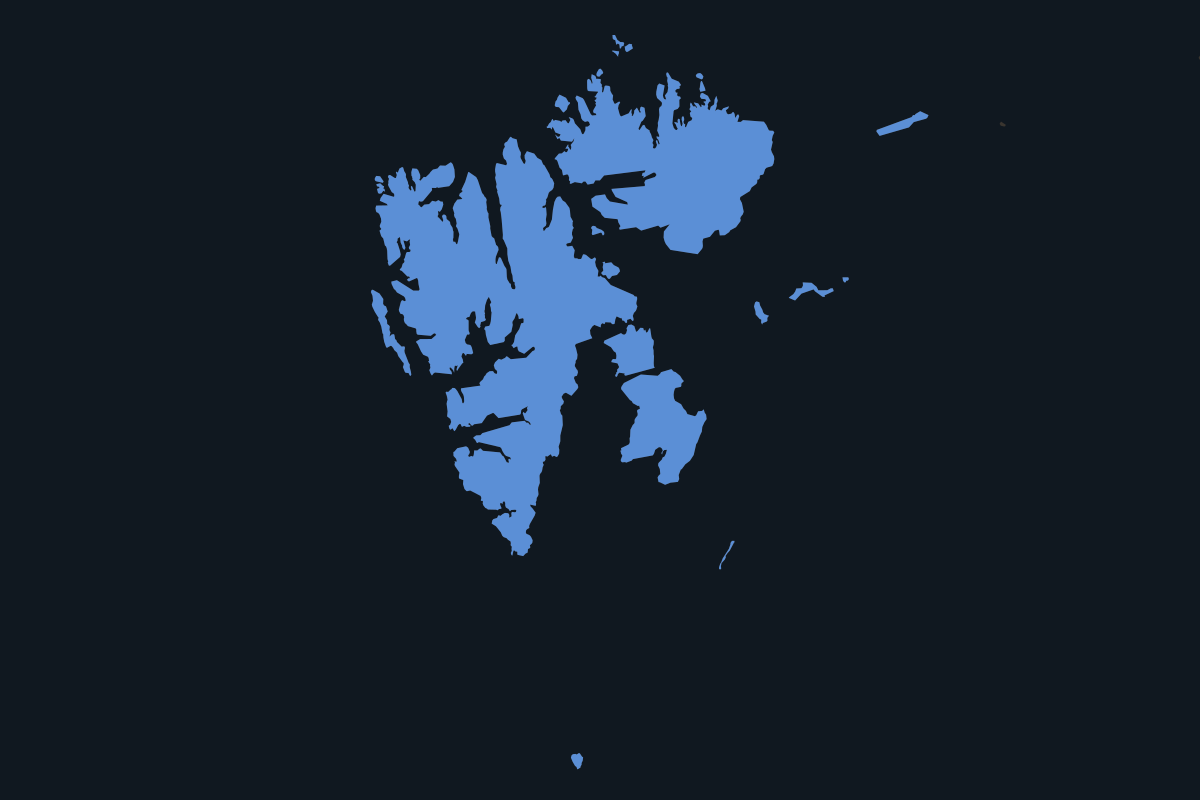
Longyearbyen
Barentsburg (Russian)
Pyramiden (Russian)
Ny-Ålesund
Nordaustlandet
Bear Island
Barents Sea
Greenland Sea
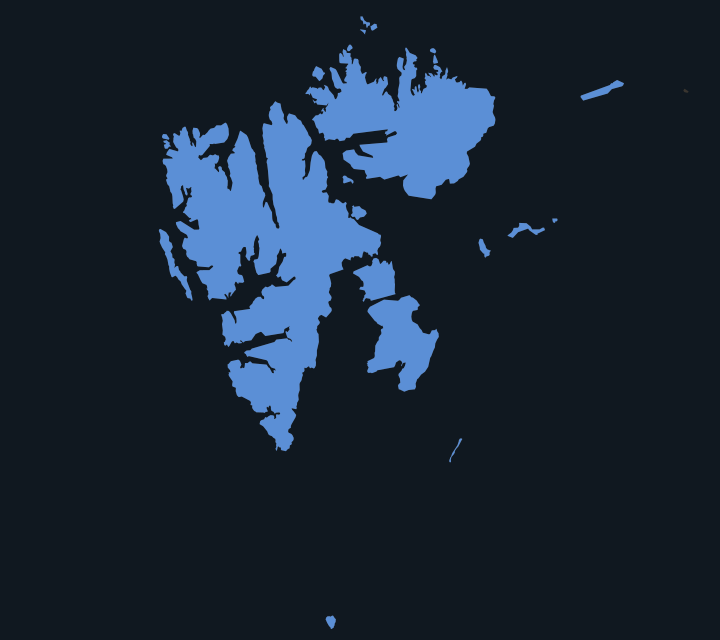 Spitsbergen
Longyearbyen
Barentsburg
Ny-Ålesund
Nordaustlandet
Bear Island
Barents Sea
What does the Svalbard Treaty allow?
The treaty gives nationals of all 49 parties equal rights to live, work, fish and mine on Svalbard. No country may be shut out. Norway's own rules go further. People of any nationality can settle there without a visa or residence permit, as long as they can support themselves.
The treaty also sets strict limits on what Norway can do. Article 9 bans naval bases, fortifications and any use of the islands for "warlike purposes." Article 8 says taxes collected on Svalbard may be spent only for Svalbard's benefit. Svalbard has its own low-tax system, separate from mainland Norway.
Norway says its sovereignty is full and that the treaty's equal-rights rules apply only on land and in territorial waters. The EU and Russia disagree. Both argue that equal access extends to the 200-nautical-mile fishery zone and the continental shelf around the islands.
What the treaty says
- Equal economic rightsNationals of all 49 parties may fish, hunt, mine and do business on equal terms
- Open residenceNationals of all parties have equal rights of access and residence (Article 3)
- Tax limitsTaxes collected on Svalbard may be spent only for Svalbard's benefit (Article 8)
- No military basesNaval bases, fortifications and use for "warlike purposes" are banned (Article 9)
Why is Russia on Svalbard?
Russia is on Svalbard because the Soviet state company Arktikugol bought a Dutch coal mine at Barentsburg in 1932. Russia has run the settlement since then. Arktikugol also operated a mine at Pyramiden until 1998. About 392 people lived in the two Russian settlements in January 2026. For decades during the Cold War, the Soviet population on Svalbard was larger than the Norwegian one.
Russia says it respects Norwegian sovereignty. Nikolay Korchunov, Russia's ambassador to Norway, has said: "We in no way question Norwegian sovereignty." But Russia regularly accuses Norway of breaking the treaty. On the eve of the centenary of Norwegian rule in August 2025, Russia's Foreign Ministry accused Norway of "anti-Russian discrimination" and "militarisation." In March 2025, Russia summoned Norway's ambassador over the same complaint.
In March 2026, a visa-free passenger voyage sailed directly from Murmansk to Barentsburg for the first time. Ten such voyages were planned for 2026.
Russian settlements on Svalbard
392
People in Barentsburg and Pyramiden
Arktikugol, the Russian state mining company, has operated at Barentsburg since 1932. Barentsburg is about 40 km from Longyearbyen. Pyramiden's mine closed in 1998 and the settlement now serves tourists.
How has Norway changed its rules on Svalbard since 2022?
Norway has imposed a series of new rules since 2022. In June 2022, the government required non-Norwegians to have 3 years of residence in a mainland Norwegian municipality before they could vote in Longyearbyen's local elections. More than 850 foreign citizens lost their vote. Emilie Enger Mehl, then justice minister, said the goal was to "maintain a Norwegian family society."
In January 2022, one of the two undersea fiber cables to Svalbard was damaged. Police said external forces caused the break but probably not intentionally. In February 2025, the state-owned company Space Norway ordered a new cable called Arctic Way, due in service in 2028. The two older cables will stay in use as backup.
In July 2024, the government used the Security Act to require state consent for any sale of Svalbard's last private land, Søre Fagerfjord, about 60 km². The owners had listed it for about 300 million euros. The Norwegian state renewed its offer of 20 million kroner. The land remains unsold. On June 30, 2025, Gruve 7, Norway's last coal mine on Svalbard, closed. It had first been due to close in 2023.
Key events, 2022 to 2026
- Jan 2022One of two undersea fiber cables to Svalbard is damaged
- Jun 2022New rule: foreigners need 3 years on the mainland to vote locally
- Jul 2024Government requires state consent for any sale of Svalbard's last private land
- Jan 2025Stricter environmental rules: polar bear distances, 200-passenger cap in protected areas
- Feb 2025New cable Arctic Way ordered, due in 2028
- Jun 2025Gruve 7 closes, ending Norwegian coal mining on Svalbard
- Sep 2026Russian vessel Professor Molchanov seized at Barentsburg
Who lives on Svalbard?
Svalbard had 2,904 residents on January 1, 2026. Most live in Longyearbyen, the main town, which together with the research base Ny-Ålesund had 2,512 people. Norwegians make up 55% of the population. The largest foreign groups are Russians (305), Filipinos (136), Thais (115) and Tajiks (83). The population turns over quickly. In 2025, 519 people moved in and 558 moved out.
The economy now runs on tourism, research, satellite services and public administration. Norwegian coal mining ended with the closure of Gruve 7 in June 2025. The coal power plant had already shut down in October 2023. Council chair Leif Terje Aunevik, of the Liberal Party, told AFP in February 2026 that he does not feel great-power attention as a threat. Anyone leaving the settlements must carry polar bear-scaring equipment, and firearms are recommended. Since January 2025, people must stay at least 300 meters from a polar bear, or 500 meters from March through June.
Residents by citizenship, January 2026
 Norway1,598
 Russia305
 Philippines136
 Thailand115
 Tajikistan83
 Ukraine78
 Germany78
What is the Svalbard Global Seed Vault?
The Svalbard Global Seed Vault is a backup storage facility for the world's crop seeds, built into a mountainside near Longyearbyen. It opened on February 26, 2008. On June 17, 2026, it passed 1.4 million samples for the first time, reaching 1,401,285. In October 2026, Ukraine made its first deposit since the full-scale war began.
The vault holds seeds from genebanks around the world. It is not a research lab. The seeds sit in sealed packages on shelves inside the mountain, kept cold by the permafrost and a cooling system. If a genebank loses its collection to war, disaster or equipment failure, it can retrieve its seeds from Svalbard. The vault is owned by the Norwegian government and managed with the Nordic Genetic Resource Centre and the Crop Trust.
Svalbard Global Seed Vault
1,401,285
Seed samples stored as of June 2026
The vault opened in 2008 and passed 1.4 million samples on June 17, 2026. In October 2026, Ukraine deposited seeds for the first time since the full-scale Russian invasion.
Why does Svalbard matter?
The Bear Gap and Russia's fleet
Svalbard sits on the northern flank of the Bear Gap, the route Russia's Northern Fleet submarines take from the Kola Peninsula into the Atlantic. Norway says Svalbard is covered by NATO's collective defense. Russia says the treaty restricts military activity there.
Satellite ground station
SvalSat, run by Kongsberg Satellite Services, is the world's largest polar ground station. It has more than 160 antennas and downloads data from polar-orbiting satellites. Two undersea fiber cables connect it to the mainland. A third, Arctic Way, is due in 2028.
Fish and the seabed
The 200-nautical-mile fishery zone around Svalbard covers rich Barents Sea cod and snow crab grounds. Norway, the EU and Russia disagree over whether the treaty's equal-access rules apply in those waters and on the continental shelf.
Research and the Seed Vault
Ny-Ålesund is an international research base with stations from many countries, including China's Arctic Yellow River Station, open since 2003. The Svalbard Global Seed Vault backs up the world's crop seeds in a mountainside near Longyearbyen.
Questions about Svalbard
Is Svalbard a country?
No. Svalbard is part of the Kingdom of Norway. It is not a separate country, a colony or an overseas territory. Norway has held full sovereignty since 1925 under the Svalbard Treaty. Svalbard has no parliament of its own. A governor appointed by the Norwegian government runs the archipelago.
Can anyone move to Svalbard?
In theory, yes. People of any nationality may live and work on Svalbard without a visa or residence permit. But getting there usually means transiting through mainland Norway, which requires a Schengen visa for many nationalities. There is no ordinary welfare safety net. Newcomers must be able to support themselves.
Is Svalbard in NATO?
Norway says yes. A Foreign Ministry spokesperson said in March 2025: "Svalbard is part of Norway and part of NATO." Norway holds that NATO's Article 5 on collective defense covers the archipelago. Russia does not dispute Norwegian sovereignty, but it says the treaty's ban on "warlike purposes" limits what Norway and NATO can do there.
What currency does Svalbard use?
The Norwegian krone. Svalbard has its own low-tax system, separate from the mainland, but uses the same currency. Taxes collected on Svalbard must be spent only for Svalbard's benefit, under Article 8 of the treaty.
How many people live on Svalbard?
Svalbard had 2,904 residents on January 1, 2026, according to Statistics Norway. Longyearbyen and Ny-Ålesund had 2,512. The Russian settlements Barentsburg and Pyramiden had 392. The population turns over quickly. In 2025, 519 people moved in and 558 moved out.
Do polar bears live on Svalbard?
Yes. A 2004 survey estimated the Barents Sea polar bear population at about 2,650. Since January 2025, people must stay at least 300 meters from a polar bear, or 500 meters between March and June. Anyone leaving the settlements must carry bear-scaring equipment, and firearms are recommended.