How did the Aztec Empire fall?
The largest city in the Americas was destroyed in 1521 by a few hundred Spaniards and tens of thousands of native allies who wanted the empire gone.
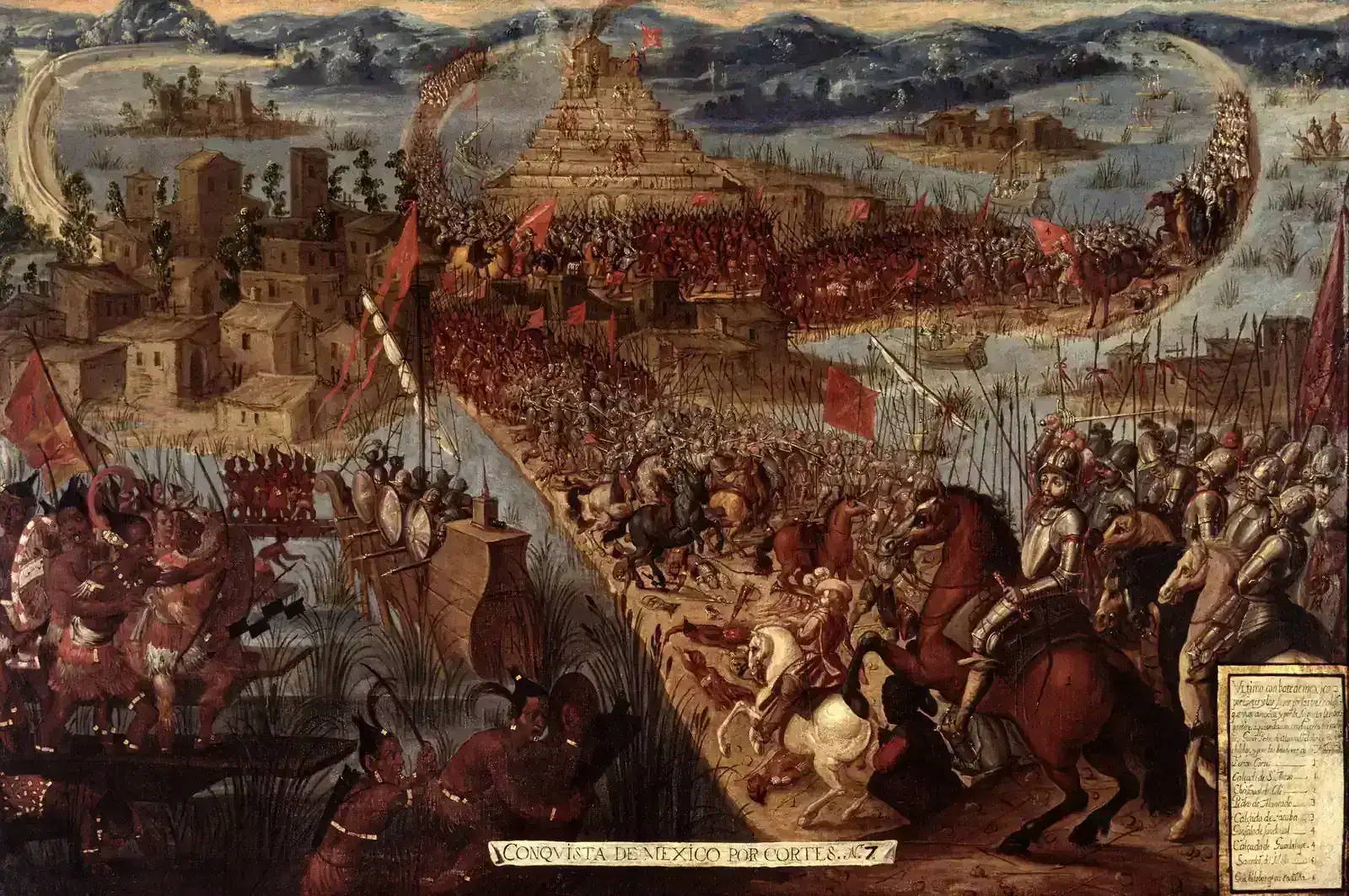
In August 1521, the largest city in the Americas was rubble. Tenochtitlan, a city of roughly 200,000 people built on an island in a lake in central Mexico, had been besieged for three months. The attackers demolished every building as they advanced, filled the canals with debris, and fought block by block until nothing was left. Fewer than a thousand of the attackers were Spanish. The rest, somewhere between 50,000 and 200,000, were indigenous warriors from neighboring states. They had not come to help the Spanish conquer Mexico. They had come to destroy an empire they hated, and the Spanish gave them the opening.
The standard version of this story focuses on Hernan Cortes: bold adventurer, handful of men, superior technology, toppled an empire. Almost none of that is right. The Aztec Empire fell because it was built to fall. It ruled through tribute and terror, gave its subjects nothing in return, and the moment a credible alternative arrived, those subjects switched sides by the tens of thousands.
A tribute empire, not a nation
The Aztec Empire was not really an empire in the way Rome or Persia was. It was a protection racket. From Tenochtitlan, the Mexica people and their two partner cities controlled roughly six million subjects across dozens of states in central Mexico. But they did not govern those states. They did not install officials, build roads between provinces, or create any shared institutions. They simply demanded tribute: food, cotton, gold, jade, cacao, and human beings for sacrifice. Local rulers stayed in power as long as they paid. If they stopped, the Aztec army arrived, burned the temple, killed the leadership, and installed someone more cooperative.
The system ran on fear. Subject peoples had no representation and no reason to feel loyal. The Mexica reinforced the message with human sacrifice on a scale that had no parallel in the Americas. Captured warriors were marched up the steps of the great temple and had their hearts cut out, sometimes by the thousands. The rituals were public and deliberately spectacular. They were not only religious. They were a demonstration of what happened to people who resisted.
This made the empire powerful and it made it fragile. An empire held together by fear works perfectly until someone offers the subjects an alternative.
Cortes and the coalition that did the fighting
Hernan Cortes sailed from Cuba in February 1519 with about 500 soldiers, a few dozen horses, and some small cannons. He landed on the Gulf coast of Mexico and quickly learned two things. First, the peoples along the coast despised their Aztec overlords and were willing to help outsiders fight them. Second, there was a powerful state inland called Tlaxcala that had been at war with the Aztecs for decades.
Tlaxcala was entirely surrounded by Aztec territory. The Aztecs had imposed a trade embargo that cut Tlaxcalans off from salt, cotton, and other basic goods. For years the two sides had fought ritualized "Flower Wars" whose main purpose was capturing prisoners for sacrifice. The Tlaxcalans had every reason to want the empire destroyed.
Cortes fought them first. After roughly three weeks of skirmishing, the Tlaxcalan leaders made a calculation: these strangers with steel armor, horses, and a willingness to kill Aztecs were more useful as allies than as enemies. The alliance that followed was the single most important event of the conquest. From that point on, Cortes never fought without thousands of Tlaxcalan and other indigenous warriors at his side.
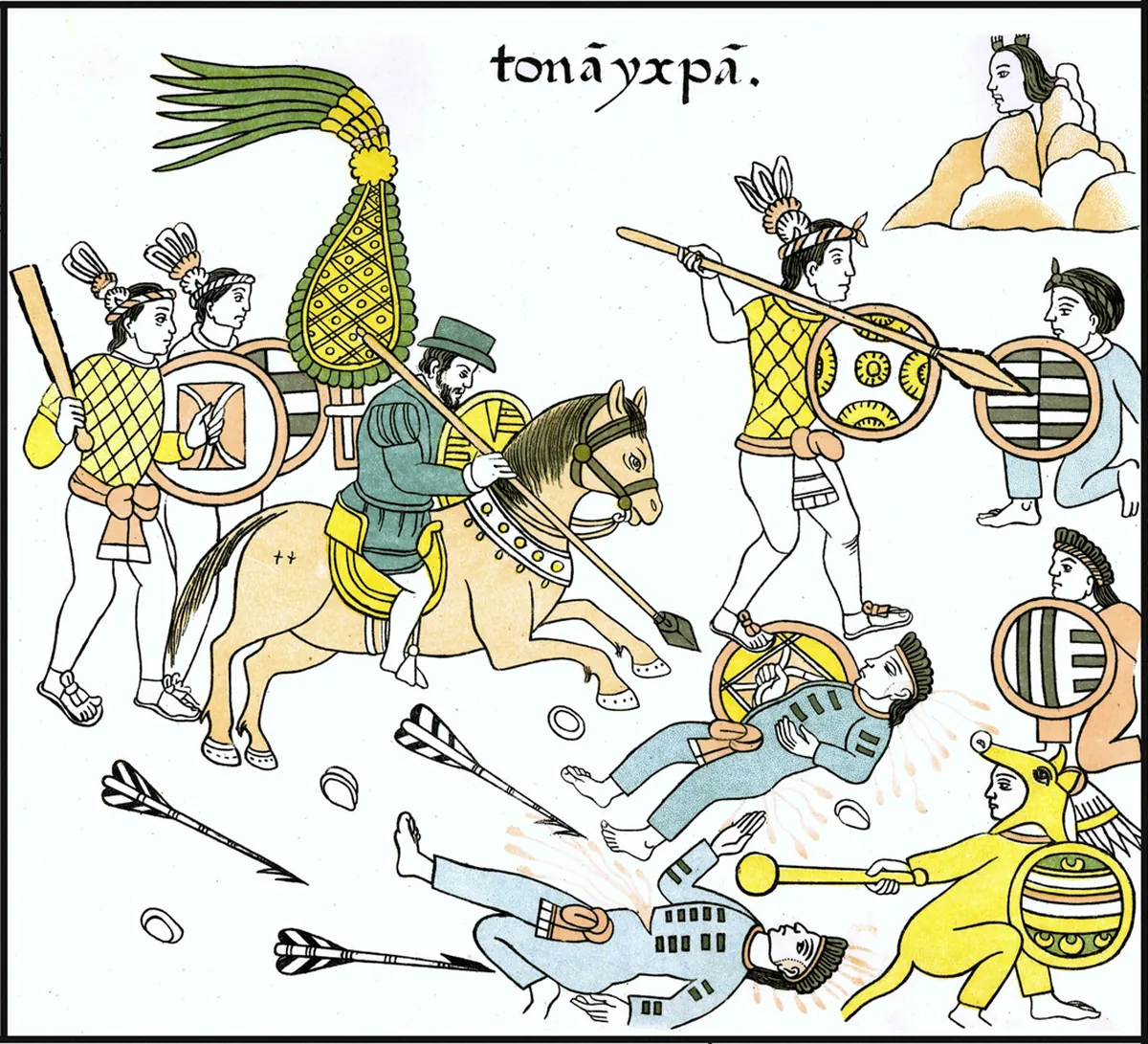
With his new allies, Cortes marched toward Tenochtitlan. At Cholula, a city that had recently switched its loyalty to the Aztecs, the Spanish and Tlaxcalans massacred the local nobility. The message was the same one the Aztecs had always sent, but pointed in a new direction: the old power can no longer protect you.
From guest to fugitive
Cortes entered Tenochtitlan on November 8, 1519, and the Aztec ruler Moctezuma received him as a guest. Within days, Cortes took Moctezuma hostage. For months the Spanish controlled the city through their captive emperor, an arrangement that held together only because Moctezuma cooperated and the Aztec nobility could not agree on what to do.
It collapsed in the spring of 1520. Cortes left the city briefly to deal with a rival Spanish force on the coast. While he was gone, his deputy ordered a massacre of Aztec nobles during a religious festival. The city exploded in revolt. Moctezuma died in the chaos. Sources disagree on whether the Spanish killed him or his own people stoned him to death for cooperating with the invaders.
On the night of June 30, 1520, the Spanish tried to flee along the causeways that connected the island to the mainland. The Aztecs attacked from canoes and from the causeway itself. Hundreds of Spaniards drowned in the lake, many dragged under by the weight of gold they had looted. Between 600 and 1,000 Spaniards died, along with several thousand Tlaxcalan allies. The survivors called it La Noche Triste, the Night of Sorrows, and retreated to Tlaxcala, broken and humiliated.
That should have been the end of it. Cortes had been thrown out, his army was shattered, and the Aztecs had won. What saved him was not Spanish courage. It was a virus.
The virus that decided the war
Smallpox arrived in Mexico in 1520, carried by a member of the rival Spanish expedition Cortes had defeated on the coast. The indigenous population had no immunity. The epidemic swept through central Mexico and hit Tenochtitlan with devastating force. Cuitlahuac, the new Aztec ruler who had led the uprising against the Spanish, died of smallpox after about 80 days in power. The death toll from this first wave ran into the hundreds of thousands.
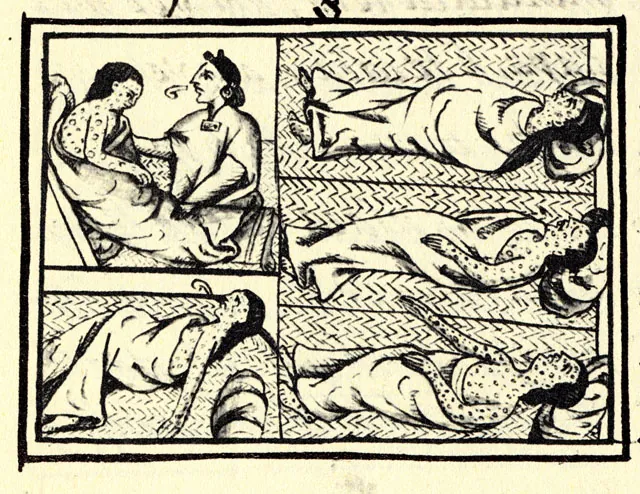
The epidemic shattered Aztec military strength at exactly the moment Cortes was rebuilding. He spent the winter of 1520 to 1521 in Tlaxcala, assembling the largest army the conquest would see. Tlaxcalan laborers built thirteen small warships in pieces, which were carried overland and assembled on the lake. By the spring of 1521, Cortes had about 900 Spanish soldiers and tens of thousands of indigenous allies drawn from Tlaxcala, Texcoco, and other states that had turned against the empire.
The siege of Tenochtitlan began in late May 1521 and lasted nearly three months. The warships gave the attackers control of the lake. Cortes advanced along the causeways, block by block, demolishing every building as he went so his army could not be cut off again. The Aztecs, led by their last ruler Cuauhtemoc, fought for every street. By August, the city was rubble. Cuauhtemoc was captured on August 13, 1521, trying to escape by canoe. The city that a Spanish soldier named Bernal Diaz had compared to a scene from a legend of enchantment was gone.
The speed of the defection is the verdict
The Aztec Empire did not fall because a few hundred Europeans had better weapons. Steel and gunpowder helped, but 500 Spaniards could not have taken a city of 200,000 on their own. The empire fell because it was a system built on extraction and fear, with no mechanism for loyalty. It offered its subjects nothing except the absence of punishment, and the moment a credible alternative appeared, tens of thousands of people who had been paying tribute for generations switched sides within months.
The conquistadors repeated the pattern a decade later. Francisco Pizarro entered the Inca highlands with 168 men in 1532, found an empire weakened by civil war and smallpox, exploited its divisions, and captured the emperor in a single afternoon. He could not have done it without indigenous allies and without the diseases that arrived before he did.
The deeper pattern has kept repeating since. Empires that rule through extraction and give their subjects no stake in the system are always one shock away from collapse. The Ottoman Empire's Balkan provinces broke away the moment external powers offered support. The Soviet Union dissolved in months once the center could no longer compel obedience. In each case, the question was the same: when the cost of loyalty exceeds the cost of defection, how fast do the subjects leave? In the Aztec case, the answer was: almost immediately. Mexico City stands on the ruins of Tenochtitlan. The main plaza, the Zocalo, sits where the Aztec ceremonial center once stood. The remains of the great temple are still being excavated next to the cathedral the Spanish built on top of it. Modern Mexico descends from both sides of the siege, and the collision of 1521 is still written into its geography.
Test what you learned
5 questions on this article. About two minutes, no signup.
Orbis teaches the history behind the news
Orbis covers the fall of the Aztec Empire, the Age of Exploration, and the collisions that built the modern Americas, lesson by lesson.