
Country profile · South Asia
 Afghanistan
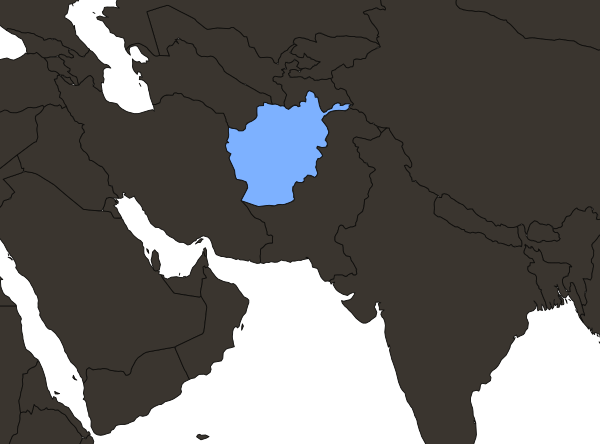
Afghanistan has 43.8 million people (2025). The Taliban took Kabul on August 15, 2021, as the last US troops were leaving, and rule through their Supreme Leader, Hibatullah Akhundzada. Russia is the only country that recognizes their government. Since February 2026 Afghanistan has fought an open border war with Pakistan, the Taliban's old backer.
Where Afghanistan ranks
All rankings →Which alliances is Afghanistan in?
All alliances →How does Afghanistan vote at the UN?
UN votes →Afghanistan has been barred from voting in the General Assembly since January 2024 because of unpaid UN dues. In September 2026 it needed to pay at least $645,500 to regain its vote. Its seat is still held by diplomats of the Islamic Republic, the government that fell when the Taliban took power in August 2021. Each year from 2021 to 2025, the UN's Credentials Committee put off deciding between those diplomats and the Taliban government, which also claims the seat. Those diplomats cast Afghanistan's last recorded votes, in 2023.
Who runs Afghanistan?
The Supreme Leader, Hibatullah Akhundzada, runs Afghanistan by decree from Kandahar. He has led the Taliban since May 2016, after a US drone killed his predecessor in Pakistan. A cabinet in Kabul under Prime Minister Mohammad Hasan Akhund carries out his decrees. There is no constitution, parliament or election, and all political parties have been banned since August 2023. Girls above grade six have been barred from school since March 2022, and women from universities since December 2022. A 2024 law says women's voices should not be heard in public. On July 8, 2025 the International Criminal Court issued a warrant for Akhundzada's arrest for persecuting women. He is a cleric who taught for about 15 years at a religious school near Quetta, in Pakistan. His son died in 2017 driving a car bomb into an army base in Helmand. Only one photograph of him has been verified.
No free photograph of him exists. The Taliban have released one undated picture.
Who are Afghanistan's allies and rivals?
Russia is the Taliban's closest partner. On July 3, 2025 it became the only country to recognize their government, and in May 2026 the two signed a military agreement. China was the first to accept a Taliban ambassador, in January 2024, and India reopened its embassy in Kabul in October 2025. Pakistan, which sheltered the Taliban for decades, is now the enemy. Pakistan says the Taliban harbor the Pakistani Taliban (TTP), who attack it. Kabul denies this. Pakistan declared "open war" on February 27, 2026 and has bombed Kabul at least four times. A strike on a drug treatment hospital in Kabul on March 16, 2026 killed at least 269 people (UN). The border crossings have been closed to trade since October 12, 2025 (map). The United States has no embassy, and the Taliban refused President Trump's demand in September 2025 to return Bagram air base.
Allies and partners
 RussiaOnly country to recognize the Taliban, 2025
 ChinaFirst to accept a Taliban ambassador, 2024
 IndiaReopened its Kabul embassy in October 2025
 UzbekistanSells electricity; a railway is planned
 QatarHosts the Taliban's office since 2013
 United Arab EmiratesAccepted a Taliban ambassador in 2024
Rivals
 PakistanDeclared open war in February 2026
- Islamic State Khorasan (ISIS-K)Killed a Taliban minister in Kabul, 2024
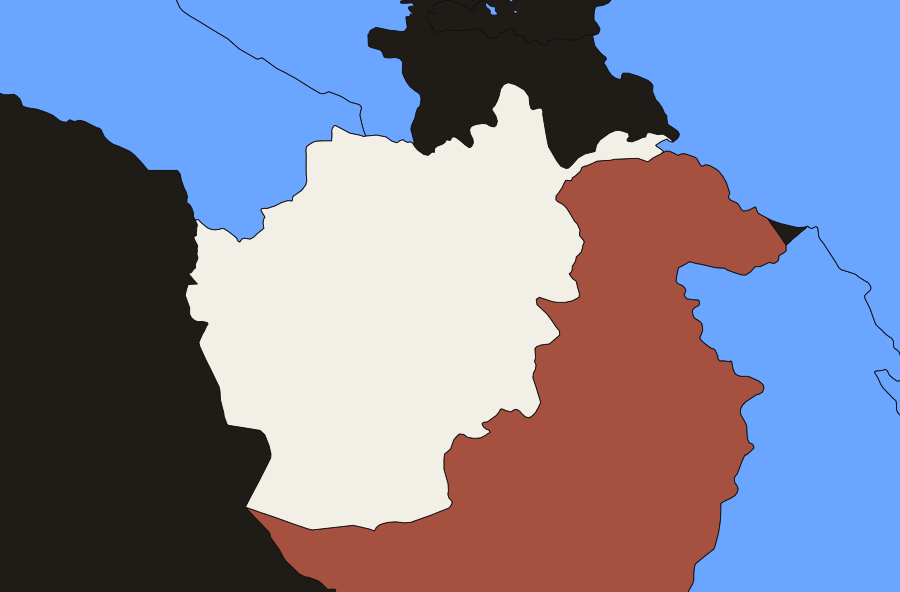
- Torkham crossing Main crossing to Pakistan. Closed to trade since October 12, 2025, it opens only for Afghans sent back.
- Chaman crossing The second main crossing to Pakistan, also closed to trade since October 2025.
- Bagram air base The main US base until 2021. President Trump demanded it back in September 2025.
- Islam Qala crossing One of the two main crossings for Afghans sent back from Iran.
- Qosh Tepa canal A 285 km canal drawing water from the Amu Darya. Uzbekistan and Turkmenistan fear losing water.
- Afghanistan
- Partner
- Rival
Who does Afghanistan trade with?
India bought 43.6% of Afghanistan's goods exports in the year to March 2026, and Iran supplied 31.3% of its imports (chart). Exports were $1.77 billion and imports $13.2 billion. About 83% of exports are food, mainly fruit, nuts and vegetables. Pakistan closed the border to trade on October 12, 2025, so trade moved to Iran's ports and to Central Asia, and coal exports to Pakistan fell to almost nothing. From April to August 2026 Iran was the largest buyer (31.1%), and India fell to fifth. The economy grew 4.8% in 2025, but income per person fell 5.6% as about 3.7 million returnees arrived (World Bank). A 2022 ban cut opium poppy fields from about 233,000 hectares to 10,200 in 2025 (UNODC). About $9.5 billion of central bank reserves have been frozen abroad since 2021.
Sells to
Share of Afghanistan's exports
- India43.6%
- Pakistan22.8%
- Uzbekistan8.0%
- United Arab Emirates6.0%
 Iran3.2%
Buys from
Share of Afghanistan's imports
- Iran31.3%
- United Arab Emirates17.8%
- China8.9%
 Turkmenistan8.0%
- Pakistan7.6%
Goods, Afghan fiscal year April 2025 to March 2026. Shares of Afghanistan's exports and imports from its customs data, compiled by the World Bank.
How strong is Afghanistan's military?
The Taliban have about 172,000 active troops (IISS 2026), the 28th largest army in the site's ranking and about a quarter the size of Pakistan's (chart). The army has eight corps under Defense Minister Mohammad Yaqoob, the son of the Taliban's founder, Mullah Omar. Its fighters use weapons the former army left behind: the US Defense Department valued the US-funded equipment left in 2021 at $7.12 billion. How much of it still works is unknown. The air force has about 34 aircraft, and many may not fly. No working air defense has been confirmed. Security took 45% to 49% of government spending in 2025 and 2026 (World Bank). The main armed threat inside the country is Islamic State's local branch, ISIS-K, with about 2,000 fighters (UN). Afghanistan has no nuclear weapons.
Active troops in South Asia and Iran, 2026
Full ranking → Sri Lanka
 Bangladesh
IISS, The Military Balance, 2024 to 2026 editions
Why are Iran and Pakistan sending Afghans home?
Both governments have ordered Afghans without legal status to leave and are deporting those who stay. About 2.9 million Afghans went back in 2025, almost all from Iran and Pakistan (UNHCR). Another 1,228,920 returned in 2026 up to September 22, and 506,410 of them were deported. Pakistan began expelling undocumented Afghans in November 2023, then holders of Afghan Citizen Cards from April 2025 and registered refugees from September 2025. Iran sped up deportations after its war with Israel in June 2025 and expelled at least 546,000 Afghans in six weeks. In 2026, 84% of returns from Iran were deportations. Iran said about 5 million Afghans still lived there in December 2025. At the end of 2025, 3,702,518 Afghans were refugees abroad, the 4th most from any country (chart). The UN's 2026 appeal counts 21.9 million Afghans in need of aid, and it was 29.7% funded in September.
Refugees by country of origin, end of 2025
Full ranking → Venezuela6,459,716
 Ukraine5,224,131
 Syria4,865,764
- Afghanistan3,702,518
 Sudan2,820,737
 South Sudan2,386,499
UNHCR Refugee Population Statistics Database