
Country profile · North Africa
 Sudan
Sudan
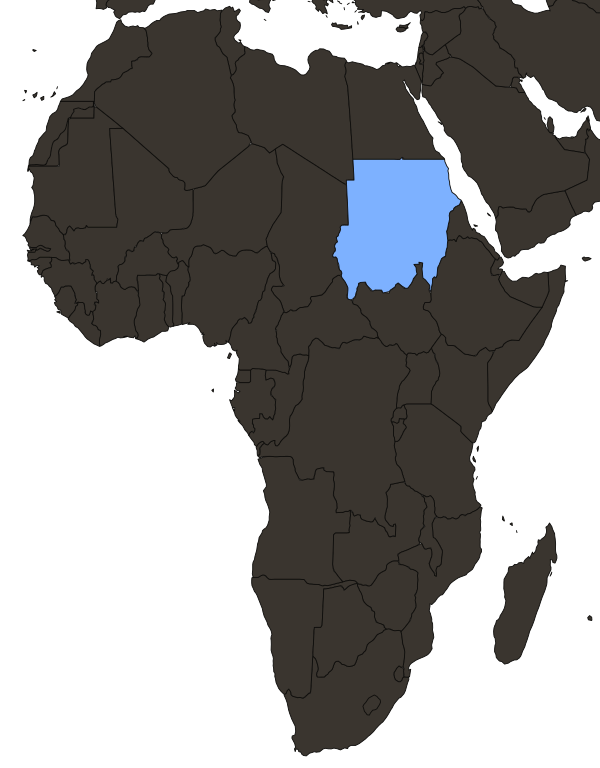
Sudan has 51.7 million people (2025). Since April 15, 2023 its army, led by General Abdel Fattah al-Burhan, has fought the Rapid Support Forces, a paramilitary force the state created from Darfur militias. The army holds Khartoum and the east. The RSF holds almost all of Darfur. The UN calls it the world's largest displacement crisis.
Where Sudan ranks
All rankings →Which alliances is Sudan in?
All alliances →Disputed territories involving Sudan
All disputed territories →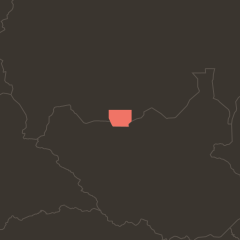
How does Sudan vote at the UN?
Sudan's voting record → With China
 With Russia
 With India
 With the US
Share of recorded UN General Assembly votes on which Sudan and each country voted the same way, 2025.
Who runs Sudan?
General Abdel Fattah al-Burhan, the army commander, runs Sudan as chairman of the Sovereignty Council. He took over after the army removed President Omar al-Bashir on April 11, 2019, shared power with civilians, then led a coup on October 25, 2021. Constitutional changes in February 2025 set a new 39-month transition and widened the council's powers. Kamil Idris has been prime minister since May 2025, and on January 11, 2026 the government moved back to Khartoum from Port Sudan. No election is scheduled. The RSF runs a rival government from Nyala in Darfur. Its commander, Mohamed Hamdan Dagalo, known as Hemedti, was sworn in as its head in August 2025, and no country recognizes it. Al-Burhan was born in 1960 in Gandatu, a village north of Khartoum. He met Israel's prime minister in Uganda in 2020, and he spent the first four months of the war trapped in army headquarters.
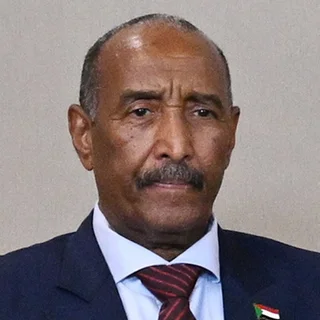
Photo (2025): Press Service of the President of Azerbaijan, Wikimedia Commons, CC BY 4.0
Who are Sudan's allies and rivals?
Egypt is the army's main backer. The New York Times reported in February 2026 that Turkish-made drones fly from an Egyptian air base to strike the RSF. Turkey's Baykar sold the army drones in 2023. Saudi Arabia signed a strategic cooperation agreement in August 2026. Eritrea trains army-aligned militias. The United Arab Emirates is the main rival. UN experts called reports of Emirati supplies to the RSF through Chad "credible." The UAE denies arming anyone. Sudan cut relations with the UAE on May 6, 2025. Chad closed its border in February 2026 after clashes. Sudan and Ethiopia accuse each other of backing rebels. The United States is pushing a 90-day truce. The RSF accepts it. The army wants the RSF to leave cities first. In September 2026 the US held back al-Burhan's visa for the UN General Assembly.
Allies and partners
 EgyptMain backer; drones reported flying from its base
 Saudi ArabiaStrategic cooperation council agreed, August 2026
 TurkeyBaykar sold the army drones in 2023
 EritreaTrains and arms army-aligned militias
 QatarPolitical backer of the army government
Rivals
- Rapid Support Forces (RSF)At war with the army since 2023
 United Arab EmiratesAccused of arming the RSF; ties cut 2025
 ChadRSF supply route; border closed in 2026
 EthiopiaEach accuses the other of backing rebels
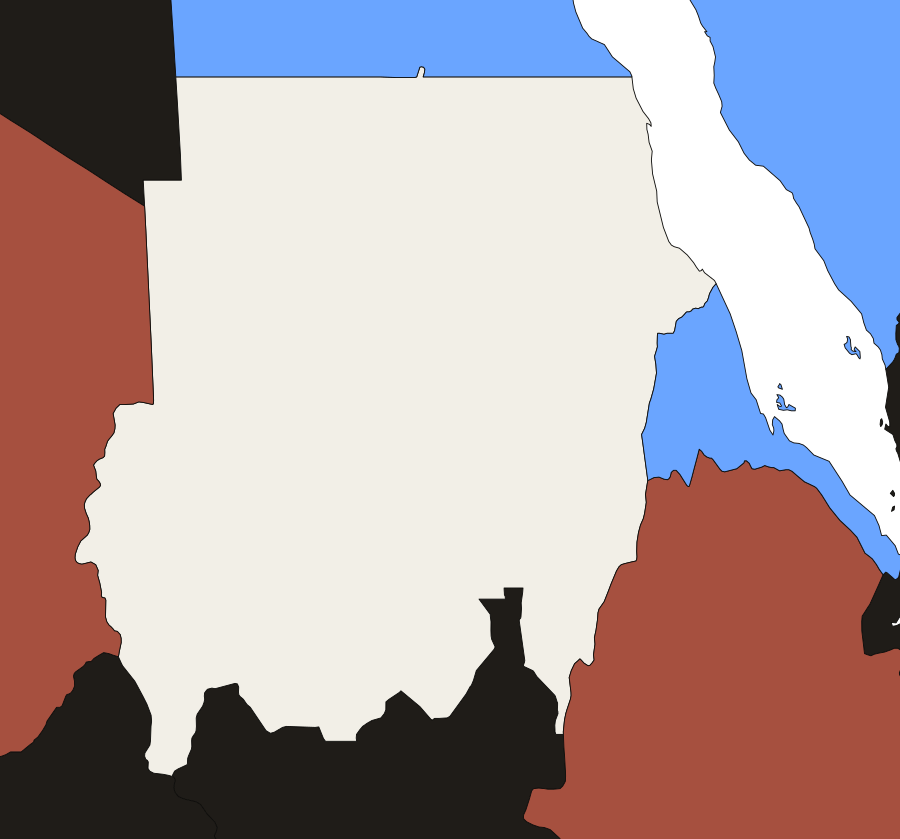
- Port Sudan The army's wartime capital from 2023. RSF drones hit it for six days in May 2025.
- Khartoum Retaken by the army in 2025. The government moved back in January 2026.
- El Obeid Army-held city under RSF drone attack. The army reopened the highway to Khartoum in July 2026.
- El Fasher Taken by the RSF on October 26, 2025 after an 18-month siege. The UN documented more than 6,000 killed in three days.
- Nyala Seat of the RSF's rival government, sworn in in August 2025.
- Sudan
- Partner
- Tensions
Why is there a war in Sudan?
The war began on April 15, 2023 over how to merge the RSF into the army. The RSF grew from the Janjaweed militias the government used in Darfur from 2003. Al-Burhan and Hemedti removed President Bashir together in 2019 and the civilian government in 2021, then turned on each other. The army retook Khartoum in 2025. The RSF took El Fasher, the last army stronghold in Darfur, on October 26, 2025. The fighting is now mainly in Kordofan. Drones are the leading cause of civilian deaths, the UN says. ACLED counted over 58,000 deaths from violence by April 2026. Estimates including hunger and disease run from 150,000 to 400,000. The United States determined in January 2025 that the RSF committed genocide. In 2025 it also determined that the government used chemical weapons in 2024. The government denies it. There is no truce.
How many people has Sudan's war driven from their homes?
The war has driven about 13 million people from their homes. About 8.6 million are displaced inside Sudan (IOM, September 2026), down from a peak of 11.58 million in January 2025. About 5.1 million have returned. The UN counts more than 3.5 million Sudanese refugees and asylum seekers abroad. About 1.4 million are in Egypt and about 942,000 have reached Chad. By UNHCR's standard count, Sudan had the 5th most refugees abroad at the end of 2025 (chart). Famine was confirmed in Zamzam camp in August 2024 and in El Fasher and Kadugli in late 2025. At the peak in September 2025, 21.2 million people faced acute hunger. No area was classed as in famine in 2026, but 14 areas were at risk. The 2026 humanitarian appeal asks for $2.9 billion, and 33.7 million people need aid, the most of any country.
Refugees by country of origin, end of 2025
Full ranking → Venezuela6,459,716
 Ukraine5,224,131
 Syria4,865,764
 Afghanistan3,702,518
- Sudan2,820,737
 South Sudan2,386,499
UNHCR Refugee Population Statistics Database
How does gold pay for Sudan's war?
Gold is Sudan's largest export and funds both sides. The state mining company reported a record 70 tonnes in 2025, but only 14.7 tonnes were officially exported, earning $1.54 billion, 58% of goods exports. The rest was smuggled or kept in the country. Much of it reaches the United Arab Emirates, which took about 97% of official gold exports in 2024. The RSF mines gold in Darfur. The EU banned imports of Sudanese gold in July 2026. Other exports are livestock and sesame. Before the war Sudan supplied 70 to 80% of the world's gum arabic. Total exports fell to $2.64 billion in 2025. The economy shrank about 39% in 2023 and 2024 combined. Government debt is 187.6% of GDP, the 3rd highest share in the world (IMF). The pound fell from about 600 per dollar before the war to 8,400 on the street in September 2026.