
Country profile · Caribbean
 Cuba
Cuba
Cuba had 9.43 million people at the end of 2025, 313,414 fewer than a year earlier (ONEI). The Communist Party is the only legal party. Miguel Díaz-Canel has been head of state since April 19, 2018 and party leader since 2021. Since January 2026 US measures have cut Cuba's oil supply, causing the worst blackouts on record.
Where Cuba ranks
All rankings →Which alliances is Cuba in?
All alliances →Who runs Cuba?
President Miguel Díaz-Canel runs Cuba. He was born in 1960 in Placetas and trained as an engineer. He became head of state on April 19, 2018, and in 2021 he succeeded Raúl Castro as First Secretary of the Communist Party, the only legal party. In 2023 the National Assembly gave him his second and last term, to 2028. Its 470 deputies were elected that year with one candidate per seat. Raúl Castro, now 95, holds no post but still shapes big decisions. In May 2026 the United States charged him with murder over the shooting down of two exiles' planes in 1996. The party congress due in April 2026 was postponed with no new date. Protests over blackouts have spread. In March 2026 protesters burned furniture from the party office in Morón. Díaz-Canel told NBC in April 2026 that he is not stepping down.
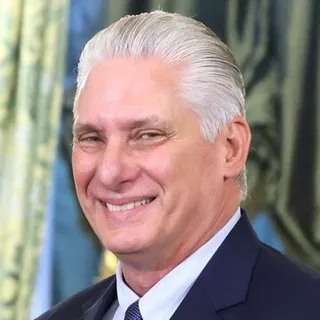
Photo (May 2025): Kremlin.ru, Wikimedia Commons, CC BY 4.0 (cropped)
Who are Cuba's allies and rivals?
The United States is Cuba's main rival, and its government says Cuba needs new leaders. On January 3, 2026, US forces seized Venezuela's president, Nicolás Maduro. Cuba says 32 of its soldiers and intelligence officers died guarding him. Venezuela had sent Cuba cheap oil since 2000, about a third of its needs by 2025. Those shipments stopped, and Cuban advisers left Venezuela. Russia supports Cuba politically, but only one Russian tanker has arrived since January. Washington let it through in March. China is Cuba's largest supplier. Chinese panels fill most of Cuba's solar parks, and China pledged 60,000 tonnes of rice. A new antenna array at Bejucal, near Havana, is suspected to be Chinese-linked. Mexico stopped sending oil in January 2026 but sends aid by ship. The United States has kept a naval base at Guantánamo Bay since 1903, which Cuba's government calls illegal.
Allies and partners


Rivals
 United StatesEmbargo since 1962; blocks oil shipments since 2026
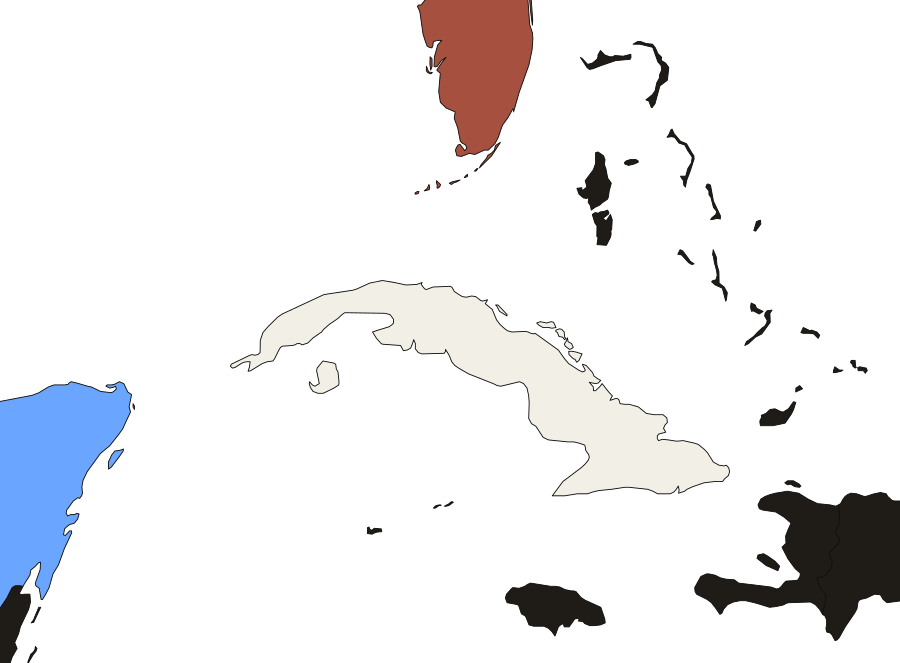
- Guantánamo Bay US Navy base, leased since 1903. Cuba's government has called it illegal and refused the rent since 1959.
- Bejucal A 32-antenna array, likely for listening to radio signals, was finished by June 2026 (CSIS). China's role is suspected, not proven.
- Moa Nickel and cobalt mines run with Canada's Sherritt. Mining stopped in 2026 after Sherritt pulled out under US sanctions.
- Cuba
- Partner
- Rival
Who does Cuba trade with?
Canada buys the most from Cuba (chart): 30.8% of goods exports in 2024, mostly nickel refined in Alberta by Canada's Sherritt. China supplied 15.9% of imports, Spain 13.2% and Venezuela 11.2%. Cuba sold $1.47 billion of goods in 2024 and bought $8.07 billion (ONEI). Services earn more: $7.77 billion that year, mostly from doctors and other professionals sent abroad. The US State Department says 15,000 to 18,000 were abroad in 2026, down from about 24,000. Cuba had 4.28 million visitors in 2019 and 1.81 million in 2025. Arrivals fell another 64.4% in January to August 2026, as airlines stopped flying and hotel chains left. A US law of 2000 lets American firms sell Cuba food for cash. The US Census Bureau counts $809.6 million of US goods sold to Cuba in 2025, mostly chicken. The average state wage was worth about $10 a month in April 2026.

 Netherlands
 Switzerland

Goods, 2024, preliminary. Statistical Yearbook of Cuba (ONEI). Cuba's statistics office records much less trade with the United States than the US Census Bureau does.
Why does the United States have an embargo on Cuba?
After Fidel Castro took power on January 1, 1959, Cuba seized American-owned property worth $1.9 billion, by the US government's count. President Eisenhower banned most exports to Cuba on October 19, 1960. President Kennedy declared a full embargo on February 3, 1962. In 1996, after Cuba shot down two exiles' planes, Congress wrote the embargo into law. Since then no president can lift it alone, and the law keeps it until Cuba has a government without Fidel or Raúl Castro. President Obama eased it in 2015, and President Trump tightened it again. In 2026 the United States went further. It threatened countries that ship oil to Cuba, the Coast Guard stopped fuel ships, and sanctions since May 1 reach foreign companies. Fuel imports now cover under 3% of needs, and in Havana blackouts can last over 20 hours a day. In October 2025 the UN General Assembly voted 165 to 7 for ending the embargo.
Why are so many Cubans leaving?
Cuba's statistics office says the population fell from about 11.1 million at the end of 2021 to 9.43 million at the end of 2025. Part of the fall comes from a change in how people are counted. Most of it is emigration: 245,264 more people left than arrived in 2025 alone. US border agents stopped Cubans about 642,000 times in the three years to September 2024. That is far more than the 1980 Mariel boatlift (about 125,000) and the 1994 rafter crisis (about 35,000) together. People leave because of blackouts, food shortages and state wages worth about $10 a month. Those who stay are getting older. Cuba has the oldest population in the Americas (chart), and 26.7% of Cubans are 60 or over. Women have 1.29 children on average, the fewest since 1958. The UN's estimate of 10.9 million people does not yet count most of those who left.
The oldest populations in the Americas, 2025
Full ranking →- Cuba42.2
 Canada40.6
 Barbados39.4
- United States38.5
 Trinidad and Tobago37.7
 Chile36.9
 Uruguay36.4
 Bahamas35.3
 Costa Rica35.2
 Brazil34.8
UN World Population Prospects 2024