
Country profile · North America
 Canada
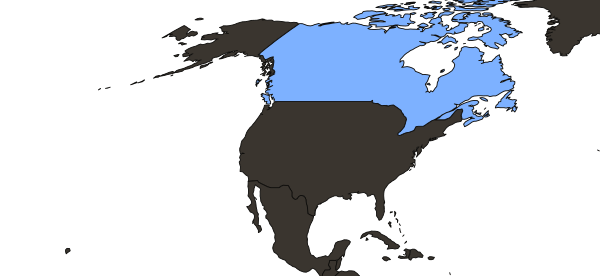
Canada is the second-largest country by area and the fourth-largest oil producer. Mark Carney of the Liberal Party has been prime minister since March 2025. The Liberals hold 173 of 343 seats. The United States bought 72.5% of Canada's goods exports in 2025. Since August 2026 the two countries have been in a trade war over 50% US tariffs.
Where Canada ranks
All rankings →Who runs Canada?
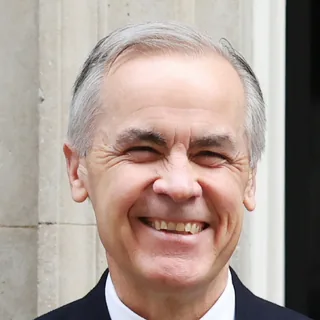
Prime Minister Mark Carney runs Canada. He became prime minister on March 14, 2025, without ever having held elected office. He was a backup goalie on Harvard's hockey team, and he later led the Bank of Canada and then the Bank of England, the first non-Briton to run the Bank of England. His Liberals won 169 of 343 seats in April 2025. They reached a majority in April 2026, after five opposition MPs crossed the floor. Two votes in October 2026 test national unity. On October 5 Quebec elects a new provincial government. The separatist Parti Québécois, which promises a referendum on independence, leads the polls. On October 19 Alberta votes on whether to start the legal process toward a referendum on leaving Canada.
- Liberals 173
- Conservatives 137
- Other parties and 6 vacant seats 33
Photo (2026): Simon Dawson, No 10 Downing Street, Wikimedia Commons, OGL 3.0
Who are Canada's allies and rivals?
The United States is Canada's closest ally and now its opponent in a trade war. The two countries defend North American airspace together through NORAD and share the world's longest land border, 8,891 km. On August 22, 2026, after talks broke down, the US put 50% tariffs on about C$27.6 billion of Canadian goods. Prime Minister Carney said: "You're at war when you get attacked. We got attacked." Canada answered with its own tariffs on September 8. President Trump has repeatedly called Canada a "51st state". Canada is the first non-European country in the EU's SAFE defense loan program, and on September 17, 2026 Carney welcomed a proposal to make Canada the EU's first associate member.
Allies and partners
- European UnionFirst non-European country in SAFE defense loans
 United KingdomSecond-largest export market in 2025, led by gold
 FranceSpace, energy and AI deals, September 2026
 GermanyPreferred builder for up to 12 submarines
 DenmarkShares Hans Island; backed on Greenland
 LatviaCanada leads NATO's multinational brigade there
Tensions
 United States50% tariffs on Canadian goods since August 2026
 China100% tariff on Canadian canola oil
 RussiaRival Arctic seabed claims, including the North Pole
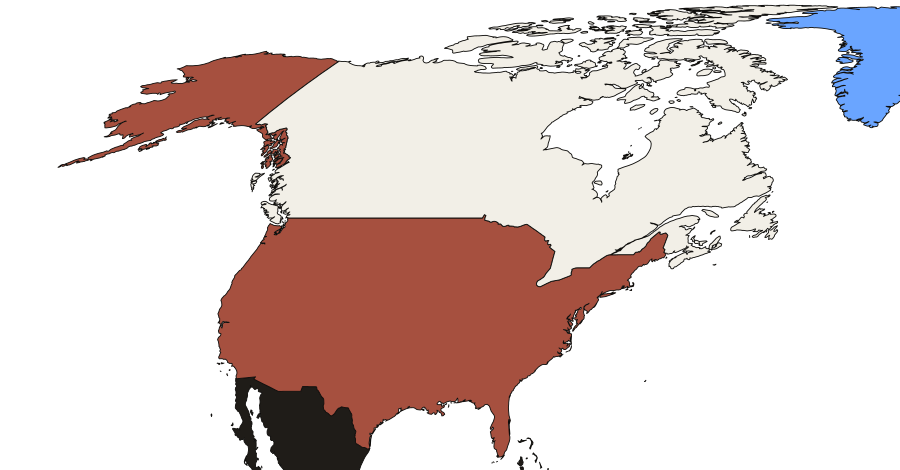
- Beaufort Sea Both countries claim a wedge of about 21,000 km². A task force set up in 2024 has made little progress.
- Northwest Passage Canada says it is internal waters. The US says it is an international strait.
- Saint-Pierre and Miquelon French islands off Newfoundland. Carney and President Macron met there on September 20, 2026, the first official visit by a Canadian prime minister.
- Windsor-Detroit North America's busiest trade corridor. The Gordie Howe bridge opened beside the Ambassador Bridge on July 27, 2026.
- Canada
- Partner
- Tensions
Who does Canada trade with?
Canada exported C$779.0 billion of goods in 2025 and imported C$789.0 billion. The United States took 72.5% of exports, down from 76.3% in 2024, the lowest share since the early 1980s. Exports to other countries rose 17.2% to a record. Energy products made up about 24% of exports. In December 2025, 89% of Canada's exports to the US entered tariff-free under the Canada-US-Mexico trade agreement. The new 50% tariffs cover about 5%. Steel was hit hardest: exports in June 2026 were 43% lower than in December 2024. Prime Minister Carney has set a goal of doubling non-US exports within a decade. LNG Canada approved a C$33 billion expansion on September 29, 2026.
Sells to
Share of Canada's exports
- United States72.5%
- United Kingdom6.0%
- China4.4%
 Japan1.9%
 Netherlands1.2%

Goods trade, 2025, customs basis. Shares of Canada's exports and imports in Statistics Canada data published by Global Affairs Canada. On Statistics Canada's balance of payments basis, the US share of exports was 71.7%.
How strong is Canada's military?
SIPRI estimates Canada spent $37.5 billion on its military in 2025, 1.6% of GDP. By NATO's wider count, Canada reached 2% in its 2025-26 fiscal year for the first time in about 35 years. Like other NATO members, Canada has pledged to spend 5% by 2035. The Regular Force had 68,714 members in August 2026, below its authorized 71,500. Only one of four secondhand Victoria-class submarines was seaworthy in July 2026. In July 2026 Canada chose Germany's TKMS as preferred builder of up to 12 new submarines. Only 16 of 88 F-35 fighters ordered in 2023 are firmly committed. Canada is working with Australia on a long-range Arctic radar and has ordered two polar icebreakers, due around 2030.
Military spending as a share of GDP in the G7, 2025
Full ranking →- United States3.1%
- United Kingdom2.4%
- Germany2.3%
- France2.0%
 Italy1.9%
- Canada1.6%
- Japan1.4%
SIPRI Military Expenditure Database, 2026 edition
How much oil does Canada produce?
Canada produced 4.96 million barrels a day of oil and other liquids in 2025 (EIA), the fourth most in the world. About two-thirds of Canada's crude comes from the oil sands, and the province of Alberta produces 83.8% of it. Canada's proven reserves, 163 billion barrels, are also the fourth-largest. In 2025, 90.1% of Canada's crude exports went to the United States, which bought 63.4% of its imported crude from Canada. Oil is excluded from the new 50% US tariffs. The Trans Mountain pipeline expansion to the Pacific coast opened in May 2024, and about two-thirds of the tankers leaving its terminal near Vancouver go to Asia. Alberta has proposed a second pipeline to the Pacific coast, carrying 1 million barrels a day.
The largest oil producers, 2025 (barrels a day)
Full ranking →- United States13,586,000
- Russia9,885,000
 Saudi Arabia9,556,000
- Canada4,964,000
 Iraq4,388,000
- China4,325,000
 Iran4,051,000
 United Arab Emirates3,771,000
 Brazil3,769,000
US Energy Information Administration, International Energy Statistics