Why did Bangladesh split from Pakistan?
Pakistan was created in two halves a thousand miles apart. When the eastern half won an election in 1970, the western half sent the army instead of handing over power.
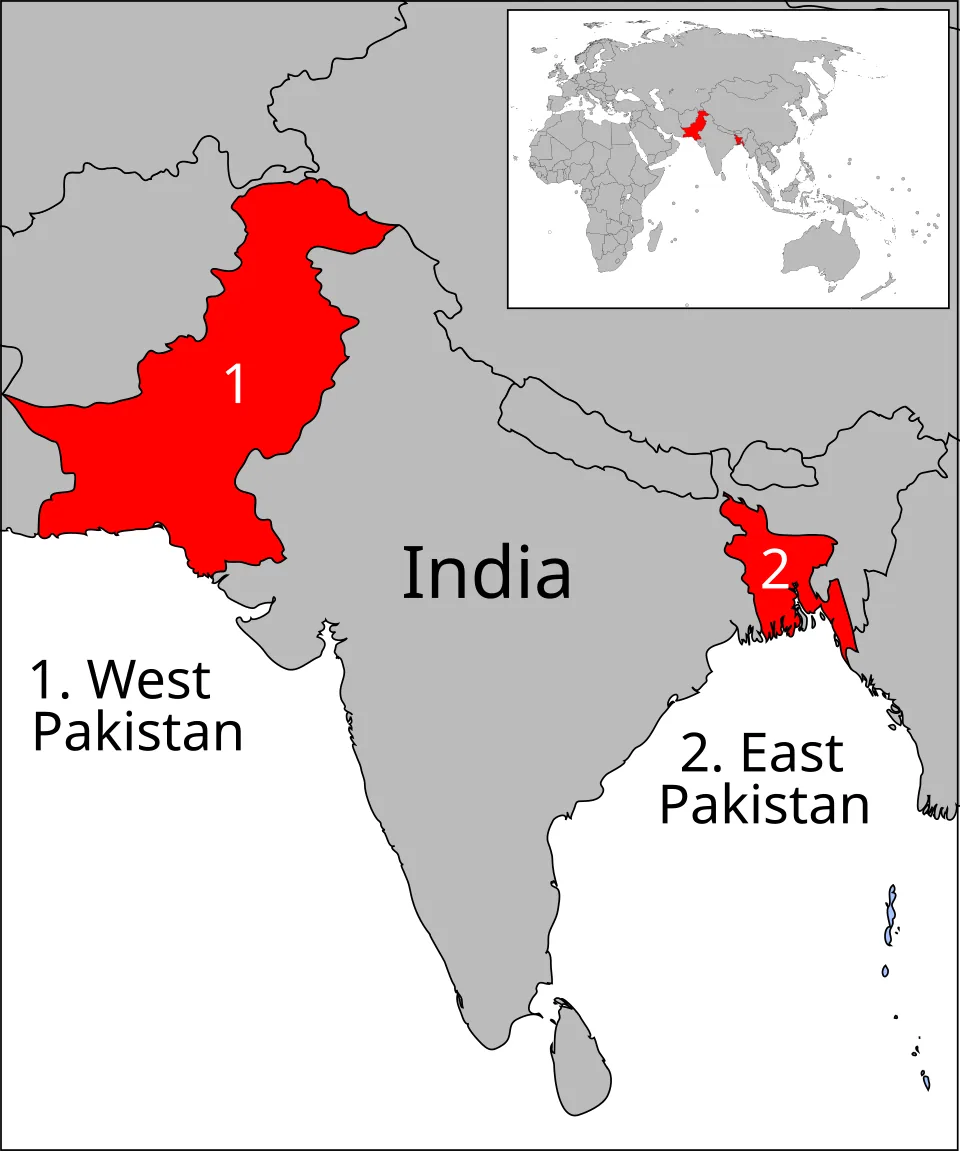
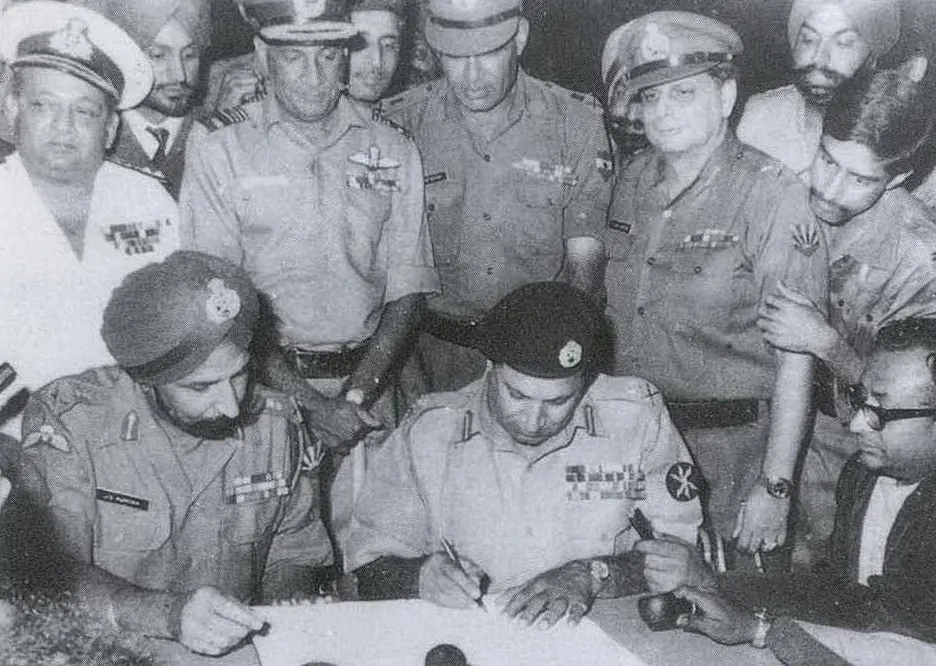
On December 16, 1971, Lieutenant General A.A.K. Niazi of the Pakistan Army signed a surrender document at Ramna Race Course in Dhaka. Roughly 93,000 Pakistani soldiers laid down their weapons. The country they had been fighting to hold together was finished. East Pakistan, the Bengali-speaking half of a nation split across a thousand miles of Indian territory, became Bangladesh.
The split had been building for twenty-four years. Pakistan was born in 1947 as two wings with almost nothing in common except religion. The western wing held the capital, the army, and the money. The eastern wing held the majority of the population and grew the jute that paid for most of Pakistan's exports. When Bengalis asked for a share of power, they were told to wait. When they won an election, the army came instead.
A country in two pieces
Pakistan was carved out of British India in 1947 on the idea that the subcontinent's Muslims needed their own state. The problem was geography. The two largest Muslim populations sat on opposite sides of India, separated by more than a thousand miles of foreign territory. West Pakistan got the capital, Karachi, and later Islamabad. East Pakistan got Dhaka and a river delta prone to cyclones and flooding. The two halves shared a religion and a flag. They did not share a language, a cuisine, a climate, or much else.
From the start, the western wing ran the country. The military officer corps was overwhelmingly Punjabi and Pashtun. The civil service recruited mostly from the west. East Pakistan grew roughly 60 percent of Pakistan's export earnings through jute, the golden fiber used in sacking and rope, but most of the revenue was spent in the west. By the late 1960s, development spending per person in West Pakistan was roughly double that of East Pakistan. Bengalis held fewer than 15 percent of senior civil service posts and a similar share of military officer positions.
The resentment started with language. In 1948, Muhammad Ali Jinnah, the founder of Pakistan, declared that Urdu would be the sole national language. Most of East Pakistan spoke Bengali. On February 21, 1952, police in Dhaka fired on students protesting the Urdu-only policy. Several were killed, including Abul Barkat and Rafiquddin Ahmed. The date is now a national holiday in Bangladesh and UNESCO's International Mother Language Day. The language movement did not start the split, but it taught Bengalis something they would not forget: the government in the west did not consider their culture worth protecting.
The election Pakistan would not honor
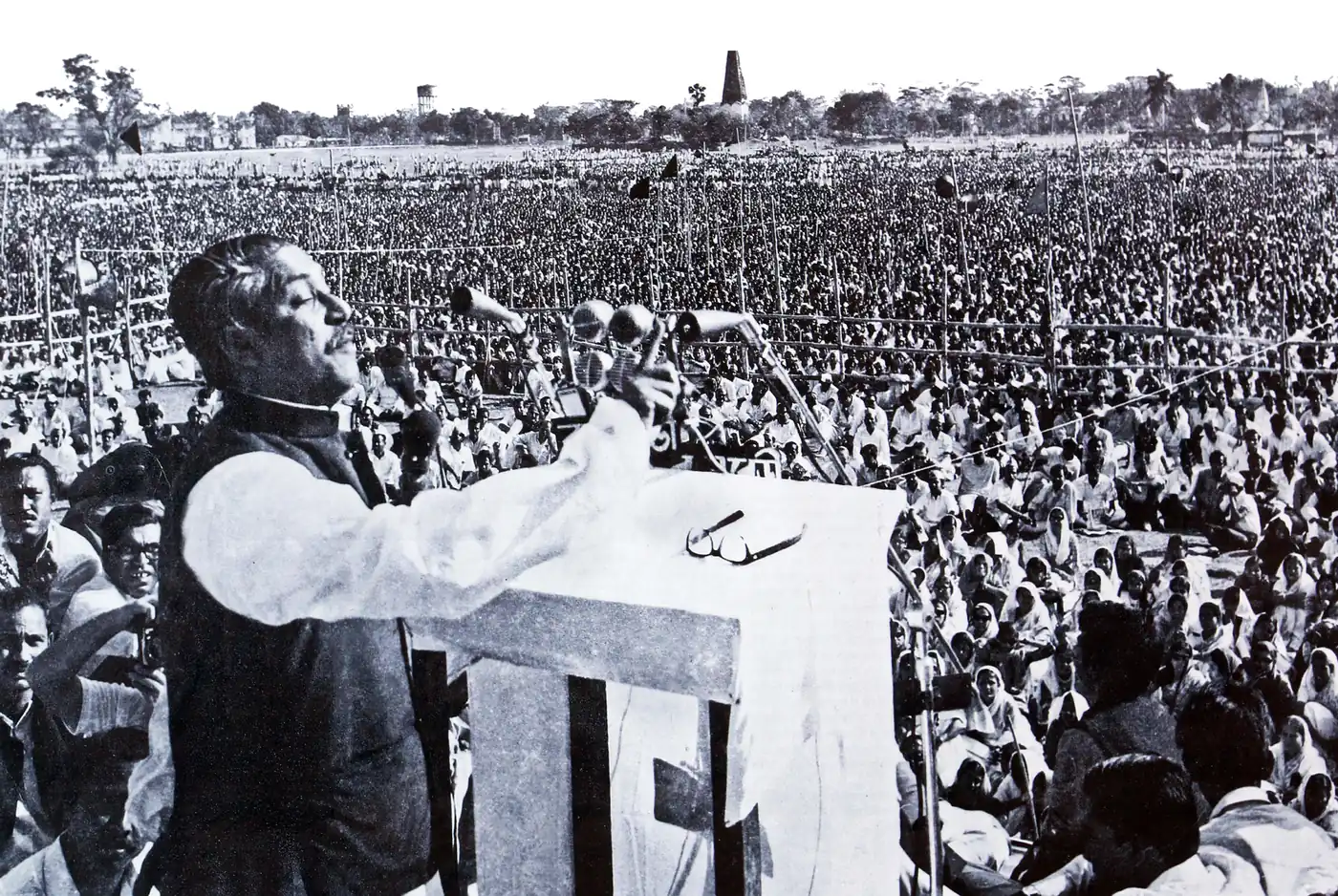
By the late 1960s, a Bengali politician named Sheikh Mujibur Rahman had become the voice of East Pakistan. Mujib, as everyone called him, was a tall, charismatic organizer who had spent years in and out of Pakistani prisons for demanding autonomy. In 1966 he laid out six points that amounted to self-government for the east: its own taxation, its own foreign exchange earnings, its own militia. The military government of Ayub Khan charged him with treason.
Then a cyclone made everything worse. On November 12, 1970, Cyclone Bhola struck the coast of East Pakistan. It was one of the deadliest natural disasters in recorded history, killing somewhere between 300,000 and 500,000 people. The military government in Islamabad, led by General Yahya Khan, responded slowly and with visible indifference. Relief supplies arrived late. The president flew over the damage and went home.
A month later, Pakistan held its first national election based on universal adult suffrage. Mujib's Awami League won 167 of the 169 seats in East Pakistan, giving it an outright majority in the 313-seat National Assembly. The result was unambiguous: the Awami League had the right to form a government. Zulfikar Ali Bhutto, the leader of the Pakistan People's Party, which had swept the west, refused to sit in an assembly led by a Bengali. Yahya Khan sided with Bhutto. The assembly session, scheduled for March 3, 1971, was postponed indefinitely.
East Pakistan erupted. Millions poured into the streets. Mujib gave the speech of his life on March 7 at the Racecourse Ground in Dhaka, before a crowd estimated at over a million people. He stopped short of declaring independence, but the meaning was unmistakable: "The struggle this time is for our freedom. The struggle this time is for our independence."
Operation Searchlight
On the night of March 25, 1971, the Pakistan Army launched Operation Searchlight. Soldiers fanned out across Dhaka, targeting the university, Hindu neighborhoods, and known Awami League supporters. Professors were dragged from their homes and shot. The army set fire to dormitories at Dhaka University and killed students in their rooms. Jagannath Hall, a Hindu dormitory, was attacked with particular ferocity.
Mujib was arrested at his home that night and flown to West Pakistan, where he would spend the next nine months in a military prison. Before his arrest, he sent a message declaring Bangladesh independent. Within days, Bengali soldiers and police who had defected from the Pakistani military formed the Mukti Bahini, the liberation army.
What followed was nine months of war and mass killing. The Pakistani army targeted intellectuals, Hindus, and anyone suspected of sympathizing with independence. The scale of the killing remains disputed. Bangladesh's official figure is three million dead. Most independent estimates range from 300,000 to 500,000, with some scholars placing it higher. Whatever the exact number, the violence was systematic.
Roughly 10 million people fled across the border into India, most of them into the Indian state of West Bengal. It was one of the largest refugee crises of the twentieth century. India's prime minister, Indira Gandhi, spent months preparing diplomatically and militarily. The United States, under Richard Nixon, sided with Pakistan, partly because Yahya Khan was secretly arranging Nixon's diplomatic opening to China. The Soviet Union signed a friendship treaty with India in August 1971.
Thirteen days
On December 3, 1971, Pakistan launched preemptive air strikes against Indian airfields in the west. India had been supplying and training the Mukti Bahini for months, and the strikes gave Indira Gandhi the justification to send the Indian Army into East Pakistan openly. Ground forces advanced from multiple directions, bypassing fortified positions and heading straight for Dhaka. The Pakistani garrison, demoralized and cut off by a thousand miles of Indian territory, collapsed in less than two weeks.
On December 16, Niazi surrendered. The ceremony took place at the same Racecourse Ground where Mujib had spoken nine months earlier. Roughly 93,000 Pakistani troops became prisoners of war. It was the largest military surrender since the Japanese capitulation in 1945. Bangladesh was free.
Mujib was released from prison in Pakistan on January 8, 1972, and flew home to Dhaka via London. He became the first prime minister of Bangladesh. The country he inherited had been wrecked: its infrastructure destroyed, its intellectuals murdered, its economy shattered. Bangladesh started life as one of the poorest countries on earth, with a per capita income below $100 a year.
What the split left behind
The 1971 war reshaped the subcontinent. Pakistan lost more than half its population in a fortnight. The army, which had started the disaster, blamed the civilians. Bhutto took power as president, oversaw the return of the prisoners of war, and launched Pakistan's nuclear weapons program, promising that Pakistan would "eat grass" if necessary to match India's bomb. The military's grip on Pakistani politics, already firm, became permanent. Every lesson the generals drew from 1971 pointed the same way: more control, more weapons, more suspicion of India.
Bangladesh struggled for decades. Mujib was assassinated in a military coup in August 1975, along with most of his family. The country cycled through military governments and fragile democracies, battered by floods and famine. But it survived, and by the 2010s it had become one of the quiet success stories of the developing world. Its garment industry grew into the world's second largest after China's. Life expectancy, which was 47 at independence, passed 72 by 2023. Bangladesh's economy per person now exceeds Pakistan's, the country that once ruled it and spent its earnings.
December 16 is Victory Day in Bangladesh. In Pakistan, the date barely registers. The country that was supposed to prove that religion alone could hold a nation together learned in 1971 that it could not. The two halves of Pakistan shared a faith, a flag, and a founding myth. They did not share a language, a fair deal, or a vote that counted. When the eastern half finally won the right to govern, the western half chose war over democracy. The result was not unity but a new country, born in blood and built on the memory of everything Pakistan had refused to share.
Test what you learned
6 questions on this article. About two minutes, no signup.
Orbis has a full course on this
India: From Midnight to Modi. 27 lessons, each ending with a quiz like this one.