Why do India and Pakistan hate each other?
In 1947 the two countries were one. The split killed a million people, started four wars, and built two nuclear arsenals pointed at each other.
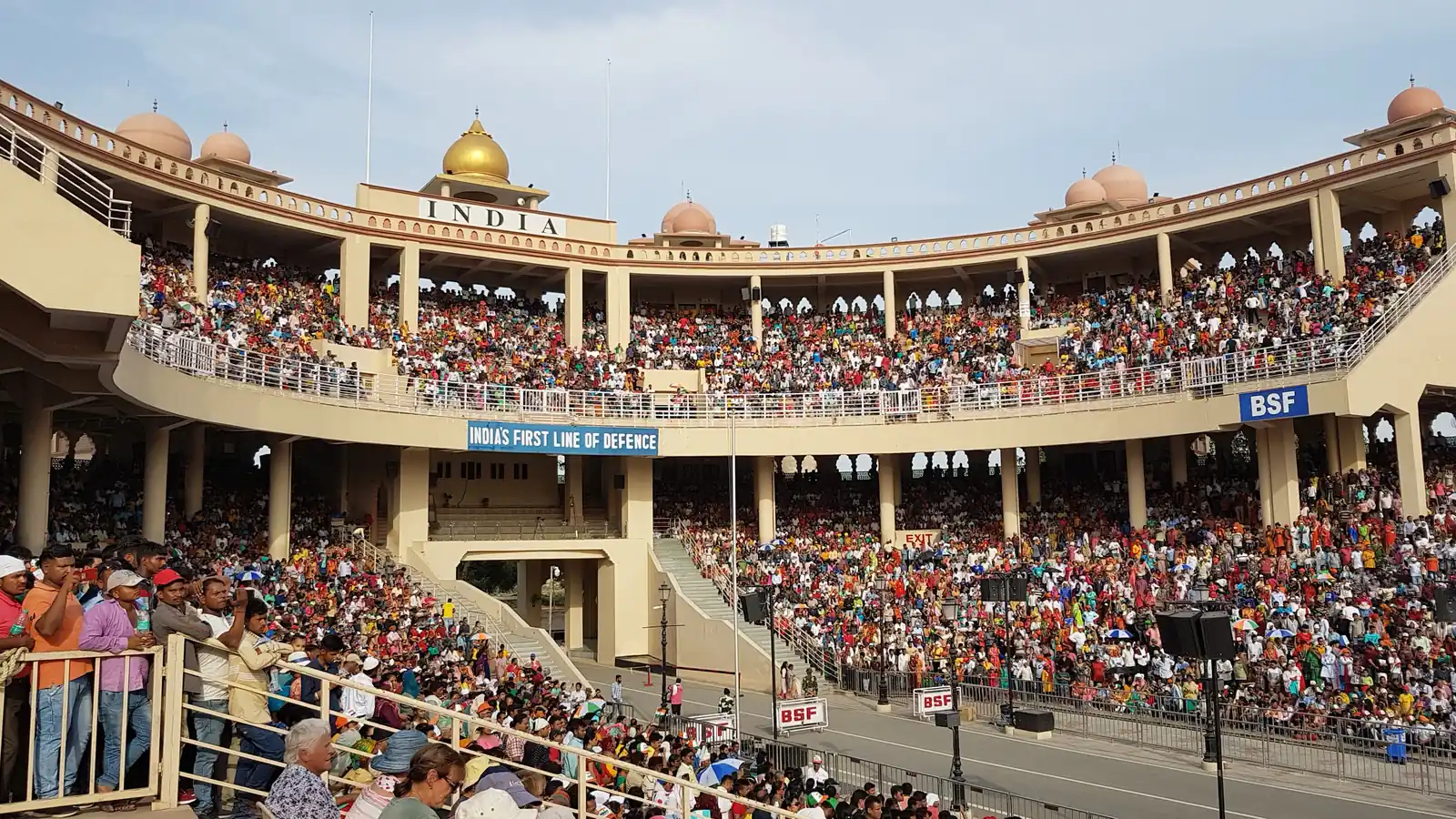
Every evening on the road between Lahore and Amritsar, where the Grand Trunk Road crosses from Pakistan into India, the two countries put on a show. Soldiers in fanned peacock headdresses kick their boots as high as their own heads and glare across the gate at each other, while packed grandstands chant patriotic slogans at the country a few meters away. When the sun sets, both flags come down in unison, the iron gates slam shut, and the crowds go home. The ceremony has run every day since 1959. The two audiences eat the same food, speak languages close enough to understand each other, and many of them descend from families who once lived on the other side. Until August 1947, there was no fence at all.
How one country became two
Britain had ruled India for nearly two hundred years, and by 1945 it could no longer afford to. The question was what would replace it. The Indian National Congress, led by Jawaharlal Nehru, wanted one country where religion was a private matter. The All-India Muslim League, led by a Bombay lawyer named Muhammad Ali Jinnah, wanted something else.
Jinnah argued that Indian Muslims were not a minority inside a Hindu country. They were a separate nation, with their own history, culture, and political destiny, and they needed their own state. Gandhi called the idea "vivisection." Nehru dismissed it. But Jinnah had something they did not: the votes of India's 100 million Muslims, who feared being swallowed by a Hindu majority four times their size. Britain agreed to split the subcontinent, and gave a London lawyer named Cyril Radcliffe five weeks to draw the line. He had never been to India.
The partition killed roughly a million people. Somewhere between 12 and 15 million were forced from their homes, the largest mass migration in human history. Armed gangs hunted refugee columns. Trains arrived at stations carrying nothing but corpses. And the two new countries went to war within months, over Kashmir, a Muslim-majority kingdom with a Hindu ruler who could not decide which side to join. That first war drew the Line of Control that still divides Kashmir today.
The war that broke Pakistan in half
India and Pakistan fought again in 1965, over Kashmir again, and the border barely moved. The war that changed everything came in 1971, and it was not about Kashmir at all.
Pakistan had been created in two pieces, separated by a thousand miles of India. The eastern piece spoke Bengali and held more than half the population, but the western piece ran the government, the military, and the money. When East Pakistan's Awami League won a national election in 1970, the military government in the west refused to hand over power. Instead, it sent the army in. Operation Searchlight killed hundreds of thousands of Bengali civilians and sent roughly 10 million refugees flooding across the border into India.
India invaded in December. The war lasted thirteen days. On December 16, 1971, Pakistan's commander in Dhaka, Lieutenant General A.A.K. Niazi, surrendered along with roughly 93,000 troops, the largest military surrender since World War II. East Pakistan became Bangladesh. Pakistan lost more than half its population in a fortnight.
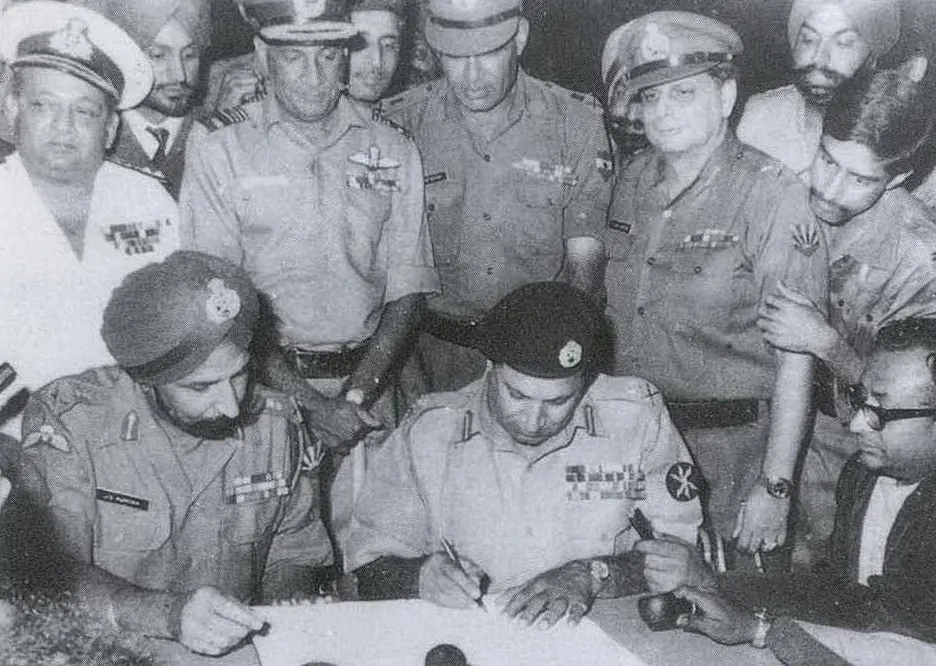
The defeat shaped Pakistan permanently. The army, which had caused the disaster, blamed the civilians and tightened its grip on the state. The lesson Pakistan drew from 1971 was not that it had treated its own people badly. It was that India could never be trusted, and that Pakistan needed a weapon India could not answer.
Two bombs, seventeen days apart
India tested its first nuclear device in 1974. Pakistan's prime minister, Zulfikar Ali Bhutto, made a promise: "If India builds the atom bomb, we will eat grass or leaves, even go hungry, but we will get one of our own." His scientists got to work.
On May 11, 1998, India detonated five nuclear devices at Pokhran. The CIA missed the preparations entirely. Seventeen days later, Pakistan answered with six of its own. President Clinton called Pakistan's prime minister, Nawaz Sharif, in a 25-minute plea to stop. Sharif authorized the tests anyway and told his atomic energy commission, in Urdu: "Dhamaka kar dein." Conduct the explosion. Both countries were now nuclear powers, and missiles between their cities would take five to eight minutes.
Barely a year later, Pakistani soldiers crossed the Line of Control and seized the heights above the town of Kargil. Two countries that had just tested nuclear weapons were fighting a shooting war in the mountains. India lost 527 soldiers retaking the peaks. What ended it was not deterrence but a phone call from Washington: Clinton summoned Sharif and confronted him with CIA intelligence that Pakistan was readying its nuclear arsenal.
Then came Mumbai. On November 26, 2008, ten gunmen from a Pakistan-based group called Lashkar-e-Taiba landed by boat in India's financial capital and attacked hotels, a train station, a cafe, and a Jewish center over four days. They killed 166 people. The sole gunman captured alive, Ajmal Kasab, confirmed the operation had been planned and directed from Pakistan. He was executed four years later.
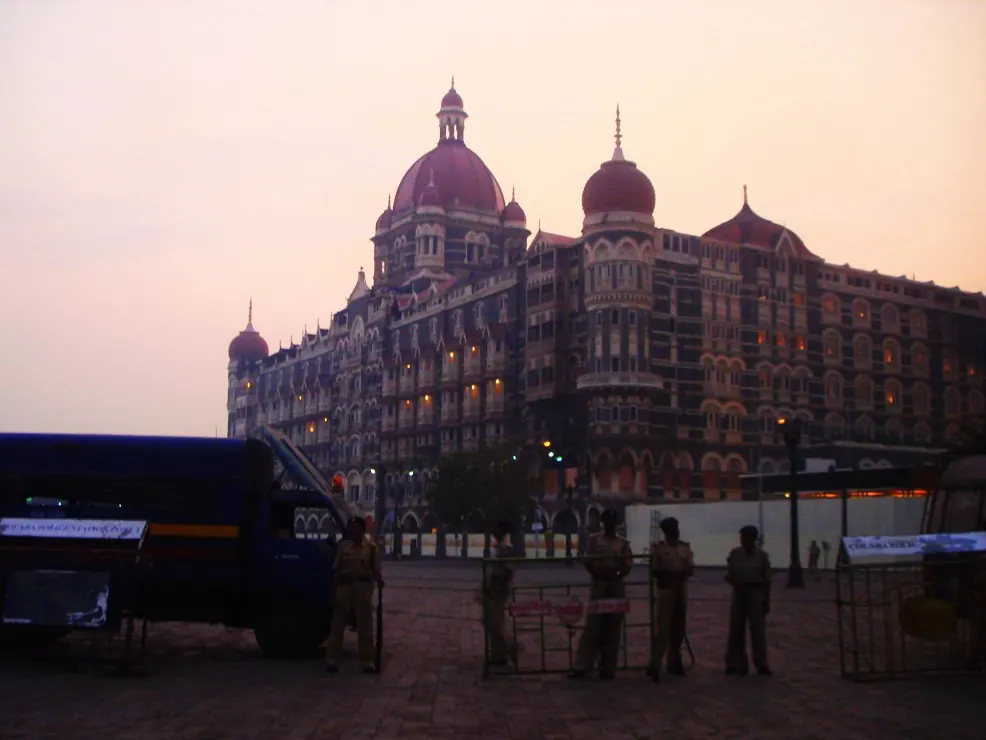
India did not retaliate militarily after Mumbai. That restraint did not last. In 2019, after a suicide bomber killed 40 Indian soldiers in Kashmir, India bombed a target inside mainland Pakistan for the first time since 1971. In May 2025, after gunmen killed 26 tourists in Kashmir, both countries struck each other's military bases. Each answer has been bigger than the last, and the gap between a conventional clash and a nuclear one keeps shrinking.
Why neither side can let go
The hatred between India and Pakistan is not ancient. It is younger than most of the countries on Earth, and both governments have reasons to keep it alive.
Pakistan's army has ruled the country for roughly half of its existence. Even when civilians hold office, the military decides policy on India, on Kashmir, and on the bomb. The army is also one of Pakistan's largest business empires, with interests in land, cement, and real estate. An enemy next door justifies the budget, the power, and the prestige. Ten days after the 2025 ceasefire, Pakistan promoted its army chief to field marshal, a rank the country has used only once before.
In India, Hindu nationalism has drawn energy from the memory of partition since 1947. The founding logic of Pakistan, that Hindus and Muslims are separate nations, gave Indian nationalists a permanent argument: that Muslims chose to leave, and that Pakistan is proof of an old threat. Prime Minister Narendra Modi revoked Kashmir's autonomy in 2019, fulfilling a decades-old promise to Hindu voters. India's military response to each crisis has grown, partly because no Indian leader can afford to look soft on Pakistan.
Almost nothing connects the two countries anymore. Official trade collapsed from $2.6 billion in 2019 to a few hundred million after India suspended what was left in 2025. The two cricket teams, whose matches once drew hundreds of millions of viewers, have not played on each other's soil since 2012. They meet only at ICC tournaments, and each game carries more weight than a sport should have to hold. Families separated by partition, many of them now in their eighties, have never been able to visit freely. After the 2025 crisis, India shut the Wagah crossing and suspended visas entirely. The flag-lowering ceremony that has run every evening since 1959 went dark.
Two countries that share a language, a cuisine, and a thousand years of common history cannot agree on a single thing. They are built on opposite answers to the same question: whether Hindus and Muslims could share one country. Seventy-nine years after partition said no, everything else has followed from that answer, and neither side has found a way to ask a different question.
Test what you learned
5 questions on this article. About two minutes, no signup.
Orbis has a full course on this
Kashmir: Three Powers, One Valley. 14 lessons, each ending with a quiz like this one.