Why did Japan attack Pearl Harbor?
Japan attacked Pearl Harbor to buy time. It needed oil it could not produce, and the US Pacific Fleet stood between Japan and the fields that had it.
By the summer of 1941, Japan had been at war in China for four years, and the army it used to fight ran on oil Japan did not have. Roughly 80 percent of Japan's oil came from the United States. When the US cut off supply in August 1941, Japan's leaders faced a choice: pull out of China and accept humiliation, or take the oil fields of Southeast Asia by force. They chose force. The attack on Pearl Harbor on December 7, 1941, was not the objective. It was the opening move to clear the path to oil.
A country that ran on someone else's fuel
Japan had industrialized faster than any country in Asia, but its economy depended on imports for nearly everything: oil, iron, rubber, and tin. It produced almost none of its own oil. The fields of the Dutch East Indies, modern Indonesia, held what Japan needed. But between Japan and those fields sat the American-held Philippines, and behind the Philippines sat the US Pacific Fleet at Pearl Harbor.
In July 1941, Japanese troops occupied southern French Indochina, within striking distance of British Malaya and the Dutch oil fields. Franklin Roosevelt responded on July 26 by freezing all Japanese assets in the United States. Export licenses were required for every shipment, and the officials who issued them simply stopped. By August, no American oil was moving to Japan.
That turned a political argument into a countdown. The Japanese navy had about two years of fuel in reserve, and every month of waiting burned more of it. If war with America was coming, it was better to fight now, while the tanks were full, than later, when they were empty.
The man who planned an attack he expected to lose
The plan fell to Admiral Isoroku Yamamoto, commander of the Combined Fleet. Yamamoto had studied at Harvard from 1919 to 1921, where he became an avid poker player and spent his summers hitchhiking across America. As a young officer he had lost two fingers at the Battle of Tsushima during the Russo-Japanese War in 1905. He understood American industrial power better than almost anyone in the Japanese military, and he was convinced Japan could not survive a long war against the United States.
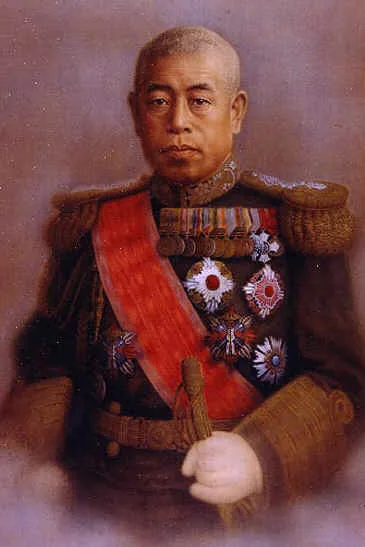
He opposed the war and said so in public. In 1939 the navy minister sent him to sea partly to keep him safe from the nationalist officers in Tokyo who had been assassinating politicians. When the decision went against him, he did not resign. He designed the attack instead, and in 1940 told Prime Minister Fumimaro Konoe what to expect: for the first six months to a year he would run wild and win victory after victory. After that, he had no expectation of success.
The plan was not to beat America. It was to make the war too expensive to fight. Destroy the Pacific Fleet, and the United States would need a year or more to rebuild and sail west. In that year, Japan would seize the oil, take the Philippines and Malaya, and fortify a ring of Pacific islands so costly to breach that America would rather negotiate than fight through them.
December 7, 1941
Pearl Harbor was not a single attack. Within hours, Japan also struck British Malaya, Thailand, Hong Kong, Guam, Wake Island, and the Philippines. The landings at Kota Bharu in Malaya, aimed at the road to the oil, began about an hour before the first bomb fell on Hawaii.
Six aircraft carriers had crossed the North Pacific in radio silence by a stormy northern route no one was watching. At 7:48 on Sunday morning, 353 aircraft came in over Oahu.
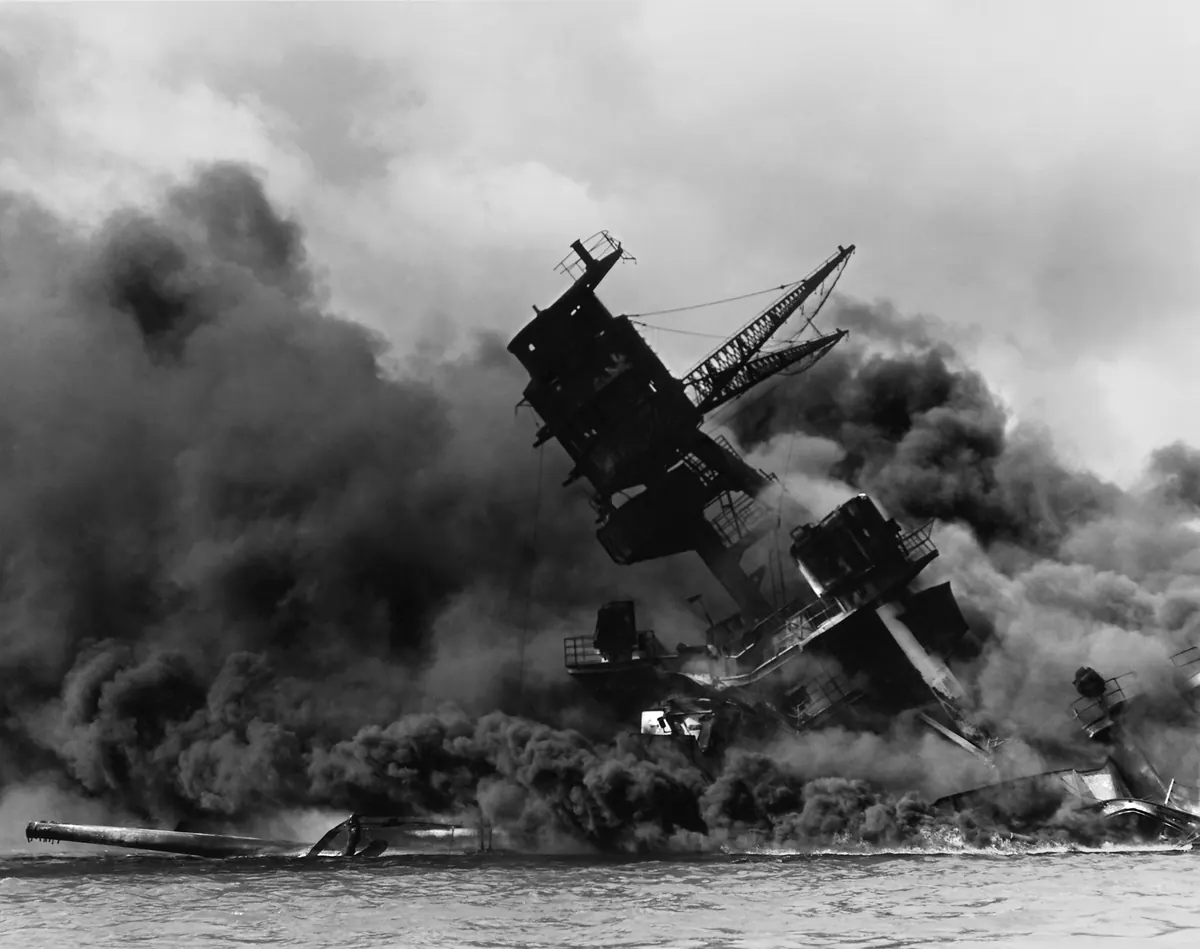
In under two hours, all eight American battleships in the harbor were hit. The Arizona took a bomb near her forward ammunition magazine and blew apart, killing 1,177 men. The Oklahoma rolled over from a wall of torpedoes with her crew still inside. When it was over, 2,403 Americans were dead. Japan lost 29 aircraft.
Japan had meant to break off diplomatic talks thirty minutes before the bombs fell. Its embassy in Washington was too slow decoding the message, and the notice arrived after the attack had already started. The next day, Roosevelt went before Congress. He had edited his own draft, crossing out "a date which will live in world history" and writing in the word that stuck: infamy.
Everything that mattered survived
The attack did enormous damage, but it missed the targets that actually mattered.
The carriers survived. The Enterprise, Lexington, and Saratoga were all at sea that morning, and none was touched. Japan had just proved that carrier aircraft could destroy battleships at anchor. The age of the battleship ended on December 7, and the weapon that replaced it was the weapon Japan failed to hit.
The base survived. Admiral Chuichi Nagumo decided against a third wave, worried about fuel and the missing carriers. The strike force went home without touching the fuel storage tanks, which held about 4.5 million barrels of oil, or the dry docks and repair yards. If those had burned, the fleet would have had to withdraw to California, and Japan would have gotten its year of breathing room. Instead, the yards went straight to work, and because the harbor is shallow, most of the sunken battleships were raised, repaired, and sent back to the war.
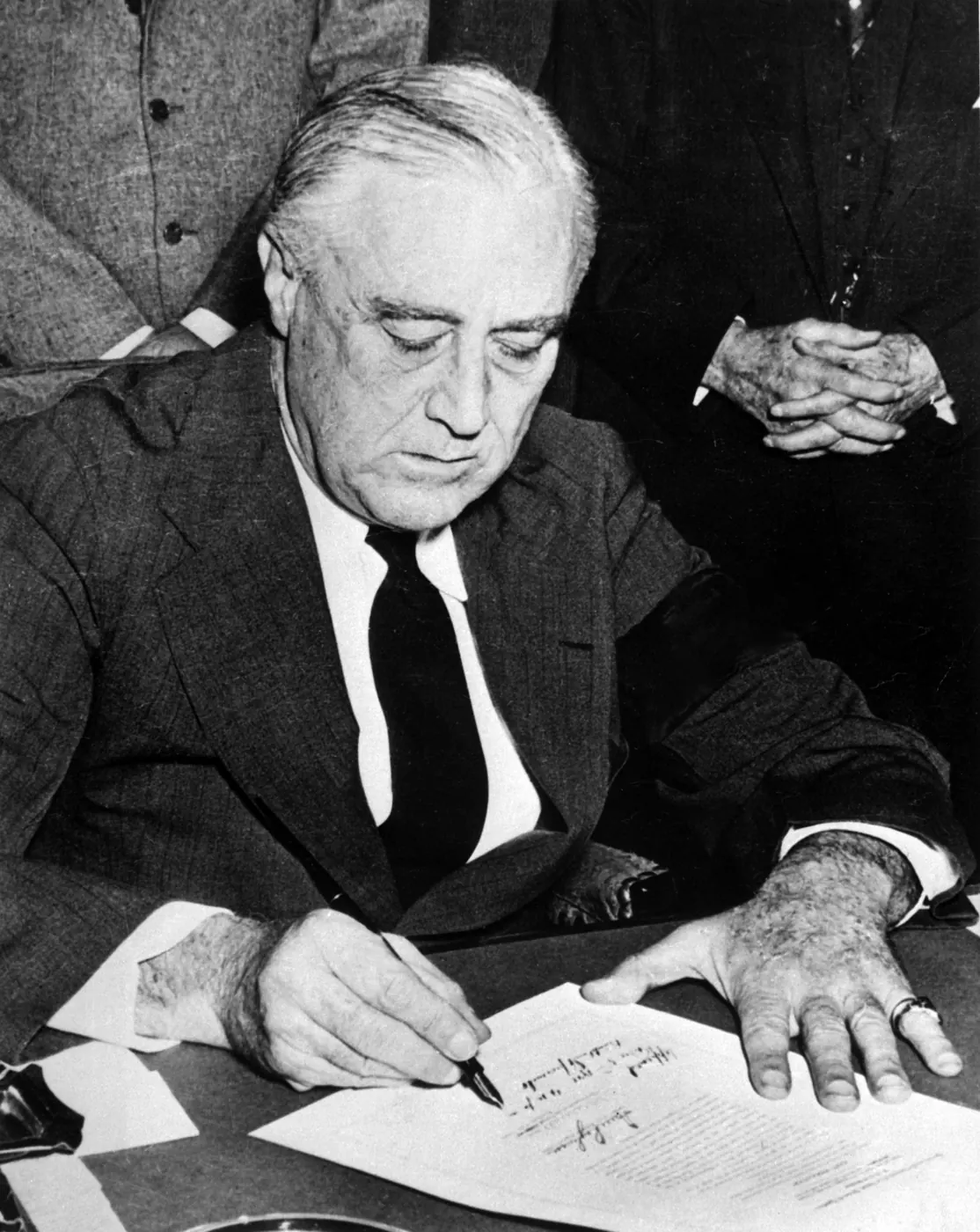
American reluctance did not survive. The whole plan depended on Americans deciding the Pacific was not worth the price, and before December 7 the country was bitterly split over intervention. The attack ended the debate in two hours. Congress declared war with one dissenting vote. Three days later, Adolf Hitler declared war on the United States, a decision the Tripartite Pact did not require him to make. Roosevelt got the war in Europe he could never have asked Congress for.
Japan got its six months, and then lost everything
The first half of Yamamoto's prediction played out exactly. Manila fell in January 1942, Singapore in February, Java in March. Japan had the oil fields of Sumatra and Borneo, and its engineers had them producing at three quarters of prewar output by 1943.
Then the clock ran out. On June 4, 1942, six months almost to the day after Pearl Harbor, American carriers caught the Japanese fleet off Midway. Dive bombers sank four Japanese carriers in a single day: the Akagi, Kaga, Soryu, and Hiryu. All four had launched the attack on Pearl Harbor. Japan also lost over 200 of its most experienced naval aviators, men it could not replace.
The oil was the deeper failure. Japan had captured the fields but still had to ship the oil two thousand miles home past American submarines. By 1944, submarines had destroyed roughly two thirds of Japan's tanker fleet. The navy ended up basing its main fleet near Singapore, because there was no fuel left in Japan to operate on. Japan went to war to take the oil, took it, and could not get it home.
Why Pearl Harbor still shapes how countries think about war
A month after the attack, Yamamoto wrote to the editor of the Asahi Shimbun that a military man could scarcely pride himself on having struck a sleeping enemy, and that the enemy, angered and outraged, would soon launch a determined counterattack.
Pearl Harbor is the textbook case of a first strike that achieves its military objective and loses the war doing it. It hit hard enough to enrage the United States and not hard enough to disarm it. An attack that destroys an enemy's willingness to compromise while leaving their ability to fight intact is worse than either crushing them or leaving them alone.
The pattern has repeated. The Blitz was supposed to break British morale and instead unified the country. The September 11 attacks were meant to drive America out of the Middle East and instead produced two decades of war across it. Each time, a surprise attack on a divided country unified it and produced exactly the war the attacker was trying to avoid.
Yamamoto was right about the factories, right about the six months, and right about the futility. He executed the plan anyway, because the decision had already been made by men who understood American power less than he did. He was killed in April 1943, when American codebreakers intercepted his flight schedule and sent fighters to shoot down his plane over Bougainville. He did not live to see the war end the way he said it would.
Test what you learned
5 questions on this article. About two minutes, no signup.
Orbis teaches the history behind the news
Orbis covers Pearl Harbor and the Pacific War in five-minute lessons, from Japan's oil crisis to Midway and the collapse of the empire it built.