Why did the Mongols destroy Baghdad?
In 1258, Mongol armies destroyed Baghdad, the intellectual capital of Islam, in less than two weeks. The city's caliph had a choice. He made the wrong one.
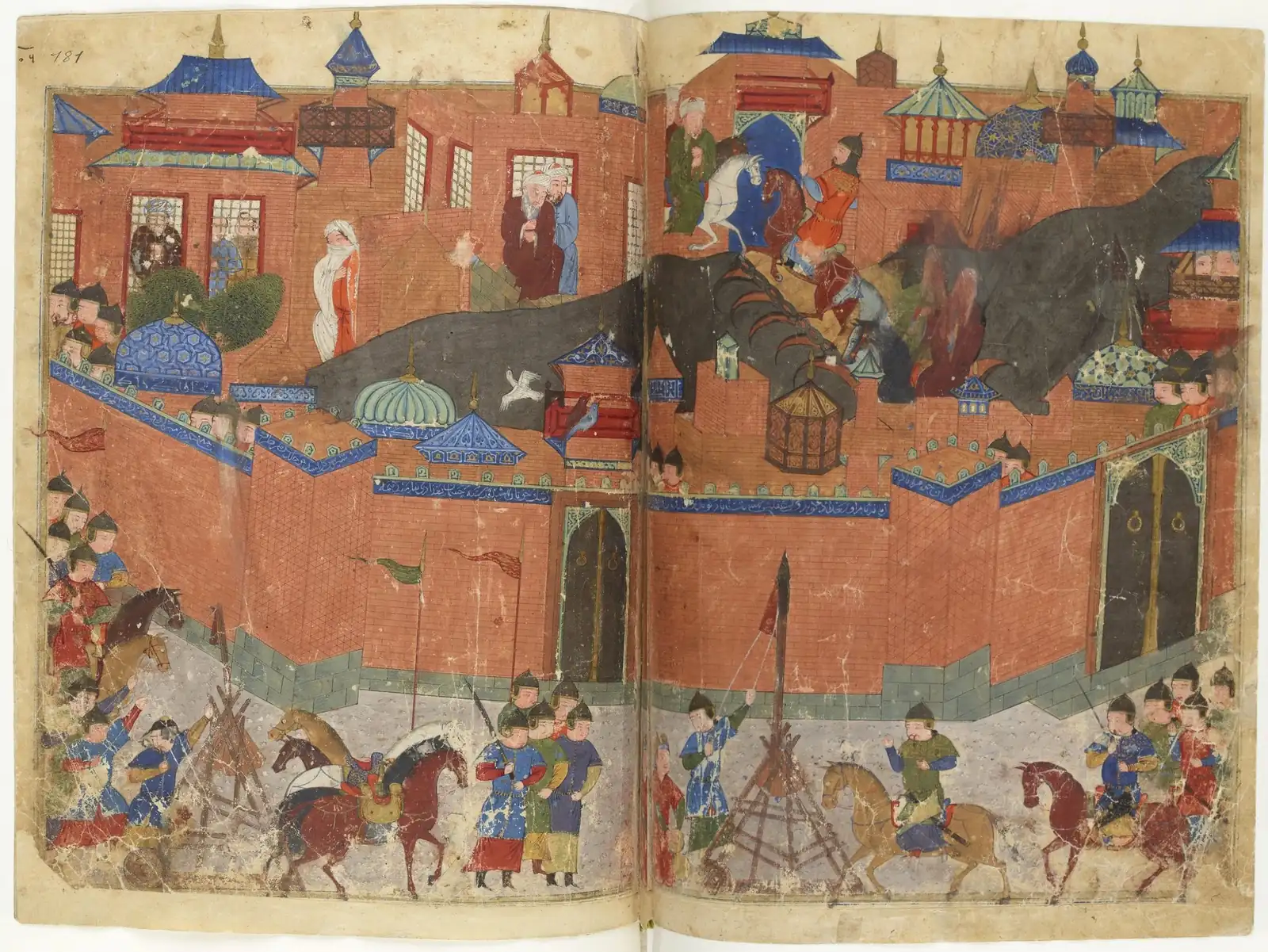
In February 1258, a Mongol army led by Hulegu Khan breached the walls of Baghdad and spent the next week destroying it. Soldiers burned mosques, palaces, and libraries. They killed the caliph, the 37th in a dynasty that had ruled since the 700s. According to the chroniclers, they dumped so many manuscripts into the Tigris that the river ran black with ink. Baghdad had been one of the largest cities on Earth, the seat of the Abbasid Caliphate, and the intellectual center of the Islamic world for five centuries. It never recovered.
The destruction looks like a story about unstoppable violence: the Mongol war machine rolled west and crushed everything in its path. But the Mongols did not destroy every city they took. Most cities they conquered survived. Baghdad was destroyed because its ruler was given a clear choice, and he chose wrong.
The city the Mongols found
Baghdad in the 1250s had been the symbolic capital of Sunni Islam for nearly five hundred years. Caliph al-Mansur founded it in 762 as a perfect circle on the banks of the Tigris, with the caliphal palace at its exact center and four gates facing the four cardinal directions. By the 900s it was probably the largest city in the world, home to as many as a million people.
The city's greatest institution was the Bayt al-Hikma, the House of Wisdom, where scholars funded by the caliphs translated Greek philosophy, Persian science, and Indian mathematics into Arabic. Al-Khwarizmi invented algebra there. Other scholars wrote medical textbooks that European doctors would use for centuries, and made advances in optics and astronomy that went beyond anything the ancient Greeks had achieved. The project was not just preservation: it produced original science that would not be matched in Europe for a long time. Baghdad's book market had over a hundred stalls. Private libraries held tens of thousands of volumes.
By the 1250s, the caliphs had been political figureheads for two hundred years, overshadowed by Turkish and Persian military strongmen. But Baghdad was still the religious center of the Sunni world. Muslim rulers across the empire still sought the caliph's approval to legitimize their power.
How Hulegu reached the gates
In 1251, the Mongol great khan Mongke ordered his brother Hulegu to march west and bring the remaining Muslim states under Mongol control. The assignment was specific: destroy the Order of Assassins, force the Abbasid caliph to submit, and extend Mongol rule across Persia and into Syria. Mongke gave Hulegu one of the largest armies the Mongol Empire ever assembled, perhaps 150,000 soldiers, with a thousand Chinese siege engineers who brought trebuchets capable of smashing any fortification on earth.
Hulegu was a grandson of Genghis Khan and a brother of Kublai Khan. He moved deliberately. He crossed the Oxus River into Persia in 1256 and spent that year destroying the mountain fortress of Alamut, headquarters of the Assassins, a Shia militant group that had carried out political killings across the Islamic world for more than 150 years. With the Assassins finished, Hulegu turned south toward Baghdad.
He sent envoys to the caliph, al-Musta'sim, demanding that he tear down the city walls and submit. This was standard Mongol practice: the offer always came before the army. And the consequences of refusing were well known across the continent. Cities that surrendered without a fight were taxed and absorbed into the empire. Cities that resisted and lost were destroyed. Each massacre made the next city more likely to open its gates.
A caliph who did nothing
Al-Musta'sim was the 37th Abbasid caliph. Medieval chroniclers described him as indecisive and more interested in his own pursuits than in governing. He rejected Hulegu's demands and sent back threats. Then he did almost nothing to prepare.
He did not reinforce the walls. He did not call for help from other Muslim rulers. He did not mobilize Baghdad's garrison to full strength. His army numbered perhaps 20,000, and he had not paid his soldiers consistently. The vassal states that might have come to his aid were too weak, too far away, or too divided to act. The Mongols had spent two generations breaking the Muslim political world apart. By 1257, the caliph had no allies.
What makes the fall of Baghdad so painful in Muslim historical memory is that the catastrophe was not inevitable. The Mongols gave al-Musta'sim the same choice they gave every city. He could have surrendered and kept his title, his city, and most of his people. He chose defiance without the strength to back it up.
The week that ended an era
Hulegu's siege engineers reached Baghdad's walls in late January 1258 and breached them within days. The caliph had sent his small army out to fight the Mongol southern column on January 17. The Mongols broke the Tigris levees upstream, flooding the Abbasid camp. The survivors were hunted down. With the field army gone, the city had nothing left.
Al-Musta'sim surrendered on February 10 and walked out with 300 officials to present himself to Hulegu. Over the following week, Mongol soldiers moved through Baghdad destroying what they found. They burned mosques, palaces, hospitals, and colleges. The libraries of five centuries of Islamic scholarship were gutted. Manuscripts went into the Tigris by the cartload.
The killing was immense. Hulegu himself reported roughly 200,000 dead. Later chroniclers pushed the number to 800,000 or beyond. Modern historians consider all of the medieval figures unreliable, but nobody disputes the scale. It was one of the worst single weeks of urban violence in pre-modern history.
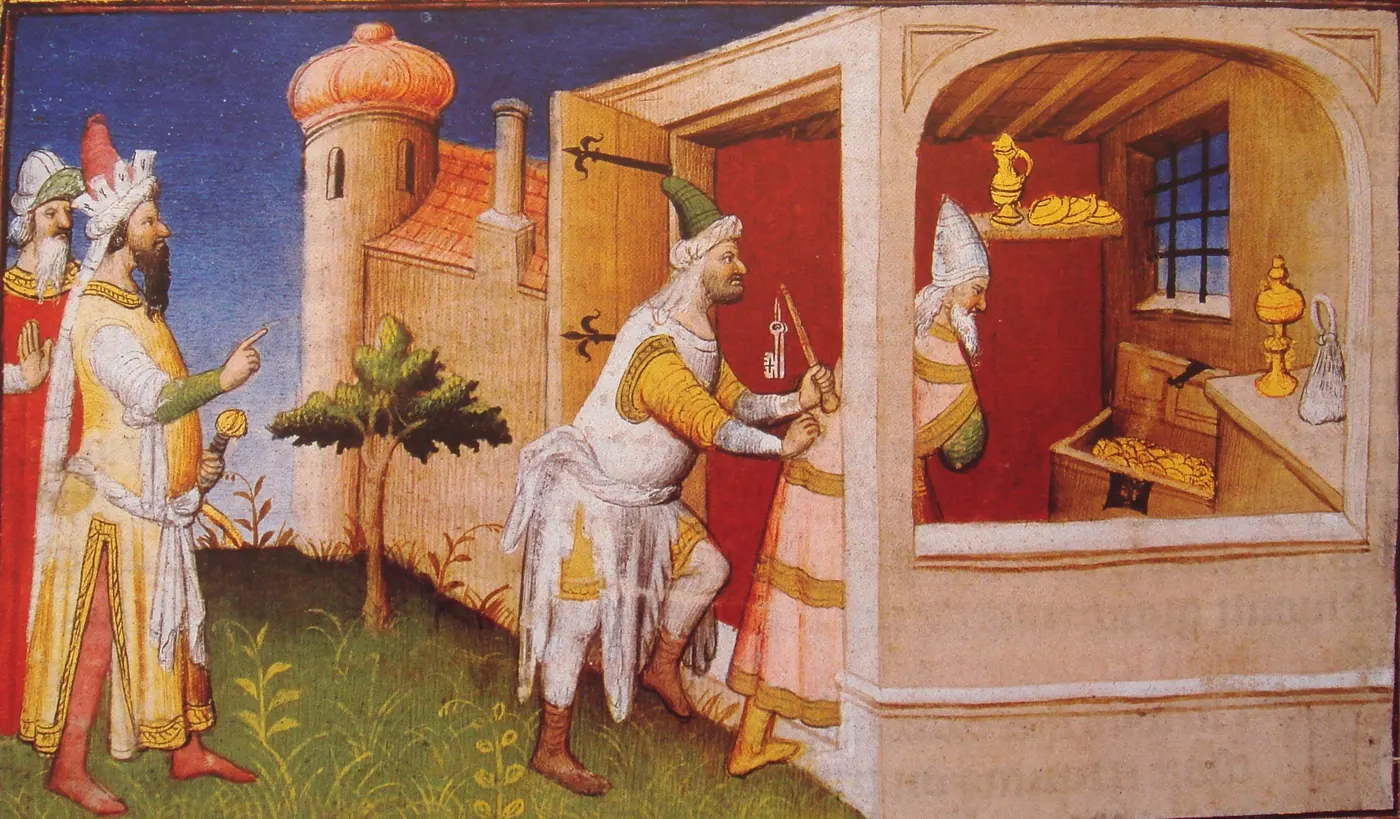
Al-Musta'sim, the last Abbasid caliph of Baghdad, was executed around February 20. In the traditional account, Mongol custom forbade spilling royal blood onto the earth. They rolled him in a carpet and had horses trample him to death.
What never came back
The Mongols were not disorganized barbarians who got lucky. They ran one of the most sophisticated empires of their era, with a postal system that spanned Eurasia, intelligence networks that mapped enemy territory years before an invasion, and a bureaucracy that kept conquered provinces running with local administrators. The destruction of Baghdad was not chaos. It was policy: a calculated punishment for a ruler who refused to submit.
Hulegu went on to take Aleppo and Damascus. His advance was finally stopped at the Battle of Ain Jalut in September 1260, when the Mamluk sultanate of Egypt defeated a Mongol force in present-day Israel. Hulegu founded the Ilkhanate, a Mongol state centered in Persia that lasted nearly a century. His successors converted to Islam in 1295 and governed with Persian bureaucrats. The Mongols were capable of governing what they conquered. Baghdad was destroyed because its caliph refused to let them.
Baghdad itself entered a long decline. The irrigation systems that had fed the city for centuries were never fully restored. Timur sacked it again in 1393 and 1401. It spent centuries afterward as a provincial town under Ottoman rule. The center of the Islamic world moved to Cairo, then Istanbul. It never returned to Iraq.
For Sunni Muslims, 1258 remains one of the defining catastrophes of their civilization. The historian Ibn al-Athir, writing about the earlier Mongol invasions of the 1220s, could not bring himself to record what he was seeing: "O would that my mother had not borne me, or that I had died and become a forgotten thing before this happened." He died 25 years before Baghdad fell, but his framing stuck. ISIS invoked 1258 in its propaganda about restoring the caliphate. Saddam Hussein cited it when naming his weapons systems. The wound has not closed in eight centuries, because what went into the Tigris that week was not just a library or a dynasty but the accumulated intellectual production of the Islamic golden age. Some of it has never been recovered.
Test what you learned
5 questions on this article. About two minutes, no signup.
Orbis has a full course on this
Islam: 1,400 Years of Faith and Power. 42 lessons, each ending with a quiz like this one.