Guerrilla groups · Colombia
ELN and the FARC dissidents
At war after all peace talks endedUpdated November 13, 2026
The ELN is a Marxist-Leninist guerrilla group founded in Colombia in 1964. The FARC dissidents are factions that rejected the 2016 peace deal. Together they have about 17,800 members, according to Colombia's armed forces. They fund themselves mainly through cocaine, illegal gold mining, extortion and smuggling. They operate in at least 19 Colombian departments and in parts of Venezuela. Their main weapons are explosive drones, car bombs, landmines and small arms. President De la Espriella's government ended all peace talks on September 11, 2026, and has bombed their camps since August.
- ELN leader
- Antonio García
- since 2021
- ELN fighters
- 7,230
- 3,568 armed (armed forces, July 2026)
- FARC dissidents
- 10,569
- in four factions (armed forces, July 2026)
- Departments
- 19
- with ELN presence (InSight Crime)
- Founded
- 1964
- first action in January 1965
Who funds the ELN and the FARC dissidents?
These groups fund themselves. No foreign government admits to backing them.
- From abroad
 VenezuelaColombia and the United States accuse Venezuela of sheltering the ELN and the FARC dissidents. InSight Crime reports that the ELN works gold mines and hands out subsidized food in Venezuelan territory. Venezuela denies hosting them.
- At home
- CocaineColombia had 261,000 hectares of coca in 2024, according to UNODC. Norte de Santander, Nariño, Putumayo and Cauca, all areas where these groups operate, account for most of it. The ELN's leadership says it does not depend on drug money. Colombian security agencies say it traffics drugs.
- Illegal gold miningAn intelligence report cited by Semana put illegal gold revenue for all armed groups at more than $8.4 billion in 2025. It estimated the ELN earns about $7 million a month from gold in the Antioquia-Bolívar-Córdoba corridor.
- Extortion and kidnappingIntelligence sources estimated in 2023 that the ELN took in about 18 billion Colombian pesos a month from extortion and kidnapping. Semana describes the ELN's pipeline bombings in Arauca as a tool of extortion.
- Front companiesIn October 2025 Colombia's Attorney General said the ELN had laundered more than $225 million through front companies in Arauca and other regions since about 2005.
- SmugglingThe groups smuggle subsidized Venezuelan fuel, weapons, food and migrants across the border, according to Semana.
ELN
Ejército de Liberación Nacional
The money pays for fighters, weapons and local control. The ELN's war fronts have their own finances and raise funds independently through whichever activity is most profitable in their area.
No credible estimate of total annual income exists for the ELN or for any FARC dissident faction. Published figures cover single revenue streams only.
ConfirmedReported, denied
Where do the ELN and the FARC dissidents operate?
The ELN is strongest in Arauca and Catatumbo, near the Venezuelan border. The FARC dissidents are strongest in Cauca, Guaviare and Putumayo in the south.
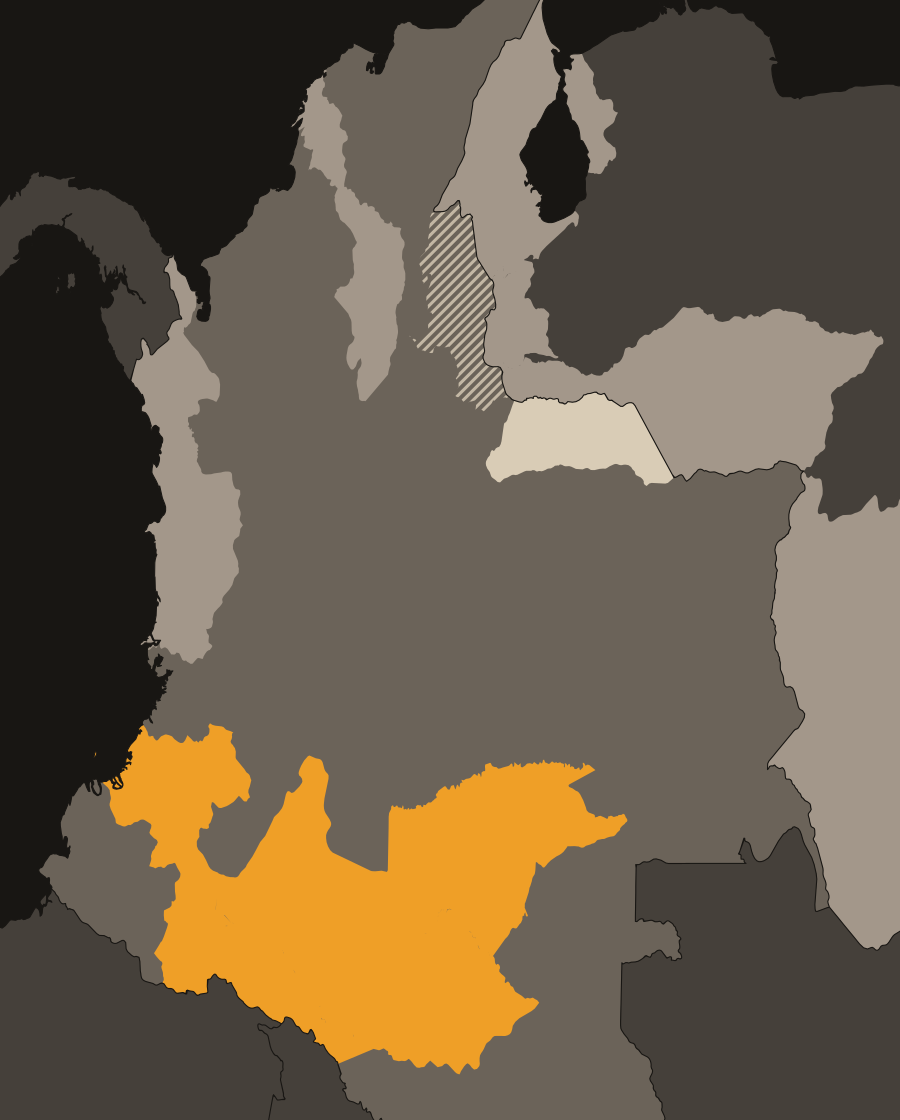
ELN strongholdCatatumbo: ELN against FARC dissidentsELN present, in Colombia and VenezuelaFARC dissident strongholdsDrawn by department, a simplification: the groups are present in parts of each, and in many more. InSight Crime counts the ELN in about 184 municipalities in 19 departments, and in 8 of Venezuela’s 24 states.
- TibúCatatumbo warThe center of coca growing in Norte de Santander, which had 48,739 hectares in 2024. The ELN launched an offensive against the FARC dissidents' 33rd Front here on January 16, 2025. More than 54,000 people were displaced by February 6, 2025, according to the Defense Ministry. On August 11, 2026, the Colombian air force carried out the first strike on ELN positions in Catatumbo under President De la Espriella.
- SaravenaELN heartlandThe heart of the ELN's Eastern War Front in Arauca. The ELN attacks the Caño Limón oil pipeline from this area. Arauca accounted for 95% of pipeline bombings in Colombia in 2025.
- GuasdualitoVenezuelaAn ELN rear base in Apure state, across the river from Arauca. InSight Crime cited intelligence reports in 2024 that about 1,200 of the ELN's roughly 6,000 members operated inside Venezuela.
- Pedro CamejoVenezuelan strikeOn October 29-30, 2026, Venezuela's armed forces struck an ELN camp in this municipality in Apure state. The NGO Fundaredes said 19 people were killed. The attack reportedly used drones and helicopter gunships.
- Bogotá2019 bombingOn January 17, 2019, the ELN drove a car bomb into the General Santander police academy, killing 21 cadets. On June 7, 2025, a gunman shot the presidential hopeful Miguel Uribe Turbay. He died on August 11, 2025. The ELN denied involvement. A convicted planner testified that the order came from the Segunda Marquetalia.
- AmalfiHelicopter downedOn August 21, 2025, a drone attack brought down a police Black Hawk helicopter here, killing 13 police. Authorities blamed Frente 36 of Calarcá's EMBF faction.
- CajibíoBus bombOn April 25, 2026, a bomb on a bus on the Pan-American Highway killed 20 people and injured 36. The army blamed Mordisco's network and the Jaime Martínez Front.
- El PlateadoMordiscoA stronghold of the EMC's Carlos Patiño Front in the Micay Canyon. The army has held the town since October 2024 under Operation Perseo. The FIP think tank said in July 2026 that the canyon was still contested.
- San José del GuaviareCalarcáA gateway to EMBF and EMC areas. At least 27 people were killed in clashes between the factions in El Retorno on January 17, 2026. The air force struck dissident camps in Guaviare in August 2026.
What weapons do the ELN and the FARC dissidents have?
Explosive drones, car bombs, landmines and small arms. They have no aircraft, armor or air defense.
Explosive drones
Modified commercial drones, fiber-optic drones · Locally assembled
The FIP counted 318 drone attacks on security forces from January 1 to October 1, 2026, one every 20 hours. The FIP attributed 72% to the EMC and 23% to the ELN. ACLED reports that the groups also use fiber-optic drones, which cannot be jammed.
Car, truck and bus bombs
Vehicle-borne IEDs · Locally built
The ELN used 80 kg of pentolite in the January 2019 Bogotá police academy bombing that killed 21. A bus bomb in Cajibío killed 20 on April 25, 2026.
Landmines
Improvised anti-personnel mines · Locally built
Colombia's mine action authority recorded 136 new victims in 2025, up 24% from the year before. The total since records began, from mines laid by all armed groups over decades, is 12,658. InSight Crime says new mines are laid mainly in areas contested by the ELN, the FARC dissidents and the Clan del Golfo.
Small arms
Rifles, sniper rifles, machine guns, mortars · Various
InSight Crime reports that guerrilla camps in Venezuela offer training in drones and sniper rifles.
- Drone attacks on security forces
- 318
- January 1 to October 1, 2026 (FIP)
- Hectares of coca
- 261,000
- in Colombia in 2024 (UNODC)
- Armed group members
- About 29,000
- in Colombia, July 2026, up from about 15,000 in December 2022 (armed forces, FIP)
Is the ELN a terrorist group?
The United States, the European Union and Canada list the ELN. No one but the US lists the FARC dissidents by name.
 United StatesForeign Terrorist Organization since October 1997
 European UnionOn the EU terrorist list
 CanadaLists the ELN and the FARC as terrorist entities since April 2, 2003
 ColombiaPresident De la Espriella declared all armed groups terrorists on August 25, 2026, as policy. A formal terrorist list is part of a draft anti-terrorism statute that is not yet law.
- United States (FARC dissidents)The FARC-EP and the Segunda Marquetalia have been Foreign Terrorist Organizations since 2021. The original FARC was removed. The EMC, the EMBF and the CNEB are not named. The FARC-EP listing covered Gentil Duarte's group, the forerunner of the EMC.
 United KingdomNot listed
- UN Security CouncilNot listed
 RussiaNot listed
 ChinaNot listed
Who are the FARC dissidents?
The FARC dissidents are factions that rejected or abandoned the November 24, 2016 peace deal between the Colombian government and the FARC. The original deal took about 13,000 FARC members out of the war. The factions that stayed armed now have about 10,569 members, according to the Colombian armed forces' count to July 2026.
The largest faction is the EMC, led by Iván Mordisco. His 1st Front left the peace process in July 2016. The Colombian government reported Mordisco dead in mid-2022, but he reappeared. His former deputy, Calarcá, split off in April 2024 to form the EMBF and continue talking to the government. The two factions have fought each other in Guaviare, where at least 27 people were killed in clashes in El Retorno on January 17, 2026.
Iván Márquez, the FARC's former chief negotiator, announced the Segunda Marquetalia in August 2019. It is the smallest faction, with 593 members. In November 2024 the CNEB split from the Segunda Marquetalia under Walter Mendoza. It is made up of the Comandos de la Frontera and the Coordinadora Guerrillera del Pacífico. Critics, including InSight Crime, call the dissident factions largely criminal groups involved in coca, drug trafficking, mining and extortion. The factions themselves claim a Marxist-Bolivarian heritage. The armed forces' count includes support networks as well as armed fighters.
Members by faction (Colombian armed forces, July 2026)
Why did Colombia's peace talks with the ELN end?
President Petro suspended the talks in January 2025 after an ELN offensive in Catatumbo. President De la Espriella formally ended them on September 9, 2026. The ELN began formal peace talks with President Petro's government in November 2022, as part of Petro's "Total Peace" policy. The talks produced a bilateral ceasefire from August 2023 to August 2024, the longest ever agreed with the ELN. It expired after the two sides could not agree on terms to extend it. Otherwise the talks made slow progress. The ELN's war fronts have their own finances and operate independently, which made a central agreement hard to enforce.
On January 16, 2025, the ELN launched an offensive against the FARC dissidents' 33rd Front in Catatumbo. At least 80 people were killed in the first weeks, and more than 54,000 were displaced. President Petro suspended the talks on January 17 and called it "war crimes." On January 20 he wrote: "The ELN has chosen the path of war, and war it will have."
Abelardo de la Espriella won the presidential runoff on June 21, 2026, with 49.66% of the vote. He took office on August 7. On August 11 the air force carried out its first strike on ELN positions in Catatumbo under the new government. On September 9, Executive Resolution 391 ended the ELN talks. On September 11 the government ended all remaining talks with every armed group. De la Espriella's offer was: submit to justice or face the full force of the state. The ELN's Central Command had said in January 2025 that it would never accept "submission or surrender" as a peace policy.
From founding to the end of talks
- Jul 1964The ELN is founded in Santander.
- Jan 7, 1965The ELN seizes the town of Simacota, announcing itself publicly.
- Feb 1966The priest Camilo Torres is killed in his first battle with the ELN.
- Oct 1997The United States designates the ELN a Foreign Terrorist Organization.
- Nov 24, 2016The FARC signs a peace deal. Dissident factions break away.
- Jan 17, 2019The ELN bombs a police academy in Bogotá, killing 21 cadets.
- Nov 2022President Petro begins formal peace talks with the ELN.
- Jan 16, 2025The ELN attacks the FARC dissidents in Catatumbo. Petro suspends the talks the next day.
- Jan 3, 2026The United States captures President Maduro of Venezuela.
- Jun 21, 2026Abelardo de la Espriella wins the presidential election.
- Sep 9, 2026Resolution 391 ends the ELN peace talks.
- Sep 11, 2026The government ends all remaining talks with every armed group.
What happened in Catatumbo?
On January 16, 2025, the ELN launched an offensive against the FARC dissidents' 33rd Front in the Catatumbo region of Norte de Santander, near the Venezuelan border. A non-aggression pact between the two groups had collapsed. The ELN said it attacked because the 33rd Front threatened the local population, and it accused the front of killing a family in Tibú. The area around Tibú is a center of coca growing. Norte de Santander had 48,739 hectares of coca in 2024, according to UNODC.
At least 80 people were killed in the first weeks, the United Nations reported. Human Rights Watch said ELN fighters went house to house on January 16, killing or taking away people they accused of links to the 33rd Front. It also received credible reports of civilians killed by the 33rd Front. The Defense Ministry said 54,038 people had been displaced by February 6, 2025, including 24,976 who went to the city of Cúcuta. Human Rights Watch said more than 56,500 people were displaced, over 14% of the region's population. After one year, Publimetro counted more than 105,000 victims.
The army put all armed groups in Catatumbo at 3,823 members as of June 2026. The fighting continues. On August 11, 2026, the Colombian air force struck ELN positions in Catatumbo for the first time under the new government.
Catatumbo
105,000+
Victims in one year of fighting
The ELN's offensive against the 33rd Front began on January 16, 2025. More than 54,000 people were displaced in the first three weeks alone. The area is still contested.
Does Venezuela protect the ELN?
Colombia and the United States have long accused Venezuela's government of sheltering the ELN and the FARC dissidents, and Venezuela denies it. In October 2026, under new leadership, Venezuela's armed forces struck an ELN camp. InSight Crime reports that relations between the ELN and the Venezuelan government warmed under President Hugo Chávez from 1999. Under Nicolás Maduro, InSight Crime says, "the balance of power tipped in favor of the ELN." The ELN's chief negotiator, Pablo Beltrán, said in 2020 that the ELN shared "common enemies" with the Maduro government.
InSight Crime reports that the ELN works gold mining sites in Venezuela's Bolívar state, helped along by Venezuelan security forces. It also reports that the ELN hands out subsidized food boxes and acts as an informal customs authority in border areas. InSight Crime also reports allegations that Venezuela's armed forces gave the group logistical support and weapons. These have not been documented as a formal supply chain. Venezuela "has repeatedly denied a sustained Colombian armed group presence," Venezuelanalysis reported.
The situation changed after the United States captured Maduro on January 3, 2026. Delcy Rodríguez became interim president. In September 2026, US Secretary of State Marco Rubio said the ELN and FARC dissident presence "needs to be addressed" by Venezuela. On October 29-30, 2026, Venezuela's armed forces struck an ELN camp in Pedro Camejo municipality, Apure. The NGO Fundaredes said 19 people were killed. Interior Minister Diosdado Cabello then sent troops along the 2,200 km border, saying: "We do not want any conflicts that are not ours." InSight Crime's view is that as long as the ELN stays useful to the Rodríguez government, existing arrangements will probably continue "with a lower profile."
Who leads the ELN and the FARC dissidents?
Antonio García has led the ELN since 2021, when the previous commander stepped down because of illness. García was born on January 10, 1956, in Mocoa, Putumayo. In September 2026 a court convicted him and 10 other Central Command members over 60 cases of forced child recruitment. He is believed to move in and out of Venezuela.
Pablo Beltrán is the ELN's political commander. He was its chief negotiator in the 2022-2025 talks. He was convicted alongside García in September 2026. Pablito heads the ELN's military strategy and is linked to the Eastern War Front in Arauca.
Iván Mordisco leads the EMC and is Colombia's most wanted rebel. The government reported him dead in mid-2022, but he reappeared. The US Treasury listed him as a Specially Designated Global Terrorist in December 2021. On November 10, 2026, the EMC announced a "revolutionary trial" of nine captive police and soldiers.
Calarcá leads the EMBF. He split from Mordisco in April 2024. His arrest warrant was reactivated on September 1, 2026. Colombia's armed forces bombed his camp in Guaviare on August 27, 2026, killing 10 or 11 people, including 3 minors.
Iván Márquez founded the Segunda Marquetalia in August 2019. He was badly wounded in an attack in Venezuela in 2022. His status is unknown. He was reportedly sentenced in absentia to 44 years in prison in July 2025.
The leadership
- ELN commanderAntonio García. Since 2021. Born 1956 in Mocoa, Putumayo. Convicted in September 2026 over forced child recruitment.
- ELN negotiatorPablo Beltrán. Political commander. Convicted alongside García in September 2026.
- EMC leaderIván Mordisco. Colombia's most wanted rebel. Wrongly reported dead in 2022.
- EMBF leaderCalarcá. Split from Mordisco in April 2024. Colombia's armed forces bombed his camp in August 2026.
- Segunda Marquetalia founderIván Márquez. Status unknown since late 2024. Reportedly sentenced to 44 years in absentia.
Who killed Miguel Uribe Turbay?
Miguel Uribe Turbay, a former senator and presidential hopeful, was shot on June 7, 2025, in the Modelia neighborhood of Bogotá by a 15-year-old. He died on August 11, 2025, aged 39. The teenager was sentenced to 7 years on August 27, 2025.
The ELN was publicly suspected early on and denied involvement. The investigation pointed elsewhere. The convicted planner, known as "El Viejo," who received a 22-year sentence, testified that Zarco Aldinever of the Segunda Marquetalia gave the order, with a bounty of 1 billion Colombian pesos.
Nine people have been convicted. None of the seven Segunda Marquetalia leaders accused by Colombia's Attorney General is in custody. Zarco Aldinever was reportedly killed by the ELN on the Venezuelan border. The Defense Ministry confirmed his death on August 11, 2025.
Questions about the ELN
Is the ELN part of the Colombian government?
No. The ELN has no seats in Congress and does not run any government. It describes itself as a revolutionary politico-military organization. The Colombian government classifies it as an organized armed group.
How many fighters does the ELN have?
The Colombian armed forces counted 7,230 ELN members as of July 2026. That number includes 3,568 armed fighters, 3,388 in support networks and 274 in urban cells. Other estimates are lower. The ELN does not publish its own figures.
What is the EMC in Colombia?
The EMC, or Estado Mayor Central, is the largest FARC dissident faction. It is led by Iván Mordisco. The Colombian armed forces counted 4,511 members as of July 2026. It operates mainly in Cauca, Nariño, Guaviare and the Venezuelan Amazon.
Did the FARC peace deal work?
Partly. The 2016 peace deal took about 13,000 FARC members out of the war. The ELN, the FARC dissidents and the Clan del Golfo then moved into the coca and mining areas the FARC left. The total number of armed group members in Colombia grew from about 15,000 in December 2022 to about 29,000 in July 2026, according to the FIP think tank and the army.
How much coca is grown in Colombia?
UNODC recorded 261,000 hectares of coca in Colombia in 2024, up 3.5% from 2023. The last official cocaine production estimate is 2,664 tons for 2023. According to InSight Crime, about 47% of all coca is in 10 municipalities, all strongholds of armed groups.
Are there peace talks with the ELN in 2026?
No. President De la Espriella ended the ELN peace talks on September 9, 2026, and ended all remaining talks with every armed group on September 11. His government has offered armed groups a choice: submit to justice or face military force. The government has drafted an anti-terrorism statute with a formal terrorist list. It is not yet law.