Chokepoint · Alaska and Russia
Bering Strait
OpenUpdated November 1, 2026
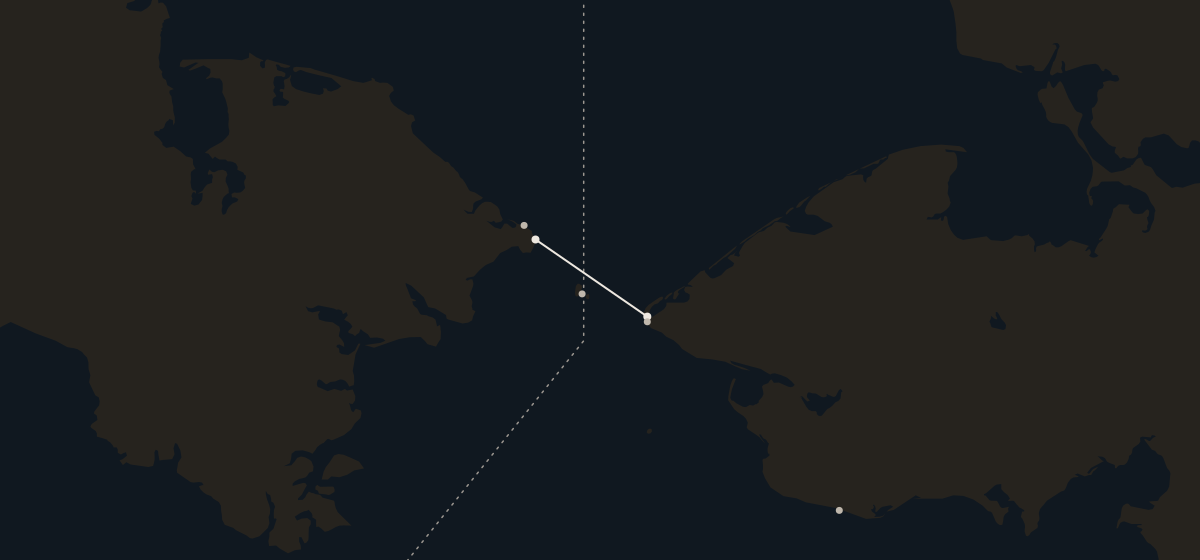
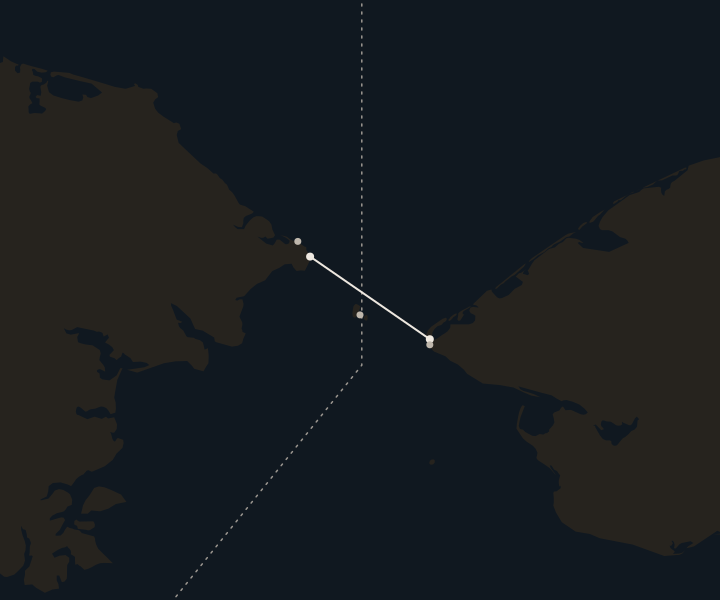
The Bering Strait is the narrow sea passage between Russia's Chukotka Peninsula and Alaska. It is about 82 km wide and 30 to 50 meters deep. It connects the Bering Sea (Pacific Ocean) to the Chukchi Sea (Arctic Ocean). The Diomede Islands sit in the middle, with the US-Russia border and the International Date Line between them.

- Width at the narrowest
- 82 km
- Cape Dezhnev to Cape Prince of Wales
- Between the Diomedes
- 3.8 km
- and 21 hours apart in winter
- Ship transits in 2024
- 665
- all vessels, against 242 in 2010
- Cargo ships a day
- 5
- Last four weeks; 2 a day in the same weeks of 2023
- Shores
 Russia
 United States
Where is the Bering Strait?
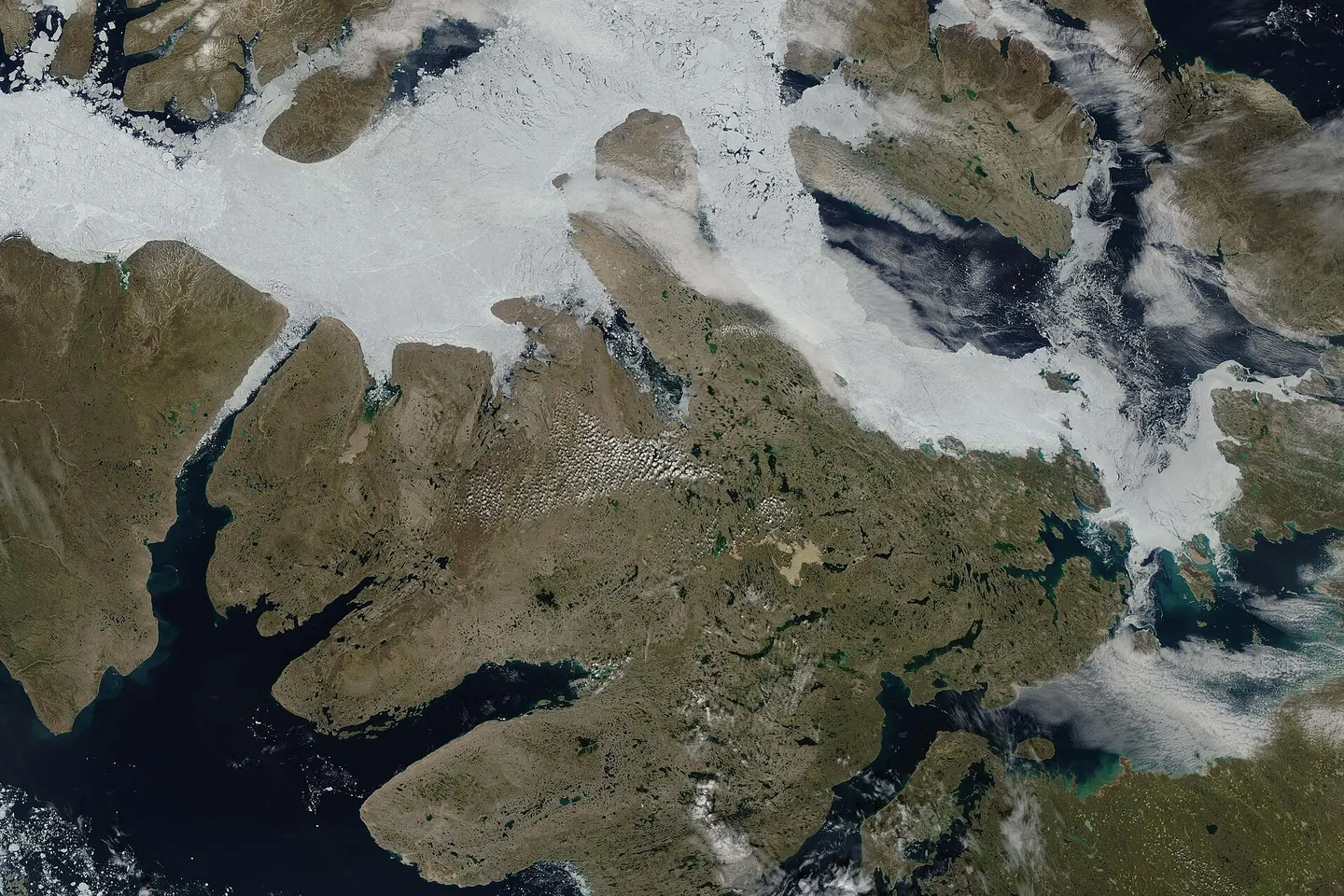
The Bering Strait runs between Cape Dezhnev on Russia's Chukotka Peninsula and Cape Prince of Wales on Alaska's Seward Peninsula. Cape Dezhnev is the easternmost point of mainland Asia. Cape Prince of Wales is the westernmost point of mainland North America. The strait is about 82 km wide at its narrowest and 30 to 50 meters deep.
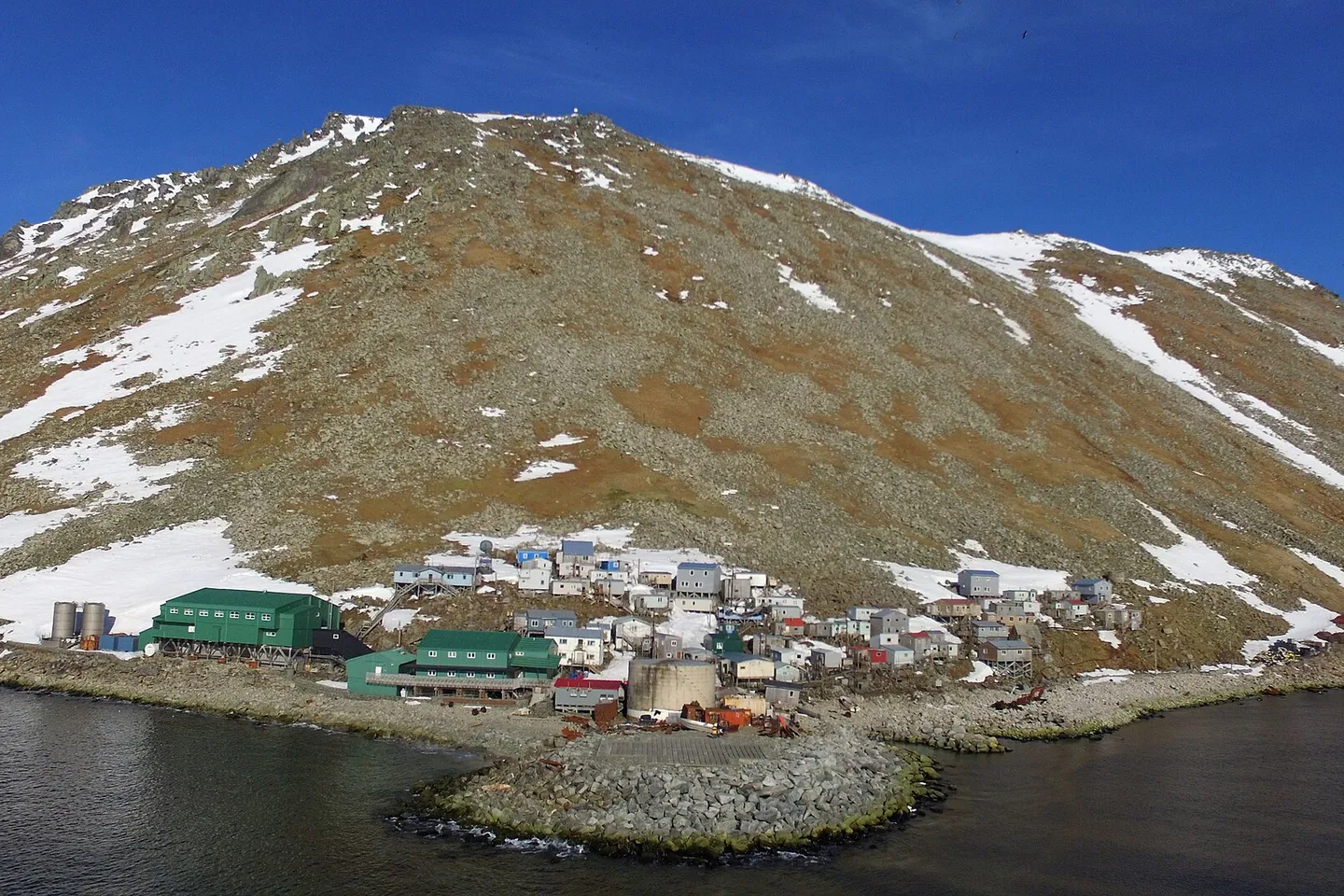
The Diomede Islands sit in the middle, 3.8 km apart. The US-Russia border and the International Date Line pass between them. Big Diomede (Russia) is called Tomorrow Island. Little Diomede (US) is called Yesterday Island. In winter the two are 21 hours apart. Little Diomede has about 80 people. Big Diomede has had no civilian residents since 1948. It is a Russian border guard post.
The strait connects the Bering Sea (Pacific) to the south with the Chukchi Sea (Arctic Ocean) to the north. The line "I can see Russia from my house" was Tina Fey playing Sarah Palin on Saturday Night Live on September 13, 2008. Palin's actual words, in an ABC interview, were "you can actually see Russia from land here in Alaska."
 RUSSIA
UNITED STATES
Chukchi Sea
Bering Sea
Uelen
Wales
Nome
Diomede Islands
82 km
 RUSSIA
ALASKA
Chukchi Sea
Bering Sea
Uelen
Wales
Diomede Islands
82 km
How many ships pass through the Bering Strait?
The Marine Exchange of Alaska counted 242 transits of all vessels in 2010 and a record 681 in 2023. In 2024 it counted 665. Most ships on the Russian side were tankers and cargo ships. Most on the US side were tugs, landing craft, passenger and research vessels.
IMF PortWatch, which counts only cargo ships and tankers, recorded 406 transits in 2026 through October 25, already above all of 2025 (372). Tanker transits reached 195, the most in its records. In the four weeks to October 25, 5 cargo ships and tankers a day passed through, against 2 a day in the same weeks of 2023.
Russia's Northern Sea Route carried 104 transit voyages by September 30, 2026, more than all of 2025. The icebreaking carrier Christophe de Margerie passed the strait on June 8, 2026, carrying sanctioned Arctic LNG 2 cargo to China. In January to August 2026, about 2.3 million tonnes in 31 cargoes went from Arctic LNG 2 to Beihai, China. The strait is ice-bound roughly from November or December to May or June. Heavy, early ice formed in the Chukchi Sea in October 2026. Since December 1, 2018, ships have been advised to follow two-way routes agreed at the International Maritime Organization, the first such routes in the Arctic.
Ships through the strait each day
Weekly average, January 2023 to October 2026
Who controls the Bering Strait?
The strait is used for international navigation. Under the UN Convention on the Law of the Sea, ships have the right of transit passage. Russia accepts that the Bering Strait is an international strait, and neither country can suspend passage.
The US-Russia border runs between the Diomede Islands. It was first drawn in 1867 when the US bought Alaska. The Baker-Shevardnadze maritime boundary agreement, signed on June 1, 1990, formalized the line at sea. The US Senate approved it 86 to 6 on September 16, 1991. Russia's parliament has never ratified it, but both sides have applied it provisionally since signing. In 2024, Russian lawmakers suggested revisiting the agreement. Russia's Foreign Minister Sergey Lavrov defended it as valid and beneficial to Russia.
The real dispute is over Russia's Northern Sea Route, which lies west of the strait. Russia calls the route a national transport route and requires ships to get permits. The US regards some of Russia's Arctic straits as international.
The line between the US and Russia
- March 30, 1867The Alaska purchase ($7.2 million) draws the border between the Diomedes.
- June 1, 1990Baker-Shevardnadze maritime boundary agreement signed in Washington.
- September 16, 1991The US Senate approves the agreement, 86 to 6.
- Since 1990Never ratified by Russia's parliament. Applied provisionally by both sides.
- 2024Russian lawmakers suggest revisiting the agreement. Lavrov defends it.
What are Russia and China doing near the Bering Strait?
On July 24, 2024, NORAD intercepted two Russian Tu-95 and two Chinese H-6 bombers in Alaska's air defense zone. It was the first time Chinese H-6 bombers entered the Alaska zone. On September 28, 2024, two China Coast Guard and two Russian Border Guard ships were spotted in the Bering Sea southwest of St. Lawrence Island, the northernmost point where the US had seen Chinese ships. In February and March 2026, NORAD intercepted Russian aircraft near Alaska twice more.
In July 2026, the Chinese icebreakers Xue Long and Xue Long 2 sailed north through the US exclusive economic zone in the Bering Sea. The US Coast Guard cutter Munro monitored them under Operation Frontier Sentinel. In summer 2026 the Coast Guard icebreaker Healy broke down. That cut US icebreaking capacity in the Arctic in half, according to the Coast Guard's Arctic commander, Rear Admiral Bob Little.
In October 2025, Kirill Dmitriev, head of the Russian Direct Investment Fund and Putin's envoy, proposed a rail and cargo tunnel under the strait, about 112 km long, which he said could cost under $8 billion. At the St. Petersburg forum in June 2026, Dmitriev said a design agreement was being signed. No signing has been confirmed, and the US government has not backed the idea. The US is building a deep-water port at Nome, Alaska. The US Army Corps of Engineers awarded a $399.4 million contract for the first phase in August 2025, due to be finished by September 5, 2029.
Russia and China near Alaska
- July 24, 2024Two Russian Tu-95 and two Chinese H-6 bombers in Alaska's air defense zone.
- September 28, 2024Chinese and Russian coast guard ships in the Bering Sea.
- August 15, 2025Trump and Putin meet in Anchorage. No deal on Ukraine.
 July 2026Chinese icebreakers Xue Long and Xue Long 2 sail north through the US zone.
- Summer 2026The US icebreaker Healy breaks down, halving US icebreaking capacity in the Arctic.
The strait over the years
- Ice AgeLow sea levels expose a land bridge up to about 1,600 km wide. People cross from Asia to North America more than 15,000 years ago, possibly much earlier.
- Aug 1728Vitus Bering, a Dane in Russian service, sails north from Kamchatka and passes the Diomedes. Fog hides America from him, and he turns back.
- 1867The United States buys Alaska from Russia for $7.2 million, about 2 cents an acre. The treaty draws the border between the Diomede Islands.
- 1948The Soviet Union moves Big Diomede's people to the mainland. The "Ice Curtain" cuts off families on the two sides of the strait for 40 years.
- Aug 1987Lynne Cox swims 4.3 km from Little Diomede to Big Diomede in water of about 3.3 °C. Reagan and Gorbachev praise the swim when they sign a nuclear arms treaty that December.
- Aug 2025Donald Trump and Vladimir Putin meet in Anchorage on August 15. Putin says the two countries are separated only by the Bering Strait.