Chokepoint · Canadian Arctic
Northwest Passage
Iced in until summer 2027Updated November 1, 2026
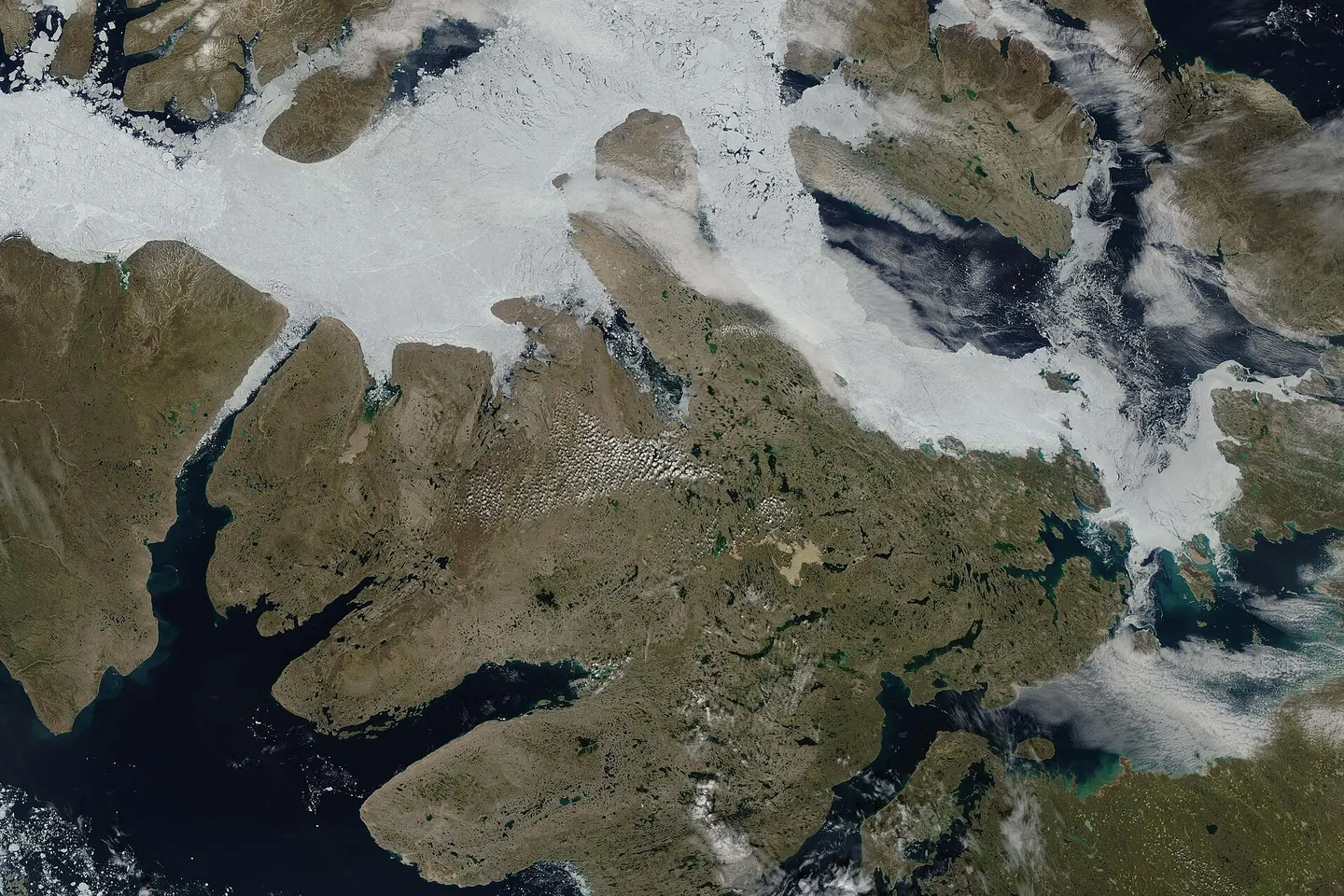
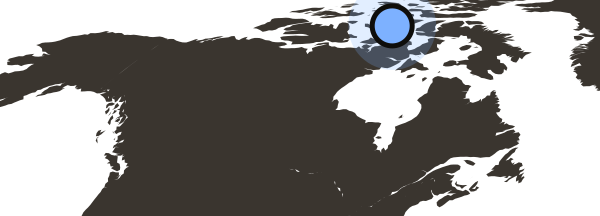
The Northwest Passage is a set of sea routes through Canada's Arctic islands connecting the Atlantic and Pacific oceans. It runs about 1,450 km east to west, from Baffin Bay to the Beaufort Sea. The Scott Polar Research Institute counts seven routes. Ships can use it from about August to October, and ice blocks the deepest route almost every year.
- Complete transits ever
- 465
- to the end of 2025
- Record year
- 41 transits
- in 2023; 38 in 2024
- Shipping season
- August to October
- 2025: August 6 to October 14
- Country
 Canada
Where is the Northwest Passage?
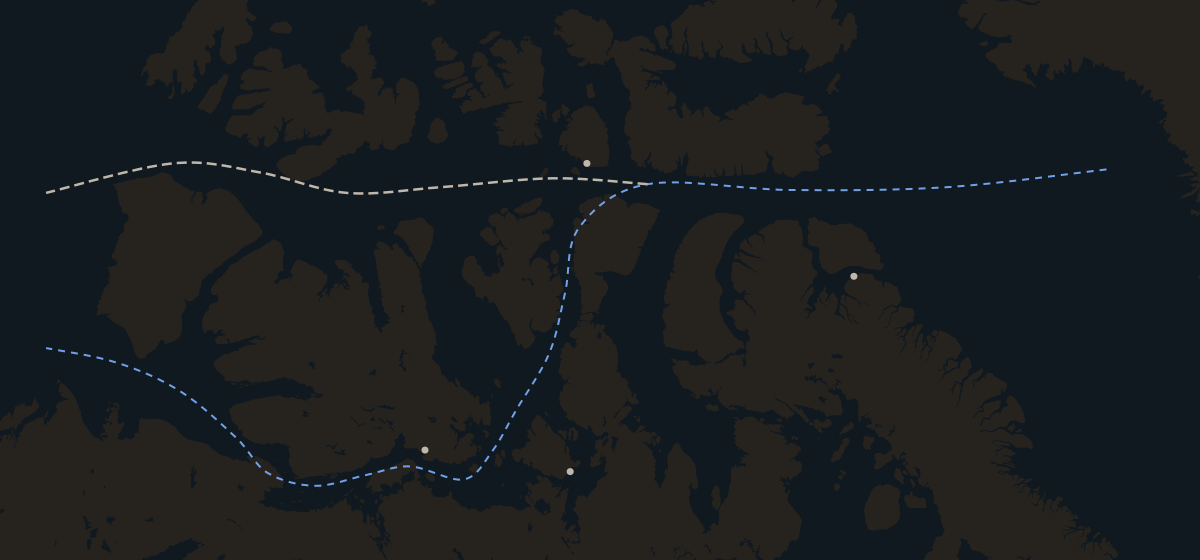
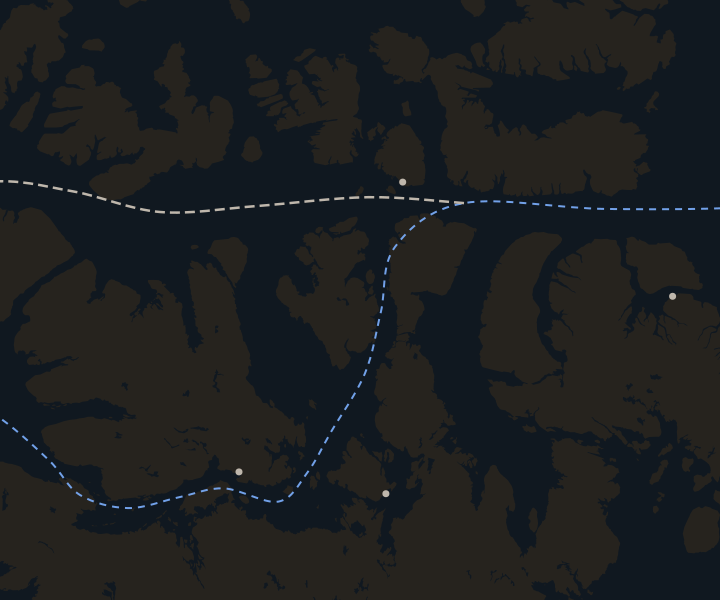
The Northwest Passage runs through Canada's Arctic islands between Baffin Bay on the Atlantic side and the Beaufort Sea on the Pacific side. The Scott Polar Research Institute counts seven routes. The main route for larger ships, those that sit less than 14 meters deep in the water, goes through Lancaster Sound, Barrow Strait, Peel Sound, Franklin Strait and Victoria Strait, then west along the mainland coast.
The deep northern route through M'Clure Strait is usually blocked by ice. Only five transits have ever used it. Smaller vessels sometimes take a shallow southern route through Rae Strait and Simpson Strait, where the water is only 6.4 meters deep. Bellot Strait, which separates Somerset Island from the Boothia Peninsula, is about 2 km wide at its narrowest, with currents reaching about 8 knots.
A voyage from East Asia to Western Europe is about 7,000 km shorter through the Passage than through the Panama Canal. In 2013 the bulk carrier Nordic Orion saved about 1,000 nautical miles on a run from Vancouver to Finland.
 BAFFIN ISLAND
VICTORIA ISLAND
BANKS ISLAND
DEVON ISLAND
GREENLAND
CANADA
Beaufort Sea
Baffin Bay
Lancaster Sound
M'Clure Strait
Peel Sound
Resolute
Gjoa Haven
Cambridge Bay
Pond Inlet
 BAFFIN ISLAND
VICTORIA ISLAND
DEVON ISLAND
CANADA
Lancaster Sound
Peel Sound
Resolute
Gjoa Haven
Cambridge Bay
Pond Inlet
Who owns the Northwest Passage?
No one disputes that the islands are Canadian. The dispute is about the water between them. The Canadian government says all waters of the Arctic Archipelago are internal waters by historic title, so foreign ships have no right to pass without Canada's permission. Canada drew straight lines around the outer edge of the archipelago, in force since January 1, 1986. The United States says the Passage is an international strait that all ships may sail through. Secretary of State Mike Pompeo called Canada's claim "illegitimate" on May 6, 2019.
The US oil tanker SS Manhattan sailed through in 1969, and Canada responded with the Arctic Waters Pollution Prevention Act (Royal Assent June 26, 1970). When the US Coast Guard's Polar Sea entered the Passage on August 1, 1985 without asking permission, both governments agreed the transit did not affect their legal positions. On January 11, 1988, Canada and the United States signed the Arctic Cooperation Agreement: US icebreakers would sail with Canada's consent, but both sides would "agree to disagree" on the law.
Canada's ship-reporting rules (NORDREG, mandatory since July 1, 2010) were folded into new vessel-traffic regulations on March 31, 2026. The US government has not challenged Canada over the Passage in 2025 or 2026. Still, President Trump's talk of taking Greenland and making Canada a US state has worried Canadians. On January 28, 2026, Natan Obed, the president of the national Inuit organization Inuit Tapiriit Kanatami, warned that the US pressure on Greenland would turn to Canada's North.
Who says what
- CanadaInternal waters by historic title. No right of passage. Canada's lines around the islands in force since January 1, 1986.
 United StatesAn international strait with transit passage. Secretary of State Mike Pompeo called Canada's claim "illegitimate" on May 6, 2019.
 RussiaThe same position as Canada, because Russia makes the same claim for its Northern Sea Route.
 ChinaHas not recognized Canada's position. Calls itself a "near-Arctic state" and stresses freedom of navigation.
How many ships use the Northwest Passage?
The Scott Polar Research Institute recorded 465 complete transits from Amundsen's voyage to the end of 2025, by 317 different vessels. The record was 41 transits in 2023, followed by 38 in 2024. About a third of transits in 2020 to 2024 were commercial ships. Yachts and private boats made up the largest share.
For comparison, Russia's Northern Sea Route had 104 transits by September 30, 2026, more than twice the Northwest Passage's record year, and most of them commercial ships. The Passage has few ports, charts or rescue bases. The Dutch cargo ship Thamesborg ran aground on an uncharted shoal in Franklin Strait on September 6, 2025 and was stuck for about five weeks. The same ship made the crossing again from August 13 to 18, 2026. On May 21, 2026, Canada's defense department stopped work on its unfinished Arctic naval facility at Nanisivik and began reviewing whether to sell it.
Transits by kind of ship, 2020 to 2024
Is the Northwest Passage open?
International transits usually run from early August to mid-October. In 2025 the first ship entered on August 6 and the last exited on October 14. The southern route was navigable by mid-August 2026, when the cargo ship Thamesborg completed a crossing. Winter ice has now ended the 2026 season. The next transits are expected around August 2027.
The Arctic sea-ice minimum in 2026 was about September 12, at 4.60 million square kilometers. That tied for the 10th lowest on record. The 20 lowest years are the last 20. A 2024 study found that the shipping season has been getting shorter since 2007, because old ice from the north drifts into the narrow channels. Ice-free Septembers in the Arctic Ocean are expected around mid-century under high emissions. Some studies say the 2030s.
How is Canada defending the Arctic?
Canada has announced a series of military and infrastructure plans for the north. On March 18, 2025, the Canadian government committed more than C$6 billion for an Arctic over-the-horizon radar based on Australia's Jindalee technology. On March 12, 2026, Prime Minister Mark Carney announced a northern plan worth more than C$35 billion in federal spending, with new hubs at Resolute and Cambridge Bay.
On July 6, 2026, Germany's TKMS was chosen to build up to 12 submarines for Canada. On August 24, 2026, the Canadian government announced more than C$11 billion for six icebreakers from Chantier Davie. In August 2026, HMCS Robert Hampton Gray sailed through the Passage, the first Canadian navy ship to move home port this way.
Four Chinese research ships, including the icebreakers Xue Long and Xue Long 2, sailed in the Arctic off Alaska in 2026. No Chinese ship has been reported going through the Northwest Passage. Inuit leaders say they must have a say in Canada's Arctic security decisions.
Canada's Arctic plans
- March 18, 2025More than C$6 billion for an Arctic over-the-horizon radar based on Australia's Jindalee technology.
- March 12, 2026Prime Minister Mark Carney's northern plan: more than C$35 billion, new hubs at Resolute and Cambridge Bay.
- July 6, 2026Germany's TKMS chosen to build up to 12 submarines for the Canadian navy.
- August 24, 2026More than C$11 billion for six icebreakers from Chantier Davie.
- August 2026HMCS Robert Hampton Gray sails through the Passage, the first Canadian navy ship to move home port this way.
The Passage over the years
- 1845Sir John Franklin leaves England with HMS Erebus and HMS Terror and 129 men to find the Passage. None return. Searchers find Erebus in 2014 and Terror in 2016, and DNA has since named some of the dead, among them Captain James Fitzjames in 2024.
- 1903–06Roald Amundsen's Gjøa completes the first transit by ship, leaving Norway in June 1903 and reaching Nome, Alaska, in August 1906.
- 1944The RCMP schooner St. Roch sails from Halifax to Vancouver in 86 days, the first transit completed in a single season.
- 1969The oil tanker SS Manhattan sails from Chester, Pennsylvania, through the Passage to test Arctic oil shipping. Canada responds with the Arctic Waters Pollution Prevention Act.
- 1985The US Coast Guard's Polar Sea enters the Passage on August 1 without asking Canada's permission. Both governments agree the voyage does not change their legal positions. Weeks later, Canada draws lines around its Arctic islands to claim the waters inside.
- 2016The cruise ship Crystal Serenity carries 1,070 passengers from Seward, Alaska, to New York in 32 days, the first large cruise ship through the Passage.