
Country profile · Southeast Europe
 Bulgaria
 is a Balkan country on the Black Sea with about 6.4 million people. It joined NATO in 2004 and the EU in 2007. It adopted the euro on January 1, 2026. Rumen Radev, a former air force commander, resigned as president and became prime minister in May 2026. A presidential election is due on October 25, 2026.
Where Bulgaria ranks
All rankings →Which alliances is Bulgaria in?
All alliances →Who runs Bulgaria?
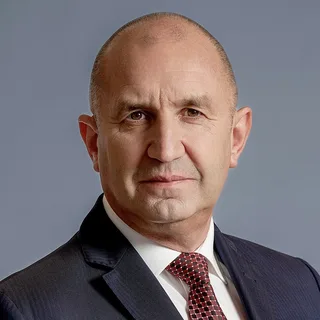
Prime Minister Rumen Radev was born in Dimitrovgrad on June 18, 1963. He flew MiG-29 fighter jets and commanded the air force from 2014 to 2016. He was elected president in 2016 and again in 2021. Bulgaria held eight parliamentary elections between April 2021 and April 2026. In late 2025 large protests, many led by young people, began against the draft 2026 budget and turned against corruption. Prime Minister Rosen Zhelyazkov's government resigned on December 11, 2025. Radev resigned as president in January 2026 and founded Progressive Bulgaria. Vice President Iliana Iotova became Bulgaria's first woman president. On April 19, 2026 Progressive Bulgaria won 131 of 240 seats (chart), the first single-party majority in decades. Parliament elected Radev prime minister on May 8, 2026. The presidential election is on October 25, 2026, with a runoff on November 1 if needed. Iotova leads the polls ahead of Andrey Gyurov, backed by the pro-Western PP-DB alliance.
- Progressive Bulgaria (Radev) 131
- GERB-SDS 39
- PP-DB 37
- DPS 21
- Revival 12
Official portrait (2026): Government of Bulgaria, Wikimedia Commons, CC BY 4.0 (cropped)
Who are Bulgaria's allies and rivals?
Bulgaria joined NATO in 2004 and the EU in 2007. Italy leads a NATO battlegroup of about 1,000 troops at Novo Selo. Bulgaria has received eight F-16 fighters from the United States, and Lockheed Martin says the other eight will come in 2030. Russia stopped selling gas to Bulgaria in April 2022. Prime Minister Rumen Radev's government takes a softer line. In June 2026 it stopped sending weapons to Ukraine from army stocks, and it made the EU drop sanctions on Russian Patriarch Kirill before agreeing to a new package. On October 6 and 13, 2026, drones hit four cargo ships in Bulgaria's waters in the Black Sea, and at least two sank. Radev said the attacks benefit Russia, and Bulgaria asked NATO for anti-drone systems. Bulgaria vetoed North Macedonia's EU membership talks in 2020. Since a 2022 compromise, the talks have been stuck because North Macedonia has not named Bulgarians in its constitution.
Allies and partners
- European UnionMember since 2007; euro since 2026
- NATOMember since 2004; Italian-led battlegroup
 RomaniaNeighbor, NATO ally and second-largest buyer
 GreeceGas from Azerbaijan arrives through Greece
 TurkeyBig trade partner; gas deal frozen in 2026
Tensions
 RussiaCut off gas in 2022; owns the Burgas refinery
 North MacedoniaEU talks stuck over history and language
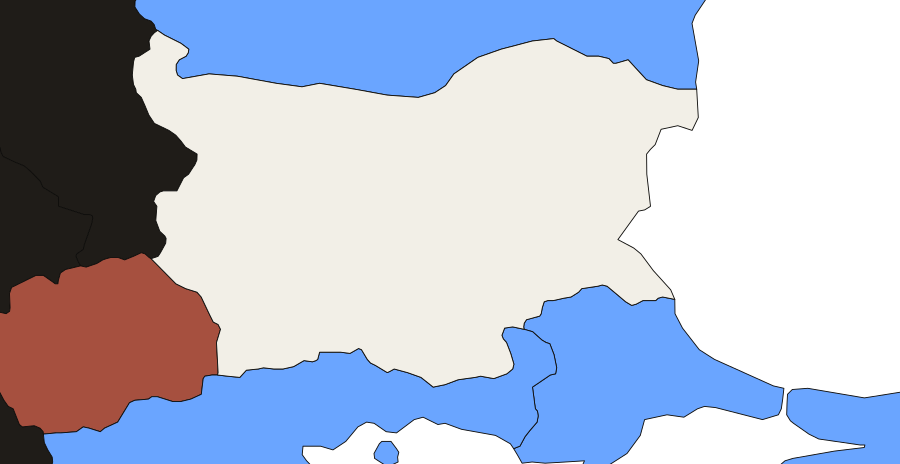
- Burgas Lukoil's refinery, the largest in the Balkans. A state-appointed manager has run it since US sanctions in 2025.
- Kozloduy Nuclear plant on the Danube that made 38% of Bulgaria's electricity in 2025. Two US-designed reactors are planned.
- Novo Selo Training area where Italy leads a NATO battlegroup of about 1,000 troops.
- Krapets A cargo ship hit by drones sank off Krapets on October 13, 2026, with about 11 crew missing.
- Bulgaria
- Partner
- Tensions
Who does Bulgaria trade with?
Bulgaria exported $47.9 billion of goods in 2025 and imported $59.6 billion (UN Comtrade). Germany bought 14.3% of exports and Romania 10.9% (chart). China supplied 12.2% of imports, Germany 9.7% and Turkey 9.0%. Bulgaria adopted the euro on January 1, 2026, as the 21st member of the euro area. Inflation rose to 5.7% in September 2026, the second-highest in the euro area. The economy grew by 3.1% in 2025. Bulgaria has the lowest minimum wage in the EU, at €620 a month, and its GDP per person at purchasing power was 68% of the EU average in 2025. Government debt was 29.9% of GDP at the end of 2025, the fourth-lowest in the EU. But the 2026 budget allows a deficit of 5.7% of GDP, the widest since 1996, and the EU opened a deficit procedure in July 2026. Bulgaria grew a record 7.3 million tonnes of wheat in 2025.


Why is Bulgaria's population shrinking?
Bulgaria had about 8.98 million people in 1988. By the end of 2025 it had 6.42 million (National Statistical Institute). In 2025 there were 50,241 births and 99,479 deaths, so deaths were almost twice the number of births. Women had 1.63 children on average. About 1.25 million people born in Bulgaria live abroad (UN, 2024), the largest groups in Turkey and Germany. Many left after communism ended in 1989 and after Bulgaria joined the EU in 2007. In 1989 alone, between 300,000 and 360,000 Turks and other Muslims were forced across the border into Turkey, after a campaign that made about 850,000 people take Bulgarian names. The UN expects Bulgaria to fall to about 5.4 million people by 2050. Half of Bulgarians are older than 44.8 (chart), and 24.3% are 65 or older.


 Slovenia
Why do Russian oil and gas still matter in Bulgaria?
Bulgaria's largest refinery, Neftochim Burgas, belongs to Russia's Lukoil. It can process 190,000 barrels of oil a day. It has not used Russian crude since March 1, 2024. After the United States put sanctions on Lukoil in late 2025, Bulgaria's parliament gave a state-appointed manager control of the refinery. A US license lets it keep working until April 24, 2027. No buyer has been found. Gazprom stopped selling gas to Bulgaria in April 2022, after Bulgaria refused to pay in rubles. Gas from Azerbaijan, which arrives through Greece, now covers nearly 40% of demand, and the rest is mostly liquefied natural gas. The TurkStream pipeline still carries Russian gas across Bulgaria to Serbia and Hungary, 16.8 billion cubic meters in 2025. The Kozloduy nuclear plant, which uses Soviet-designed reactors, made 38% of the country's electricity in 2025. Since 2024 one of its reactors has used fuel from the US company Westinghouse instead of Russian fuel.