
Country profile · Southern Europe
 Portugal
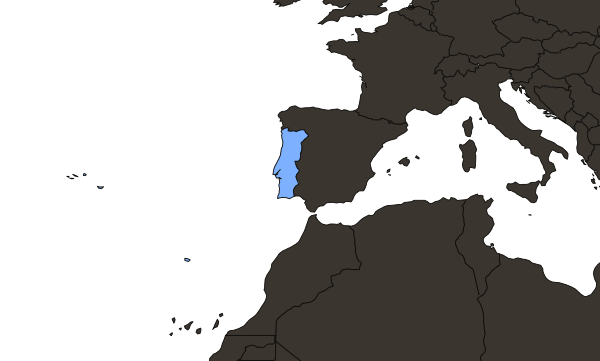
 is a country of about 11.4 million people on the Atlantic edge of Europe, with the Azores and Madeira islands far out at sea. It was a founding member of NATO and lets the United States use an air base in the Azores. Prime Minister Luís Montenegro leads a minority center-right government, and the far-right Chega party is now the second largest in parliament.
Where Portugal ranks
All rankings →Which alliances is Portugal in?
All alliances →Who runs Portugal?
Portugal is a parliamentary republic. Prime Minister Luís Montenegro, who leads the center-right Social Democratic Party (PSD), was born in Porto in 1973 and worked as a lawyer. He became prime minister on April 2, 2024. On March 11, 2025 his government lost a confidence vote over Spinumviva, a consulting firm owned by his family. Prosecutors later closed their inquiry without charges. In the snap election of May 18, 2025, his Democratic Alliance won 91 of the 230 seats (chart). Chega, a far-right party founded by André Ventura in 2019, won 60 seats and became the second largest party for the first time, two seats ahead of the Socialists. Montenegro leads a minority government, and its budgets pass because the Socialists abstain. On February 8, 2026 António José Seguro, a former Socialist leader, beat Ventura in the presidential runoff with about 67% of the vote. In October 2026 polls showed the Socialists, Chega and the government's alliance roughly tied.

- Democratic Alliance (PSD, CDS) 91
- Chega 60
- Socialist Party 58
- Liberal Initiative 9
- Livre 6
- Communists and Greens 3
- Others 3
Photo (September 2025): Cabinet Public Affairs Office of Japan, Wikimedia Commons, CC BY 4.0 (cropped)
Who are Portugal's allies and rivals?
Portugal was one of the 12 founding members of NATO in 1949, while it was still a dictatorship. Its alliance with England dates from a treaty of 1373, confirmed by the Treaty of Windsor in 1386. The British government calls it the longest continuing alliance in history. The United States uses Lajes air base on Terceira, in the Azores, under a 1995 agreement. During the war with Iran in 2026, US tanker planes and fighters were based there. Portugal allowed their use only in response to Iranian attacks. In October 2026 prosecutors opened an inquiry into the base's use. Portugal spent 2% of GDP on defense in 2025 for the first time and is buying three frigates from Italy. Spain is its closest economic partner. Portugal has never recognized Spanish rule over Olivenza, a border town Spain took in 1801. China Three Gorges owns 22% of EDP, Portugal's biggest power company. Portugal recognized the State of Palestine on September 21, 2025.
Allies and partners
 SpainBiggest trade partner; buys about a quarter of exports
 United KingdomAllied since a treaty of 1373
 United StatesUses Lajes air base in the Azores
 BrazilBrazilians are the largest group of foreign residents
Tensions
 RussiaPortugal's navy tracked 69 Russian ships off its coasts in 2025
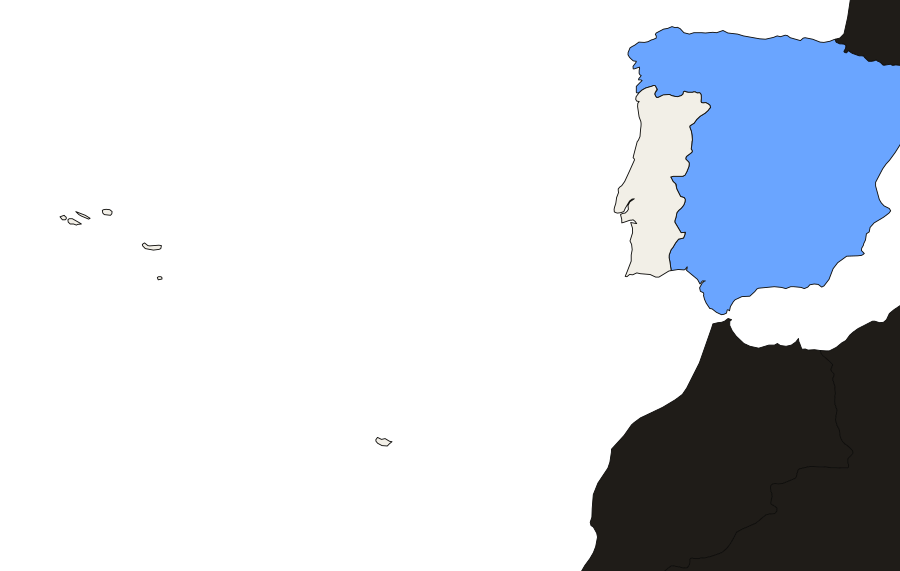
- Lajes US air base under a 1995 agreement. US tankers and fighters were based here during the 2026 war with Iran.
- Sines Deep-water port and gas terminal. About 95% of Portugal's gas arrived here in 2025, mostly from Nigeria and the US.
- Olivenza Border town held by Spain since 1801. Portugal has never legally recognized Spanish rule.
- Savage Islands Uninhabited Portuguese islets. Spain says they are rocks that give Portugal no economic zone.
- Portugal
- Partner
Who does Portugal trade with?
Portugal exported €79.0 billion of goods in 2025 and imported €112.1 billion (INE). Spain bought about 26% of exports (chart). Germany passed France in 2025 to become the second largest buyer. Sales to the United States fell 13% in 2025, the year the US raised tariffs. Cars from the Volkswagen Autoeuropa plant and fuel from the Sines refinery are big exports. Portugal also produces about half of the world's cork. Tourism earns even more. Hotels and other lodgings counted a record 32.5 million guests in 2025, and tourism receipts reached a record €29.1 billion. Portugal needed a €78 billion bailout in 2011. Its public debt has since fallen from 135% of GDP in 2020 to 89% in 2025, and the budget has been in surplus every year since 2023. House prices rose 16.5% in the year to mid-2026. On October 14, 2026 the government chose Lufthansa to buy 44.9% of TAP, the national airline, for €1.2 billion.
Sells to
Share of Portugal's exports
- Spain26.0%
 Germany13.9%
 France12.0%
- United States5.8%
- United Kingdom4.5%


Goods, 2025, as reported by Portugal. UN Comtrade.
How fast is Portugal's population aging?
Half of Portugal's people are older than 46.9, one of the highest median ages in the world (UN) (chart). Deaths have outnumbered births every year since 2009. Women have 1.4 children on average (INE, 2024). Emigration has added to the problem. About 1.8 million people born in Portugal live abroad, equal to 17% of the population, the fourth highest share in the EU. Emigration peaked in 1970 under the dictatorship and again in 2013 after the bailout. About 30% of Portuguese-born people aged 15 to 39 live abroad. Immigrants have filled the gap. Portugal had 1.59 million foreign residents at the end of 2025, almost four times as many as in 2017 (AIMA). Brazilians are the largest group, with 493,622. The population reached 11.4 million, and it grows only because of immigration. In May 2026 a new law raised the years of residence needed for citizenship from 5 to 10, or 7 for people from Portuguese-speaking countries.

Why does Portugal have such a big sea zone?
Portugal's explorers opened sea routes for Europe. Vasco da Gama reached India by sea in 1498, and Pedro Álvares Cabral reached Brazil in 1500. Today about 265 million people speak Portuguese as their first language, more than 8 in 10 of them in Brazil. Portugal still holds two Atlantic island groups, the Azores and Madeira, which govern themselves as autonomous regions. They give Portugal an exclusive economic zone, the sea area where it controls fishing and minerals, of about 1.7 million square kilometers (chart). That is about 18 times its land area, and the islands account for about four fifths of it. In 2009 Portugal asked a UN commission to recognize its rights over 2.15 million more square kilometers of seabed. No decision is expected before 2029. A 2025 law bans deep-sea mining in Portuguese waters until 2050. Since January 1, 2026 a marine protected area has covered 30% of the waters around the Azores, the largest in the North Atlantic.
Exclusive economic zones of European countries
Full ranking →- France9,529,864
- United Kingdom4,085,524
 Denmark2,638,178
 Norway2,021,014
- Portugal1,728,718
- Spain1,007,673
 Italy536,446
 Greece482,936
Marine Regions, EEZ version 12