
Country profile · Central Africa
 Cameroon
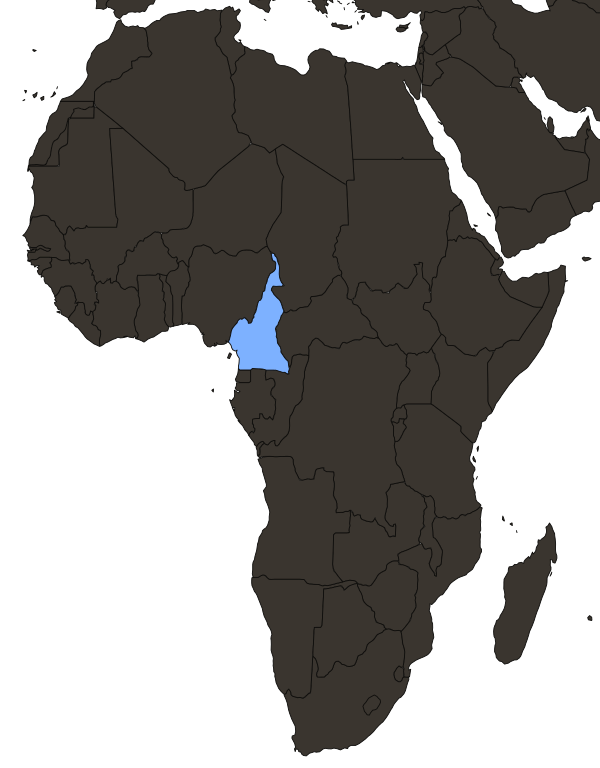
 is a Central African country of about 29.9 million people. French and English are its official languages. President Paul Biya, 93, the world's oldest head of state, has been in power since 1982 and won an eighth term in October 2025. Separatists fight the army in the English-speaking west, and jihadists attack in the far north.
Where Cameroon ranks
All rankings →Which alliances is Cameroon in?
All alliances →Who runs Cameroon?
President Paul Biya was born in Mvomeka'a on February 13, 1933. He studied law in Paris and graduated from Sciences Po in 1961. Biya became prime minister in 1975 and president on November 6, 1982, when Ahmadou Ahidjo resigned. Presidential term limits were removed in April 2008. Biya often spends weeks at the InterContinental hotel in Geneva. His latest stay ran from June to August 2026. In the election of October 12, 2025, the Constitutional Council gave Biya 53.66% and Issa Tchiroma Bakary, a former minister, 35.19%. The main opposition leader, Maurice Kamto, had been barred. Tchiroma said he had won and now lives in exile in the Gambia. The UN said 48 people were killed in protests after the vote. The government admits 16. Joseph Dion Ngute has been prime minister since 2019. A vice-president post was created in April 2026 but remains empty, and no successor has been named. On October 16, 2026, Fitch cut Cameroon's credit rating, citing the risk of a disorderly transfer of power.
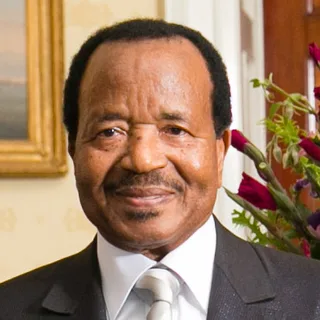
Photo (August 2014): Amanda Lucidon, The White House, Wikimedia Commons, public domain (cropped)
Who are Cameroon's allies and rivals?
France ruled most of Cameroon until independence on January 1, 1960. In a letter published on August 12, 2025, President Macron recognized that France had waged a war in Cameroon before and after independence against the UPC independence movement. Historians estimate tens of thousands were killed. Nigeria and Cameroon disputed the Bakassi peninsula until the International Court of Justice gave it to Cameroon on October 10, 2002. Nigeria handed it over on August 14, 2008. The two countries now fight Boko Haram and the Islamic State's West Africa branch around Lake Chad. On September 17, 2026, militants killed at least 15 people at Madegoua in the Far North. Cameroon hosted 408,613 refugees at the end of 2025, almost all from the Central African Republic and Nigeria (UNHCR). China is Cameroon's largest trading partner, and Cameroon owed it $3.31 billion in 2024, 26.4% of its public foreign debt (World Bank). Cameroon signed a military cooperation agreement with Russia on April 12, 2022.
Allies and partners


Rivals
- Boko Haram and ISWAPJihadist attacks in the Far North
- Ambazonia separatistsWar in the English-speaking regions since 2017
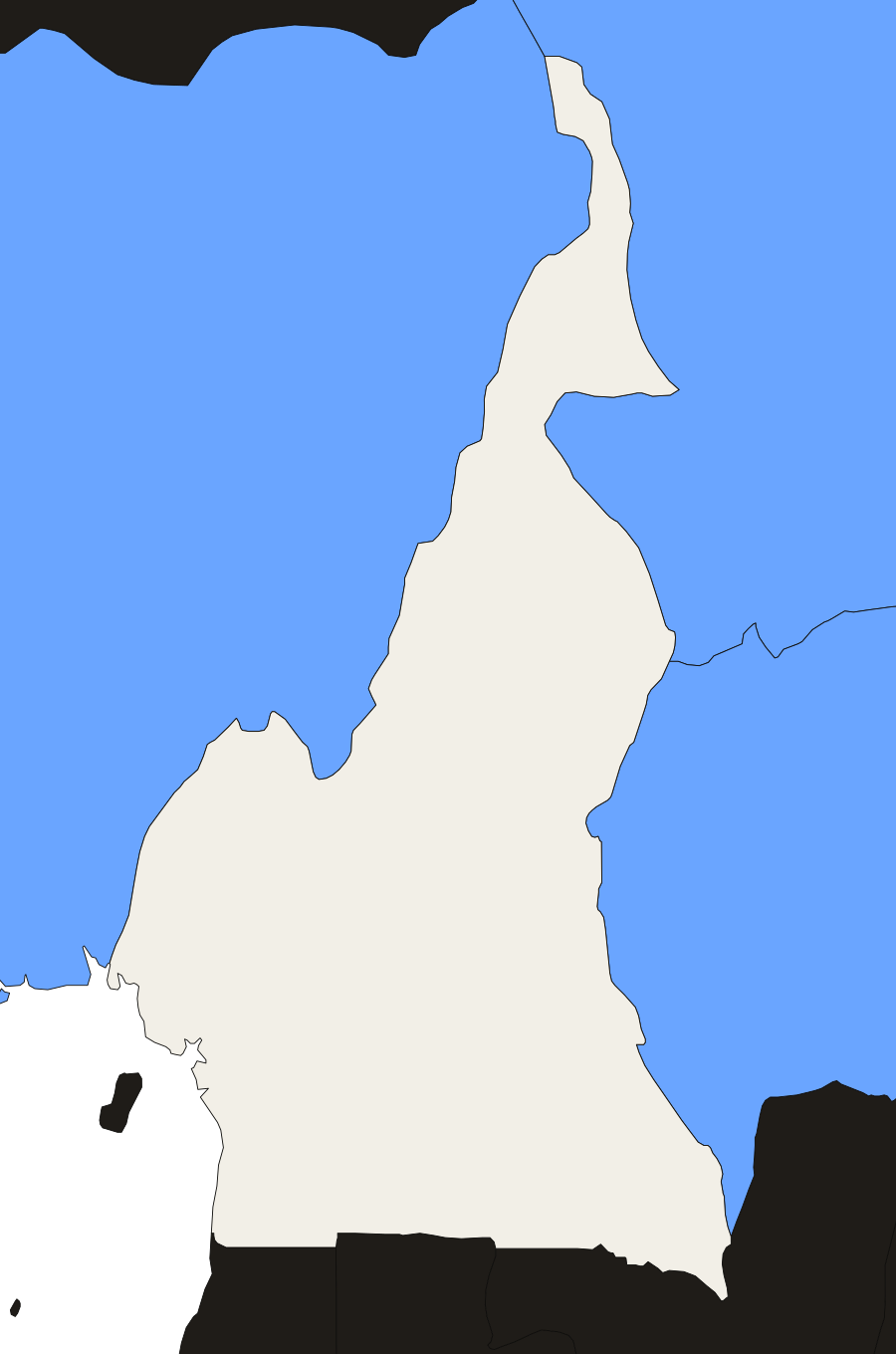
- Bakassi Peninsula Nigeria handed to Cameroon in 2008 after a 2002 International Court of Justice ruling.
- Bamenda Main city of the English-speaking North-West region and center of the separatist war.
- Madegoua Militants killed at least 15 people in this Far North village on September 17, 2026.
- Kribi Deep-sea port opened in 2018. The floating gas plant off the coast left in 2026.
- Cameroon
- Partner
Who does Cameroon trade with?
Cameroon exported 3,252 billion CFA francs of goods in 2024 and imported about 5,000 billion (National Institute of Statistics). The Netherlands bought 19.2% of exports and China 16.5% (chart). China supplied 22.2% of imports and is Cameroon's largest trading partner overall. Crude oil was 31% of exports in 2024, cocoa beans 21% and liquefied natural gas 12% (French Treasury). Oil output peaked at 186,000 barrels a day in 1985 and was about 59,000 in 2025, a fall of more than two thirds. The floating gas plant off Kribi left in mid-2026, ending gas exports. The SONARA refinery has been shut since a fire in 2019. Cocoa sales fell to 247,914 tonnes in 2025/26 from 309,518 the season before. Cameroon also sells timber, bananas, cotton and aluminium. The Nachtigal dam reached its full 420 megawatts in March 2025. Douala is the main port for Chad and the Central African Republic. Growth was 3.5% in 2025, and public debt was 40.3% of GDP (IMF).


What is the Anglophone crisis in Cameroon?
Germany ruled Kamerun from 1884. After World War I it was split between France and Britain. French Cameroun became independent on January 1, 1960. In a UN vote on February 11, 1961, British Southern Cameroons chose to join Cameroon, and Northern Cameroons joined Nigeria. A federation followed, but a referendum on May 20, 1972 ended it. In October and November 2016, lawyers and teachers in the two English-speaking regions, the North-West and the South-West, went on strike against the use of French in courts and schools. A crackdown followed, and separatists declared a state called "Ambazonia" in October 2017. The International Crisis Group counts more than 7,000 deaths (April 2026). About 493,000 people are displaced inside the two regions (OCHA, July 2026). The Uppsala Conflict Data Program recorded more than 6,000 deaths in all of Cameroon's conflicts from 2016 to 2025 (chart). The separatist leader Lucas Cho Ayaba goes on trial in Norway on November 10, 2026.
Deaths in conflicts in Africa, 2016 to 2025
Full ranking → Ethiopia333,126
 Sudan103,355
 DR Congo46,512
 Nigeria34,103
 Somalia26,899
 Burkina Faso21,900
 Mali15,980
 Central African Republic7,141
 Niger6,661
 Mozambique6,517
- Cameroon6,502
Uppsala Conflict Data Program (UCDP), Georeferenced Event Dataset, version 26.1
Why did sanctioned tankers fly Cameroon's flag?
Shipowners often register ships in another country. This is called a flag of convenience. Cameroon's registry grew from 434,000 deadweight tonnes in 2015 to 8.12 million in 2024, mostly oil tankers (UNCTAD). Our ranking puts the fleet at 14.47 million tonnes in 2026, 21st in the world (chart). Many of the new ships were old tankers carrying Russian oil despite Western sanctions, part of the so-called shadow fleet. Sanctioned tankers under Cameroon's flag rose from 10 in June 2025 to 143 in February 2026 (Centre for Research on Energy and Clean Air). Only Russia's own flag had more. Many registrations were fraudulent. On February 6, 2026, the transport ministry stopped registering ships that sail outside Cameroon's waters. In June it told the International Maritime Organization it had struck off 39 ships. Five of the nine ships seized by European navies in 2026 flew Cameroon's flag. By the end of September 2026, 69 Cameroon-flagged ships were still in the Russian oil trade.
Merchant fleets by flag, 2026
Full ranking → Liberia447
 Panama350
 Marshall Islands318
 Singapore186
 Malta114
 Bahamas71.3
 Greece51.7
 Russia19.6
 Barbados14.5
- Cameroon14.5
 Sierra Leone13.4
UNCTADstat maritime transport data, from Clarksons Research, 2026