
Country profile · Central Africa
 DR Congo
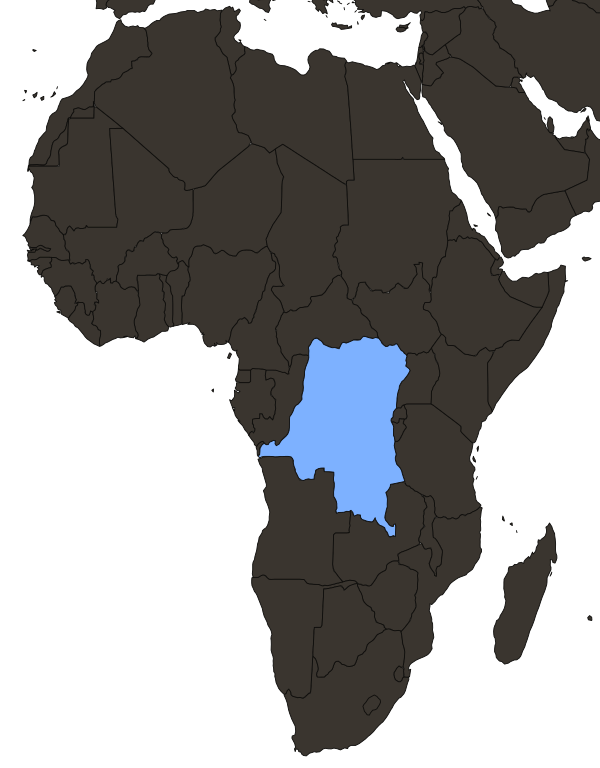
The Democratic Republic of the Congo (DR Congo) is the second-largest country in Africa and the 11th-largest in the world, with about 112.8 million people. It mined 74.2% of the world's cobalt in 2025 and is the second-largest copper producer. President Félix Tshisekedi has led it since 2019. M23 rebels backed by Rwanda have held Goma since January 2025.
Where DR Congo ranks
All rankings →Who runs DR Congo?
President Félix Tshisekedi runs DR Congo. He took office on January 24, 2019, the first peaceful handover of power since independence in 1960. The official count gave him 38.57% in the 2018 election, but leaked electoral data and the Catholic Church's observers showed Martin Fayulu winning. He was re-elected in December 2023 with 73.47%. Tshisekedi was born in Kinshasa in 1963. His father, Étienne, co-founded the UDPS party in 1982 to oppose the dictator Mobutu, and the family was held under house arrest in Kasai. Félix moved to Belgium in 1985, where his CV lists jobs as a filing clerk, a courier and a bank employee. The constitution allows two five-year terms. In May 2026 Tshisekedi said he would accept a third term "if people want," and in June parliament passed a law to organize a referendum on a new constitution.
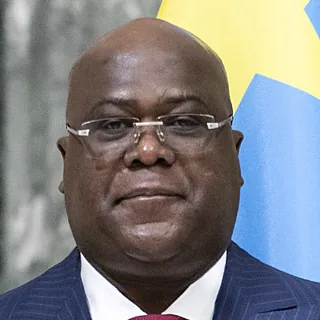
Photo (2021): Presidency of the Italian Republic, Wikimedia Commons, free with attribution
Who are DR Congo's allies and rivals?
Rwanda is DR Congo's main rival. UN experts say it directs the M23 rebels, who hold much of the east. The United States is the main outside partner. It brokered a peace agreement between DR Congo and Rwanda in June 2025, and on December 4, 2025 President Tshisekedi and Rwanda's President Kagame signed the Washington Accords with President Trump. The same day DR Congo gave US companies preferential access to a reserve of mineral assets. On March 2, 2026 the US sanctioned the Rwandan army itself. Qatar hosts separate talks between the government and M23, but only two of eight planned protocols had been signed by September 2026. Burundi is the main military ally, with more than 6,000 troops in the east in mid-2026. China is the main economic partner, because Chinese firms own the largest copper and cobalt mines.
Allies and partners
 United StatesPeace and minerals deals, December 2025
 BurundiMore than 6,000 troops in the east
 ChinaIts firms own the biggest mines
 QatarHosts peace talks with M23
 AngolaLobito railway carries Congolese copper
Rivals
 RwandaUN experts say it controls M23
- M23Has held Goma and Bukavu since 2025
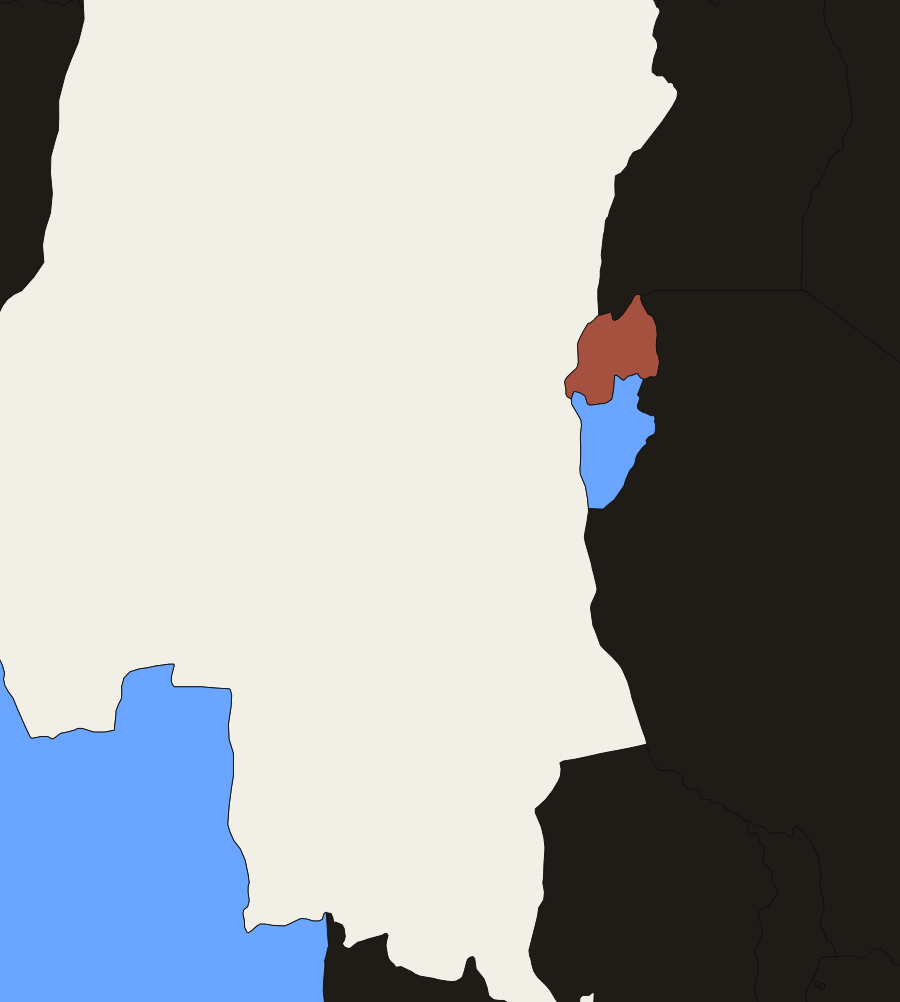
- Goma Largest city in the east; held by M23 since January 2025
- Bukavu Held by M23 since February 2025
- Uvira Taken by M23 in December 2025, left in January 2026
- Kolwezi Center of the copper and cobalt mining belt
- DR Congo
- Partner
- Rival
Who does DR Congo trade with?
DR Congo sells copper and cobalt, mostly to China. In 2024 its goods exports were worth $34.9 billion and its imports $31.0 billion, and copper made up 79.3% of exports and cobalt 10.9% (USGS). China bought 51.2% of exports in 2023. Copper output reached about 3.2 million tonnes in 2025, second only to Chile. DR Congo also mines about 52% of the world's tantalum, a metal used in electronics, from coltan ore. Much of the gold from the east is smuggled out: UN experts say gold from Ituri province inflated Uganda's record exports of 62 tonnes in 2025. Little of this wealth reaches the people. GDP per person was $871 in 2025, 178th of 189 countries, and the World Bank estimates that 81.1% of people lived on less than $3 a day. Only 22.5% had electricity in 2024.
Sells to
Share of DR Congo's exports
- China51.2%
- Hong Kong7.2%
 United Arab Emirates5.2%
 Mozambique4.9%
 South Africa4.8%
Buys from
Share of DR Congo's imports
- China26.1%
- United Arab Emirates11.6%
- South Africa6.4%
 India5.5%
 Belgium4.3%
Goods, 2023. Shares of DR Congo's exports and imports as reported by its trading partners (CEPII BACI). DR Congo's own customs data are incomplete.
Why is there a war in eastern Congo?
The war in the east is between the army and the M23 rebels, whom UN experts say Rwanda controls. M23 came back in 2021 and took Goma on January 27, 2025, and Bukavu on February 16. UN experts estimated that 14,000 to 18,000 Rwandan soldiers were in eastern DR Congo at the end of 2025. Rwanda says it is acting against the FDLR, an armed group with roots in the forces that fled Rwanda after the 1994 genocide. M23 has held the Rubaya mines, which produce about 15% of the world's coltan, since April 2024, and UN experts found it earned at least $800,000 a month by taxing the coltan trade there. The army has about 123,300 troops and spent $1.2 billion in 2025. The UN says 6.1 million people are displaced inside the country.
Refugees by country of origin, end of 2025
Full ranking → Venezuela6,459,716
 Ukraine5,224,131
 Syria4,865,764
 Afghanistan3,702,518
 Sudan2,820,737
 South Sudan2,386,499
 Myanmar1,524,378
- DR Congo1,176,489
UNHCR Refugee Population Statistics Database
Why does the world need Congo's cobalt?
Cobalt goes into the batteries of electric cars, phones and laptops, and into superalloys for jet engines. DR Congo mined 230,000 of the world's 310,000 tonnes in 2025, and Indonesia was second with 44,000. China refines 79% of the world's cobalt, and the Chinese company CMOC, the largest producer, mined a record 117,549 tonnes in Congo in 2025. To push up prices, DR Congo banned cobalt exports on February 22, 2025, then replaced the ban with quotas of 96,600 tonnes a year for 2026 and 2027, less than half of its 2025 output. Cobalt hydroxide rose from as little as $5.60 a pound in February 2025 to about $26 in April 2026, then fell to $17.25 by the end of September. Small artisanal mines, where child labor has been documented, produced only about 1.3% of Congo's cobalt at the end of 2024.


 Madagascar
 Philippines