
Country profile · West Africa
 Ghana
Ghana
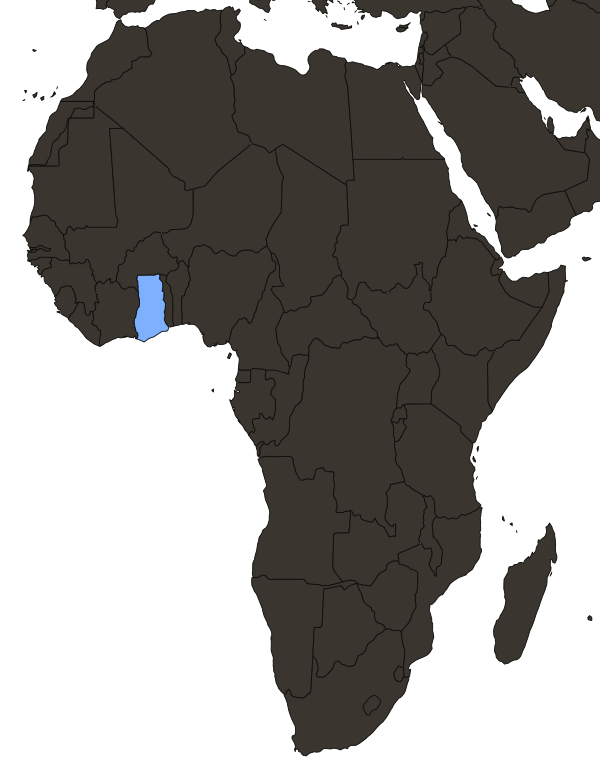
Ghana is a West African country of about 35 million people and Africa's largest gold producer. President John Dramani Mahama won back power in December 2024, eight years after voters removed him. Ghana stopped paying its debts in 2022 and completed a $3 billion IMF loan in July 2026. Unlike its neighbors Burkina Faso and Togo, Ghana has suffered no jihadist attack.
Where Ghana ranks
All rankings →Which alliances is Ghana in?
All alliances →Who runs Ghana?
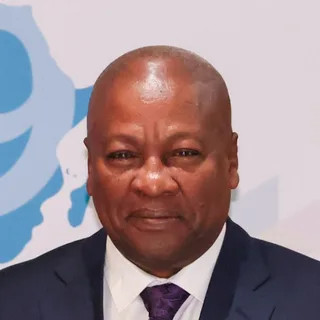
President John Dramani Mahama was born on November 29, 1958, in Damongo, in the north. He became vice president in 2009 and president on July 24, 2012, when President John Atta Mills died. Voters removed him in 2016, and he lost again in 2020, both times to Nana Akufo-Addo. On December 7, 2024, he beat Vice President Mahamudu Bawumia with about 56% of the vote, the first Ghanaian president to win back the office at the ballot box. Jane Naana Opoku-Agyemang is Ghana's first woman vice president. Mahama's National Democratic Congress (NDC) holds 185 of the 276 seats in parliament (chart). The constitution limits presidents to two terms, but several cases ask the Supreme Court whether terms that are not back to back count. Mahama denies wanting a third term. In September 2025 Mahama removed Chief Justice Gertrude Torkornoo after an inquiry, which the opposition called unconstitutional. On August 6, 2025 a military helicopter crash killed the defense and environment ministers.
- National Democratic Congress (NDC) 185
- New Patriotic Party (NPP) 87
- Independents 4
Photo (August 2025): Cabinet Public Relations Office, Government of Japan, Wikimedia Commons, CC BY 4.0 (cropped)
Who are Ghana's allies and rivals?
Ghana stayed in ECOWAS, the West African bloc, when Burkina Faso, Mali and Niger left it in January 2025. President John Dramani Mahama named an envoy to them that month and visited all three capitals in March 2025. Jihadists of JNIM, a group linked to al-Qaeda, killed eight Ghanaian tomato traders at Titao in Burkina Faso on February 14, 2026. In August 2026 Ghana and Burkina Faso signed a defense agreement on escorts and joint patrols. Côte d'Ivoire is Ghana's partner in cocoa. Together the two countries grow about 60% of the world's supply. China is Ghana's largest source of imports and co-chairs the group of countries that restructured Ghana's debts. Since September 2025 Ghana has accepted West Africans deported from the United States. In April 2026 Ghana's cabinet rejected a $109 million US health deal over data sharing. On March 25, 2026 the UN General Assembly adopted Ghana's resolution calling the slave trade the gravest crime against humanity.
Allies and partners
 Côte d'IvoireCocoa partner; together about 60% of world supply
 ChinaLargest source of imports; debt deal co-chair
 United KingdomFormer colonial power; growth partnership June 2026
 Burkina FasoDefense agreement signed August 2026
Tensions
- JNIMJihadist group; killed Ghanaian traders in Burkina Faso
 United StatesDeportee deal; Ghana rejected a US health deal
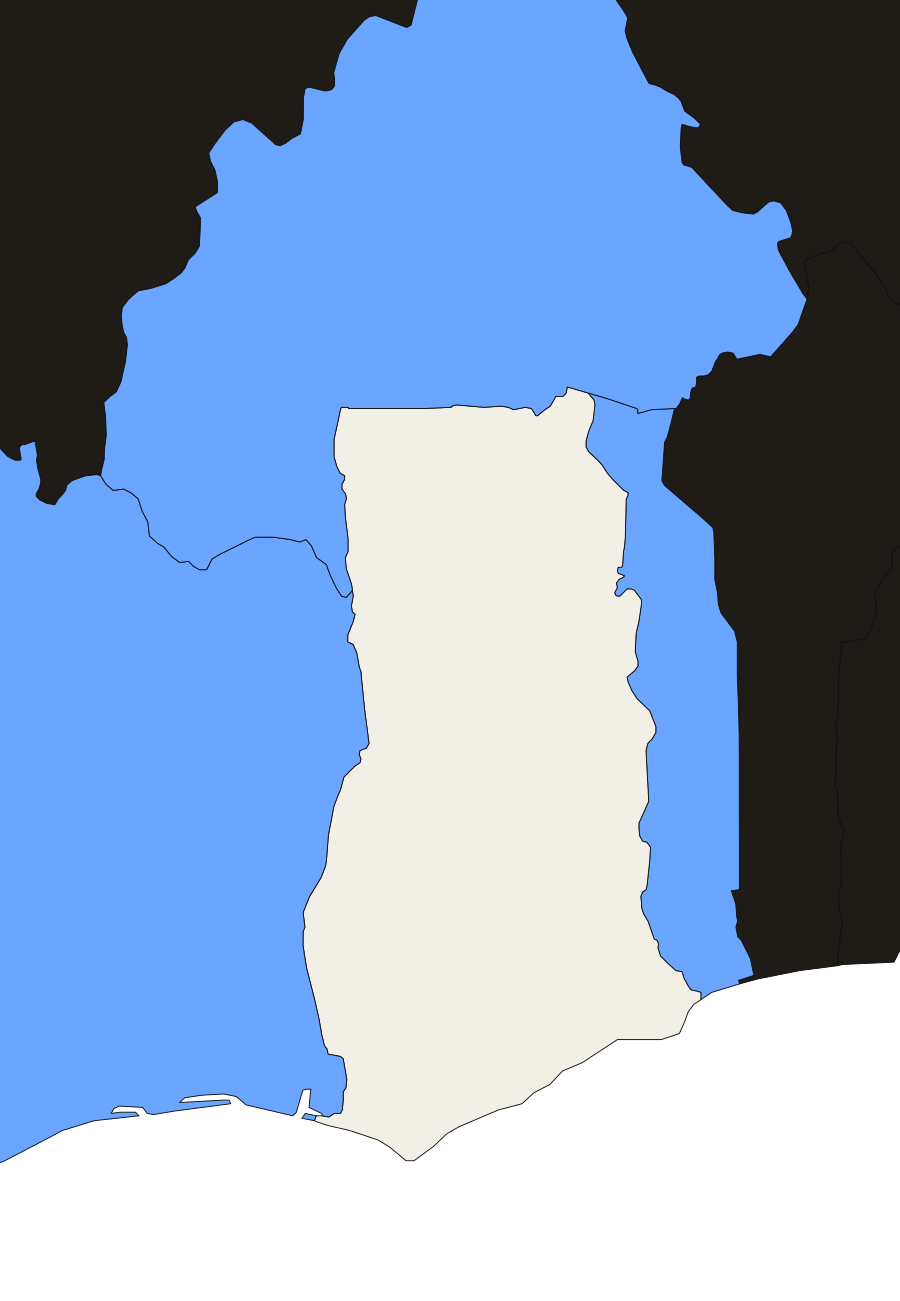
- Accra The capital. Home of the secretariat of the African Continental Free Trade Area.
- Bawku Town torn by a chieftaincy conflict. By October 2026 it had gone 150 days without gunfire.
- Titao Town in Burkina Faso where jihadists killed eight Ghanaian traders on February 14, 2026.
- Jubilee oil field Ghana's main oil field, pumping since 2010.
- Ghana
- Partner
Who does Ghana trade with?
Ghana exported goods worth about $32 billion in 2025 and imported about $20.5 billion (Ghana Statistical Service). Gold made up 63% of exports, worth about $20 billion. The United Arab Emirates, India and Switzerland buy most of it (chart). Since April 2025 a state body, the Ghana Gold Board, has been the only legal buyer and exporter of gold from small miners. Much of that mining is illegal, known as galamsey, and has poisoned rivers and destroyed forests and cocoa farms. Ghana is traditionally the world's second-largest cocoa grower after Côte d'Ivoire. Its harvest fell from a record 1.05 million tonnes in 2020/21 to about 604,000 tonnes in 2024/25, hit by disease, galamsey and smuggling, and recovered to about 771,000 tonnes in 2025/26. Oil output fell to about 102,000 barrels a day in 2025, from about 196,000 in 2019. China supplies 22.7% of imports. Ghanaians abroad sent home about $7.8 billion in 2025 (Bank of Ghana).
Sells to
Share of Ghana's exports
 United Arab Emirates25.9%
 India16.0%
 Switzerland14.2%
 South Africa10.3%
- China4.9%
Buys from
Share of Ghana's imports
- China22.7%
- United States7.0%
- India6.8%
- United Arab Emirates6.0%
 Belgium5.0%
Goods, 2025, as reported by Ghana. UN Comtrade.
How did Ghana recover from its 2022 debt crisis?
By November 2022 Ghana's public debt had reached 93.5% of GDP, and inflation hit 54.1% that December. On December 19, 2022 the government stopped paying most of its foreign debts. The IMF approved a $3 billion loan on May 17, 2023. In October 2024 holders of about $13 billion of Ghana's bonds agreed to swap them for new ones, which the government said cut its debt by about $5 billion. Countries that lent to Ghana, led by China and France, signed a debt deal in January 2025. Then gold prices soared. The cedi gained more than 40% against the dollar in 2025, inflation fell to 3.2% in March 2026, and the economy grew 6.0% in 2025. The IMF completed its last review on July 27, 2026, and now gives advice without lending. Moody's raised Ghana's rating on October 9, 2026. The cedi has lost about 11% of its value in 2026, and Ghana has not borrowed on bond markets again.
Why does Ghana send so many UN peacekeepers?
Ghana has sent soldiers on UN missions since the Congo crisis of 1960, three years after independence. In July 2026 it had 1,929 peacekeepers abroad, the seventh-largest contribution (chart). Its largest groups serve in Abyei, a territory claimed by both Sudan and South Sudan, in Lebanon and in South Sudan. Since 1948, 156 Ghanaian peacekeepers have died, the fifth-highest toll of any country, 49 of them in Congo. On March 6, 2026 Israeli tank fire hit the headquarters of Ghana's battalion in Lebanon and wounded five soldiers. Israel said it was a mistake and apologized. The UN force in Lebanon ends its operations on December 31, 2026. UN budget cuts have already shrunk Ghana's battalion there from 862 to 615 soldiers. Kofi Annan, the Ghanaian who led the UN from 1997 to 2006, gave his name to Ghana's peacekeeping training center in Accra. Ghana spent 0.38% of its GDP on its military in 2024 (SIPRI).
UN peacekeepers, July 2026
Full ranking → Nepal4,285
- India4,260
 Rwanda4,016
 Bangladesh4,003
 Pakistan2,085
 Indonesia1,972
- Ghana1,929
- China1,651
UN Peacekeeping open data, on the Humanitarian Data Exchange, July 2026