
Country profile · Southern Africa
 South Africa
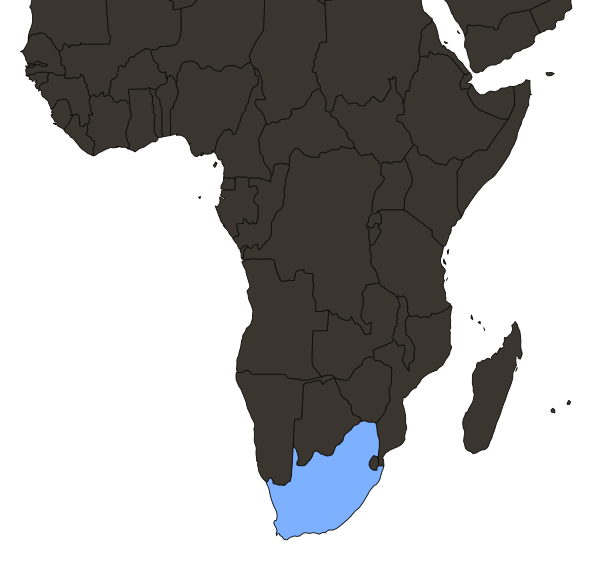
South Africa has 64.7 million people and mines 70.6% of the world's platinum. Cyril Ramaphosa of the African National Congress has been president since February 2018. The ANC lost its majority in the May 2024 election, the first time since apartheid ended in 1994, and now governs in a coalition of ten parties.
Where South Africa ranks
All rankings →Who runs South Africa?
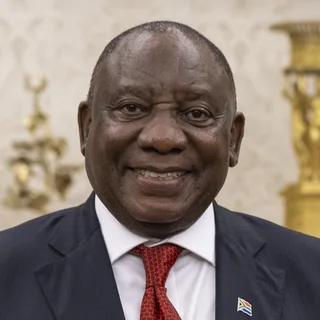
President Cyril Ramaphosa runs South Africa. Parliament elected him when Jacob Zuma resigned in February 2018 and re-elected him on June 14, 2024. He founded the National Union of Mineworkers in 1982 and was the ANC's chief negotiator in the talks that ended apartheid. In 2012 he bid R19.5 million for a buffalo cow and her calf, then apologized for paying "an excessive price in the sea of poverty". In May 2026 the Constitutional Court ordered parliament to open an impeachment inquiry over cash stolen from his game farm in 2020, $580,000 by his own account. A court has paused the public hearings while it decides his challenge. Official unemployment was 33.6% in mid-2026.
- African National Congress 159
- Coalition partners (DA and eight others) 128
- Opposition (MK, EFF and others) 113
Portrait (2025): The White House, Wikimedia Commons, public domain
Who are South Africa's allies and rivals?
South Africa's ties with the United States are the worst in decades. President Trump cut US aid on February 7, 2025, citing a land expropriation law and South Africa's genocide case against Israel at the International Court of Justice. About 13,200 South Africans, mostly Afrikaners, have been admitted to the US as refugees since May 2025. The United States boycotted the Johannesburg G20 in November 2025 and has not invited South Africa to the 2026 summit in Miami. It joined BRICS in 2010, and China has let South African goods in without tariffs since May 1, 2026. In January 2026 Chinese, Russian and Iranian warships held exercises from Simon's Town, although President Ramaphosa had ordered Iran kept out.
Allies and partners


Tensions
 United StatesAid cut, tariffs, not invited to 2026 G20
 IsraelGenocide case at the ICJ since 2023
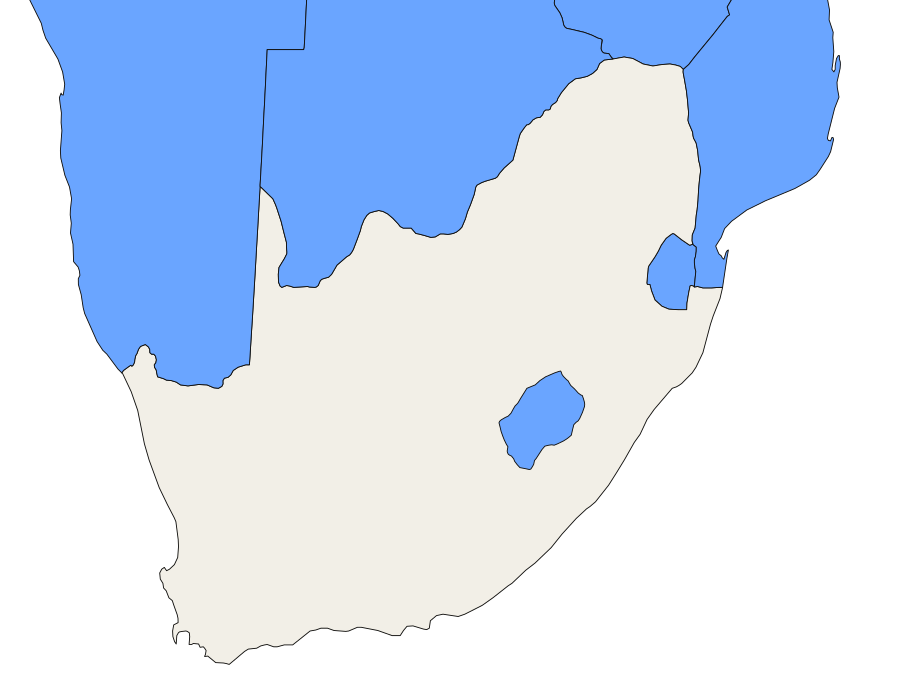
- Cape of Good Hope About 90 ships a day rounded the Cape in 2025, 82% more than in 2023, as traffic avoided the Red Sea.
- Orange River Border line on the river disputed with Namibia. Presidents to meet in early 2027.
- Pelindaba Former nuclear weapons site. About 220 kg of weapons-grade uranium stored here as of 2015.
- Lesotho Highlands Water Project Lesotho's dams send about 780 million cubic meters of water a year to Gauteng.
- South Africa
- Partner
Who does South Africa trade with?
South Africa exported about $116 billion of goods in 2025 and imported about $105 billion. China took 11.0% of exports and supplied 22.5% of imports. Precious metals and stones were 20% of exports, ores 15.5% and vehicles 13.1%. South Africa holds about 83% of known platinum-group reserves and mines more manganese and chrome than any other country. A record 414,271 vehicles were exported in 2025, 80% of them to the EU and Britain. Car exports to the United States fell from R17.7 billion to R8 billion after a 25% US tariff took effect in April 2025. Since July 24, 2026 most other South African goods pay 12.5%. The rolling power cuts known as load-shedding have not happened since May 15, 2025.
Sells to
Share of South Africa's exports
 China11.0%
 Germany7.6%
- United States7.1%
 Japan4.7%
 United Kingdom4.6%
Buys from
Share of South Africa's imports
- China22.5%
 India7.3%
- Germany6.9%
- United States6.9%
 Oman3.3%
Goods trade, 2025. Shares of South Africa's exports and imports as South Africa reported them to UN Comtrade. About 8% of exports are not assigned to any country.
How strong is South Africa's military?
South Africa spent $3.2 billion on its military in 2025, 0.7% of GDP (SIPRI). About two-thirds of the R57.6 billion defense budget for 2026/27 goes to pay. Only 2 of the air force's 26 Gripen fighters were combat-capable in May 2026. The navy has one working frigate, and only one of its three submarines is ready to deploy. At home, 2,200 soldiers are deployed against illegal mining and gangs until March 2027. Fourteen South African soldiers were killed near Goma, in eastern Congo, in January 2025. The last troops of a 27-year deployment in Congo left on July 2, 2026. The arms industry is doing better: export permits worth R10.1 billion were approved in 2025.
Military spending in the first five BRICS countries, 2025
Full ranking →
SIPRI Military Expenditure Database, 2026 edition
Why did South Africa give up its nuclear weapons?
President F. W. de Klerk told parliament that South Africa gave up its nuclear weapons because the Cold War had ended, the war in Angola was over and the country wanted to end its isolation. Some historians add a motive he did not state: keeping the bombs from a future ANC government. South Africa decided in 1974 to build a nuclear deterrent and completed six gun-type bombs. De Klerk ordered the bombs dismantled in February 1990, and the work was done by June 1991. South Africa joined the Non-Proliferation Treaty in July 1991 and revealed the program on March 24, 1993. It is the only country that built its own nuclear weapons and then dismantled them all.