
Country profile · Western Europe
 Switzerland
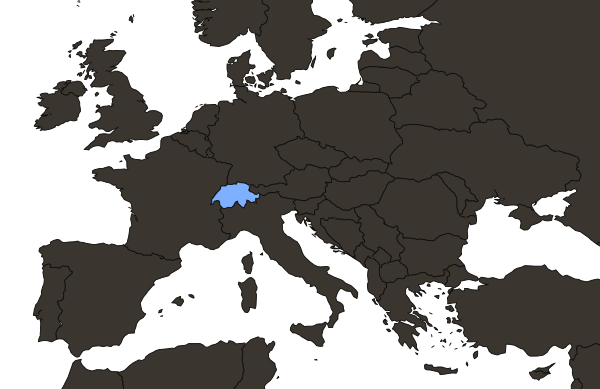
Switzerland has about 9.1 million people (Federal Statistical Office, end of 2025). It has no prime minister: seven ministers govern together, and Guy Parmelin is president for 2026. Switzerland is neutral and belongs to neither NATO nor the European Union. It is one of the richest countries in the world and lives from medicines, finance and trade.
Where Switzerland ranks
All rankings →Who runs Switzerland?
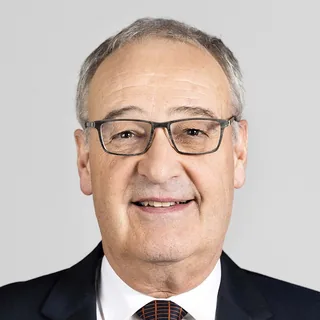
Switzerland has no prime minister. Seven ministers, the Federal Council, govern together. Parliament elects them for four-year terms and cannot remove them. The four largest parties share the seats: two each for the Swiss People's Party (SVP), the Liberals (FDP) and the Social Democrats, and one for the Centre. Every year one of the seven becomes president, and President Guy Parmelin of the SVP holds the post in 2026. He was born in 1959 in Bursins, near Lake Geneva, and trained as a farmer and winegrower. He joined the Federal Council in 2016 and has run the economy ministry since 2019. On October 2, 2026 he announced that he will leave at the end of the year, and parliament chooses his successor on December 9. The SVP is the largest party in parliament (chart). Voters have the last word on many questions. On September 27, 2026, 70% of them rejected an SVP initiative to ban sanctions. The next federal election is on October 24, 2027.
- Swiss People's Party (SVP), 2 ministers 62
- Social Democrats (SP), 2 ministers 41
- The Centre, 1 minister 29
- Liberals (FDP), 2 ministers 28
- Greens 23
- Green Liberals 10
- Others 7
Official photo (2024): Swiss Federal Chancellery / Sina Guntern, Wikimedia Commons, free to use with attribution (cropped)
Who are Switzerland's allies and rivals?
Switzerland belongs to no military alliance. The great powers recognized its permanent neutrality in Paris on November 20, 1815. It is not in NATO, but it has worked with NATO in the Partnership for Peace since 1996. Four of its five neighbors are in the European Union, and the EU accounted for 61% of Swiss goods trade in 2025. Switzerland is buying American F-35 fighter jets, but in March 2026 it cut the order from 36 to about 30 after the price rose. It spent $7.6 billion on defense in 2025 (SIPRI), less than 1% of GDP. In December 2025 the outgoing army chief, Thomas Süssli, said Switzerland could not defend itself on its own. Russia lists Switzerland as an unfriendly country because it follows EU sanctions. Switzerland had frozen 8.5 billion francs of private Russian assets by June 2026. Since 1980 Switzerland has represented US interests in Iran. Geneva hosts about 40 international organizations, and US talks with China, Ukraine and Iran took place there in 2025 and 2026.
Allies and partners
- European Union61% of goods trade; new treaties signed March 2026
 GermanyLargest supplier; second-largest export market
 LiechtensteinCustoms union since 1923; uses the Swiss franc
Tensions
 RussiaCalls Switzerland unfriendly since it joined sanctions in 2022
 United StatesLargest export market; 12.5% tariff since July 2026
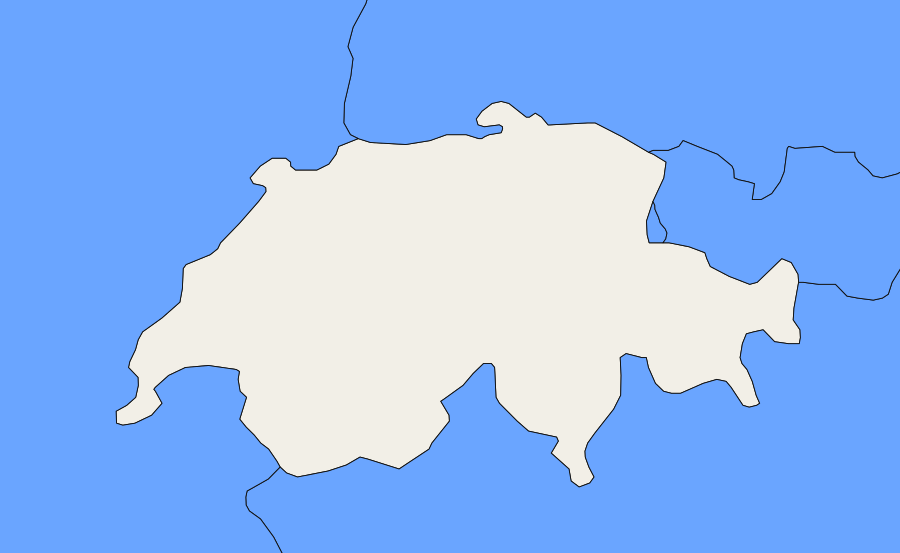
- Geneva Home of the UN's European office, the Red Cross and about 40 international organizations.
- Basel Home of the drugmakers Roche and Novartis. Chemicals and medicines were 53% of exports in 2025.
- Zug Low-tax canton where commodity traders such as Glencore are based.
- Mendrisio Three of the four big Swiss gold refineries are in this corner of Ticino.
- Switzerland
- Partner
Who does Switzerland trade with?
Switzerland exported 287 billion francs of goods in 2025, about $345 billion, and imported 233 billion, not counting gold and other precious metals (Federal Office for Customs and Border Security). The United States and Germany are the largest buyers (chart). Imports from Slovenia, the second-largest supplier, are almost all chemicals and medicines. Chemicals and medicines, from companies such as Roche and Novartis in Basel, were 53% of exports, and watches earned 25 billion francs. Gold is counted separately because so much of it passes through: Swiss refineries handle about a third of the world's gold. Including gold, exports were 461 billion francs. A rush of gold bars to New York in early 2025 swelled the US trade deficit with Switzerland. On August 7, 2025 the United States imposed a 39% tariff on Swiss goods, and a deal in November cut it to 15%. Since July 24, 2026 most Swiss goods have faced a US tariff of up to 12.5%. The economy grew 1.6% in 2025.
Sells to
Share of Switzerland's exports
- United States19.1%
- Germany15.0%
 Slovenia9.2%
 Italy7.3%
 China5.3%

Goods excluding gold and other precious metals, 2025. Swiss Federal Office for Customs and Border Security (BAZG).
Is Switzerland still neutral?
Switzerland has stayed out of every war between other states since 1815, when the great powers recognized its permanent neutrality. The Hague Conventions of 1907 set the rules: a neutral state must not send arms to a country at war or let foreign troops cross its land. In World War II Switzerland was not invaded. But its central bank bought gold from Nazi Germany that it knew from 1941 was looted, and in August 1942 Switzerland closed its border to people fleeing only for racial reasons. It joined the United Nations only in 2002. On February 28, 2022, four days after Russia invaded Ukraine, Switzerland adopted the EU's sanctions on Russia. The government says sanctions do not break neutrality law, which covers only military help. Switzerland still sends no weapons to Ukraine and does not let other countries pass on Swiss-made weapons to it. On September 27, 2026, 70% of voters rejected an initiative to ban sanctions. Switzerland spends a smaller share of its GDP on defense than most of Europe (chart).


 Austria
Why is Switzerland not in the EU?
Swiss voters have refused every step toward membership. Switzerland applied to join the European Community in May 1992. On December 6, 1992 voters rejected joining the European Economic Area, a single market with the EU, by 50.3% to 49.7%, and the application was frozen. Parliament declared it withdrawn in 2016. In 2001, 76.7% of voters rejected opening membership talks. Instead Switzerland signed separate treaties with the EU. Since 2002 they have given it access to much of the EU's single market and free movement of people. Since 2008 it has been part of the Schengen area of passport-free travel. A new package of treaties, signed on March 2, 2026, would have Switzerland take over changes to EU law in these areas, but Swiss voters could still hold a referendum on each. In September 2026 the upper house of parliament approved most of the package and voted that it needs a majority of both voters and cantons. A national vote is most likely in 2028.