
Country profile · West Africa
 Guinea
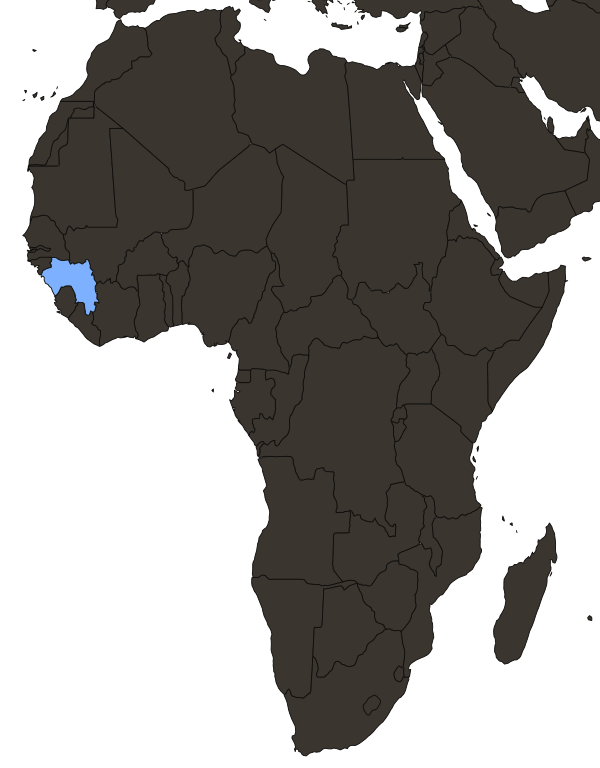
 is a West African country of about 17.5 million people. It holds about a quarter of the world's bauxite, the ore used to make aluminum, and is the largest producer. Iron ore from the Simandou mines began shipping to China in December 2025. General Mamadi Doumbouya seized power in a 2021 coup and won a presidential election in December 2025.
Where Guinea ranks
All rankings →Which alliances is Guinea in?
All alliances →Who runs Guinea?
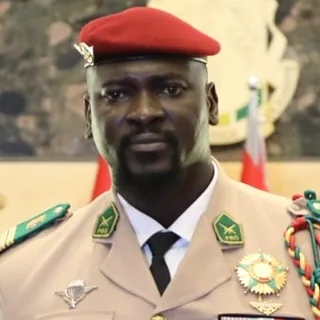
President Mamadi Doumbouya was born in Kankan. His official biography gives 1984 as the year. He is a Malinké. He served in the French Foreign Legion until 2009 and took command of Guinea's Special Forces Group in 2018. His wife, Lauriane Darboux, is French and served in the French gendarmerie. On September 5, 2021 Doumbouya overthrew President Alpha Condé. In November 2024 he made himself an army general, the top rank. A new constitution approved by referendum on September 21, 2025 allowed him to run for president, for seven-year terms. He won the election of December 28, 2025 with 86.72% of the vote and was sworn in on January 17, 2026. The main opposition leader, Cellou Dalein Diallo, could not run. In March 2026 the government dissolved 40 parties, including Diallo's UFDG and Condé's RPG. The opposition boycotted the election of May 31, 2026, and Doumbouya's coalition won 127 of 147 seats (chart). Amadou Oury Bah has been prime minister since February 2024.
- GMD and allies (Doumbouya) 127
- Others 20
Photo (January 2022): US Embassy in Conakry, Wikimedia Commons, public domain (cropped)
Who are Guinea's allies and rivals?
The West African bloc ECOWAS suspended Guinea after the 2021 coup and imposed sanctions. The African Union lifted its own suspension on January 22, 2026, and ECOWAS lifted all remaining sanctions on January 28, 2026. Guinea refused to join the Alliance of Sahel States formed by Mali, Burkina Faso and Niger. China took 74.3% of its bauxite imports from Guinea in 2025. The United Arab Emirates buys most of Guinea's gold. In August 2025 Guinea took a bauxite concession from a company owned by the UAE's Emirates Global Aluminium without compensation, and the two sides settled in May 2026. Russia's Rusal runs the Friguia alumina refinery, and Russia delivered drones and air defense equipment in May 2026. Guinean troops have held the Yenga border area since the 1990s, although Sierra Leone says it is Sierra Leonean. In February 2026 Guinea detained 16 Sierra Leonean soldiers and police near the border and released them three days later.
Allies and partners
 ChinaBuys most of its bauxite and iron ore
 United Arab EmiratesBuys most of its gold
 MaliLandlocked neighbor that relies on Conakry port
 RussiaRusal refinery; sent military equipment in 2026
 Côte d'IvoireDoumbouya made a state visit in September 2026
Tensions
 Sierra LeoneDispute over the Yenga border area
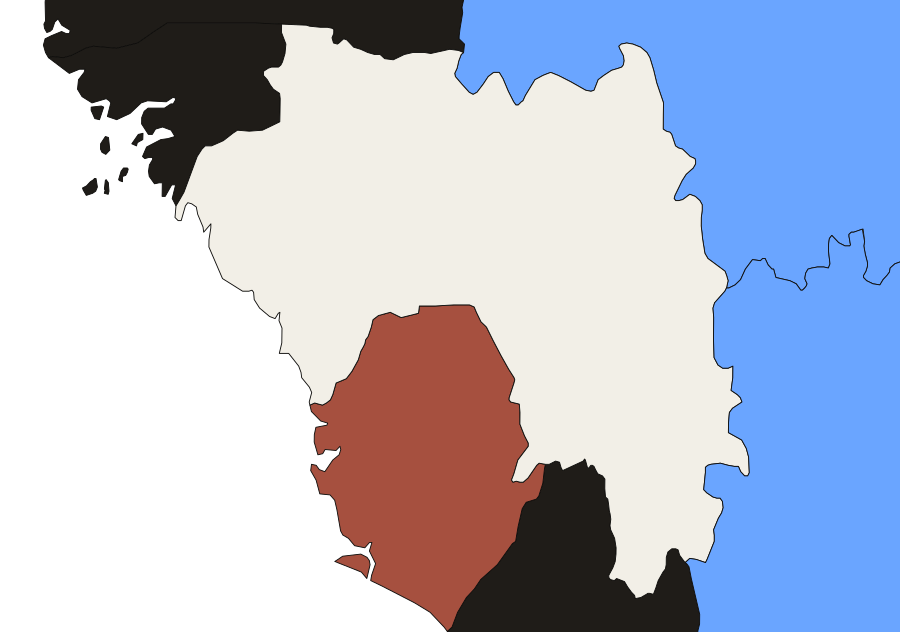
- Simandou Iron ore mines in the southeast. The first ore left for China in December 2025.
- Morebaya New port where a railway of about 600 km brings Simandou iron ore to ships.
- Kamsar Port in the Boké region, the center of Guinea's bauxite exports.
- Yenga Border area held by Guinean troops since the 1990s and claimed by Sierra Leone.
- Guinea
- Partner
- Tensions
Who does Guinea trade with?
Guinea's own trade figures are incomplete, so the chart uses what its partners reported for 2023. That was the last year the United Arab Emirates published figures. The UAE bought 50.1% of Guinea's exports (chart), mostly gold. China bought 35.5% and India 8.0%. China supplied 38.4% of imports, India 9.2% and the Netherlands 6.5%, mostly fuel. Minerals earned 92% of export revenue in 2025 (Coface). Guinea exported 182.8 million tonnes of bauxite in 2025, a record, according to the government. It also exported 72.12 tonnes of gold, and small-scale miners produced more than two-thirds of it. In June 2026 President Mamadi Doumbouya banned exports of unrefined gold, so all gold must now be refined in Guinea. Iron ore from Simandou adds a new export from 2025. In the first four months of 2026 Guinea's trade with China reached $6.6 billion, according to Chinese customs.
Sells to
Share of Guinea's exports
- United Arab Emirates50.1%
- China35.5%
 India8.0%
 Switzerland1.3%
 Spain1.0%
Buys from
Share of Guinea's imports
- China38.4%
- India9.2%
 Netherlands6.5%
 Belgium5.9%
- United Arab Emirates4.1%
Goods, 2023. UN Comtrade (as reported by Guinea's trade partners).
Will Simandou and bauxite make Guinea rich?
Guinea has 7.4 billion tonnes of bauxite, about a quarter of the world's reserves and more than any other country (USGS). It mined about 150 million tonnes in 2025, against 97 million tonnes in Australia, the second largest producer. In 2025 the government took back 51 mining licenses and told companies to build alumina refineries in Guinea. Mining at Simandou, in the southeast, began on November 11, 2025, and the first ship left for China on December 2, 2025. A new railway of about 600 km links the mines to a port at Morebaya. Rio Tinto and Chinese companies, including China Baowu, run the project, and the Guinean state owns 15%. The mines can produce 120 million tonnes a year at full capacity. In October 2026 Rio Tinto said its half should reach 60 million tonnes a year in late 2028. The World Bank expects growth of 9% a year from 2026 to 2028. It estimates that 36.8% of Guineans were poor in 2025.
Why did Guinea say no to France in 1958?
On August 25, 1958, in front of Charles de Gaulle, the Guinean leader Sékou Touré said: "We prefer poverty in freedom to wealth in slavery." In the referendum of September 28, 1958, 95.22% of voters rejected de Gaulle's new French Community. Guinea was the only French territory to vote no, and it became independent on October 2, 1958. France pulled out its officials and aid. Guinea turned to the Soviet bloc, and Touré ran a one-party state. Thousands died in his Camp Boiro prison. After Touré died in 1984, Colonel Lansana Conté seized power and ruled until his death in 2008. Captain Moussa Dadis Camara then took over. On September 28, 2009 soldiers killed at least 156 people at a stadium rally in Conakry, according to the UN. Alpha Condé became the first democratically elected president in 2010 and was overthrown in 2021. The 2014 to 2016 Ebola epidemic began in a Guinean village and killed 2,544 people in Guinea.