Ranking · Land and sea
Exclusive economic zones by country
The United States has the largest exclusive economic zone, 11.7 million km² of sea, most of it off Alaska, Hawaii and its Pacific islands. France is second with 9.5 million km², followed by Australia, Russia and Indonesia. Waters that two or more countries claim are not counted for anyone.
Five countries hold a third of all national ocean zones
Share of the 134 million km² of zones counted, 2023
- United States 11,733,355
- France 9,529,864
- Australia 8,993,463
- Russia 7,730,566
- Indonesia 6,019,205
- Everyone else 89,970,547
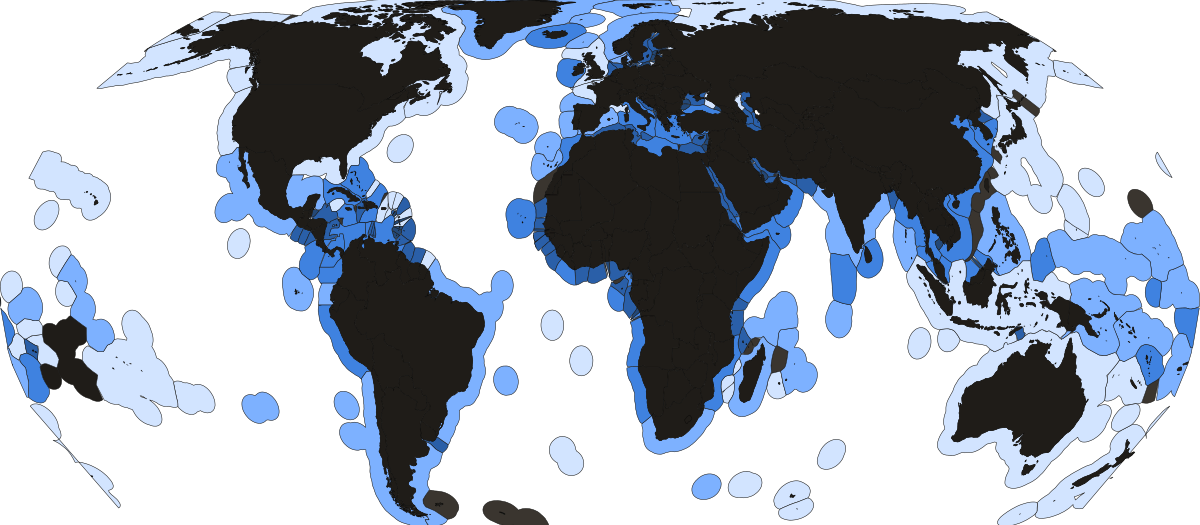
- Under 50,000
- 50,000–250,000
- 250,000–1 million
- 1 million–4 million
- Over 4 million
- Disputed or shared waters
- Not in this ranking
| # | Country | Sea area (km²) |
|---|---|---|
| 1 |  United States United States |
11,733,355 |
| 2 |  France France |
9,529,864 |
| 3 |  Australia Australia |
8,993,463 |
| 4 |  Russia Russia |
7,730,566 |
| 5 |  Indonesia Indonesia |
6,019,205 |
| 6 |  Canada Canada |
5,740,658 |
| 7 |  New Zealand New Zealand |
4,425,099 |
| 8 |  United Kingdom United Kingdom |
4,085,524 |
| 9 |  Japan Japan |
4,066,513 |
| 10 |  Brazil Brazil |
3,677,664 |
| 11 |  Chile Chile |
3,668,775 |
| 12 |  Kiribati Kiribati |
3,440,220 |
| 13 |  Mexico Mexico |
3,187,013 |
| 14 |  Micronesia Micronesia |
3,007,718 |
| 15 |  Denmark Denmark |
2,638,178 |
| 16 |  Papua New Guinea Papua New Guinea |
2,399,617 |
| 17 |  India India |
2,323,948 |
| 18 |  Norway Norway |
2,021,014 |
| 19 |  Marshall Islands Marshall Islands |
2,002,220 |
| 20 |  Philippines Philippines |
1,964,764 |
| 21 |  Mauritius Mauritius |
1,925,860 |
| 22 |  Portugal Portugal |
1,728,718 |
| 23 |  Solomon Islands Solomon Islands |
1,602,781 |
| 24 |  South Africa South Africa |
1,547,576 |
| 25 |  Seychelles Seychelles |
1,341,524 |
| 26 |  Fiji Fiji |
1,302,114 |
| 27 |  Madagascar Madagascar |
1,196,285 |
| 28 |  Ecuador Ecuador |
1,077,731 |
| 29 |  Argentina Argentina |
1,075,192 |
| 30 |  Spain Spain |
1,007,673 |
| 31 |  China China |
963,556 |
| 32 |  Maldives Maldives |
923,833 |
| 33 |  Peru Peru |
854,698 |
| 34 |  Somalia Somalia |
821,444 |
| 35 |  Cape Verde Cape Verde |
801,936 |
| 36 |  Iceland Iceland |
763,239 |
| 37 |  Tuvalu Tuvalu |
753,133 |
| 38 |  Vietnam Vietnam |
752,197 |
| 39 |  Colombia Colombia |
727,967 |
| 40 |  Tonga Tonga |
666,052 |
| 41 |  Vanuatu Vanuatu |
625,850 |
| 42 |  Bahamas Bahamas |
619,785 |
| 43 |  Palau Palau |
616,431 |
| 44 |  Costa Rica Costa Rica |
581,726 |
| 45 |  Mozambique Mozambique |
566,292 |
| 46 |  Namibia Namibia |
562,212 |
| 47 |  Oman Oman |
556,490 |
| 48 |  Italy Italy |
536,446 |
| 49 |  Sri Lanka Sri Lanka |
533,559 |
| 50 |  Yemen Yemen |
527,384 |
| 51 |  Malaysia Malaysia |
517,589 |
| 52 |  Myanmar Myanmar |
497,460 |
| 53 |  Angola Angola |
495,866 |
| 54 |  Greece Greece |
482,936 |
| 55 |  Venezuela Venezuela |
472,546 |
| 56 |  Ireland Ireland |
428,004 |
| 57 |  Libya Libya |
357,386 |
| 58 |  Cuba Cuba |
352,259 |
| 59 |  Dominican Republic Dominican Republic |
350,694 |
| 60 |  South Korea South Korea |
347,671 |
| 61 |  Panama Panama |
331,318 |
| 62 |  Nauru Nauru |
309,261 |
| 63 |  Equatorial Guinea Equatorial Guinea |
304,133 |
| 64 |  Thailand Thailand |
298,561 |
| 65 |  Morocco Morocco |
280,452 |
| 66 |  Turkey Turkey |
262,233 |
| 67 |  Jamaica Jamaica |
256,909 |
| 68 |  Liberia Liberia |
251,781 |
| 69 |  Egypt Egypt |
242,929 |
| 70 |  Tanzania Tanzania |
241,567 |
| 71 |  Ghana Ghana |
227,500 |
| 72 |  Pakistan Pakistan |
224,361 |
| 73 |  Saudi Arabia Saudi Arabia |
224,157 |
| 74 |  Iran Iran |
215,613 |
| 75 |  Nicaragua Nicaragua |
213,813 |
| 76 |  Honduras Honduras |
208,636 |
| 77 |  Gabon Gabon |
201,759 |
| 78 |  Barbados Barbados |
185,007 |
| 79 |  Nigeria Nigeria |
179,048 |
| 80 |  Mauritania Mauritania |
173,180 |
| 81 |  Côte d'Ivoire Côte d'Ivoire |
171,760 |
| 82 |  Comoros Comoros |
164,476 |
| 83 |  Sierra Leone Sierra Leone |
160,584 |
| 84 |  Senegal Senegal |
158,358 |
| 85 |  Sweden Sweden |
155,386 |
| 86 |  Netherlands Netherlands |
144,842 |
| 87 |  Uruguay Uruguay |
143,092 |
| 88 |  Ukraine Ukraine |
136,198 |
| 89 |  Guyana Guyana |
135,060 |
| 90 |  Suriname Suriname |
133,668 |
| 91 |  Algeria Algeria |
131,193 |
| 92 |  São Tomé and Príncipe São Tomé and Príncipe |
130,844 |
| 93 |  Samoa Samoa |
130,480 |
| 94 |  Kenya Kenya |
124,028 |
| 95 |  Kazakhstan Kazakhstan |
114,383 |
| 96 |  North Korea North Korea |
114,379 |
| 97 |  Bangladesh Bangladesh |
112,166 |
| 98 |  Antigua and Barbuda Antigua and Barbuda |
111,568 |
| 99 |  Guatemala Guatemala |
110,695 |
| 100 |  Guinea-Bissau Guinea-Bissau |
106,870 |
| 101 |  Haiti Haiti |
103,485 |
| 102 |  Guinea Guinea |
102,163 |
| 103 |  Tunisia Tunisia |
99,701 |
| 104 |  Cyprus Cyprus |
98,450 |
| 105 |  El Salvador El Salvador |
95,099 |
| 106 |  Finland Finland |
81,553 |
| 107 |  Azerbaijan Azerbaijan |
80,614 |
| 108 |  Eritrea Eritrea |
78,110 |
| 109 |  Timor-Leste Timor-Leste |
77,473 |
| 110 |  Trinidad and Tobago Trinidad and Tobago |
76,562 |
| 111 |  Sudan Sudan |
62,826 |
| 112 |  Turkmenistan Turkmenistan |
61,226 |
| 113 |  Germany Germany |
56,831 |
| 114 |  Croatia Croatia |
55,159 |
| 115 |  Malta Malta |
52,923 |
| 116 |  United Arab Emirates United Arab Emirates |
51,674 |
| 117 |  Cambodia Cambodia |
48,697 |
| 118 |  Brunei Brunei |
43,038 |
| 119 |  Estonia Estonia |
36,451 |
| 120 |  Saint Vincent and the Grenadines Saint Vincent and the Grenadines |
36,244 |
| 121 |  Benin Benin |
35,493 |
| 122 |  Bulgaria Bulgaria |
34,745 |
| 123 |  Republic of the Congo Republic of the Congo |
33,807 |
| 124 |  Belize Belize |
32,862 |
| 125 |  Qatar Qatar |
31,363 |
| 126 |  Poland Poland |
30,666 |
| 127 |  Romania Romania |
29,606 |
| 128 |  Dominica Dominica |
28,552 |
| 129 |  Latvia Latvia |
28,322 |
| 130 |  Israel Israel |
25,955 |
| 131 |  Grenada Grenada |
25,571 |
| 132 |  Gambia Gambia |
23,097 |
| 133 |  Georgia Georgia |
22,944 |
| 134 |  Lebanon Lebanon |
18,857 |
| 135 |  Togo Togo |
15,447 |
| 136 |  Saint Lucia Saint Lucia |
15,413 |
| 137 |  Cameroon Cameroon |
15,143 |
| 138 |  DR Congo DR Congo |
13,373 |
| 139 |  Albania Albania |
12,165 |
| 140 |  Kuwait Kuwait |
10,775 |
| 141 |  Syria Syria |
10,269 |
| 142 |  Saint Kitts and Nevis Saint Kitts and Nevis |
9,502 |
| 143 |  Bahrain Bahrain |
7,516 |
| 144 |  Djibouti Djibouti |
7,223 |
| 145 |  Lithuania Lithuania |
6,864 |
| 146 |  Montenegro Montenegro |
6,383 |
| 147 |  Belgium Belgium |
3,531 |
| 148 |  Iraq Iraq |
1,342 |
| 149 |  Palestine Palestine |
1,120 |
| 150 |  Singapore Singapore |
675 |
| 151 |  Monaco Monaco |
288 |
| 152 |  Slovenia Slovenia |
214 |
| 153 |  Jordan Jordan |
97 |
| 154 |  Bosnia and Herzegovina Bosnia and Herzegovina |
13 |
Why they rank where they do
-
United States
Alaska adds 3,682,912 km² and Hawaii 2,474,715 km², each more than the zone off the lower 48 states (2,450,909 km²). Most of the rest lies around small Pacific islands, such as the Northern Mariana Islands, Johnston Atoll and American Samoa. The zone around Wake Island (406,970 km²) is left out, because the Marshall Islands also claim it.
-
France
The zone around mainland France is only 348,474 km². French Polynesia's zone alone is 4,766,689 km², larger than the land area of the whole European Union. Clipperton, an uninhabited atoll off Mexico with 1.7 km² of land, adds 435,657 km². About 572,000 km² around islands that other countries also claim (Tromelin, Matthew and Hunter, Mayotte and the Glorioso Islands) is left out.
-
Australia
The mainland and Tasmania account for 6,873,830 km². Five remote islands and island groups, such as Macquarie Island and the Cocos (Keeling) Islands, make up the other 23.6%. Australia's Antarctic claim is not counted.
-
Russia
Russia's Arctic coastline is about 24,150 km long, 53% of the Arctic Ocean's coast. In February 2023 the UN continental shelf commission accepted that the Lomonosov Ridge under the Arctic Ocean is an extension of Russia's seabed. Denmark, for Greenland, and Canada claim overlapping seabed along the same ridge.
-
Indonesia
Indonesia is the world's largest archipelagic state: its geospatial agency counted 17,380 named islands in December 2024. On July 14, 2017 Indonesia renamed the northern part of its zone the "North Natuna Sea", where China's claim overlaps. China's foreign ministry called the renaming "totally meaningless".
-
New Zealand
New Zealand's own waters cover 4,104,551 km², and Tokelau adds 320,548 km². The Cook Islands (1,969,553 km²) and Niue (318,140 km²) govern themselves in free association with New Zealand and manage their own zones, so they are not counted here. In February 2025 the Cook Islands signed agreements with China, including on seabed minerals research, without consulting New Zealand. New Zealand paused NZ$18.2 million of aid in June 2025 and resumed its funding in April 2026.
-
United Kingdom
Pitcairn (842,291 km²) and Tristan da Cunha (758,168 km²) each give the UK more sea than the zone around Britain itself (727,260 km²). The Falklands (550,566 km²) and South Georgia and the South Sandwich Islands (1,237,783 km²) are left out, because Argentina also claims them. On September 3, 2026 Argentina's president, Javier Milei, announced sanctions on companies working in the Falklands' oil sector.
-
Japan
Japan's government puts its waters at about 4.47 million km², counting the waters it disputes around the Kuril Islands (with Russia), the Senkaku Islands (with China and Taiwan) and Liancourt Rocks (with South Korea). Okinotorishima, a reef 1,700 km south of Tokyo with two tiny islets above water at high tide, gives Japan about 400,000 km². China and South Korea say Okinotorishima is a rock, which under the law of the sea cannot have such a zone.
-
Kiribati
Kiribati's 33 islands have only 811 km² of land. They straddle the equator and the 180th meridian, and since January 1, 1995 the International Date Line has bent east around Kiribati so the whole country shares one date. Kiribati switched its diplomatic recognition from Taiwan to China on September 20, 2019.
-
Denmark
Greenland's zone is 2,268,623 km² and the Faroe Islands' 265,326 km². Denmark itself provides 104,229 km², 4% of the total. On September 22, 2026 the US, Denmark and Greenland signed a deal at the UN that confirms Greenland is part of the Kingdom of Denmark; the parliaments of Denmark and Greenland still have to approve it.
-
Norway
Svalbard adds 796,819 km² and Jan Mayen 292,907 km² to the mainland's 931,288 km². The 1920 Svalbard Treaty gives Norway sovereignty over Svalbard, but the other parties have equal rights to fish, hunt and mine there. In 1977 Norway declared a 200-mile Fisheries Protection Zone around Svalbard instead of an exclusive economic zone, and Russia calls that zone unlawful.
-
Mauritius
Marine Regions counts the Chagos Archipelago's zone (647,678 km²) for Mauritius. In 2019 the International Court of Justice advised that the UK should end its administration of the islands "as rapidly as possible". The UK and Mauritius signed a treaty on May 22, 2025 handing the islands to Mauritius, with the UK leasing the Diego Garcia military base for 99 years. As of September 2026 the treaty has not been ratified, and the UK still runs the islands.
-
Portugal
The Azores (960,421 km²) and Madeira (452,796 km²) make up 82% of Portugal's total. In 2009 Portugal asked the UN continental shelf commission to recognize about 2 million km² of seabed beyond 200 nautical miles. As of September 2026 the commission has not decided.
-
Ukraine
Marine Regions marks all of Ukraine's zone as also claimed by Russia since Russia's 2014 annexation of Crimea. The UN General Assembly (resolution 68/262) and this site's maps treat Crimea as part of Ukraine, so this ranking counts the zone for Ukraine.
Which country has the largest exclusive economic zone?
The United States has the largest exclusive economic zone, about 11.7 million km² of sea. NOAA, the US ocean agency, gives the same size: more than 3.4 million square nautical miles. France is second with 9.5 million km².
Some sources say France has the world's largest zone, because they count it differently. The French government does not. It puts France's maritime space at about 10.7 million km² and calls it "the second largest maritime area in the world, behind that of the United States". It leaves out Adélie Land in Antarctica, because of the 1959 Antarctic Treaty. Overseas territories provide 97% of France's maritime space.
- United States11,733,355
- France9,529,864
- Australia8,993,463
- Russia7,730,566
- Indonesia6,019,205
- Canada5,740,658
- New Zealand4,425,099
- United Kingdom4,085,524
What is an exclusive economic zone?
An exclusive economic zone is the sea up to 200 nautical miles (370.4 km) from a country's coast. Under the UN Convention on the Law of the Sea, agreed in 1982, the country has sovereign rights over the fish, oil, gas, seabed minerals and wind energy in that zone. Ships and planes of all countries keep the freedom to sail, fly over and lay cables. Closer in, the territorial sea reaches 12 nautical miles, and there the country is sovereign.
The United States has never ratified the convention. President Ronald Reagan proclaimed a 200-mile US zone on March 10, 1983. The zones in this ranking cover about 37% of the ocean. Most of the rest is high sea, which belongs to no country. The High Seas Treaty, which protects marine life there, entered into force on January 17, 2026. The United States signed it in 2023 but has not ratified it.
How much of the South China Sea does China claim?
China's "nine-dash line" encloses about 62% of the South China Sea, according to a 2014 US State Department measurement. On July 12, 2016 a tribunal set up under the Law of the Sea, in a case brought by the Philippines, found "no legal basis for China to claim historic rights" within the line. China's foreign ministry called the award "null and void" the same day.
In this ranking, China's undisputed zone is 963,556 km², 31st in the world. On September 10, 2025 China declared a nature reserve at Scarborough Shoal, which the Philippines also claims. On September 24, 2026 Chinese coast guard and navy ships blocked a Philippine resupply mission to the BRP Sierra Madre, a grounded Philippine navy ship at Second Thomas Shoal.
Which countries have the most sea for their size?
Tuvalu has about 29,000 km² of sea for every km² of land: 753,133 km² of sea around 26 km² of land. Nauru has about 14,700 km² of sea for each km² of land, the Marshall Islands about 11,000, Kiribati about 4,700 and Micronesia about 4,300. Fishing license fees paid about 67% of Kiribati's government revenue from 2021 to 2025, according to the IMF.
Rising seas threaten low-lying atoll countries such as Tuvalu, Kiribati and the Marshall Islands. In 2021 the Pacific Islands Forum declared that its members' maritime zones will continue to apply "without reduction", even if the coastlines change. Under the Falepili Union treaty with Australia, in force since August 28, 2024, up to 280 Tuvaluans a year can move to Australia.