
Country profile · West Africa
 Côte d'Ivoire
, also called Ivory Coast, is a West African country of about 32.7 million people and the world's largest cocoa grower. President Alassane Ouattara, 84, a former IMF economist, has ruled since 2011 and won a fourth term in October 2025 after courts barred his two main rivals. Its economy has grown about 6.7% a year since 2012.
Where Côte d'Ivoire ranks
All rankings →Which alliances is Côte d'Ivoire in?
All alliances →Who runs Côte d'Ivoire?
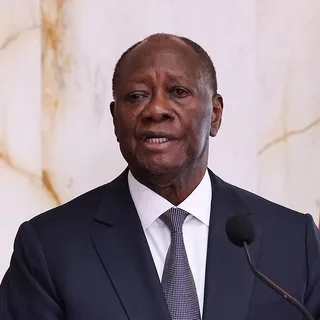
President Alassane Ouattara was born on January 1, 1942, in Dimbokro. He earned a doctorate in economics at the University of Pennsylvania in 1972, ran the West African central bank (BCEAO) from 1988 to 1993, and was prime minister under the founding president, Félix Houphouët-Boigny, from 1990 to 1993. He later served as deputy managing director of the IMF. His wife, Dominique Ouattara, is a businesswoman of French origin, born in French Algeria. On October 25, 2025 Ouattara won a fourth term with 89.77% of the vote on a turnout of 50.1%, after courts barred Laurent Gbagbo and Tidjane Thiam. His party, the RHDP, won 197 of 255 seats in the National Assembly in December 2025 (chart). Robert Beugré Mambé is prime minister. Ouattara's brother, Téné Birahima Ouattara, became vice prime minister in January 2026 and kept the defense ministry. No successor has been named. In May 2026 the government abolished the electoral commission, and no new body had replaced it by October.
- RHDP (Ouattara) 197
- PDCI 32
- Independents 23
- Others 3
Photo (April 2024): Dario Pignatelli, European Union, Wikimedia Commons, free with attribution (cropped)
Who are Côte d'Ivoire's allies and rivals?
France ruled Côte d'Ivoire until 1960 and kept troops there afterwards. On February 20, 2025 France handed its base at Port-Bouët in Abidjan to the Ivorian army. About 80 French soldiers stayed on to train troops. President Alassane Ouattara met President Macron in Paris on February 24, 2026. In May 2025 the two countries agreed in principle to let the United States fly drones from part of the air base at Bouaké. The US also signed a $300 million energy grant through the Millennium Challenge Corporation. Relations with the military governments of Burkina Faso and Mali are tense. Burkina Faso's leader, Captain Ibrahim Traoré, says Côte d'Ivoire shelters plotters against him. Abidjan denies this. Burkinabè militias seized five Ivorian gendarmes in June 2025 and released them a week later. About 82,000 refugees from Burkina Faso lived in Côte d'Ivoire in June 2026 (UNHCR). Ghana, the second-largest cocoa grower, sets cocoa prices together with Côte d'Ivoire.
Allies and partners
 FranceFormer ruler; still trains the army
 United StatesDrone deal at Bouaké; $300 million grant
 GhanaNeighbor and cocoa price partner
 ChinaBiggest supplier; owed $4.11 billion
Tensions
 Burkina FasoJunta accuses Abidjan of hosting plotters
 MaliJailed 49 Ivorian soldiers in 2022
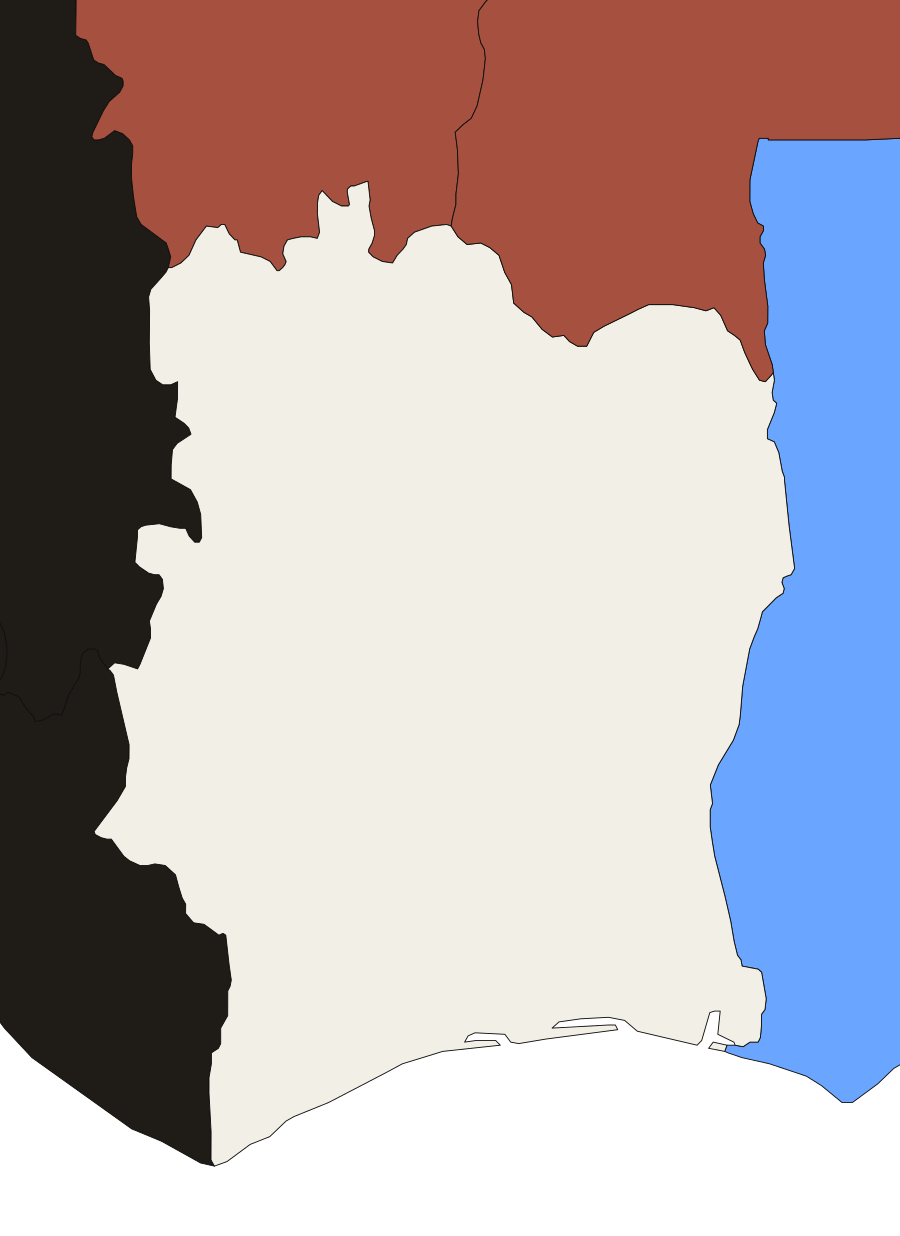
- Abidjan Economic capital and main port. France handed over its army base here in February 2025.
- San-Pédro The world's largest cocoa export port.
- Bouaké Rebel capital in the 2002 civil war. The US agreed to fly drones from its air base in 2025.
- Bouna Main town of the Bounkani region, which hosts most refugees from Burkina Faso.
- Côte d'Ivoire
- Partner
- Tensions
Who does Côte d'Ivoire trade with?
Côte d'Ivoire exported $29.4 billion of goods in 2025, up from $20.5 billion in 2024, and imported $19.6 billion (UN Comtrade). Switzerland was the largest buyer, mostly of gold, with 14.5% (chart). The Netherlands followed with 12.6%. China supplied 19.2% of imports and Nigeria 10.0%. In 2024 cocoa was 35.2% of exports and gold 15.4%. Gold output reached a record 59.3 tonnes in 2025. Eni's Baleine oil field has pumped since August 28, 2023, and produces about 60,000 barrels a day. A third phase, approved in May 2026, aims for 150,000. The economy grew by about 6.7% a year on average from 2012 to 2025 (World Bank), and the IMF expects 6.0% in 2026. In June 2026 the IMF and the World Bank cut their rating of Côte d'Ivoire's risk of debt distress to low, the only such rating in sub-Saharan Africa (Reuters). Abidjan is the main sea gateway for Mali and Burkina Faso.
Sells to
Share of Côte d'Ivoire's exports
 Switzerland14.5%
 Netherlands12.6%
- Mali5.7%
 Vietnam5.4%
- United States5.3%
Buys from
Share of Côte d'Ivoire's imports
- China19.2%
 Nigeria10.0%
- France6.4%
 India5.5%
- United States4.9%
Goods, 2025. UN Comtrade (Côte d'Ivoire's own figures).
Why does Côte d'Ivoire grow so much cocoa?
Côte d'Ivoire grew about 36% of the world's cocoa in the 2024/25 season (International Cocoa Organization). The government says the share is about 40%. Officials say the country has lost 80% to 90% of its forest since 1960. A 2020 study counted about 790,000 children working in cocoa farming (NORC). The state's Coffee-Cocoa Council sets the price paid to farmers. World prices peaked at about $12,900 a tonne in December 2024, and the farm price rose to a record 2,800 CFA francs a kilo in October 2025. When world prices fell, the farm price was cut to 1,200 CFA francs in March 2026 and kept there for the 2026/27 season. A farmers' union began an unlimited strike on September 16, 2026. Organizers said more than 10,000 people rallied in Daloa on October 17. The EU's deforestation law applies to cocoa from December 30, 2026. Côte d'Ivoire is also the largest cashew grower, with a record 1.55 million tonnes in 2025.
Why did Côte d'Ivoire fight two civil wars?
Côte d'Ivoire won independence from France on August 7, 1960. Félix Houphouët-Boigny ruled until his death on December 7, 1993. Growth of about 7% to 8% a year until 1980 was called the "Ivorian miracle". He built the Basilica of Our Lady of Peace in Yamoussoukro, which Guinness lists as the largest church in the world. About 2.9 million immigrants lived in Côte d'Ivoire in 2024, more than in any other African country (chart). After 1993 politicians promoted "ivoirité", which cast doubt on the nationality of northerners such as Ouattara. A coup on December 24, 1999 was followed by a civil war from September 2002, which split the rebel north from the south until a peace deal on March 4, 2007. After the November 2010 runoff, President Laurent Gbagbo refused to step down. An official inquiry counted 3,248 dead. Gbagbo was arrested on April 11, 2011. The International Criminal Court acquitted him in 2019. Côte d'Ivoire hosted and won the Africa Cup of Nations in February 2024.
Immigrants living in African countries, 2024
Full ranking →- Côte d'Ivoire2,880,839
 South Africa2,631,100
 Sudan2,397,113
 Uganda2,057,759
- Nigeria1,403,281
 Chad1,269,673
 Ethiopia1,168,455
 Egypt1,139,820
UN DESA, International Migrant Stock 2024, 2024