
Country profile · Arabian Peninsula
 Yemen
Yemen
Yemen has 41.8 million people (2025) and two rival governments. The Houthis, an Iran-backed movement, have held the capital, Sanaa, since September 2014, and most Yemenis live under their rule. The internationally recognized government, led by Rashad al-Alimi and backed by Saudi Arabia, holds Aden and the east. On October 4, 2026 it announced an offensive to retake Sanaa.

Where Yemen ranks
All rankings →Which alliances is Yemen in?
All alliances →How does Yemen vote at the UN?
Yemen's voting record → With China
 With India
 With Russia
Share of recorded UN General Assembly votes on which Yemen and each country voted the same way, 2025.
Who runs Yemen?
Yemen has two governments. The internationally recognized one is the eight-member Presidential Leadership Council, set up on April 7, 2022, when President Abdrabbuh Mansour Hadi handed over his powers. Rashad al-Alimi chairs it, and he works largely from Riyadh. Shaea al-Zindani has been prime minister since January 2026. The Houthis run Sanaa. Their leader, Abdul-Malik al-Houthi, took over the movement in 2004 after government forces killed his brother Hussein. He holds no state office and speaks only in televised speeches. An Israeli strike on August 28, 2025 killed the Houthi prime minister and nine ministers. Yemen has held no national election since 2012. Al-Alimi was born in Taiz in 1954 and has a PhD in sociology from Ain Shams University in Cairo. He was interior minister from 2001 to 2008. In 2011 he was wounded alongside President Ali Abdullah Saleh when a bomb hit the presidential mosque.
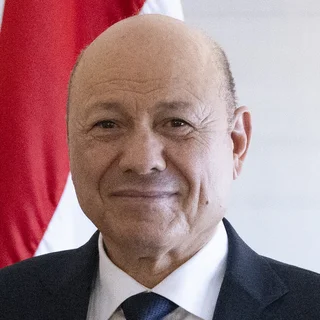
Photo (2023): UK Government, Wikimedia Commons, CC BY 2.0
Who are Yemen's allies and rivals?
Saudi Arabia is the recognized government's patron. It led the coalition that began bombing the Houthis in March 2015, and it pays much of the government's budget, including $346.6 million for salaries and running costs in February 2026. The Saudi-led coalition says 100 jets are supporting the October 2026 offensive. The Houthis declared a blockade of Saudi shipping on July 20, 2026, and in September the coalition said Houthi missiles and drones had wounded 73 civilians in southern Saudi Arabia. The United Arab Emirates, the coalition's second power, armed southern separatists. On December 30, 2025 Chairman al-Alimi canceled Yemen's defense pact with the UAE and gave Emirati forces 24 hours to leave. Iran arms the Houthis. In July 2025 pro-government forces seized 750 tons of Iranian weapons bound for them. President Trump refused Saudi requests for US air strikes in 2026, but about 100 US military advisers help the Saudis choose targets.
Allies and partners
 Saudi ArabiaPays salaries; air cover since 2015
 United StatesListed Houthis as terrorists, March 2025
 United KingdomJoined strikes on Houthis, 2024 and 2025
 EgyptFounding member of the Saudi-led maritime coalition
 OmanMediator, hosts Houthi negotiators in Muscat
Rivals
- The HouthisAt war with the government since 2014
 IranArms the Houthis, ties cut 2015
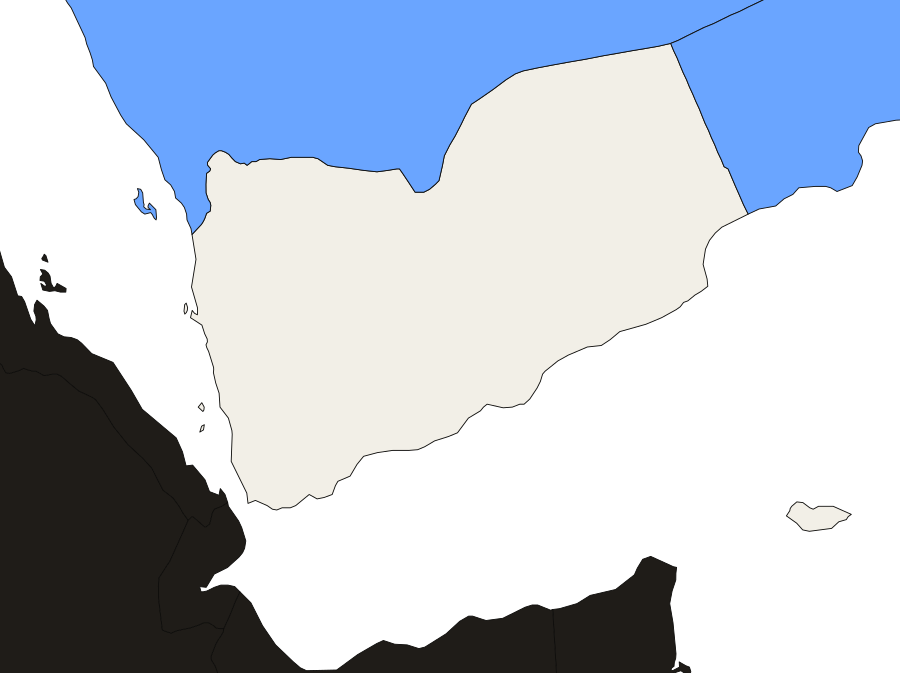
- Sanaa The capital, held by the Houthis since September 2014.
- Aden The government's base, taken from southern separatists in January 2026.
- Hodeidah Houthi-held port. Houthi ports handled 67% of imports in 2025.
- Taiz Government-held city, nearly surrounded. The Houthis cut its road to Aden in October 2026.
- Perim island Island in the Bab el-Mandeb strait. The Houthis took it on September 11, 2026, a day after Mokha.
- Yemen
- Partner
Why do the Houthis attack ships in the Red Sea?
The Houthis say they attack ships to support Gaza. They began on November 19, 2023 by seizing the Galaxy Leader and held its 25 crew for 430 days. By July 2025 they had targeted more than 100 merchant ships. Five vessels have sunk and at least 13 crew have been killed. Ships passing Bab el-Mandeb fell from about 75 a day in 2023 to 26 a day in September 2026. Egypt's Suez Canal revenue fell 61%, from $10.25 billion in 2023 to $3.99 billion in 2024. US strikes from March to May 2025 hit more than 1,100 targets, and a Pentagon review found that three of them killed 153 civilians. The Houthis paused after the Gaza ceasefire of October 2025. In July 2026 they started again, against Saudi shipping. On August 11 a Houthi attack on the Tihamah, an Egyptian-owned cargo ship, killed four crew and two rescuers.
Why is Yemen so poor?
Yemen's GDP per person was $420 in 2025, the lowest of 189 countries (chart). Real GDP per person has fallen 58% since 2015 (World Bank). Oil output peaked at 441,000 barrels a day in 2001 and fell to 15,000 in 2025 (EIA). Houthi drones hit the government's oil export terminals in late 2022, and exports stopped. Oil had been about 70% of government revenue. Chairman al-Alimi announced a restart on July 20, 2026, but no shipment has been confirmed. Yemen has two central banks and two sets of banknotes. On October 4, 2026 a dollar cost 1,576 rials in Aden and 533 in Houthi-held Sanaa. In 2024 Yemen bought $8.8 billion of goods from abroad and sold $662 million. About 80% of staple foods are imported. Money sent home by Yemenis working abroad is about a quarter of GDP, and about 60% of it comes from Saudi Arabia.
GDP per person on the Arabian Peninsula, 2025
Full ranking → Qatar$69,680
 United Arab Emirates$50,232
- Saudi Arabia$35,464
 Kuwait$30,877
 Bahrain$29,344
- Oman$19,996
- Yemen$420
IMF World Economic Outlook (April 2026)
How bad is the humanitarian crisis in Yemen?
The UN says 22.3 million people, more than half of all Yemenis, need aid in 2026. Of these, 18.3 million do not have enough food, and 2.2 million children under five are acutely malnourished. No famine has been declared, but the IPC, the global hunger monitor, projects 41,000 people at its worst level. Some 5.2 million people are displaced inside Yemen. The new fighting drove out more than 184,000 from August to early October 2026. Yemen had 260,552 suspected cholera cases in 2024, the most in the world. The World Food Programme stopped work in Houthi areas in August 2025 after the Houthis detained its staff, and the Houthis held 72 UN staff in October 2026. In 2021 the UN estimated that the war would cause 377,000 deaths by the end of that year, about 60% of them from hunger and disease.