Ranking · Energy and resources
Countries most dependent on the Strait of Hormuz
Pakistan and Sri Lanka bought all of their 2025 crude oil imports from the seven Gulf producers inside the Strait of Hormuz, by their own customs figures. The Philippines bought 95.0% and Japan 93.0%. South Korea bought 69.6% and India 47.5%. About a fifth of the world's oil passed through the strait in 2024.
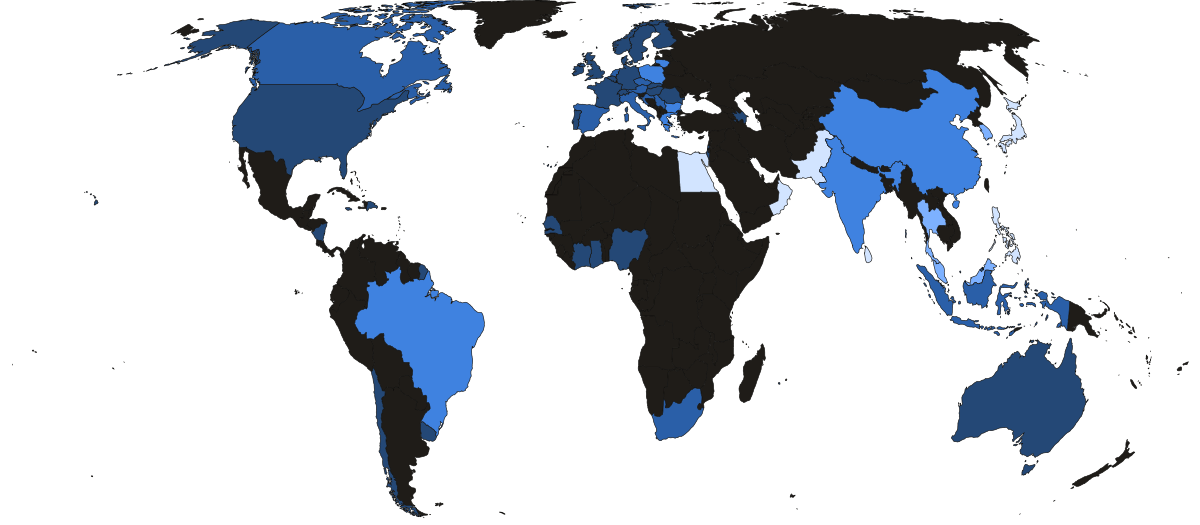
- Under 10%
- 10%–25%
- 25%–50%
- 50%–75%
- Over 75%
- Not in this ranking
- Under 10%
- 10%–25%
- 25%–50%
- 50%–75%
- Over 75%
- Not in this ranking
- Under 1
- 1–5
- 5–20
- 20–80
- Over 80
- Not in this ranking
| # | Country | Share from the Gulf | Share from Qatar and the UAE | Million tonnes |
|---|---|---|---|---|
| 1 |  Pakistan Pakistan |
100.0% | 99.0% | 11.1 |
| 2 |  Sri Lanka Sri Lanka |
100.0% | · | 1.4 |
| 3 |  Oman Oman |
97.2% | 0.0% | 7.0 |
| 4 |  Philippines Philippines |
95.0% | 3.6% | 7.5 |
| 5 |  Japan Japan |
93.0% | 6.3% | 107 |
| 6 |  Egypt Egypt |
89.7% | 0.0% | 2.4 |
| 7 |  Singapore Singapore |
71.8% | 47.2% | 33.8 |
| 8 |  South Korea South Korea |
69.6% | 15.4% | 95.4 |
| 9 |  Malaysia Malaysia |
59.9% | 0.0% | 13.7 |
| 10 |  Thailand Thailand |
59.6% | 21.1% | 27.7 |
| 11 |  India India |
47.5% | 58.6% | 125 |
| 12 |  Poland Poland |
47.3% | · | 12.0 |
| 13 |  Lithuania Lithuania |
46.6% | 0.0% | 4.4 |
| 14 |  Greece Greece |
45.0% | 0.0% | 8.2 |
| 15 |  China China |
37.8% | 29.0% | 209 |
| 16 |  Bulgaria Bulgaria |
31.9% | · | 1.5 |
| 17 |  Brazil Brazil |
26.9% | 0.0% | 3.4 |
| 18 |  Indonesia Indonesia |
18.1% | · | 3.2 |
| 19 |  South Africa South Africa |
17.1% | 0.0% | 1.2 |
| 20 |  Austria Austria |
15.9% | · | 1.3 |
| 21 |  Croatia Croatia |
13.0% | 0.0% | 0.50 |
| 22 |  Brunei Brunei |
12.1% | · | 0.90 |
| 23 |  Canada Canada |
11.3% | 0.0% | 2.6 |
| 24 |  Serbia Serbia |
10.6% | · | 0.20 |
| 25 |  Spain Spain |
10.3% | 2.0% | 6.4 |
| 26 |  Italy Italy |
10.2% | 32.9% | 5.1 |
| 27 |  Czechia Czechia |
10.0% | · | 0.70 |
| 28 |  Netherlands Netherlands |
10.0% | 0.0% | 7.1 |
| 29 |  France France |
8.7% | 0.0% | 4.7 |
| 30 |  Slovakia Slovakia |
8.5% | · | 0.40 |
| 31 |  United States United States |
8.0% | 7.0% | 28.3 |
| 32 |  Germany Germany |
6.1% | 0.0% | 4.6 |
| 33 |  Romania Romania |
0.4% | · | · |
| 34 |  Australia Australia |
0.2% | · | · |
| 35 |  Azerbaijan Azerbaijan |
0.0% | · | · |
| 36 |  Belgium Belgium |
0.0% | 25.3% | · |
| 37 |  Chile Chile |
0.0% | 0.0% | · |
| 38 |  Côte d'Ivoire Côte d'Ivoire |
0.0% | · | · |
| 39 |  Denmark Denmark |
0.0% | · | · |
| 40 |  Dominican Republic Dominican Republic |
0.0% | 0.0% | · |
| 41 |  Finland Finland |
0.0% | 0.0% | · |
| 42 |  Ghana Ghana |
0.0% | · | · |
| 43 |  Hungary Hungary |
0.0% | · | · |
| 44 |  Ireland Ireland |
0.0% | · | · |
| 45 |  Israel Israel |
0.0% | · | · |
| 46 |  Jamaica Jamaica |
0.0% | 0.0% | · |
| 47 |  Nicaragua Nicaragua |
0.0% | · | · |
| 48 |  Nigeria Nigeria |
0.0% | · | · |
| 49 |  Norway Norway |
0.0% | · | · |
| 50 |  Portugal Portugal |
0.0% | 0.0% | · |
| 51 |  Senegal Senegal |
0.0% | 0.0% | · |
| 52 |  Sweden Sweden |
0.0% | 0.0% | · |
| 53 |  Switzerland Switzerland |
0.0% | · | · |
| 54 |  United Kingdom United Kingdom |
0.0% | 2.2% | · |
| 55 |  Uruguay Uruguay |
0.0% | · | · |
| # | Country | Share from Qatar and the UAE | Share from the Gulf | Million tonnes |
|---|---|---|---|---|
| 1 | Pakistan |
99.0% | 100.0% | 11.1 |
| 2 | India |
58.6% | 47.5% | 125 |
| 3 | Singapore |
47.2% | 71.8% | 33.8 |
| 4 |  Taiwan Taiwan |
33.7% | · | · |
| 5 | Italy |
32.9% | 10.2% | 5.1 |
| 6 | China |
29.0% | 37.8% | 209 |
| 7 | Belgium |
25.3% | 0.0% | · |
| 8 | Thailand |
21.1% | 59.6% | 27.7 |
| 9 | South Korea |
15.4% | 69.6% | 95.4 |
| 10 | United States |
7.0% | 8.0% | 28.3 |
| 11 | Japan |
6.3% | 93.0% | 107 |
| 12 | Philippines |
3.6% | 95.0% | 7.5 |
| 13 | United Kingdom |
2.2% | 0.0% | · |
| 14 | Spain |
2.0% | 10.3% | 6.4 |
| 15 | Oman |
0.0% | 97.2% | 7.0 |
| 16 | Egypt |
0.0% | 89.7% | 2.4 |
| 17 | Malaysia |
0.0% | 59.9% | 13.7 |
| 18 | Lithuania |
0.0% | 46.6% | 4.4 |
| 19 | Greece |
0.0% | 45.0% | 8.2 |
| 20 | Brazil |
0.0% | 26.9% | 3.4 |
| 21 | South Africa |
0.0% | 17.1% | 1.2 |
| 22 | Croatia |
0.0% | 13.0% | 0.50 |
| 23 | Canada |
0.0% | 11.3% | 2.6 |
| 24 | Netherlands |
0.0% | 10.0% | 7.1 |
| 25 | France |
0.0% | 8.7% | 4.7 |
| 26 | Germany |
0.0% | 6.1% | 4.6 |
| 27 | Chile |
0.0% | 0.0% | · |
| 28 | Dominican Republic |
0.0% | 0.0% | · |
| 29 | Finland |
0.0% | 0.0% | · |
| 30 | Jamaica |
0.0% | 0.0% | · |
| 31 | Portugal |
0.0% | 0.0% | · |
| 32 | Senegal |
0.0% | 0.0% | · |
| 33 | Sweden |
0.0% | 0.0% | · |
| 34 |  Argentina Argentina |
0.0% | · | · |
| 35 |  Cambodia Cambodia |
0.0% | · | · |
| 36 |  Colombia Colombia |
0.0% | · | · |
| 37 |  El Salvador El Salvador |
0.0% | · | · |
| 38 |  Malta Malta |
0.0% | · | · |
| # | Country | Million tonnes | Share from the Gulf | Share from Qatar and the UAE |
|---|---|---|---|---|
| 1 | China |
209 | 37.8% | 29.0% |
| 2 | India |
125 | 47.5% | 58.6% |
| 3 | Japan |
107 | 93.0% | 6.3% |
| 4 | South Korea |
95.4 | 69.6% | 15.4% |
| 5 | Singapore |
33.8 | 71.8% | 47.2% |
| 6 | United States |
28.3 | 8.0% | 7.0% |
| 7 | Thailand |
27.7 | 59.6% | 21.1% |
| 8 | Malaysia |
13.7 | 59.9% | 0.0% |
| 9 | Poland |
12.0 | 47.3% | · |
| 10 | Pakistan |
11.1 | 100.0% | 99.0% |
| 11 | Greece |
8.2 | 45.0% | 0.0% |
| 12 | Philippines |
7.5 | 95.0% | 3.6% |
| 13 | Netherlands |
7.1 | 10.0% | 0.0% |
| 14 | Oman |
7.0 | 97.2% | 0.0% |
| 15 | Spain |
6.4 | 10.3% | 2.0% |
| 16 | Italy |
5.1 | 10.2% | 32.9% |
| 17 | France |
4.7 | 8.7% | 0.0% |
| 18 | Germany |
4.6 | 6.1% | 0.0% |
| 19 | Lithuania |
4.4 | 46.6% | 0.0% |
| 20 | Brazil |
3.4 | 26.9% | 0.0% |
| 21 | Indonesia |
3.2 | 18.1% | · |
| 22 | Canada |
2.6 | 11.3% | 0.0% |
| 23 | Egypt |
2.4 | 89.7% | 0.0% |
| 24 | Bulgaria |
1.5 | 31.9% | · |
| 25 | Sri Lanka |
1.4 | 100.0% | · |
| 26 | Austria |
1.3 | 15.9% | · |
| 27 | South Africa |
1.2 | 17.1% | 0.0% |
| 28 | Brunei |
0.90 | 12.1% | · |
| 29 | Czechia |
0.70 | 10.0% | · |
| 30 | Croatia |
0.50 | 13.0% | 0.0% |
| 31 | Slovakia |
0.40 | 8.5% | · |
| 32 | Serbia |
0.20 | 10.6% | · |
Why they rank where they do
-
Pakistan
Pakistan's customs figures list only Saudi Arabia, the UAE and Kuwait for 2025, but its Cnergyico refinery received its first US crude cargoes, about 1 million barrels each, in late October and November 2025. In March 2026 Prime Minister Shehbaz Sharif announced a four-day office week, closed schools for two weeks and cut fuel for government vehicles by half.
-
Sri Lanka
Sri Lanka's only refinery, Sapugaskanda (about 50,000 barrels a day), was built to run Iranian crude. After the war began, Sri Lanka brought back QR-code fuel rationing on March 15, 2026 and made Wednesdays a public-sector holiday from March 18.
-
Oman
Oman's Duqm refinery is a 50-50 joint venture with Kuwait Petroleum International, designed to run 65% Kuwaiti crude and 35% Omani crude. Oman's coast lies outside the strait, but Kuwaiti crude has to pass through it.
-
Philippines
President Marcos declared a state of national energy emergency on March 24, 2026, valid for up to one year. Petron's Bataan refinery (180,000 barrels a day) is the country's only refinery. Petron bought Russian crude in March 2026 after Gulf supplies were cut.
-
Japan
By Japan's own figures, the United Arab Emirates supplied 43.3% of its crude in 2025, Saudi Arabia 39.4%, Kuwait 6.2% and Qatar 4.2%. The United States supplied 3.8%.
-
Egypt
Egypt buys Saudi crude that is pumped across Saudi Arabia and shipped from Yanbu up the Red Sea to Ain Sokhna. Most of that oil never passes through Hormuz. Saudi deliveries to Ain Sokhna averaged about 755,000 barrels a day in 2026.
-
Singapore
Singapore's refineries process crude for export as fuel across Asia. In March 2026 Singapore Refining Company cut its runs to about 60%, and ExxonMobil's Jurong refinery cut to 50% or less.
-
South Korea
South Korea's reserves equal 208 days of net imports by the IEA's method. Korea contributed 22.5 million barrels to the IEA's March 2026 emergency stock release, its largest ever. Korea cut the private stockholding obligation from 40 to 20 days from May 29, 2026.
-
India
Russia was India's largest supplier in 2025, with 33.7% of its crude imports. India's strategic petroleum reserve can hold 5.33 million tonnes in caverns at Visakhapatnam, Mangaluru and Padur. On March 23, 2026 it held 3.372 million tonnes, about 64% full.
-
Poland
Orlen's 2022 contract with Saudi Aramco supplies 200,000 to 337,000 barrels a day, up to about 45% of Orlen's crude. Poland signed it to replace Russian oil.
-
China
China reports no imports of Iranian crude since 2022. In 2025 China imported 1.3 million barrels a day of crude labelled as Malaysian, more than Malaysia's own output of about 535,000 barrels a day. The Center on Global Energy Policy at Columbia says many Iranian and Venezuelan barrels are relabelled as Malaysian.
-
Taiwan
Taiwan has no 2025 figures in UN Comtrade, so it appears only under LNG, with figures from Taiwan's Energy Administration. The Energy Administration told the cabinet on March 5, 2026 that 62% of Taiwan's crude and 34% of its natural gas came through Hormuz in 2025, down from 73% and 47% in 2015.
How much of Japan's oil comes through the Strait of Hormuz?
Japan's industry ministry (METI) reported on March 24, 2026 that 93.0% of Japan's crude oil imports passed through the Strait of Hormuz in 2025. Japan imported about 2.36 million barrels a day of crude that year, and 94.0% came from the Middle East.
Japan held 248 days of oil stocks at the end of January 2026, split between 146 days of government reserves, 96 days of private reserves, and 6 days held jointly with producer countries. When the IEA agreed on March 11, 2026 to release 400 million barrels from emergency stocks, Japan contributed 79.8 million barrels. By July 2026 the Middle East's share of Japan's crude imports fell to 58.9%, 28.7 points lower than a year earlier. US crude rose to 36.3% of Japan's imports by finance ministry figures.
Which countries buy the most oil from the Gulf?
China imported 209.2 million tonnes of crude from the seven Gulf producers inside the Strait of Hormuz in 2025, the largest volume of any country. India was second at 124.9 million tonnes, Japan third at 107.2 million tonnes, and South Korea fourth at 95.4 million tonnes.
The EIA reported that China, India, Japan and South Korea together took 69% of the crude and condensate that passed through Hormuz in 2024. After those four, Singapore imported 33.8 million tonnes, the United States 28.3 million tonnes, and Thailand 27.7 million tonnes. Overall, 84% of the crude and condensate through Hormuz went to Asia.
- China209
- India125
- Japan107
- South Korea95.4
- Singapore33.8
- United States28.3
- Thailand27.7
- Malaysia13.7
Which countries depend on LNG from the Gulf?
Pakistan imported 99.0% of its LNG from Qatar and the UAE in 2025. India was next at 58.6%, Singapore at 47.2%, and Italy at 32.9%. China imported 29.0% and Belgium 25.3%. About 20% of world LNG trade passed through Hormuz in 2024, nearly all of it from Qatar.
QatarEnergy stopped LNG production on March 2, 2026 and declared force majeure on March 4. Iranian strikes on March 18 and 19 damaged two LNG trains with 12.8 million tonnes a year of capacity, about 17% of Qatar's total. QatarEnergy's chief executive said in September that repairs would take three years. Qatar exported about 1.6 million tonnes of LNG in September 2026, under a quarter of its prewar rate.
- Pakistan99.0%
- India58.6%
- Singapore47.2%
- Taiwan33.7%
- Italy32.9%
- China29.0%
- Belgium25.3%
- Thailand21.1%
Can oil get around the Strait of Hormuz?
Two pipelines bypass the strait. Saudi Arabia's East-West pipeline to Yanbu on the Red Sea has a capacity of 5 million barrels a day. In 2019 Saudi Aramco converted some gas liquids lines to raise it temporarily to 7 million. The UAE's pipeline from Habshan to Fujairah, on the Gulf of Oman outside the strait, carries up to 1.8 million barrels a day. The EIA estimated about 2.6 million barrels a day of these pipelines' capacity was unused before the war.
Bloomberg reported on March 28, 2026 that the East-West line was running at its full 7 million barrels a day, with about 5 million exported from Yanbu. Egypt buys Gulf oil that skips the strait. Saudi crude is pumped across Saudi Arabia and shipped from Yanbu up the Red Sea to Ain Sokhna. Saudi deliveries to Ain Sokhna averaged about 755,000 barrels a day in 2026.
How did the 2026 Iran war change where countries buy oil?
The Middle East's share of Japan's crude imports fell from 87.6% in July 2025 to 58.9% in July 2026, a drop of 28.7 points. US crude rose to 36.3% of Japan's imports. Thailand's Middle East share went from 55% in the first quarter of 2026 to 35% in the second. Greece's refiners switched from Iraqi crude, which had been nearly two-thirds of Motor Oil Hellas's supply, to US, Libyan, Egyptian and Kurdish crude.
Governments imposed emergency measures. The Philippines declared a national energy emergency on March 24, 2026. Sri Lanka brought back QR-code fuel rationing on March 15. Bangladesh capped fuel per vehicle from March 8. Slovenia limited sales to 50 liters per person a day from March 22, the first EU country to ration. On March 11 IEA members agreed to release 400 million barrels from emergency stocks. Japan contributed 79.8 million barrels and South Korea 22.5 million, Korea's largest release ever.