
Country profile · Oceania
 Australia
Australia is the sixth-largest country by area and mined 31.7% of the world's lithium in 2025. Prime Minister Anthony Albanese's Labor Party won 94 of 150 House seats in May 2025. China bought 29.4% of Australia's exports in 2025. The United States is its treaty ally, and under AUKUS Australia is buying nuclear-powered submarines from it.
Where Australia ranks
All rankings →Who runs Australia?
Prime Minister Anthony Albanese of the Labor Party runs Australia. King Charles III is head of state, represented by Governor-General Sam Mostyn. Albanese grew up in public housing in Sydney, raised by his single mother, a disability pensioner. He was told his father had died, learned at about 14 that he was alive, and first met him in Barletta, Italy, in 2009. In November 2025 he married Jodie Haydon at The Lodge, the prime minister's residence, the first prime minister to marry in office. His dog Toto was the ring bearer. Labor was re-elected in May 2025 without losing a seat, the first government to do so since 1966. In 2026 Pauline Hanson's anti-immigration One Nation party surged. It won its first House seat in May, and it led the September Newspoll with 30%, against Labor's 27%.

- Labor 94
- Liberal-National Coalition 41
- Others (10 independents, One Nation 2, others 3) 15
Official portrait (2022): David Foote, AUSPIC, Wikimedia Commons, CC BY 4.0
Who are Australia's allies and rivals?
The United States is Australia's main ally under the ANZUS treaty, signed on September 1, 1951 and invoked once, after the September 11 attacks. About 2,000 US Marines rotated through Darwin in 2026, and US B-52 bombers arrived at RAAF Base Tindal on September 1, 2026. Since July 24, 2026, most Australian goods have paid a 12.5% US tariff. In the Pacific, Australia signed alliances with Papua New Guinea and Fiji in 2026, its first new alliances in more than 70 years. China is the main rival. After Australia called for an inquiry into the origins of COVID-19 in 2020, China blocked more than US$12 billion a year of Australian exports. It lifted the last barriers in December 2024. In February 2025 a Chinese navy group sailed around Australia for the first time.
Allies and partners
 United StatesTreaty ally since 1951
 United KingdomAUKUS submarine partner since 2021
 JapanIts Mogami design chosen for 11 new frigates
 New ZealandANZUS treaty ally
 Papua New GuineaDefense treaty in force July 2026
 FijiMutual defense alliance, July 2026
 IndonesiaSecurity treaty signed February 2026
Rivals
 ChinaLargest customer, trade barriers 2020 to 2024
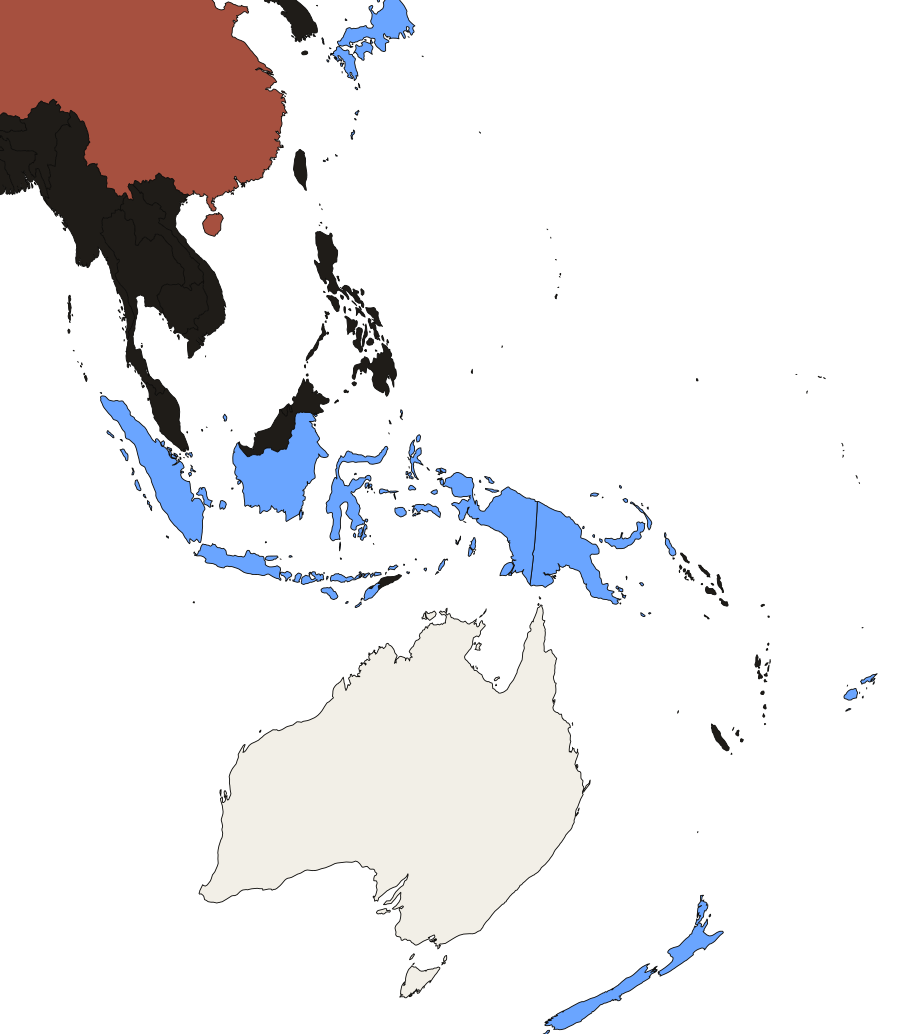
- Pine Gap Joint US-Australia intelligence base near Alice Springs, operating since 1970.
- Darwin About 2,000 US Marines rotate through here. The port is leased to China's Landbridge for 99 years.
- HMAS Stirling Navy base near Perth. US and UK nuclear submarines will rotate here from 2027 under AUKUS.
- Solomon Islands Signed a security pact with China in 2022. Prime Minister Matthew Wale, in office since May 2026, is reviewing it.
- Australia
- Partner
- Rival
Who does Australia trade with?
Australia exported A$665.2 billion of goods and services in 2025 and imported A$658.3 billion. China was the largest partner on both sides, buying A$195.6 billion of exports. Resources and energy earned A$385 billion in the year to June 2025, led by iron ore at A$116 billion. In the year to June 2026, gold overtook liquefied natural gas as the second-largest resource export, at a record A$68 billion. Education brought in A$55.0 billion in 2025. About 94% of Australia's lithium concentrate went to China in the first half of 2025, and Albemarle closed its Kemerton lithium refinery in Western Australia in February 2026. On October 20, 2025, Prime Minister Albanese and President Trump signed a critical minerals deal with a US$8.5 billion project pipeline.
Sells to
Share of Australia's exports
- China29.4%
- Japan9.8%
- United States9.0%
 South Korea6.6%
 India4.8%
Buys from
Share of Australia's imports
- China19.8%
- United States15.0%
- Japan4.9%
 Singapore4.3%
 Thailand3.6%
Goods and services, 2025. Shares of Australia's exports and imports in Australian Bureau of Statistics data. The destinations of some commodities are confidential.
How strong is Australia's military?
SIPRI estimates Australia spent $35.3 billion on its military in 2025, 1.9% of GDP. The Australian Defence Force had more than 61,000 permanent members on July 1, 2026, its largest in 25 years. A strategy published on April 16, 2026 set a goal of 3% of GDP by 2033 under a broader measure. On the traditional count the 2026-27 budget is 2.02% of GDP. The navy is ordering 11 frigates based on Japan's Mogami class, with Mitsubishi Heavy Industries building the first three in Japan, the first due by December 2029. Australia is buying up to 220 US Tomahawk cruise missiles and 42 HIMARS rocket launchers, and began making GMLRS rockets at Port Wakefield in 2026, the first such factory outside the United States.
Military spending in Asia and the Pacific, 2025
Full ranking →- China est.$336bn
- India$92.1bn
- Japan$62.2bn
- South Korea$47.8bn
- Australia$35.3bn
 Taiwan$18.2bn
- Singapore$17.4bn
- Indonesia$15.0bn
SIPRI Military Expenditure Database, 2026 edition
What is AUKUS?
AUKUS is a security pact among Australia, the United Kingdom and the United States, announced on September 15, 2021. From 2027, US and UK nuclear submarines will rotate through HMAS Stirling, near Perth. Australia will buy three used US Virginia-class submarines, in 2032, 2035 and 2038, with an option for two more in 2041 and 2044. A new class, SSN-AUKUS, designed with Britain, will be built in Adelaide from the early 2040s. The submarines will carry conventional weapons, and Australia will not have nuclear weapons. The government's 2023 cost estimate is A$268 to 368 billion to 2055. The risk is on the US side. US shipyards build about 1.1 to 1.2 Virginia-class boats a year, against the 2.33 needed, and US law requires the president to certify that each sale will not weaken the US Navy.