
General Assembly vote · November 29, 1947
How countries voted on the partition of Palestine at the UN in 1947
On November 29, 1947 the General Assembly recommended dividing Palestine, then ruled by Britain, into an Arab state and a Jewish state, with Jerusalem under UN rule, by 33 votes to 13 with 10 abstentions. The Assembly treated the plan as needing two-thirds of those voting yes or no, and it cleared that bar. The Jewish Agency accepted the plan, subject to further discussion. The Arab Higher Committee and the Arab states rejected it. Israel declared independence in May 1948, and after the war that followed, the Arab state was never created.
- Yes
- 33
- No
- 13
- Abstained
- 10
- Didn't vote
- 1
Adopted: it needed two-thirds of the countries voting yes or no, and got 72%. Abstentions count for neither side.
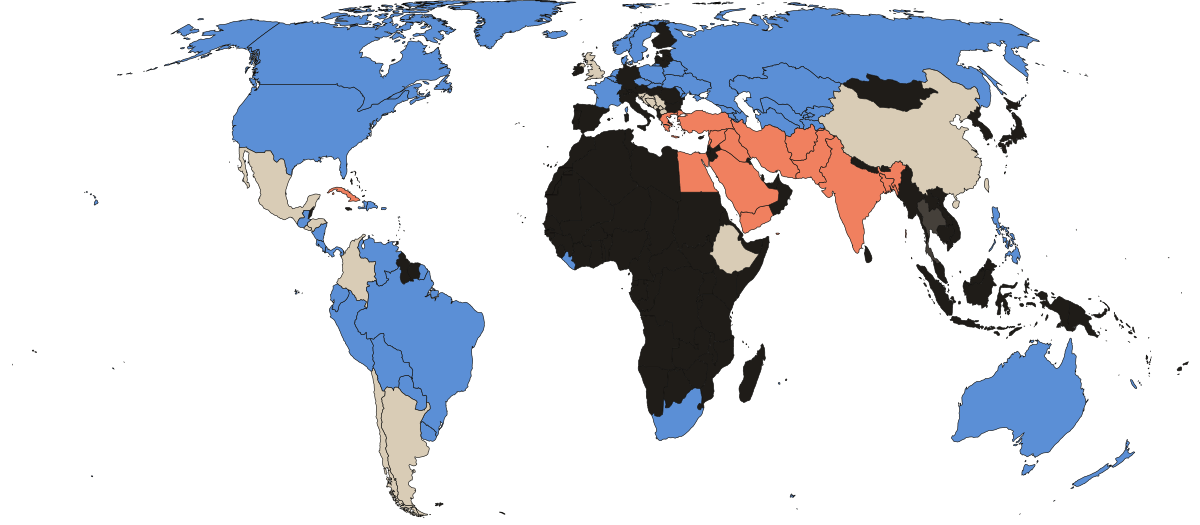
- Yes
- No
- Abstained
- Didn't vote
- Not a UN member
Which countries voted against?
Every Arab member of the UN voted no: Egypt, Iraq, Lebanon, Saudi Arabia, Syria and Yemen. Their delegates said partition violated the UN Charter and denied self-determination to Palestine's Arab majority. Afghanistan, Iran, Pakistan and Turkey also voted no. India voted no on Prime Minister Nehru's instruction, after backing a federal plan on the UN's special committee on Palestine. Cuba was the only Latin American country to vote no. Cuba's delegate, Ernesto Dihigo, argued that partition violated self-determination. Greece's ambassador told the US State Department that Greece's no vote was part of a deal its representatives had made with the representatives of Muslim states.
How did the big powers vote?
How did the plan win two-thirds?
Britain, which ruled Palestine under a League of Nations mandate, asked the UN to take up the question in April 1947. A special committee, UNSCOP, proposed partition by a majority of seven of its 11 members. India, Iran and Yugoslavia proposed a single federal state instead. Australia abstained.
The Assembly treated the plan as needing two-thirds of countries voting yes or no, not counting abstentions. A vote expected on November 26 was put off. There was no meeting on Thanksgiving, November 27. On November 28 Colombia's delegate warned that the committee vote would, in the Assembly, "be one short of the two-thirds majority required by our rules." The Assembly voted 25 to 15 for France's motion to delay by 24 hours. After the committee vote of November 25, several countries moved to yes, among them France, Belgium, the Netherlands, Haiti and Liberia, which had abstained, and the Philippines, which had been absent.
Historians agree that US officials and private individuals lobbied delegations. The Philippine president, Manuel Roxas, said his ambassador had reported that an unnamed US representative hinted that not backing the US "might have an adverse effect" on relations. The State Department said it "had not sought to bring pressure." A note from a Truman cabinet meeting reads: "We have been in touch with Liberian minister to try to get the government's instructions changed." President Truman wrote that a report said the US consul in Haiti had urged Haiti's president to change the vote. Truman said: "I refused to make statements to any country on the subject of its vote in the United Nations." The Arab Higher Committee later told the UN that Haiti had "surrendered to pressure" and Liberia had come under "heavy pressure." Haiti formally rejected the claim that US pressure explained its vote. Historians still disagree about how far Truman himself was involved.
- The partition plan (this vote)Nov 1947 33 yes13 no10 abstained
- Refugees and a conciliation commissionDec 1948 35 yes15 no8 abstained
- Admitting Israel to the UNMay 1949 37 yes12 no9 abstained
- Observer status for the PLONov 1974 95 yes17 no19 abstained
- Palestine as a non-member observer stateNov 2012 138 yes9 no41 abstained
- Palestine's membership bidMay 2024 143 yes9 no25 abstained
What did the plan propose?
The plan divided Palestine into three parts: an Arab state, a Jewish state and an international zone around Jerusalem and Bethlehem. All three were to be joined in an economic union. By commonly cited estimates (the resolution itself gives no percentages), the Jewish state was to get about 55 to 56 percent of the territory and the Arab state about 42 to 43 percent. Jerusalem, under one percent, would be run by the UN.
At the end of 1946 UNSCOP estimated Palestine's population at about 1,237,000 Arabs and others and about 608,000 Jews. Within the proposed Jewish state there were to be about 500,000 Jews and 400,000 to 500,000 Arabs, depending on whether Bedouin were counted. Counting Bedouin, a UN sub-committee made up mostly of Arab states found that, under the committee's first borders, Arabs would have been a slight majority there. The final plan moved Jaffa to the Arab state, which left about 427,000 Arabs. Opponents said it gave the Jewish minority, roughly a third of the population, more than half the territory. Supporters said it gave each people a state of its own.
How did each side argue its case?
The Jewish Agency's representative, Abba Hillel Silver, said that if "that heavy sacrifice was the inescapable condition of a final solution," and if it "made possible the immediate re-establishment of the Jewish State," the Agency "was prepared to recommend the acceptance of the partition solution." The Arab Higher Committee's representative, Jamal Husseini, said Palestine's future was "a matter for the rightful owners of Palestine to decide" and that the UN "was not legally competent" to impose a constitution.
After the vote, Iraq's delegate called the decision "anti-democratic, illegal, impractical and contrary to the Charter." Arab delegates argued that partition denied self-determination to Palestine's Arab majority.
The United States and the Soviet Union both voted yes. In May 1947 the Soviet delegate Andrei Gromyko had said the Soviet Union preferred a single Arab-Jewish state, but would accept "two independent autonomous states" if that proved impossible. Britain abstained. Colonial Secretary Arthur Creech Jones said Britain would not carry out a plan unless both Jews and Arabs accepted it.
What happened after the vote?
Fighting began within days of the vote. On November 30, 1947 Arab attackers ambushed two buses near Kfar Sirkin, killing seven Jews. The historian Benny Morris says it is unclear whether this was a reaction to the vote or revenge for an earlier raid by the Jewish underground group Lehi. The Arab Higher Committee called a three-day strike beginning December 2, during which Jerusalem's commercial center was burned.
In March 1948 the United States proposed a temporary UN trusteeship and asked that work on partition be suspended. Britain ended the Mandate on May 14, 1948, earlier than the August 1 deadline. Israel declared independence the same day. Israel's declaration proclaims the state "on the strength of the resolution of the United Nations General Assembly." On May 15 the armies of Egypt, Transjordan, Syria, Iraq and Lebanon entered the former Mandate territory. About 700,000 Palestinians fled or were expelled. UN estimates put the number at 711,000 to 726,000. Israeli officials gave about 520,000 and Arab states 900,000 to 1 million (figures collected by the historian Benny Morris). Palestinians call this the Nakba, "the catastrophe." Israelis call the war the War of Independence. The Arab state was never created. When the fighting ended in 1949, Israel held more territory than the plan had given it, Transjordan held the West Bank (annexing it in 1950) and Egypt held the Gaza Strip.
In 1988 the declaration of independence by the Palestine Liberation Organization (PLO) also cited resolution 181, saying it "continues to attach conditions to international legitimacy" that guarantee Palestinian sovereignty. Since 1978, under a 1977 resolution, the UN has marked November 29 as the International Day of Solidarity with the Palestinian People. Israelis call the date "Kaf-Tet b'November," Hebrew for "the 29th of November."
How did each region vote?
All seven Middle Eastern members voted no, while most of Europe (13 of 16) and the Americas (15 of 22) voted yes. Most of Africa was still under colonial rule, and much of Asia was colonized, occupied or outside the UN, so they had no vote.
- Europe16 countries 13 yes1 no2 abstained
- Americas22 countries 15 yes1 no6 abstained
- Asia6 countries 1 yes3 no1 abstained
- Oceania2 countries 2 yes0 no0 abstained
- Middle East7 countries 0 yes7 no0 abstained
- Africa4 countries 2 yes1 no1 abstained
What did the resolution say?
- It recommended to the United Kingdom, as the mandatory power, and to all other UN members the adoption and implementation of the "Plan of Partition with Economic Union."
- Its plan said the Mandate should end "not later than 1 August 1948" and that the two states should come into existence by October 1, 1948 at the latest.
- It proposed an Arab state and a Jewish state joined in an economic union binding for at least ten years, with Jerusalem as a "corpus separatum under a special international regime" to be administered by the UN through the Trusteeship Council.
- It called for democratic constitutions guaranteeing "equal and non-discriminatory rights" and protected minority rights, including a bar on taking Arab-owned land in the Jewish state, or Jewish-owned land in the Arab state, except for public purposes with full compensation.
- It asked the Security Council to take the necessary measures and to treat "any attempt to alter by force the settlement" as a threat to the peace, and called on the inhabitants of Palestine to put the plan into effect. The Security Council never adopted enforcement measures.
- It was a recommendation: it did not itself create a state, and the text speaks of an "Arab State" and a "Jewish State," naming neither "Israel" nor "Palestine" as a state.
How did every country vote?
| Country | Region | Vote |
|---|---|---|
| Afghanistan | Asia | No |
| Argentina | Americas | Abstained |
| Australia | Oceania | Yes |
| Belgium | Europe | Yes |
| Bolivia | Americas | Yes |
| Brazil | Americas | Yes |
| Byelorussian SSR | Europe | Yes |
| Canada | Americas | Yes |
| Chile | Americas | Abstained |
| China | Asia | Abstained |
| Colombia | Americas | Abstained |
| Costa Rica | Americas | Yes |
| Cuba | Americas | No |
| Czechoslovakia | Europe | Yes |
| Denmark | Europe | Yes |
| Dominican Republic | Americas | Yes |
| Ecuador | Americas | Yes |
| Egypt | Africa | No |
| El Salvador | Americas | Abstained |
| Ethiopia | Africa | Abstained |
| France | Europe | Yes |
| Greece | Europe | No |
| Guatemala | Americas | Yes |
| Haiti | Americas | Yes |
| Honduras | Americas | Abstained |
| Iceland | Europe | Yes |
| India | Asia | No |
| Iran | Middle East | No |
| Iraq | Middle East | No |
| Lebanon | Middle East | No |
| Liberia | Africa | Yes |
| Luxembourg | Europe | Yes |
| Mexico | Americas | Abstained |
| Netherlands | Europe | Yes |
| New Zealand | Oceania | Yes |
| Nicaragua | Americas | Yes |
| Norway | Europe | Yes |
| Pakistan | Asia | No |
| Panama | Americas | Yes |
| Paraguay | Americas | Yes |
| Peru | Americas | Yes |
| Philippines | Asia | Yes |
| Poland | Europe | Yes |
| Saudi Arabia | Middle East | No |
| Siam | Asia | Didn't vote |
| Soviet Union | Europe | Yes |
| Sweden | Europe | Yes |
| Syria | Middle East | No |
| Turkey | Middle East | No |
| Ukrainian SSR | Europe | Yes |
| Union of South Africa | Africa | Yes |
| United Kingdom | Europe | Abstained |
| United States | Americas | Yes |
| Uruguay | Americas | Yes |
| Venezuela | Americas | Yes |
| Yemen | Middle East | No |
| Yugoslavia | Europe | Abstained |