
General Assembly vote · December 21, 2017
How countries voted on the status of Jerusalem at the UN in 2017
On December 21, 2017, the General Assembly voted 128 to 9 with 35 abstentions, according to the UN voting record, that decisions which "purport to have altered" Jerusalem's status "have no legal effect, are null and void and must be rescinded." It called on states not to open embassies there. Like all General Assembly resolutions, it is not legally binding. The vote came two weeks after President Donald Trump recognized Jerusalem as Israel's capital and three days after a United States veto in the Security Council. The resolution did not mention the United States or President Trump, did not use the word "condemn," and did not call Jerusalem the capital of Israel or of a Palestinian state.
- Yes
- 128
- No
- 9
- Abstained
- 35
- Didn't vote
- 21
Adopted: it needed more yes votes than no votes, and abstentions count for neither side.
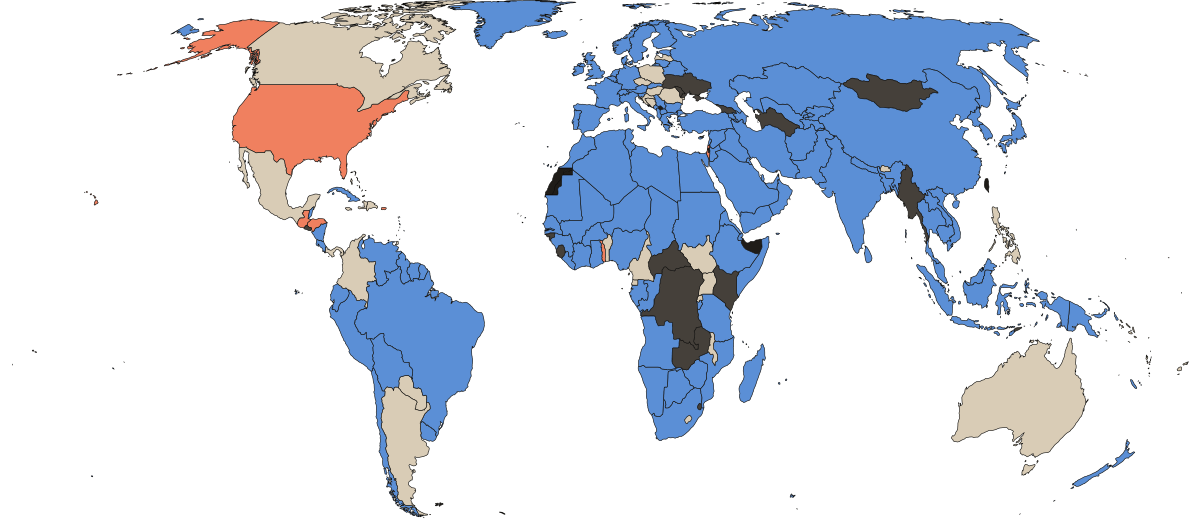
- Yes
- No
- Abstained
- Didn't vote
- Not a UN member
Which countries voted against?
The United States and Israel were joined by Guatemala, Honduras, Togo, the Marshall Islands, Micronesia, Nauru and Palau, none of which explained its vote in the meeting. Three days later, Guatemala's president announced that Guatemala would move its embassy to Jerusalem, citing a call with Prime Minister Benjamin Netanyahu and Guatemala's support for Israel's creation.
 United States
 Guatemala
 Honduras
 Israel
 Marshall Islands
 Micronesia
 Nauru
Nauru Palau
Palau Togo
Togo
How did the big powers vote?
Why did the United States and Israel vote no?
On December 6, 2017, President Donald Trump recognized Jerusalem as Israel's capital and directed the State Department to begin preparing to move the United States embassy from Tel Aviv. On December 18, 2017, the United States blocked an Egyptian draft in the Security Council with its veto, a permanent member's power to stop any resolution. The other 14 members voted for it.
Nikki Haley, the United States ambassador to the UN, said the decision followed a 1995 United States law, "does not prejudge any final-status issues, including Jerusalem's boundaries," and "does not preclude a two-State solution, if the parties agree to that." She said it reflected "our right as a nation to choose the location of our embassy." Danny Danon, Israel's ambassador to the UN, said "Jerusalem is the holiest place on Earth for the Jewish people." He gave delegates replicas of a coin from 67 C.E. inscribed "Freedom of Zion." Before the vote, Prime Minister Benjamin Netanyahu said Israel "flatly rejects this vote even before it is held."
Why did 128 countries vote yes?
The UN's 1947 partition plan proposed Jerusalem as an international city. After the 1948 war, Israel held West Jerusalem and Jordan held East Jerusalem, including the Old City, until 1967. Israel notes that Jews could not reach the Western Wall in those years. Palestinians note that Arab residents of West Jerusalem lost their homes in 1948. In 1967, Israel extended its law to East Jerusalem. The UN and most states call this annexation. Israel calls it reunification. Israel's 1980 Basic Law, a constitutional law, declared "Jerusalem, complete and united" its capital. Security Council resolution 478 called it "null and void."
Palestinian foreign minister Riyad al-Maliki said the United States decision "will have no impact on the status and position of the Holy City" and described Jerusalem as the city of Al-Aqsa, "the first of two points of prayer and the third of the holy mosques." Palestinians want East Jerusalem as the capital of a future state. Estonia, speaking for 22 EU states, said Jerusalem's status should be settled in negotiations "as the future capital of both States."
Did the United States pressure other countries?
On December 19, 2017, Nikki Haley, the United States ambassador to the UN, tweeted: "...we don't expect those we've helped to target us. On Thurs there'll be a vote criticizing our choice. The US will be taking names." President Trump said the next day: "They take hundreds of millions of dollars and even billions of dollars, and then they vote against us. Well, we're watching those votes. Let them vote against us, we'll save a lot. We don't care."
In the Assembly, Haley said the United States "will remember this day, in which it was singled out for attack in the General Assembly for the very act of exercising our right as a sovereign nation." Turkey, which put forward the draft with Yemen, called the warnings "bullying." No aid cut to any country over its vote has been reported. On January 3, 2018, Haley held a "Friends of the US" reception for 64 other countries that had not voted yes. In January 2018 the United States withheld $65 million from UNRWA, the UN agency for Palestinian refugees, saying it wanted reform, and in August it ended all funding. The State Department did not mention the vote.
Which countries have embassies in Jerusalem now?
The United States opened its embassy on May 14, 2018. Guatemala followed two days later. Paraguay opened one on May 21, 2018, moved back to Tel Aviv that September, and returned to Jerusalem in December 2024. Honduras opened its embassy in 2021 but recalled its ambassador from Israel in November 2023. The embassy is still listed in Jerusalem. Papua New Guinea opened its embassy in 2023, Fiji in 2025 and Nauru in September 2026. Kosovo, which is not a UN member, and Somaliland, which only Israel recognizes, also have embassies there. That makes nine, by the Times of Israel's count.
Israel's foreign minister Gideon Saar said Colombia would open its embassy on October 14, which would make 10, and that DR Congo's would open "very soon."
How did each region vote?
By the UN's voting record, the Middle East, Asia, Africa and Europe voted yes by large majorities: 13 of 14, 23 of 29, 37 of 54 and 36 of 47. The Americas and Oceania were divided, with 12 and six abstentions respectively.
- Europe47 countries 36 yes0 no7 abstained
- Americas35 countries 17 yes3 no12 abstained
- Asia29 countries 23 yes0 no2 abstained
- Oceania14 countries 2 yes4 no6 abstained
- Middle East14 countries 13 yes1 no0 abstained
- Africa54 countries 37 yes1 no8 abstained
What did the resolution say?
- The preamble reaffirms Security Council resolutions including 242 (1967), 478 (1980) and 2334 (2016), and "the inadmissibility of the acquisition of territory by force."
- The preamble states that Jerusalem "is a final status issue to be resolved through negotiations in line with relevant United Nations resolutions" and expresses "deep regret at recent decisions concerning the status of Jerusalem."
- Paragraph 1 affirms that any decisions that "purport to have altered the character, status or demographic composition" of Jerusalem "have no legal effect, are null and void and must be rescinded."
- The same paragraph calls on all states not to establish diplomatic missions in Jerusalem, citing Security Council resolution 478 of 1980.
- Paragraph 2 demands that all states comply with Security Council resolutions on Jerusalem and not recognize measures contrary to them.
- Paragraph 3 repeats the Assembly's call to reverse "negative trends on the ground that are imperilling the two-State solution" and for efforts toward "a comprehensive, just and lasting peace" based on UN resolutions, the Madrid terms of reference "including the principle of land for peace," the Arab Peace Initiative, the Quartet road map "and an end to the Israeli occupation that began in 1967."
- The resolution does not mention the United States or President Trump, does not use the word "condemn," and does not call Jerusalem the capital of Israel or of a Palestinian state.
How did every country vote?
| Country | Region | Vote |
|---|---|---|
 Afghanistan Afghanistan | Asia | Yes |
 Albania Albania | Europe | Yes |
 Algeria Algeria | Africa | Yes |
 Andorra Andorra | Europe | Yes |
 Angola Angola | Africa | Yes |
 Antigua and Barbuda Antigua and Barbuda | Americas | Abstained |
 Argentina Argentina | Americas | Abstained |
 Armenia Armenia | Europe | Yes |
 Australia Australia | Oceania | Abstained |
 Austria Austria | Europe | Yes |
 Azerbaijan Azerbaijan | Europe | Yes |
 Bahamas Bahamas | Americas | Abstained |
 Bahrain Bahrain | Middle East | Yes |
 Bangladesh Bangladesh | Asia | Yes |
 Barbados Barbados | Americas | Yes |
 Belarus Belarus | Europe | Yes |
 Belgium Belgium | Europe | Yes |
 Belize Belize | Americas | Yes |
 Benin Benin | Africa | Abstained |
 Bhutan Bhutan | Asia | Abstained |
 Bolivia Bolivia | Americas | Yes |
 Bosnia and Herzegovina Bosnia and Herzegovina | Europe | Abstained |
 Botswana Botswana | Africa | Yes |
 Brazil Brazil | Americas | Yes |
 Brunei Brunei | Asia | Yes |
 Bulgaria Bulgaria | Europe | Yes |
 Burkina Faso Burkina Faso | Africa | Yes |
 Burundi Burundi | Africa | Yes |
 Cambodia Cambodia | Asia | Yes |
 Cameroon Cameroon | Africa | Abstained |
 Canada Canada | Americas | Abstained |
 Cape Verde Cape Verde | Africa | Yes |
 Central African Republic Central African Republic | Africa | Didn't vote |
 Chad Chad | Africa | Yes |
 Chile Chile | Americas | Yes |
 China China | Asia | Yes |
 Colombia Colombia | Americas | Abstained |
 Comoros Comoros | Africa | Yes |
 Costa Rica Costa Rica | Americas | Yes |
 Côte d'Ivoire Côte d'Ivoire | Africa | Yes |
 Croatia Croatia | Europe | Abstained |
 Cuba Cuba | Americas | Yes |
 Cyprus Cyprus | Europe | Yes |
 Czechia Czechia | Europe | Abstained |
 Denmark Denmark | Europe | Yes |
 Djibouti Djibouti | Africa | Yes |
 Dominica Dominica | Americas | Yes |
 Dominican Republic Dominican Republic | Americas | Abstained |
 DR Congo DR Congo | Africa | Didn't vote |
 Ecuador Ecuador | Americas | Yes |
 Egypt Egypt | Africa | Yes |
 El Salvador El Salvador | Americas | Didn't vote |
 Equatorial Guinea Equatorial Guinea | Africa | Abstained |
 Eritrea Eritrea | Africa | Yes |
 Estonia Estonia | Europe | Yes |
 Ethiopia Ethiopia | Africa | Yes |
 Fiji Fiji | Oceania | Abstained |
 Finland Finland | Europe | Yes |
 France France | Europe | Yes |
 Gabon Gabon | Africa | Yes |
 Gambia Gambia | Africa | Yes |
 Georgia Georgia | Europe | Didn't vote |
 Germany Germany | Europe | Yes |
 Ghana Ghana | Africa | Yes |
 Greece Greece | Europe | Yes |
 Grenada Grenada | Americas | Yes |
| Guatemala | Americas | No |
 Guinea Guinea | Africa | Yes |
 Guinea-Bissau Guinea-Bissau | Africa | Didn't vote |
 Guyana Guyana | Americas | Yes |
 Haiti Haiti | Americas | Abstained |
| Honduras | Americas | No |
 Hungary Hungary | Europe | Abstained |
 Iceland Iceland | Europe | Yes |
 India India | Asia | Yes |
 Indonesia Indonesia | Asia | Yes |
 Iran Iran | Middle East | Yes |
 Iraq Iraq | Middle East | Yes |
 Ireland Ireland | Europe | Yes |
| Israel | Middle East | No |
 Italy Italy | Europe | Yes |
 Jamaica Jamaica | Americas | Abstained |
 Japan Japan | Asia | Yes |
 Jordan Jordan | Middle East | Yes |
 Kazakhstan Kazakhstan | Asia | Yes |
 Kenya Kenya | Africa | Didn't vote |
 Kiribati Kiribati | Oceania | Abstained |
 Kuwait Kuwait | Middle East | Yes |
 Kyrgyzstan Kyrgyzstan | Asia | Yes |
 Laos Laos | Asia | Yes |
 Latvia Latvia | Europe | Abstained |
 Lebanon Lebanon | Middle East | Yes |
 Lesotho Lesotho | Africa | Abstained |
 Liberia Liberia | Africa | Yes |
 Libya Libya | Africa | Yes |
 Liechtenstein Liechtenstein | Europe | Yes |
 Lithuania Lithuania | Europe | Yes |
 Luxembourg Luxembourg | Europe | Yes |
 Madagascar Madagascar | Africa | Yes |
 Malawi Malawi | Africa | Abstained |
 Malaysia Malaysia | Asia | Yes |
 Maldives Maldives | Asia | Yes |
 Mali Mali | Africa | Yes |
 Malta Malta | Europe | Yes |
| Marshall Islands | Oceania | No |
 Mauritania Mauritania | Africa | Yes |
 Mauritius Mauritius | Africa | Yes |
 Mexico Mexico | Americas | Abstained |
| Micronesia | Oceania | No |
 Moldova Moldova | Europe | Didn't vote |
 Monaco Monaco | Europe | Yes |
 Mongolia Mongolia | Asia | Didn't vote |
 Montenegro Montenegro | Europe | Yes |
 Morocco Morocco | Africa | Yes |
 Mozambique Mozambique | Africa | Yes |
 Myanmar Myanmar | Asia | Didn't vote |
 Namibia Namibia | Africa | Yes |
| Nauru | Oceania | No |
 Nepal Nepal | Asia | Yes |
 Netherlands Netherlands | Europe | Yes |
 New Zealand New Zealand | Oceania | Yes |
 Nicaragua Nicaragua | Americas | Yes |
 Niger Niger | Africa | Yes |
 Nigeria Nigeria | Africa | Yes |
 North Korea North Korea | Asia | Yes |
 North Macedonia North Macedonia | Europe | Yes |
 Norway Norway | Europe | Yes |
 Oman Oman | Middle East | Yes |
 Pakistan Pakistan | Asia | Yes |
| Palau | Oceania | No |
 Panama Panama | Americas | Abstained |
 Papua New Guinea Papua New Guinea | Oceania | Yes |
 Paraguay Paraguay | Americas | Abstained |
 Peru Peru | Americas | Yes |
 Philippines Philippines | Asia | Abstained |
 Poland Poland | Europe | Abstained |
 Portugal Portugal | Europe | Yes |
 Qatar Qatar | Middle East | Yes |
 Republic of the Congo Republic of the Congo | Africa | Yes |
 Romania Romania | Europe | Abstained |
 Russia Russia | Europe | Yes |
 Rwanda Rwanda | Africa | Abstained |
 Saint Kitts and Nevis Saint Kitts and Nevis | Americas | Didn't vote |
 Saint Lucia Saint Lucia | Americas | Didn't vote |
 Saint Vincent and the Grenadines Saint Vincent and the Grenadines | Americas | Yes |
 Samoa Samoa | Oceania | Didn't vote |
 San Marino San Marino | Europe | Didn't vote |
 São Tomé and Príncipe São Tomé and Príncipe | Africa | Didn't vote |
 Saudi Arabia Saudi Arabia | Middle East | Yes |
 Senegal Senegal | Africa | Yes |
 Serbia Serbia | Europe | Yes |
 Seychelles Seychelles | Africa | Yes |
 Sierra Leone Sierra Leone | Africa | Didn't vote |
 Singapore Singapore | Asia | Yes |
 Slovakia Slovakia | Europe | Yes |
 Slovenia Slovenia | Europe | Yes |
 Solomon Islands Solomon Islands | Oceania | Abstained |
 Somalia Somalia | Africa | Yes |
 South Africa South Africa | Africa | Yes |
 South Korea South Korea | Asia | Yes |
 South Sudan South Sudan | Africa | Abstained |
 Spain Spain | Europe | Yes |
 Sri Lanka Sri Lanka | Asia | Yes |
 Sudan Sudan | Africa | Yes |
 Suriname Suriname | Americas | Yes |
| Swaziland | Africa | Didn't vote |
 Sweden Sweden | Europe | Yes |
 Switzerland Switzerland | Europe | Yes |
 Syria Syria | Middle East | Yes |
 Tajikistan Tajikistan | Asia | Yes |
 Tanzania Tanzania | Africa | Yes |
 Thailand Thailand | Asia | Yes |
 Timor-Leste Timor-Leste | Asia | Didn't vote |
| Togo | Africa | No |
 Tonga Tonga | Oceania | Didn't vote |
 Trinidad and Tobago Trinidad and Tobago | Americas | Abstained |
 Tunisia Tunisia | Africa | Yes |
 Turkey Turkey | Middle East | Yes |
 Turkmenistan Turkmenistan | Asia | Didn't vote |
 Tuvalu Tuvalu | Oceania | Abstained |
 Uganda Uganda | Africa | Abstained |
 Ukraine Ukraine | Europe | Didn't vote |
 United Arab Emirates United Arab Emirates | Middle East | Yes |
 United Kingdom United Kingdom | Europe | Yes |
| United States | Americas | No |
 Uruguay Uruguay | Americas | Yes |
 Uzbekistan Uzbekistan | Asia | Yes |
 Vanuatu Vanuatu | Oceania | Abstained |
 Venezuela Venezuela | Americas | Yes |
 Vietnam Vietnam | Asia | Yes |
 Yemen Yemen | Middle East | Yes |
 Zambia Zambia | Africa | Didn't vote |
 Zimbabwe Zimbabwe | Africa | Yes |