What caused the Thirty Years' War?
The Thirty Years' War killed a fifth of Germany, pulled in every major European power, and ended with the peace that built the modern state system.
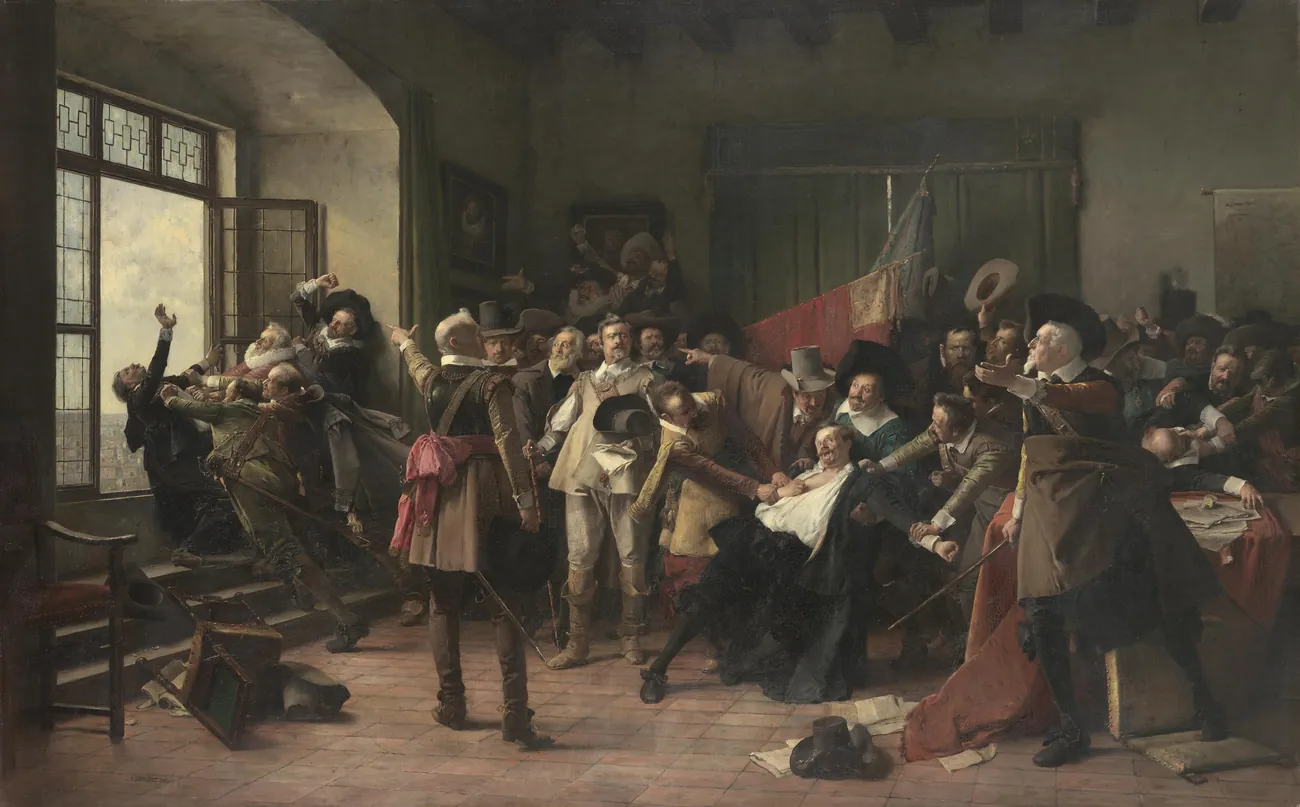
On May 23, 1618, a group of Protestant nobles in Prague marched into the royal castle, seized three Catholic officials, and threw them out of a third-floor window. The men fell about seventy feet. Catholics said angels broke their fall. Protestants said they landed in a dung heap. Both sides agreed on what came next: war.
The war lasted thirty years. It killed somewhere between four and eight million people, shrank Germany's population by roughly a fifth, and pulled in every major power in Europe. It started as a religious dispute inside a single kingdom. By the end, Catholic France was fighting alongside Protestant Sweden, and the peace that stopped the killing produced the principle that countries should mind their own business.
The religious divide
The ground was ready long before Prague. A century earlier, in 1517, a monk named Martin Luther posted his 95 Theses on a church door in Wittenberg, launching the Reformation that split Western Christianity in half. The printing press, barely sixty years old, turned a local theological complaint into a continental crisis. Within a generation, princes across the Holy Roman Empire had adopted Protestantism, seized Church property, and broken with Rome.
The Empire was not a country. It was a patchwork of hundreds of territories, from major kingdoms to tiny city-states, loosely governed by a Catholic Habsburg emperor in Vienna. By the 1550s, Catholic and Protestant lands sat side by side across Germany with no clean dividing line.
A 1555 deal called the Peace of Augsburg tried to freeze the religious lines. Each prince could choose his territory's faith, Catholic or Lutheran, and subjects who disagreed could leave. It was a truce, not a settlement. It ignored Calvinism, which kept spreading. It had no way to handle territories that changed rulers. And it satisfied nobody: Catholics wanted their property back, Protestants saw the remaining Catholic lands as targets. For sixty years the truce held, barely, while both sides armed.
The spark: Prague, 1618
The Bohemian nobles who threw the emperor's officials out that window had specific grievances. Emperor Ferdinand II had been raised by Jesuits, was devout even by the standards of Catholic monarchs, and had been revoking the religious freedoms that Bohemia's Protestants had been promised. The nobles deposed him as King of Bohemia and offered the crown to Frederick V, a young Calvinist prince from the Palatinate.
Frederick's reign lasted a single winter. Imperial forces crushed the Bohemian army at the Battle of White Mountain outside Prague in November 1620. Frederick fled into exile, earning the nickname "the Winter King."
Ferdinand could have stopped there. He had his kingdom back. Instead, emboldened by victory, he moved to roll back Protestantism across all of Germany. That decision turned a local revolt into a continental war.
Why the war kept growing
Denmark intervened first, in 1625, to defend Protestant interests in northern Germany. Imperial armies under Albrecht von Wallenstein, a Bohemian nobleman devoted to astrology who kept the astronomer Johannes Kepler on retainer to cast his horoscope, drove the Danes back within two years. Wallenstein raised tens of thousands of soldiers on the promise that war would pay for itself: his troops took money and food from every territory they entered, friend or enemy.
In 1630, King Gustavus Adolphus of Sweden landed in northern Germany with a disciplined professional army. He was tall, led cavalry charges from the front, and won a string of victories that turned the war's direction. At the Battle of Lützen in November 1632, he rode into the fight wearing only a leather coat because an old wound made full armor painful. He was killed in a cavalry charge at 37, lost in thick fog. His army won the battle, but Sweden had lost its best general.
The Sack of Magdeburg in May 1631 became the war's defining horror. Imperial forces stormed the Protestant city, fires spread until most of it burned, and roughly 20,000 of the city's 25,000 inhabitants were killed in a single day. The word "Magdeburgisieren" entered the German language: to do to a city what was done to Magdeburg.
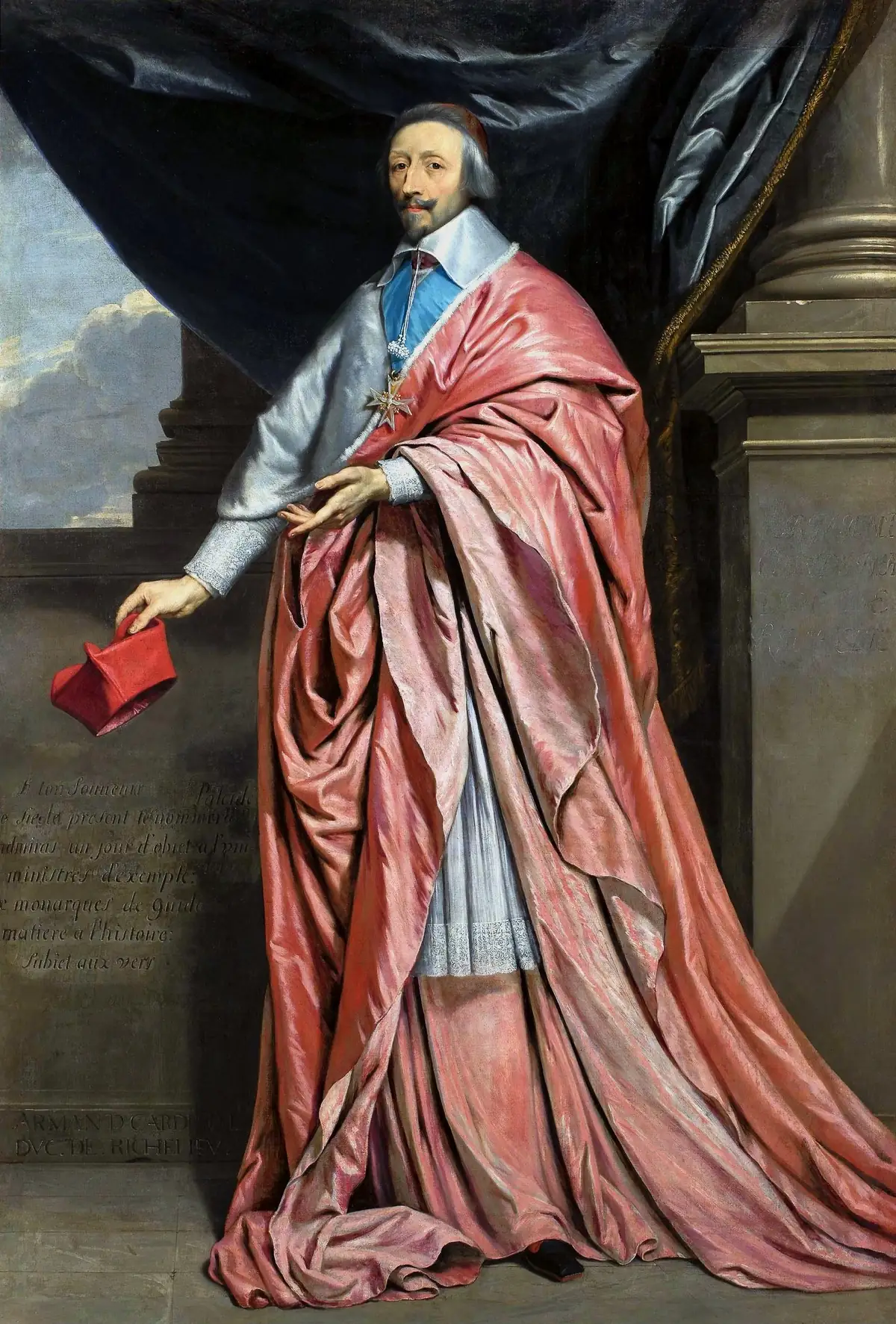
Then came the proof that the war had outgrown religion entirely. In 1635, Catholic France declared war on Catholic Spain and joined the fighting alongside Protestant Sweden. France's chief minister, Cardinal Richelieu, was himself a Catholic clergyman. But the Habsburgs ruled both the Holy Roman Empire and Spain, surrounding France on nearly every border. Richelieu cared about the survival of France, not theology. He had been funding Sweden's army with French money for years. Now he sent French troops.
After France entered, the fighting dragged on for thirteen more years. Wallenstein had already been assassinated by his own officers in 1634, on the emperor's orders, after he grew too powerful and was suspected of negotiating with the enemy on his own. France and Spain wore each other down in campaigns that settled nothing. By the mid-1640s, every major power was exhausted.
What the war cost
Germany paid the price. The population of the Holy Roman Empire fell from roughly 20 million to about 12 million over three decades. Some regions, like Pomerania and Württemberg, lost close to half their people. Rural areas were the hardest hit, losing about 40 percent of their inhabitants on average.
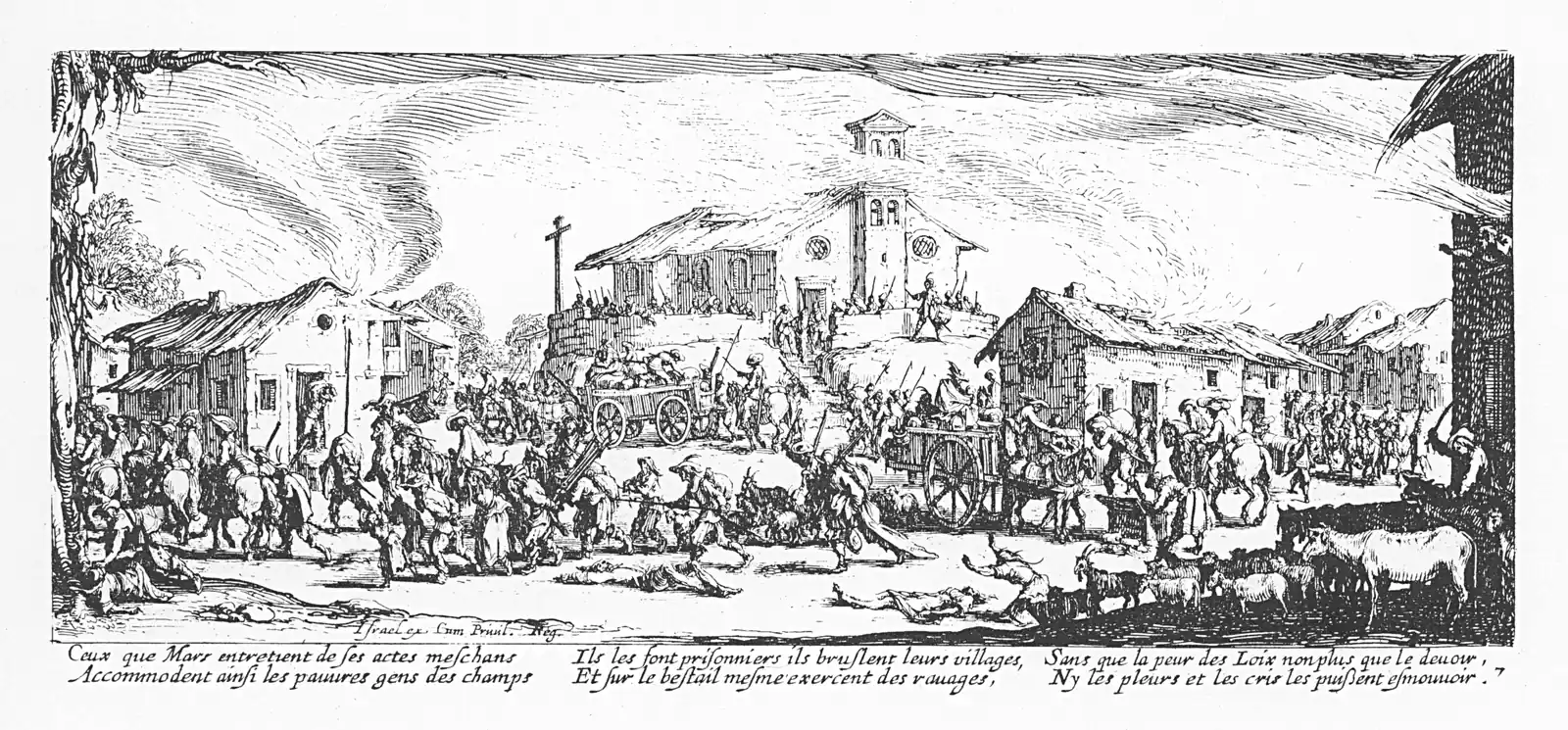
Most of the dead were not soldiers. Armies lived off the land, stripping the countryside of grain, livestock, and anything of value as they marched. Famine came first. Plague and typhus followed in the armies' wake. The French engraver Jacques Callot documented what he saw in a series of etchings called Les Misères de la Guerre: soldiers hanging from trees, villages on fire, peasants beaten and robbed on the road. It was one of the first great works of anti-war art, and the scenes it recorded were happening across Germany for thirty years.
The destruction set Germany back by generations. The land that had been one of the most prosperous regions in Europe became a ruin, and the political fragmentation the peace would formalize kept Germany divided until unification in 1871, more than two centuries later.
The Peace of Westphalia
Delegates from 109 parties gathered in the Westphalian cities of Münster and Osnabrück to negotiate. It took them four years. The Peace of Westphalia, signed on October 24, 1648, remade Europe's political order.
France and Sweden gained territory. The Dutch Republic and Switzerland won official independence. Inside the Empire, each of the roughly 300 German princes gained the right to run his own foreign policy, which left the emperor with little real power. No prince could force his subjects to convert anymore. The religious wars were over because every side had decided that forcing your neighbor to worship your way was not worth the cost.
The negotiators did not set out to write a philosophy of sovereignty. They made practical concessions to end a catastrophe. But those concessions hardened into a principle: each state is the final authority within its own borders, and other states do not interfere. The UN Charter builds on it. China invokes it over Taiwan and Xinjiang. Russia invoked it over Chechnya. When NATO bombed Serbia in 1999 to stop ethnic cleansing in Kosovo, the strongest legal argument against the bombing was Westphalian: Serbia's internal affairs were Serbia's business.
The Thirty Years' War started because one side tried to impose its version of the truth on everyone else and no mechanism existed to stop the escalation. The peace said: stop trying. That bargain, born from exhaustion rather than idealism, still governs how countries deal with each other. Nearly four centuries later, every argument about sanctions, intervention, and humanitarian war is still an argument about where to draw the line the negotiators at Westphalia first scratched in 1648.
Test what you learned
5 questions on this article. About two minutes, no signup.
Orbis teaches the history behind the news
Orbis covers the Thirty Years' War and the Reformation that caused it, from Luther's revolt to the Peace of Westphalia.