Why was it called the Holy Roman Empire?
Voltaire called it "neither holy, nor Roman, nor an empire." But the name was not always a joke. Each word was a political claim, added one at a time.
In 1756, Voltaire wrote that the Holy Roman Empire was "neither holy, nor Roman, nor an empire." The line is the most famous thing anyone has ever said about a political entity that lasted a thousand years. By Voltaire's century, it was accurate on all three counts. The empire was half Protestant, entirely German, and so fragmented that its emperor could not levy a tax or raise an army without asking hundreds of princes, bishops, and city councils for permission.
But the name was not always a joke. It was assembled one word at a time over four centuries, and each word was a political claim. The story of how those claims were made, and when each one stopped being true, is the story of the empire itself.
Where "Roman" came from
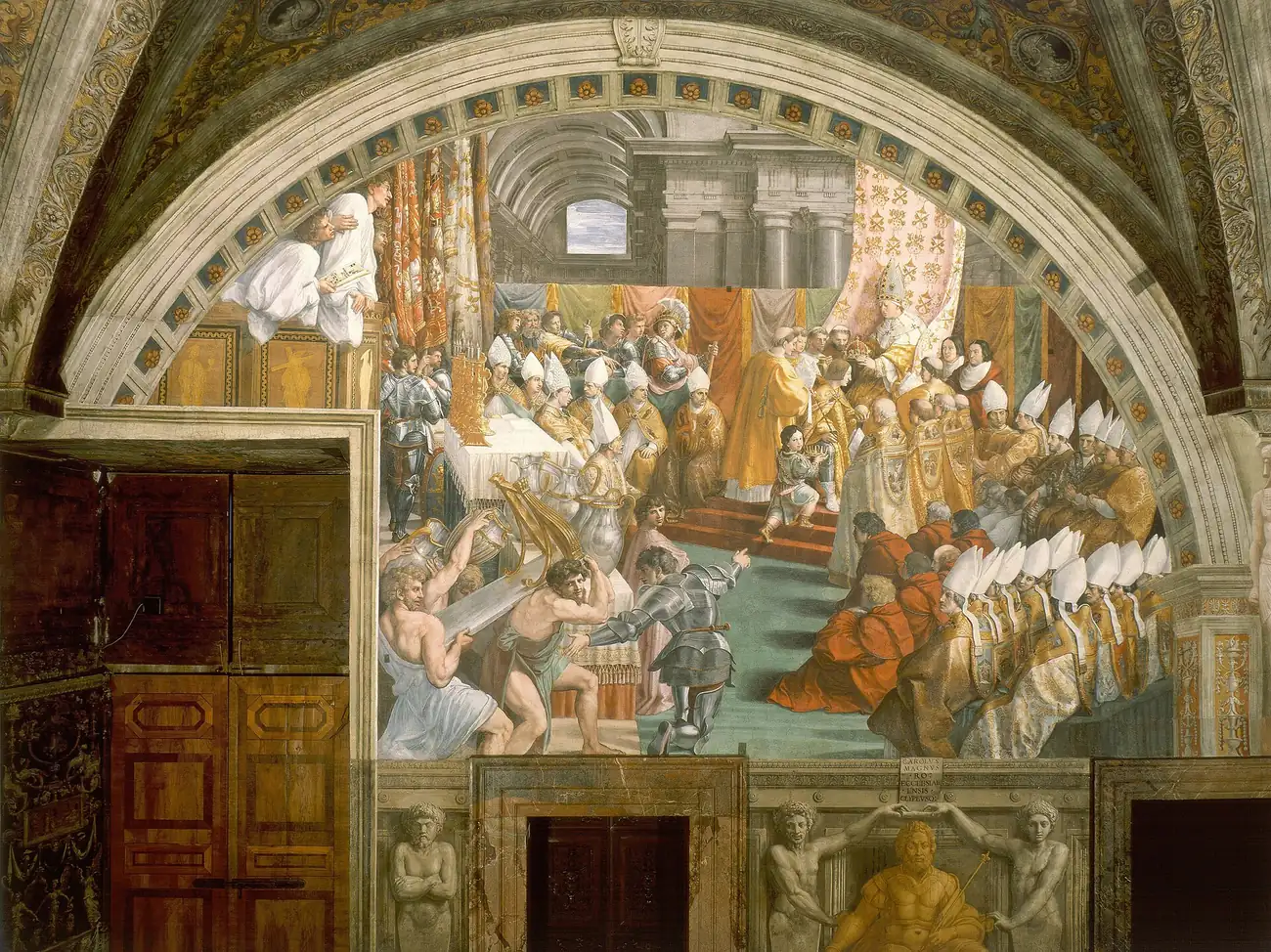
The oldest word in the name was "Roman," and it had nothing to do with geography. On Christmas Day in the year 800, Pope Leo III placed a crown on the head of Charlemagne, king of the Franks, in the old St. Peter's Basilica in Rome. He proclaimed him Emperor of the Romans, reviving a title that no one in western Europe had held since the fall of Rome in 476. Charlemagne's biographer Einhard later wrote that the king was caught off guard and said he would never have entered the church if he had known what the pope was planning. Whether that was true or a show of modesty, the title stuck.
Charlemagne was not Roman. He was a Frank from Aachen, in what is now western Germany, who could barely write his own name. But the title was not about where the emperor came from. The Roman emperors had governed the known world. Claiming their title meant claiming their authority: the right to be the highest secular ruler in Christendom.
The empire Charlemagne built did not survive his grandsons, who divided it among themselves in 843. But the idea survived. In 962, a Saxon duke named Otto I marched to Rome and had Pope John XII crown him emperor on Candlemas Day, February 2. From that point on, the title belonged to whoever held the German crown. The claim was always the same: this state is Rome's heir.
Where "Holy" came from
"Holy" came later, and it came from a fight. For over a century, the papacy and the emperor had been locked in a struggle over who held the real authority in Christian Europe. Popes claimed the right to appoint bishops and, by extension, to approve or remove kings. Emperors insisted their power came from God directly, not through the pope.
In 1077, the conflict turned into one of the most famous scenes in medieval history. Pope Gregory VII excommunicated Emperor Henry IV over the question of who had the right to appoint bishops. Henry crossed the Alps in winter and stood barefoot in the snow outside the castle of Canossa for three days, waiting for the pope to forgive him. He got his absolution, but the humiliation proved the pope's point: if the emperor needed the Church's permission to rule, then the Church held the real power.
That was the argument Frederick Barbarossa tried to settle eighty years later. In 1157, his chancery began using the Latin phrase sacrum imperium, "holy empire," in official documents. The word was a counter-claim: the emperor's authority was sacred on its own terms, and he did not need papal permission to exercise it.
The full title "Holy Roman Empire" appeared in documents by the 1200s. Three centuries later, the name shifted again. In 1474, the empire officially became the "Holy Roman Empire of the German Nation," quietly admitting what had long been obvious: whatever universal authority the old name claimed, the empire's reach had shrunk to the German-speaking lands of central Europe.
An empire that could not give orders
"Empire" was always the loosest fit. The Holy Roman Emperor was elected, not born to the title. The Golden Bull of 1356 set the rules: seven prince-electors, three archbishops and four secular rulers, chose each new emperor. If they could not agree within thirty days, they would be locked in Frankfurt and fed only bread and water until they did.
From 1438, the Habsburg dynasty held the imperial title almost without interruption, but even the Habsburgs could not give orders. In 1519, Charles V became emperor after borrowing heavily from the Fugger banking family in Augsburg to bribe the electors. He won the title and then spent his reign fighting the Reformation, the Ottoman Empire, and France simultaneously, while paying back the debt. Below the emperor sat an Imperial Diet where princes and cities debated policy, and imperial courts where a small bishopric could bring a legal case against a powerful duchy. The emperor had no standing army, no central treasury, and no capital. His power depended on his family's own lands and his ability to bargain.
By the late 1700s, the empire contained roughly 300 separate territories: kingdoms, duchies, principalities, bishoprics, abbeys, and free cities. Some were powerful states like Prussia and Bavaria. Others were barely visible on a map. All of them guarded their own laws, taxes, and armies. The emperor needed their cooperation and could not compel it.
When each word stopped being true
The Reformation broke "Holy." When Martin Luther split Western Christianity in 1517, the empire that claimed divine authority over a united Christendom found half its territory turning Protestant. Emperor Charles V spent decades trying to put the religious split back together by force and by negotiation, and failed at both. The Thirty Years' War that followed killed roughly a third of the German population. The Peace of Westphalia in 1648 ended the fighting by giving each territory the right to choose its own religion and run its own foreign policy. An empire that claimed to govern Christendom in God's name now included Lutheran and Calvinist states that rejected the Church the emperor belonged to.
"Roman" had never been geographically true. By the 1500s, the empire's territory was German, Czech, and Dutch, with a nominal claim over northern Italy that meant less with every decade. No part of the empire had been governed from Rome in centuries. The title survived the way inherited titles do: because it still carried prestige, long after the reality behind it had disappeared.
And "Empire" was the most generous word of all by Voltaire's century. The emperor still existed, still wore a magnificent crown, and still presided over the Diet. But France, Britain, and Russia were the real powers in Europe. The emperor could not declare war, raise taxes, or pass a law for the empire as a whole without the consent of princes who routinely ignored him. The Holy Roman Empire was a shared set of courts and conventions among German-speaking states, useful for settling disputes and not much else.
How it ended, and what the name left behind
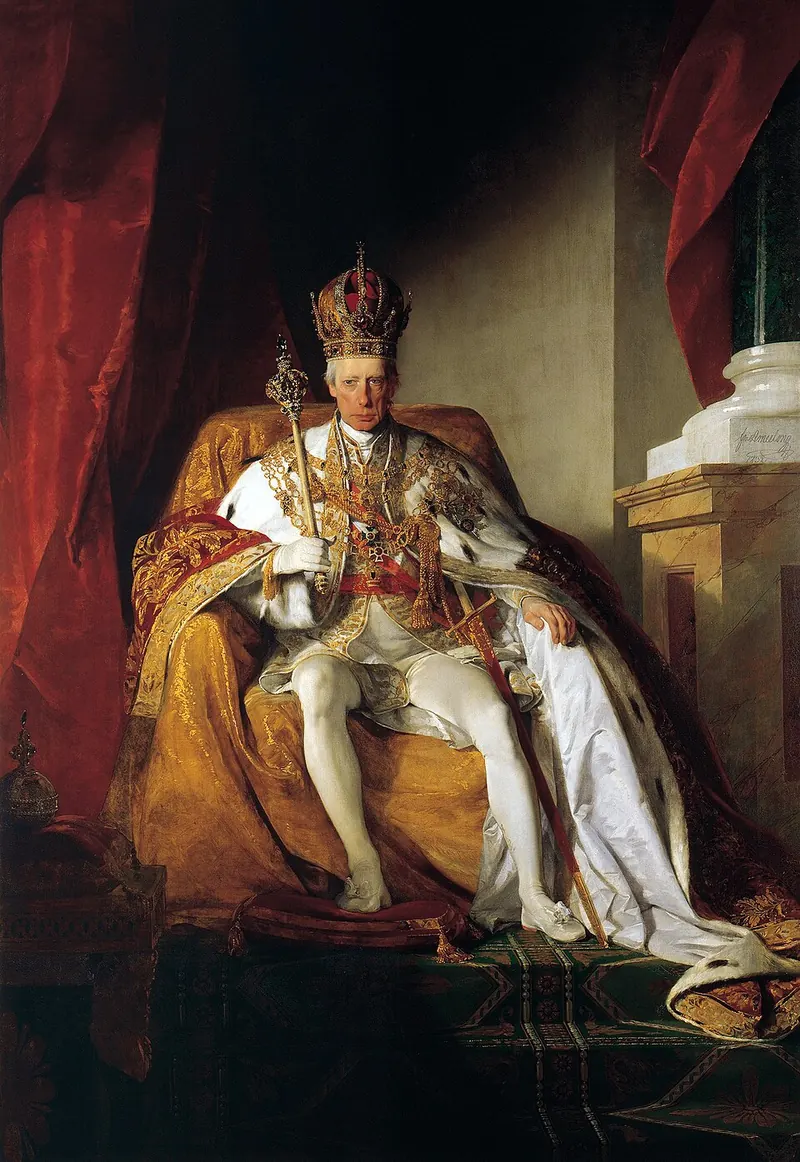
Napoleon killed it. After defeating Austria at Austerlitz in December 1805, he reorganized sixteen German states into the Confederation of the Rhine, a French satellite that pulled them out of the empire entirely. On August 6, 1806, Emperor Francis II abdicated the imperial title and declared the empire dissolved. He had already taken the title Emperor of Austria in 1804, because he could see what was coming. One reason he dissolved the empire rather than just stepping down: he wanted to make sure Napoleon could not claim the imperial title for himself.
An institution that had lasted a thousand years ended with a piece of paper. But the name kept echoing. When Bismarck unified Germany in 1871, Germans called his new state the Second Reich. Hitler called his regime the Third. Both were staking a claim to the same lineage: that Germany had always been an empire, and they were its rightful continuation.
The deeper legacy is structural. The Holy Roman Empire lasted a thousand years not because it was strong but because it was weak enough to survive. A centralized state can be conquered or overthrown. A loose framework of hundreds of small states, sharing a legal order but governing themselves, has no center to seize. The European Union, with its sovereign member states, shared courts, and limited central authority, is in some ways closer to the Holy Roman Empire than to any nation-state that replaced it. A thousand years of European history suggest the arrangement works better than it looks.
Test what you learned
5 questions on this article. About two minutes, no signup.
Orbis teaches the history behind the news
Orbis covers the empires and conflicts that shaped Europe, from Charlemagne to Napoleon, in five-minute lessons.